




Scuttle past the sheaves of the cornfield. Scurry between the skyscrapers of the city. Shimmy down the second story corridor of a suburban house. Cults chant in the countryside. Kidnappers conceal themselves as citizens. Zombies shuffle through our malls. Although we soothe ourselves with the lie that there are safe spots, the truth is that we are always standing on haunted ground. Stalling at the intersection of country, city, and suburbs, you stagger before your surroundings, rattled by the reality that nowhere is safe.
Sinister Cinema is a film festival where Ian Olson and I invite you to roam with us through the eerie places of the rural, the urban, and the suburban. Convinced that locations are not neutral, we will traverse these embattled regions as we view nine movies from each setting. Over the month of October, Ian and I will report our investigations to Mockingbird, one article for each region reflecting on three films as we retreat from the rural to the suburban.
While Modernity has influenced the Church to commodify and disenchant the earth, as religious animals, we intuit that there are sacred spaces and scared spaces. Central to our Christian imagination is the promise of a land and a city. Assembling together in a church building is not incidental to our worship but is the locus for our formation. Orienting us to a vision of the good or the ghoulish, the areas we inhabit are marked by transcendence. Gathering at the narthex, we are funneled into a house of praise. In the sanctuary, we tremble before the voice and presence of the Holy Ghost. At the altar, we feast on the body and blood of Christ. Since all places are contested, Christ is exorcising everywhere until the whole earth is possessed by him.
Enter the theater of terror with us. As you recline and rinse yourself in these images, scan the room and shiver; there is no exit. Even if you could escape though, there is nowhere to hide.

Up this week:
- The Blood on Satan’s Claw (1971)
- The Wicker Man (1973)
- Sator (2019)
Many of us think the paranormal — if it’s even real — intervenes in such a way as to make our world weird. But this isn’t so. The world is only ever weird, in multiple magnifications and intensities, and the weird and the eerie, in their sharper concentrations, exacerbates the pressure cooker that is the shared life of fallen human beings.
These three films show the interwovenness of the rural weird within the human lifeworld. Not their intrusion, that is, but their obdurate givenness. The ecology in which humankind is always already situated is fallen. Evil is in the soil, in the trees, in the atmosphere of these film’s settings, always present in them, but occasionally erupting into open destruction that cannot be ignored.
Such frothing ruination broods over the characters and setting of our first movie. In Piers Haggard’s The Blood on Satan’s Claw (1971), the children are not alright. After plowing a field, Ralph Gower (Barry Andrews) uncovers a skull with an eerie eye and strange fur. What pervades the next ninety minutes is a palpable fear of the land and a juxtaposition of the strange, even occultish ways of the country with the sophisticated ways of the city. Embodying the oddity of the land is the epidemic of fur on those who are touched by the devil. Fur is dehumanizing and bestializing, a blurring into nature itself. We get a sense that things are just strange out in the wild, and Dick Bush’s cinematography is reminiscent of Bergman in how he contrasts characters with sprawling backdrops and open skies. Rurality reigns by both obscuring human characters and displaying their dissonance. The vastness of the country, indeed.
Ralph takes his discovery back to the Judge (Patrick Wymark), who dismisses such claims as superstition. The Judge, interestingly, has no name aside from his title: his subjectivity is collapsed entirely into this symbolic identity. Representing the city’s attempt to colonize and domesticate the wildness of the country, he retreats to London to study a book of witchcraft after jettisoning his initial suspicion of the supernatural.
While the judge signifies Enlightenment, Reverend Fallowfield (aptly named) depicts the insufficiency of religion to overcome the allure of the pagan. Despite the reverend’s scoldings to his schoolchildren, he is sidelined for most of the film after being arrested for the false accusation of molesting the ringleader of the cultish children, Angel Blake (Linda Hayden). His sermonizing and catechizing is not aimed at the imagination but at the intellect; it is quintessential Reformed Scholasticism, and it is impotent to transform the children against the seductions of older, weirder religion.
Equally archetypal is The Doctor (Howard Goorney), who identifies the witchcraft that is proliferating and says to The Judge that decries such practices as a relic of the past, “How do we know, sir, what is dead? You come from the city. You cannot know the ways of the country.” The country is a site that emanates the weird and the eerie in ways the city is unprepared and unwilling to cope with and thus seeks to pacify it.
Compulsions to domesticate the land and reduce it to manageable “resources” might strike some as a sort of consecration but it is rather an confiscation. Eradication of the weird complicates the film’s ending, as the defeat of Satan and his cult is surely a good thing, but the final shot, a frozen frame of the Judge’s enraged face wreathed in flame, leaves the viewer with the sense of one devil having triumphed over another. Because the pretentious, superegoic order the Judge represents and enforces has won, the village itself is reclaimed under its domination.
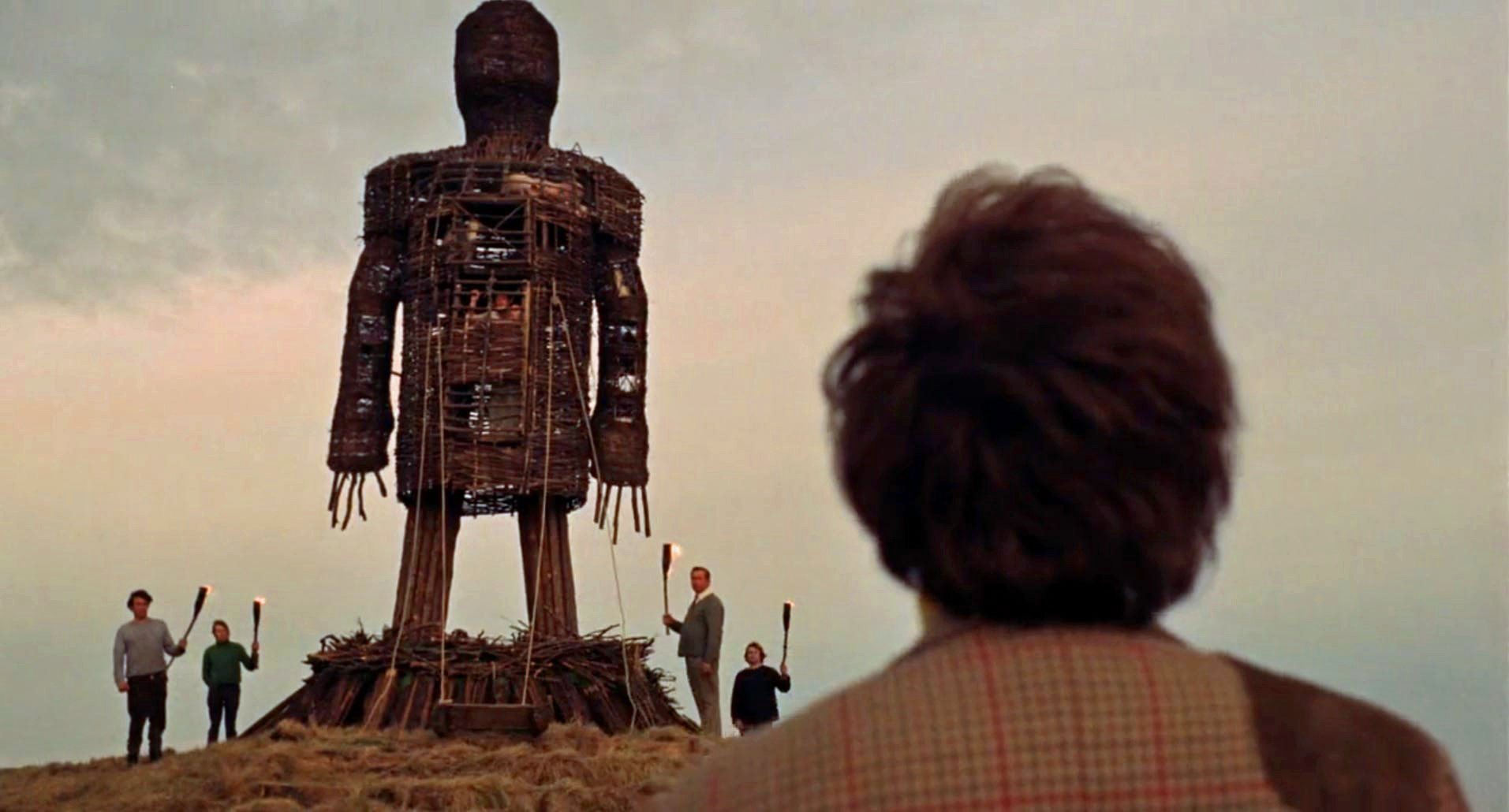
The justly famous The Wicker Man (1973) conducts a similar implicit critique of civic authority and of contemporary Christianity. The pompous police Sergeant Neil Howie (Edward Woodward) depicts the false superiority all too many Christians feel on the basis of their being-Christian, as though their belonging to Christ created capability and proficiency ex nihilo. And it is these pompousness the denizens of Summerisle exploit to manufacture a willing sacrifice. What is most frightening about The Wicker Man is its portrayal of our proclivity for self-destruction and how it is often only intelligible retroactively. Sergeant Howie has numerous opportunities to conclude his investigation, to rein in his curiosity and his presumption of superior intelligence and rectitude but he declines to do so at every opportunity. As all of us do in multitudes of ways, every day, undermining our avowed interests and paving our paths towards death. The tragedy of this story is that, much like real life, the failure to acknowledge and own this principle rules out the possibility of death giving rise to love or redemption.
Searching for a missing girl named Rowan Morrison (Geraldine Cowper), Howie bumbles through the rugged terrain, mystified by what he calls “degeneracy.” His word choice is significant as he, like the Judge, is an arm of “enlightened,” hegemonic power, encroaching upon the rustic Other. His colonial discourse conveys contempt by reducing Summerisle’s practices to the transmission of moral corruption. In the island’s schoolhouse, Miss Rose explains to Howie the content of her catechesis: reincarnation. For the sergeant’s part, he can only muster, “Do you mean to say that you teach the children this stuff?” Clarifying further, Rose insists that rotting bodies are a barrier to the childish imagination. To be certain, Howie’s offense with the pagan religion is not stemming from the absence of the gospel but from the absence of the propriety of gospel religion.
Bestialization recurs in The Wicker Man as the children mask themselves as animals and it persists right up to the final sequence when Howie is set ablaze. Crying out to Christ, he is deafened by the pagan chorus singing “Sumer is Icumen In”, and, while Howie recites Psalm 23, his faith is not visceral and imaginative like the masses before him. And though he evokes our intense pity, his death is not that of a martyr’s but the one who conceives of his faith indicative of cultural superiority. And here is the great irony: the one who believes too much in his power to save is now in the need of saving.
In Sator (2019), Nani suffers from dementia but retains memory of the spirit that spoke to her, “inspiring” her to record a series of messages as an alternative, pagan set of Scriptures. For Pete and Adam, the entity presides over their family with the same kind of presence as an actual family member. In fact, Sator is a replacement for the absent father, as are many depictions of God or gods. Sator is generative both in dictating through automaticity the scripture that Nani writes as well as being an inheritance attached to and passed down through the family. Catechizing each other under the lordship of Sator, Adam will succumb to the worship of this demon, so it might be tempting to discredit this kind of formative experience altogether. However, the catechizing in Sator enculturates an individual to live amongst soil and flora and animals unlike the Reformed Scholasticism that caters only to disembodied thinking. There is a world to which Sator’s catechesis corresponds, unlike with Reformed Scholasticism, which fits no real world.
All three films culminate in a sacrifice. In The Blood on Satan’s Claw, Ralph is the cult’s would-be offering that the Judge saves; the cult, in their turn, are liquidated so as to restore the order of the city. With The Wicker Man, Howie, the embodiment of the law, is immolated to placate the gods and fertilize the blighted ground. In Sator, Adam is bestialized by the familial spirit and sacrifices his siblings.
But in every instance, someone is selected for sacrifice for the benefit of the one who usurps the right of sacrifice. But this is sacrifice only in a colloquial sense. For sacrifice is most truly itself when it is one’s decision for the benefit of another, as it is then an act of love. The death drive is subverted when it is directed towards the interest of the Other, as then and only then death serves as the handmaiden of love. But this is not the case in these films. Here Christianity in its most vulgar forms meets its formal opposite but finds material similarity with eldritch horror. And in that encounter no one truly wins.
Nowhere is safe: the landscape from which we spring is the genesis of our lifeworld but far from a haven; it is the site of terrors older than civilization. There is no shelter here for death and devilry call it home as well.
See you next week for Urban haunts: Rosemary’s Baby (1968), Possession (1981), The People Under the Stairs (1991)
Followed by the ‘Burbs: Dawn of the Dead (1978), Poltergeist (1982), Session 9 (2001)







