




The movie Jaws is both the original summer blockbuster as well as the movie that made people afraid to get in the pool or take a bath, much less go to the beach. It’s been on my mind quite a lot over the last three years due to its uncomfortable parallels with the pandemic, namely how the those who possess the financial means ignore a grave threat and how consumers are conditioned to go where frivolity and escape are promised, whatever the risk. “You’re going to ignore this problem until it swims up and bites you in the ass!” is the prophetic word shouted by Richard Dreyfuss in 1975 that could have been repeated, syllable for syllable, throughout the pandemic and similarly gone unheeded.
Right now things feel relatively “back to normal,” a banal phrase that camouflages how the conclusion of one crisis too often serves the illusion that now “everything will be okay.” We are always shocked that yet another crisis arises, but this doesn’t stop us from investing faith in new stories of how everything will be okay starting now.
The formal and conceptual harmony is so apt precisely because the human propensity to deny reality is so pervasive. It is perhaps one of humanity’s defining characteristics — for ill and (sometimes) good — to ignore the obvious threats lurking just beneath the surface. Jaws, after all, earned its classic status not only for its performances and thrilling sequences, but for its unflinching portrayal of predation both animal and human. And the intervening decades haven’t softened its grisliness one bit. While it is rightly renowned for its masterful restraint, when that restraint is released is it a bloodbath.
This is just as true of our world. For we all — “we” meaning all human beings, at all times and in all places — are determined by what Freud called the death drive, “an urge in organic life to restore an earlier state of things” (Beyond the Pleasure Principle, 30), the irrational instinct to sabotage our own best interests and repeat what has hurt us. Jacques Lacan later radicalized the concept and identified it as the one drive impelling human behavior, such that whatever we do, we are always working against our conscious desire or aim.
The apostle Paul described the same self-undermining force in his Letter to the Romans: “For I do not understand my own actions. For I do not do what I want, but I do the very thing I hate. Now if I do what I do not want, I agree with the law, that it is good. So now it is no longer I who do it, but sin that dwells within me” (7:15-17). He predates Freud’s terminology, of course, but a similar phenomenon is in view: the good and holy Law in the hands of sinners divides the self against itself in the service of death.
This convergence of Law, sin, and death complicates the “common sense” view most of us presume regarding goodness, truth, and their opposites. It surprised Paul, too. This is how radical evil is: it insinuates itself within and warps the goods of our world, even the gifts of God, to distort, degrade, and destroy. This same convergence of forces is everywhere in Jaws, funneling people towards decisions that are absurd and irresponsible and from there to destructive outcomes.
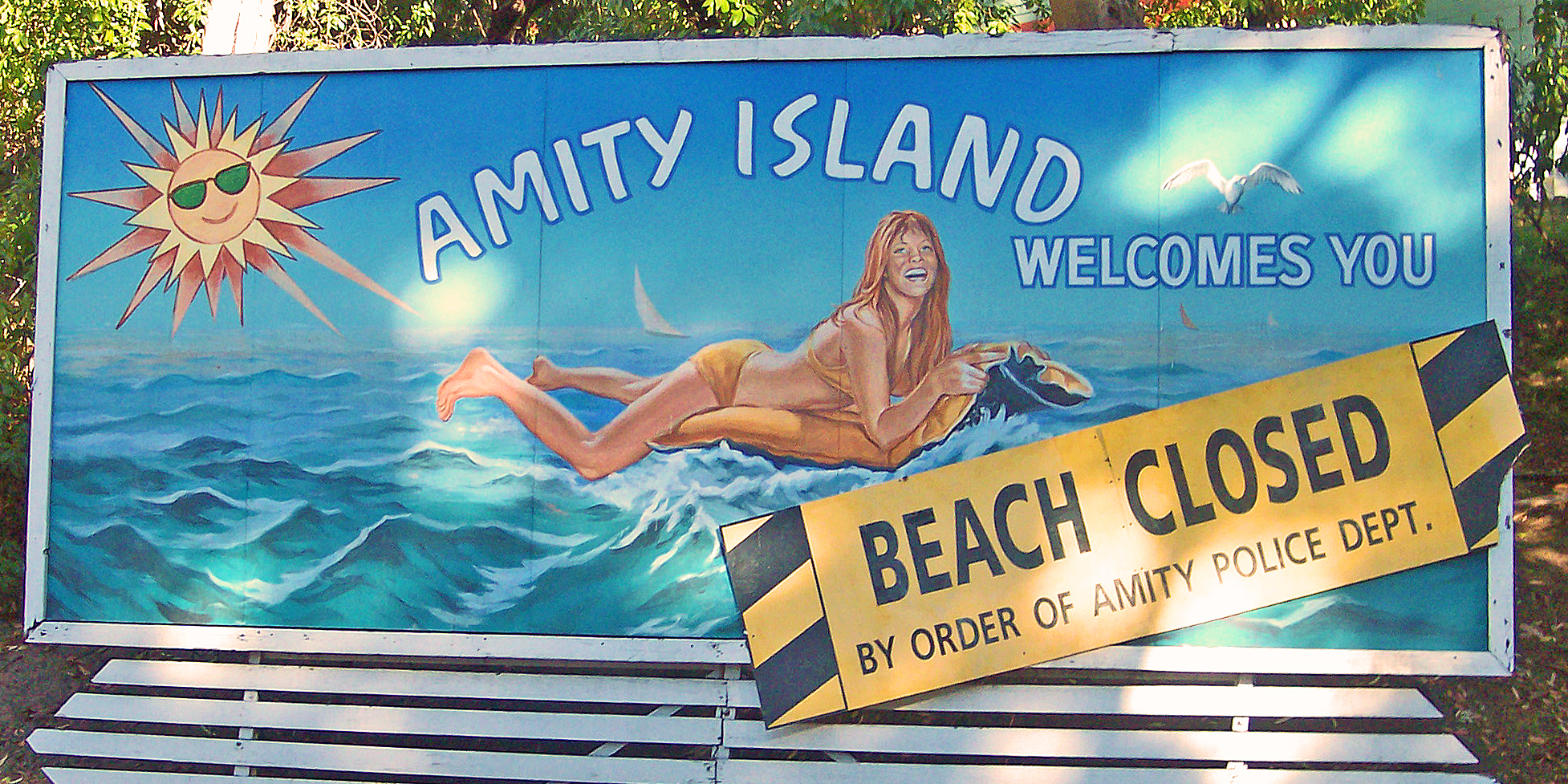
With every twist, the film depicts characters being commandeered by the death drive. That drive impels Amity’s overseers to suppress the truth haunting their island, impels Brody’s passivity and deference to men he doesn’t trust, impels vacationers to swim in dangerous waters, and impels Quint to destroy his radio and push his boat, the Orca, to its breaking point. To an onlooker, none of these things make any sense, like watching a car crash about to happen in slow motion. But this is the shape of our lives as well.
While the symbols of authority and order that give shape to communal life in Amity are good and necessary, the tragedy in both Amity and our world is that they are sabotaged and exploited by Sin and Death. Though the Law correlates with order, they are distinct, such that when Chief Brody steps out on his own to do what he he should, the mayor and other business owners quickly coerce him into enforcing their will.
The Law is both close and distant enough to shield them from scrutiny, which allows Chief Brody to serve as a buffer for the deadly consequences of their decisions. Following the protocol of the chain of command offers only the semblance of safety, while simultaneously risking lives. Thus a mother whose son was killed by the shark confronts and slaps Chief Brody when she learns he allowed the beaches to stay open after the first attack. “I’m sorry, Martin. She’s wrong,” the mayor assures him after her denunciation. But Brody knows this isn’t true. He is responsible because he abdicated his agency in subservience to unprincipled men. He absorbs the wrath they deserve.
The Law given at Mt. Sinai operates similarly, as Paul teaches in the same section of Romans 7, as Sin, treated here as a sinister force with something like agency, utilizes the Law as a “base of operations from which to seize the agency of those who wish to keep the Law (Rom 7:8-11). However good, however salutary any law or body of laws may be, even a divine origin is not sufficient to overrule its misuse or corruption. The procedures invoked by Amity’s mayor and his circle, while necessary to maintain civic checks and balances, only aid the shark (and Death) when they are demanded by these men to undercut and overrule Chief Brody.
Brody thus enlists the help of marine researcher Matt Hooper to buttress his authority. The audience immediately likes Hooper, who is affable and passionate in equal measure. A card-carrying member of the scientific community, Hooper holds high social status. But he’s frustrated, as he presumes the type of knowledge he possesses should carry an authority greater than he is permitted to wield in Amity. But Amity’s overlords dismiss him as well.
He, in turn, is dismissive of local fisherman Quint. Quint possesses knowledge as well, but it is a type Hooper patronizingly sees as quaint (however accidental the similarity between his name and that word may be its significance is real) and insufficiently scientific. The difference between Hooper’s boat and equipment and Quint’s is striking: Hooper’s is technologically state of the art, but Quint demonstrates a practical familiarity with the ocean and its creatures that reckons with its alienness. Quint is charismatic and brash, boastful in a way the viewer both envies and disapproves of. He is the old order of fishermen, a living relic of an Amity that is vanishing.
Quint, Hooper, and Chief Brody eventually are dispatched to hunt down and kill the shark once denial of its existence becomes impossible to uphold. These three are representatives of Amity’s symbolic order: the Law, human scientific achievement, and the working class hero. But one of them is already marked for death. Status buffers Hooper from danger and the badge shields Brody from it; only Quint is truly susceptible to harm.
But what does the shark represent? In his analysis of the film, Fredric Jameson asserted that it was a floating signifier, a symbol with little by way of definite content: it simply reflects the audience’s fear back to them. It is whatever threatens the order to which we belong. After all, it is basically invisible for over half of the film, prowling below the surface of consciousness.
But more than merely a stand-in for our fears, the shark exteriorizes our compulsion to pursue our own destruction. This death drive is the most fundamental law guiding us, though the shape it takes depends upon context to which we are privy and our personal history. Each of us undermines our best intentions in accordance with another law that pushes us in this or that direction: towards supercilious righteousness, towards macho overperformance, towards passive erasure. Traits exemplified by the men on the Orca heading out to sea.
The film’s decision to spare Hooper (who dies in the novel and, well, definitely has it coming) and offer up Quint instead is consistent with its tacit critique of capitalism: the working class are fodder to be sacrificed to the terrifying forces that threaten the authoritative position and assets of the bourgeoisie. The modern, neoliberal order must amputate that portion of itself that will not passively submit.
Semiotics are important here as well, for while Quint’s death is sometimes described as a “sacrifice”, it isn’t so in the most proper sense of the word because his death doesn’t render anything sacred as a result. It doesn’t salvage the abuse of the Law or satisfy its demands: it’s simply the price Amity is willing to pay for the Law to restore the status quo. It’s an abandonment, a covenant with death, not a substantive act of redemption. Though the tide might be with the scientist and policeman as they swim ashore, they and the town remain the same.
Unlike Jaws, however, Gregory of Nyssa, uses the same imagery of baiting and slaying a monster to unpack the death of Jesus Christ, a sacrifice that overthrows the law rather than upholding it. He writes that:
the Deity was hidden under the veil of our nature, that so, as with ravenous fish, the hook of the Deity might be gulped down along with the bait of flesh, and thus, life being introduced into the house of death, and light shining in darkness, that which is diametrically opposed to light and life might vanish.
There is no overcoming of the death drive this side of the eschaton. There will always be other sharks lurking beneath. It is both bug and feature in the present age, but one God has ventured to the abyss to defeat the forces that degrade and destroy us. Jesus Christ has died not to secure profits or to maintain the present, unjust order, but to free all the captives of Sin and Death. He disrupts all these to instill life through its opposite; he is the fish hook that conquers Death.








Brilliant piece, Ian. “But Brody knows this isn’t true. He is responsible because he abdicated his agency in subservience to unprincipled men. He absorbs the wrath they deserve.” Love that.
Indeed! Really creative and layered. Love how you incorporate Gregory of Nyssa into this. A fitting end to your argument and a reminder that I, that is, my sin in me, is my worst enemy, and I “chum” with it more than I’d like to admit.
This, sir, is the best sermon I was never able to imagine much less to give. There is now nothing left to say, theologically, about this my most favorite of films. It is finished. Thank you.
Wow, Chris, that is very generous of you. I’m so happy it tetelestai’ed the Jaws discourse for you! Thank you!
[…] You know me, and I see the death drive at work in this tale as well as others like it. It’s never an accident that we end up at a fatal […]
[…] someone is selected for sacrifice for the benefit of the one who usurps the right of sacrifice. But this is sacrifice only in a colloquial sense. For sacrifice is most truly itself when it is one’s decision for the benefit of another, as it […]