




Imagine yourself as one of the millions of Americans for whom the paranormal is not a meaningful reality. It is not that you utterly swear off the possibility of something extramundane existing at some level of reality, but rather that such things do not, and seemingly cannot, impinge upon your day-to-day life. If they are, they are elsewhere, unconcerned with what is transpiring down where you are, operating at a register that does not impact the routines of being and doing.
Imagine you are such a person. Imagine you have a steady job, one you reasonably enjoy, or at very least do not despise. You read the newspaper each day to stay acquainted with the state of the world and of your community. You have a house and the other accouterments of late modern America, things you are glad you have but are all too aware you do not fully own, for you are encumbered with debt you will be working for decades yet to pay off. The pressure to maintain all you have is enormous at times, but you figure this is Life, this is what Normal is made out of.
Imagine this is you, and now imagine the stomach-turning trauma of watching your life collide with the unimaginable. It comes to you, uninvited, imposing itself upon a routine ride home: the unforeseeably, unthinkably Other suddenly takes notice of you and evaporates the momentum of your typical, workaday patterns. It locks on you and though you try to swerve away you find your own self unresponsive — you will to command your body to flee, to close your eyes and wait for this nightmare to subside, but nothing happens. Your own self does not answer to you and you are made to traffic in high strangeness.
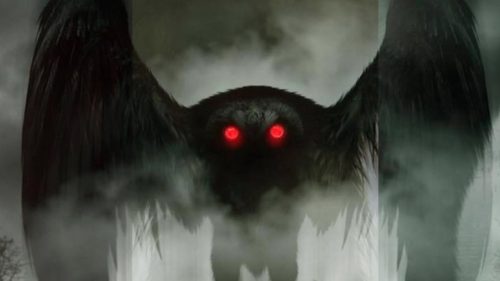
This is the premise of the 2002 film, The Mothman Prophecies. It follows a widowed reporter, John Klein (Richard Gere), who becomes enmeshed in a wave of sightings of an otherworldly winged creature with glowing red eyes. In time, he realizes this entity played a part in the death of his wife two years earlier and, further, that he has been drawn to the area it is haunting by a force beyond human comprehension, a force which exploits the human longing for meaning and foster obsession.
The Mothman Prophecies continually frames its scenes with disconcerting aerial shots suggestive of pervasive, invisible surveillance and images of electrical signals either fragmenting apart or converging into an identifiable image. At times a shot of two people situated near each other talking will suddenly shift to an oblique, overhead view, giving the appearance of a voyeur’s first-person observation. But why is it positioned so high above the characters we’ve been viewing? In one scene in a hospital the camera moves in this way and appears to be spying above a privacy screen, peering from an unusual height. The audience is made privy to the perspective of something non-human.
These shots imply a continual monitoring of the film’s protagonists’ activity, both of minutiae and at citywide levels. They typically resolve into a vaguely moth- or angelic-shaped figure, which reinforces the odd coincidences over the course of Klein’s investigation. In addition, they often incorporate distortion patterns which dissolve into a new scene, as though seeing, hearing, and speaking all existed on a continuum for the forces Klein and the town of Point Pleasant are coming into contact with.
These directorial moves insinuate a sweeping scope to the activity of the entity or entities haunting the protagonists as well as suggest an eerie parallel to the unseen but always present existence of electromagnetic forces. Perhaps, the film’s visual language posits, these entities are as natural a feature of our world as electricity? And perhaps their motives are just as capable of being understood.
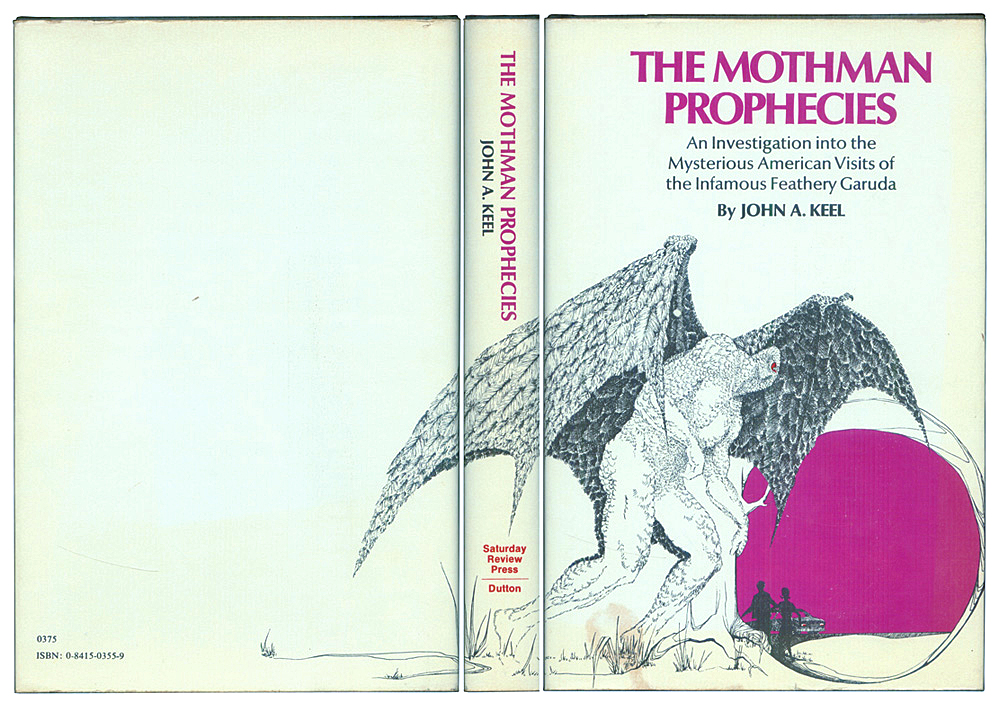
The film is adapted from John Keel’s 1975 classic of paranormal journalism of the same name. The film doesn’t attempt to cinematize Keel’s investigation so much as it draws from the frightening and inexplicable events Keel catalogues to depict the traumatic upheaval of contact with inscrutable non-human entities. While there is some embellishment and conflation of multiple events from book to film, the film captures the horror of typical American lives being caught up in the net of chaotic powers with no apparent scruples against toying with those they esteem lower than themselves.
Keel’s investigation of the Mothman sightings in 1966-1967 uncovered vastly more than sightings of the bizarre flying humanoid. An invisible “zone of fear,” strange aerial lights, and a network of strange visitors who appeared human but behaved in absurd ways and monitored both Keel’s movement and who he spoke to. High strangeness sprang up everywhere Keel went.
The phrase “high strangeness” was coined by J. Allen Hynek in a 1975 paper entitled, “The Emerging Picture of the UFO Problem.” Three years later, in an address to the United Nations on the scope and implications of worldwide UFO sightings, he would describe what these sightings represented:
There exists a global phenomenon the scope and extent of which is not generally recognized. It is a phenomenon so strange and foreign to our daily terrestrial mode of thought that it is frequently met by ridicule and derision by persons and organizations unacquainted with the facts […]
We have on record many tens of thousands of UFO reports … they include extremely intriguing and provocative accounts of strange events experienced by highly reputable persons … events which challenge our present conception of the world about us and which may indeed signal a need for a change in some of these concepts […]
Any phenomenon which touches the lives of so many people, and which engenders puzzlement and even fear among them, is therefore not only of potential scientific interest and significance but also of sociological and political significance, especially since it carries with it many implications of the existence of intelligences other than our own.
“High strangeness” refers to the consummately bizarre events that surround certain UFO sightings, such as time dilation, poltergeist activity, heightened states of consciousness, unusual phone calls and messages, and intimidation from bizarre persons who betray a sense of not belonging to our time or place. These anomalies seem to cluster together in a significant number of UFO cases, things so outlandish and absurd they call into question the reality of the initial sighting. Investigators wedded to the extraterrestrial hypothesis routinely discount these reports because they problematize their presupposed interpretation of the phenomena; moreover, they are simply so fantastical they seem to belong to another era and its mysticisms and superstitions.
But this is precisely the common thread which ties together the UFO phenomenon and the otherworldly experiences of our ancestors. Keel and other researchers such as Jacques Vallee have noted the similarities between the bizarre behaviors of UFO occupants in the modern era and fairies, goblins, and other supernatural creatures in past eras. Rather than trying vainly to superimpose the popular conception of visitors from outer space upon the data by hastily harmonizing a minority of reports, they allowed the data from thousands of sightings to testify on its own terms.
Keel remarks that his
long and very expensive excursions into the borderland where the real and the unreal merge have failed to produce any evidence of any kind to support the idea that we are entertaining shy strangers from some other galaxy. Rather, I have come to realize that we have been observing complex forces which have always been an essential part of our immediate environment.
These forces manifest principally in “mysterious aerial lights which appear to have an intelligence of their own,” but also in what Keel calls “explanatory manifestations”: “explanatory manifestations have accompanied them always, and these manifestations have always been adjusted to the psychology and beliefs of each particular period in time.” Therefore, these things — whatever they are — present themselves as djinn in Arabia, or as impundulu in South Africa, or as animistic spirits in Southeast Asia and in the pre-conquest Americas, or as witches and sprites in the European medieval period. In a modern era characterized by mechanistic rationalism, however, Keel hypothesized that they have shifted their strategy to present themselves as the crew of interstellar spacecraft to better fit the plausibility structure of modernity.
But this goes beyond simple sightings of strange things at a distance. Keel interviewed and claims to have come in contact with beings with mysterious intent and superhuman knowledge of the world and of the future. These entities execute strategies of deception (what Keel calls, “the games nonpeople play”) which bewilder the human subjects with whom they come in contact. They are as persuasive as gravity and the things they describe as belonging to the future seem just as inevitable. Contactees are given predictions and seeded enough true information over a period long enough to secure their trust in the entities, but more than this, they come to believe that these entities possess a knowledge base and a means of gathering information which borders on omniscience.
As contactees are drawn further and further into the web of manipulation they often undergo a shift in self-understanding and in their understanding of the universe, which Keel dubs “false illumination.” This shift reorients the contactee completely, similar to conversion. Though the entities adhere to the world-picture of the eyewitnesses with whom they make contact, they enlarge the frame of that world-picture so as to enthrall the contactee.
Many tilt full-on into fanaticism and reconfigure their lives around promulgating the good news of the cosmic benefactors they represent. Keel avers that “[t]heir lives are manipulated disastrously. Once a person has undergone false illumination [i.e., has experienced a shift in consciousness brought on by these entities] he becomes vulnerable to repetitions, just as once a person has been hypnotized he can easily be hypnotized again.” They become addicted to the contact experience, to its insider route to revelation and mystery. Would it not be insanely difficult to resist the flattery of such an experience? To turn your back on an invitation into a larger, more fantastic world than the one you had known before?
Others, however, simply run aground on the shoals of the contact experience. They are shattered by the otherworldly tangent striking their plane and cannot recover to a state of mind or state of being belonging to a time prior to the obtrusion. In cases such as these, one crumbles beneath the weight of the entities’ apparent omniscience. Every new prediction which proves correct tightens the screws upon them, enclosing them within a tight alley of predestination so exhaustive they feel trapped within these entities’ omniscient gaze. They experience the extinction of any will for an alternative.
In every instance, whether one becomes an evangelist for the powers that have “illuminated” them or she succumbs to the crushing constriction of totalitarian omniscience, the end result is the same: the contactee is abandoned and subsequently humiliated by the public. He or she has been fed enough accurate information that she wholly trusts her sources; they therefore feels no basis for doubt when they are given a final message to relay, one, they are told, of paramount importance to the world. It is usually on a scale beyond any prior prediction given and typically involves calling for others to avoid a catastrophic outcome by joining the contactee in a shelter or waiting on top of a hill for these nameless benefactors to come. But inevitably the promised end does not come. The catastrophe doesn’t arise and the contactee is exposed and becomes an object of ridicule.
Keel notes how the forces at work within these phenomena seem to enjoy damaging and destroying marriages and other relationships. They plainly see nothing wrong with ruining people’s reputations and show little regard to the personal wreckage that follows failed prophecy. They do nothing to help rehabilitate the contactee following their disgrace; instead, they vanish back into the silent spaces of a once-more quotidian universe, leaving their lackeys to spiral into the loss of their jobs, of their social capital, into alcohol and drug addictions, divorce, mental illness, and sometimes suicide. They play upon the credulity of those to whom they offer false illumination and wreak havoc upon their lives and those with whom they share their lives.
Faith is clearly a key component of the contact experience. These entities take advantage of the human need for something beyond the Given, something which complicates the prosaic picture of reality we are encumbered with and toil within. Apart from faith or belief in them, they can do nothing:
The phenomenon is dependent on belief, and as more and more people believe in flying saucers from other planets, the lower force [i.e., the beings that mimic genuine illumination] can manipulate more people through false illumination. I have been watching, with great consternation, the worldwide spread of the UFO belief and its accompanying disease. If it continues unchecked we may face a time when universal acceptance of the fictitious space people will lead us to a modern faith in extraterrestrials that will enable them to interfere overtly in our affairs, just as the ancient gods dwelling on mountaintops directly ruled large segments of the population in the Orient, Greece, Rome, Africa, and South America. (168)
Perhaps this last sentence strikes you as alarmist, but the Apostle Paul testifies that “[f]ormerly, when you did not know God, you were enslaved to those that by nature are not gods,” (Gal 4:8). As much as we might try to pretend otherwise, the world of the New Testament is anything but a stranger to the paranormal. If belief in older pantheons of powers is indeed on the wane in the modern west, then perhaps this is because it is to these beings’ advantage for it to be so. They are more than capable of adapting themselves to new patterns of belief, whether that be New Age hermeticism, alt-right nationalism, or even Christian fundamentalism; whatever allows them to cloak themselves as rulers and authorities to be trusted and obeyed absolutely. Examining the accounts of encounters with them we find outcroppings of a universe vaster and stranger than the prosaic closed system we take for granted and a subjectivity that is more porous than the scientistic and capitalist conditioning to which we’re accustomed. And, insidiously, these beings use the contemporary dissatisfaction with “disenchantment” to further their ends.
On this matter, regarding the disconnect between a naïve modern sense of superiority over the “magical” thinking of our predecessors, particularly with regard to the powers and principalities, Karl Barth writes,
In this matter we have one of the not infrequent cases in which it has to be said that not all people, but some to whom a so-called magical view of the world is now ascribed, have in fact, apart from occasional hocus pocus, seen more, seen more clearly, and come much closer to the reality in their thought and speech, than those of us who are happy possessors of a rational and scientific view of things, for whom the resultant clear (but perhaps not wholly clear) distinction between truth and illusion has become almost unconsciously the criterion of all that is possible and real.
In our time and place it can be easy to dismiss as fanciful primitivism the view that non-human powers influence our affairs and bring about disorder and death. A confident rationalism that presumes Western ingenuity and technique is capable of explaining all of reality in mundane, mechanical terms scoffs at the possibility of another unseen strain to that reality, one that complicates the closed, mechanistic system many of us presume is all that is real. It is this picture of reality that sickens the souls of millions who inhabit it but even a naive resistance to that picture can sabotage and harm human beings.
But the solution isn’t a wholesale re-enchantment of the world — the past was host to these inimical powers as well. The testimony of the church, the testimony commissioned by Jesus Christ, asserts, counter to any worldview on offer throughout every period it has had to critique and deconstruct, that this is reality. Following the end of the Second World War, Carl Jung similarly noted that
Just when people were congratulating themselves on having abolished spooks, it turned out that instead of haunting the attic or old ruins the spooks were flitting about in the heads of apparently normal Europeans. Tyrannical, obsessive, intoxicating ideas and delusions were abroad everywhere, and people began to believe the most absurd things, just as the possessed do.
We cannot dismiss the existence of evil powers, but we simultaneously must not believe in them. “Theological exorcism must be an act of unbelief which is grounded in faith,” Barth writes. To orient ourselves towards them in a posture of belief is to give them power over us and to become like them. We acknowledge their existence, but we must disbelieve in them. We must expose them as the frauds they are and broadcast the poverty of their lordship. But this can only be done effectively by those who have appropriated freedom from these entities’ tyranny by enacting the freedom we have in Christ.
It is in this spirit that Paul asserts with all the forcefulness that can be funneled through a single set of lungs, “For freedom Christ has set us free; stand firm therefore, and do not submit again to a yoke of slavery” (Galatians 5:1). This is not a naïve fundamentalist or secular call to assert self-mastery: it is the summons of God himself, Paul claims, to accept the proffered gift of healed (and healing) agency and the liberty at the center of God’s being by which it is funded.
The freedom that God is in his inmost self is enfleshed in the man Jesus Christ and made available through the Spirit he shares with those who are united to him through faith. The breaking of Christ’s body is the shattering of the powers’ regimes. It is only in Christ that their mastery is or can be broken. Their domain is being extirpated so long as Christ reigns, and it is in the sphere of his rule that their coercive regime is exposed as the Nothingness it truly is.
Whatever patterns of servitude you have found yourself participating in, whatever labyrinth of passivity you have become bewitched within, it is not too late to remove yourself from the playing board. You do not belong to the powers and principalities. And you are not an inert mass of matter to be manipulated and bent to the will of anyone or anything. Nothing you have done under the subjection of the powers necessitates you continuing on because you deserve no better. The fulfillment they promise cannot be delivered. They don’t exhaustively know the future; they cannot decide your fate. Their power lies in the half-truth they tell of the bondage of the will. In Christ you can decide otherwise. In Christ you can recover the agency the bearers of God’s image were meant to enjoy, and if you can’t remember what genuine agency feels like, you can discover and begin to practice at it in the liberation with which the God-Man interrupts the “inevitabilities” of our world. Freedom is about more than the availability of choices: it’s the possibility and actualization of Christlikeness. And these entities want anything —anything — other than this.
The Mothman prophecies may prove plausible for a time, but they are not true. The overtures of the powers and principalities are often attractive in the way they defamiliarize the ordinary world and seem to present something grander and more mysterious. But the end of these overtures is slavery and abandonment. The revelation of God in Jesus Christ disrupts and dismantles disenchantment and re-enchantment, indeed, every world-picture. The graced reaching out of God in Christ is an acid eating away at the mis-enchanted propaganda these entities promulgate. His perfect love cast out all fear, his word a peace that passes all understanding.







I loved this piece so much; it was right in my Q zone! You ever find one of those movies that just strikes a strangely resonant chord with you, even if it’s largely forgettable to the rest of the world? “The Mothman Prophecies” is one of those for me. The odd camera angles, Richard Gere’s haunted performance, the lack of clarity about what exactly is really happening… I found it so compelling.
This piece really drives home language that helps explain how these things take hold with people. “Explanatory manifestations” and “false illumination” are excellent descriptors. I think of this as similar to how some people relate to dreams or horoscopes as well. All are explanations that “may prove plausible for a time but [are] not true”. What a comfort to know we don’t belong to these things, that we can “remove ourselves from the playing board”. Thank you Ian!
Pierre, this is so kind of you. I am so immensely pleased that this aided you! It was almost an exorcism for me, as well, as I have been subject to the kind of fatalism Indred Cold and his cronies proliferate among contactees. May we, however imperfectly, resist that passivity that acquiesces to powers that do not love us!
[…] of us think the paranormal — if it’s even real — intervenes in such a way as to make our world weird. But this isn’t so. The world is only […]
Ian, I love this thorough, well-researched piece. I can remember watching The Mothman Prophecies my junior year of high school, and I was transfixed. Your description of the cinematography voiced one of the ways that film left such residue with me.
I have not seen it since, but I think it is time for a rewatch.
TODO: watch or read The Mothman Prophecies.
Pro tip: both!