




If you haven’t been following the news coming out of the congressional hearings on UFOs, the (possible) revelations from the whistleblower last week are pretty wild stuff. As if stolen from the X-files, we’ve heard allegations of aircraft of “non-human” origin, “a multi-decade [UFO] crash retrieval and reverse-engineering program,” and the discovery of “non-human biologics.” These come on top of the decades of mysterious footage of floating vessels and hypersonic fly-bys. For some, the question isn’t whether aliens exist, but how far down the conspiracy-theory rabbit hole goes. The truth is not only “out there,” but has occasionally come for a visit.
Given the seemingly infinite number of galaxies we can now observe, courtesy of the James Webb Space Telescope, the possibility of intelligent alien life can feel more probable than impossible. Or at the very least, the niche extraterrestrial fandom that has long found themselves as the butt of jokes — only the mentally ill wear tinfoil hats — have more reason to feel their suspicions vindicated.
If aliens showed up tomorrow on the White House lawn, how would their possible existence shift Christian theology? Which beliefs would now appear implausible and what would be left after the dust settled?
This thought experiment isn’t merely hypothetical. As silly as it is for me to even be writing an article about extraterrestrials, recent polls have found that 65% of Americans now believe that aliens exist, only a smidge lower than the 81% who believe in God. To say nothing of the decades of movies, TV, books, or comics depicting alien encounters. One can ponder why most now think there is extraterrestrial life: is it an attempt to enchant a disenchanted world, a projection that coincides with rising loneliness, or the comfort in thinking that the universe is larger than the petty, human-centric squabbles of daily life, or something more reflective of the apocalyptic despair of the age?
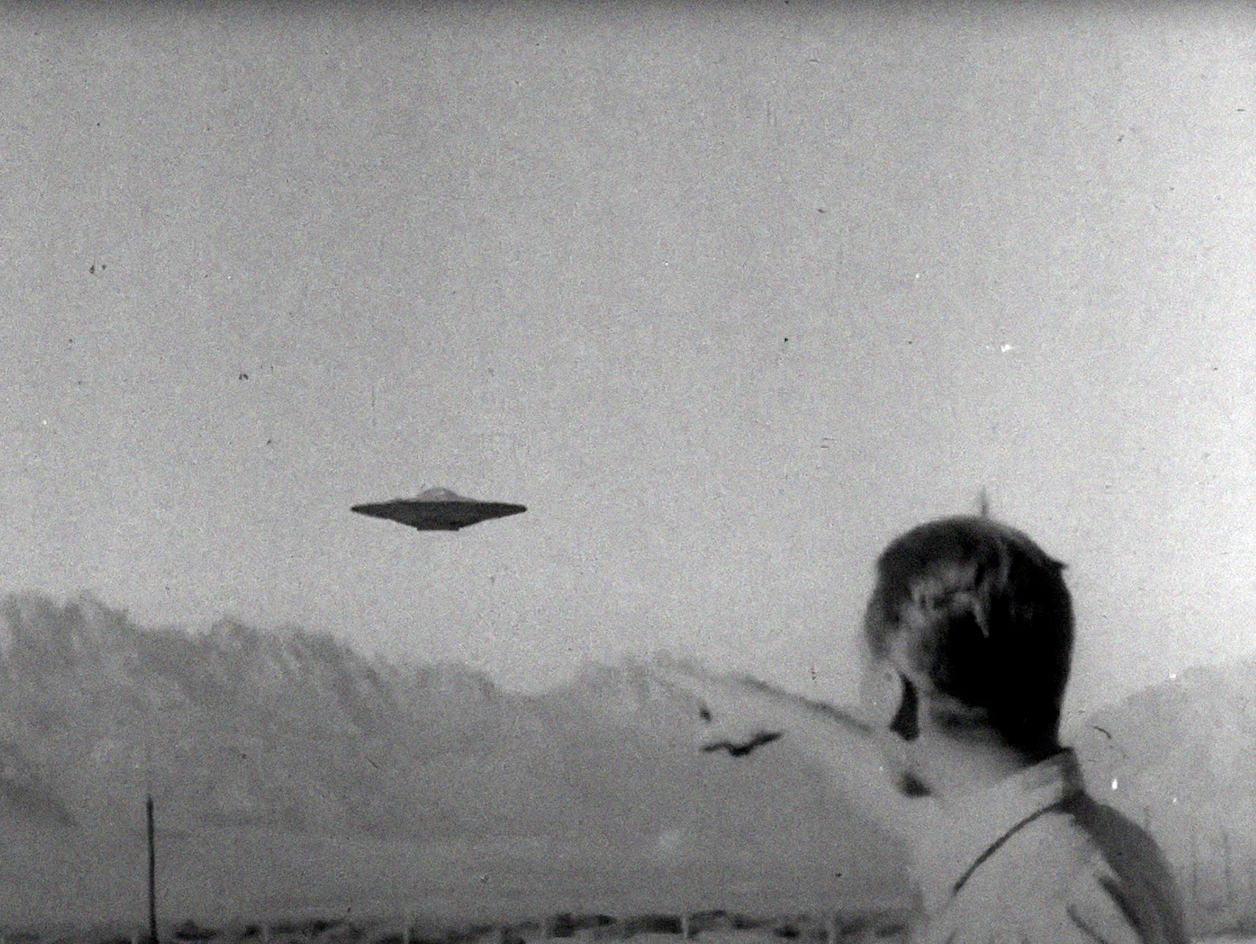
Regardless of how skeptical one may be of extraterrestrial life, it is a belief that implicitly informs how most people think about the world and their place in it.
The discovery that the Sun did not revolve around the Earth dislodged more than our planet from the center of the universe. If our world was a mere planet, then the great, continuous chain of being was fundamentally disrupted. No longer could one look to the heavens and see the outward divine emanations of the heavens. Humanity is a part of the vast cosmos, rather than its focal point. As the universe grew larger with each new astrological discovery, humanity grew smaller. The discovery of aliens would continue this trajectory further, placing our species within a cacophony of living beings across the cosmos. If the universe is so big, then why would we presume a divine being would deign to turn their eye upon this fragile blue marble? Or a scientific rationality is preferred, where religion itself is an evolutionary coping mechanism that interstellar aliens would surely have left behind long ago. For others, aliens slot neatly into a religious pluralism they already espouse. They have their gods and so do we.
Along these lines, some are inclined to think a White House lawn visit would confirm what Christians already believe. Descending from their flying saucer, these foreign evangelists preach of a God who died for the sins of their people and invite all sentient creatures to follow him for the forgiveness of sins. A kind of multiverse Jesus who became incarnate across the universe. One can hope, I guess. But even in this scenario, the efficacy of Jesus’ death is redefined, divorcing the sacrificial Jesus who became human to die for humans from the apocalyptic Jesus whose death marked the turning of the ages of the cosmos. Moreover, the meaning of divine revelation and of scripture (by extension) shifts, limiting the scope of their efficacy to human recipients. If, as some argue, Christian ethics reflects the creational structure of human nature, then perhaps alien nature results in ethical values?
Aside from a multiverse Jesus or outright pluralism, for those who wish to continue to confess that Jesus is the Son of God who takes away the sin of the cosmos, the appearance of aliens on the White House lawn would transform Christian belief. In the same way that the mission to the Gentiles opened up newfound understandings about the Law or how heliocentrism altered how Christians talk about humanity and creation, the advent of Martians would spur further reflections on a number of issues.
The Patristic-era debates in early Christianity about the human and divine natures of Jesus were propelled, in part, by the practical concern to ensure the efficacy of Jesus’ death/resurrection. Or, in the words of the Cappodocian axiom “what he did not assume, he could not save.” If the second person of the Trinity only appeared to be human, then human nature could not itself be redeemed. If Jesus was not fully human, then the messiness of physical, human life is a thing to be eschewed in favor of higher, spiritual realities. But a human Jesus does the opposite, endowing common, everyday life, with ultimate purpose. As told by Robert Frost:
But God’s own descent
Into Flesh was meant
As a demonstration
That the supreme merit
Lay in risking spirit
In substantiation.
The theological crisis of an alien visitation (invasion?) of the capitol would not nullify Jesus’ humanity, but expand its significance more radically, further underscoring Christianity’s scandal of particularity. Just as a Jewish messiah died for the salvation of the world, one can likewise say that a human died for the healing of the cosmos. The grace of God knows no bounds, it is for Jew and Greek, slave and free, male and female, Earthling and Martian. If Jesus were to have died for all, then the significance of his human nature lay not in Jesus’ possession of human DNA, but in his creaturely substantiation. A becoming, in the words of the Gospel of John, flesh — which John understood not simply as human embodiment, but as the physical sphere of all worldly activity. And at the Feast of Pentecost, God “poured his Spirit out upon all flesh” (Acts 2:17, Joel 2:28). Death comes for all eventually (even alien Time Lords), and the defeat of death by one who was slain before the foundation of the universe is good news to all living creatures great and small.
In assuming a physical existence, God entered into the universe on a particularly unimpressive planet revolving around a moderately sized sun located on the Orion Arm of the Milky Way galaxy. It seems that Jesus was not only raised in the unassuming and unimportant town of Nazareth, but on a planet of equally insignificant stature. The death Jesus died, he died once for all — humans and aliens alike. Emanating from Jerusalem to the ends of the earth to the ends of the universe, the story of salvation would culminate in the unveiling of a “new heavens and a new earth” (Rev 21:1, Isa 65:17) where there will be no more death or mourning or crying or pain (Rev 21:4).
I’m not much for predictions, but the flying saucers aren’t going to land on the White House lawn tomorrow. And for all we know, the grainy videos of mysterious airships could just be secretive military tests of profoundly new technology. Whether aliens have already arrived or not, they certainly aren’t going away anytime soon. But perhaps the God of Abraham, Isaac, and Jacob, who redeemed us and delivered us from sin and death, is also the God of cosmos?








Couldn’t help but recall lyrics enjoyed by nerdy 80’s Christian teens:
“And if there’s life on other planets
Then I’m sure that He must know
And He’s been there once already
And has died to save their souls”
Larry Norman’s song, UFO, 1972
this makes me think of C.S Lewis’ space trilogy. especially Perelandra where he toys with the idea of a world without the experience of sin. fun concepts to play with. I love the idea of Earth being the universe’s Nazareth. great article!
Thank you for this. Confirms my preaching on Sunday in regards to the Parable of the Net.
It is a well-known fact that Aliens pass by Earth, taking one horrified look, and keep going.
God created the universe. Why do we think we’re so unique?
“The death Jesus died, he died once for all — humans and aliens alike.”
With all due respect, this raises serious questions. Like, if there were to be aliens, why should we presume that they are fallen? Was Adam a federal head of not only humanity (earth-beings) but also representative of all intelligent created life in the universe? Adam didn’t represent angels, nor does Jesus redeem them. Just a few questions that come to mind here.
Todd, this is SO good – and I love the Frost quote. The scandal of radical particularity indeed. Thank you, brother!