





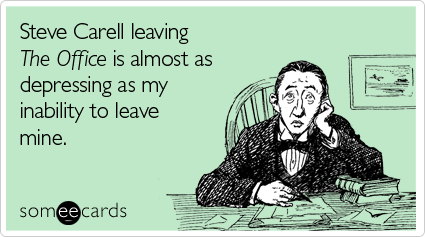
Over at Slate, Bill Wyman (not that Bill Wyman) examines of Steve Carrell’s achievement these past seven years playing Michael Scott on The Office with characteristic insight. He not only puts Scott in the context of post-Seinfeld nihilism and self-loathing – i.e. characters universally defined by their unchanging weakness and self-centeredness – he points out a telling distinction between the BBC and NBC versions of the show. Namely, that despite being lighter in tone, the American version actually maintains a more realistic view of human nature, that our failed lives are not merely the product of external circumstances (oppression from the higher-ups), but rather the product of something intrinsic to ourselves. And while I prefer the BBC version – he may not be doing Gervais’ worldview total justice – I’m generally in agreement with him about both the bad and the good being more evenly distributed on NBC, ht Jeff Dean:
Having grown up without a father and as an adult essentially friendless, Scott as portrayed by Carell derives virtually all of his opaque identity from his job at the office, a platform from which he tries to act out his improbable dreams, which range from the pedestrian one of merely having a friend to more rococo concoctions, like being a standup comedian, an improvisationalist, or an emcee… While Scott has always been capable of unthinking (and sometimes thinking) cruelty, during the second season I think the edges of Scott’s character were de-Brentified, softened.
I think the show was trying to tell us that the failures of business aren’t necessarily bureaucracy or the pursuit of profits, but the result essentially of ever deepening psychological problems in upper management. The company can’t right itself because each successive level of management is as damaged as the one beneath it. So central is this analysis that the main criticism you can make of the show is that they have gone to this well too often.
Now, Ricky Gervais has a dark worldview, but it basically involves the fact that the good are often at the mercy of the bad. The signature image of the series was one of Brent’s victims, most notably the unfortunate receptionist, bearing his barbarities with a stoic resignation…But the worldview of the British version of The Office was nonetheless somewhat sentimental.
The point is that, while Gervais is seen as acerbic, he turned out to be a softie. The American Office, a key part of the golden age of television we’re now living in, is visualized from a darker perspective. The characters’ personal damage determines their dead-end futures, because they don’t have it in them to make it. Ryan will never succeed in business. Pam is not an artist. Jim is not ruthless enough to succeed as a salesman. Dwight’s family line will no doubt expire with him and his cousin Mose. And Michael will never have an adult relationship, because he’s not yet an adult.
In this way he is the quintessential American… And right now, we’re all so many Jims and Pams (and, no doubt, Dwights), all at the mercy of supremely damaged people but prevented by our own deficiencies from being able to stop them.
For a free copy of Mbird’s publication “The Gospel According to the Office,” go here.








DZ,
I have to agree–I saw the BBC version first, and after that I just couldn’t watch the American version–not as sharp or ironic.
Why do the Brits do Irony so much better than us?
Being “at the mercy of supremely damaged people but prevented by our own deficiencies from being able to stop them” sounds more like a brief history of the world than something quintessentially American.
Mich, Simon Pegg fielded this issue several years ago. He pointed out that it was not Brits who invented The Simpsons or South Park. He said Brits are not better at satire, they use it like a tea kettle, it’s always on and it’s likely to whistle once in a while in the background. Americans use irony more like spices used in chilli, it’s go-for-broke all-you-can-stand or it’s not there. But because Brits always want a little bit it of it here and there they look at American literature and film and assume (wrongly) that Americans don’t do irony well.
Tangential to this, John Woo once said that Americans and Westerners as a whole used to be more sympathetic to melodrama. It’s not exactly that Asian films (i.e. his melodramatic stories) are that unusual in world story-telling, it’s that Western audiences don’t like melodramatic tragedies in which a person is doomed because they like to think they can avert fate or destiny. Never mind that the Greeks were great at exploring the immutability of a terrible fate. 🙂
Interesting discussion, guys. I think Pegg is onto something, but I’m not entirely sure what. That is, the Brits are certainly not afraid of go-for-broke comedy (e.g. Python for pure silliness or Alan Partridge for black humor), but not necessarily when it comes to strict irony or satire. Do they have a Stephen Colbert?
The contrast is particularly evident in music. They’re so much better than us at the earnest, romantic stuff! A reaction to the stiff-upper-lip mentality? I don’t know. I suppose Morrissey brings some serious irony to the table, but a band like, say, Pavement could have only come from the US.
Regardless, I didn’t mean to imply that the US Office didn’t have its merits. But you can only see them (and they only started showing) once the show found its own voice apart from the BBC one, i.e. if you view the NBC one as an “American version” of the BBC one, it’s hard to appreciate. But as its own thing entirely, it was really pretty good. Especially seasons 2&3 (which we may or may not have written a teaching-series on) and the Andy Bernard parts of 6&7. All this to say, I thought the final Michael Scott episode of The Office was pretty terrific. And quite touching. For some great write-ups go here:
http://www.avclub.com/articles/goodbye-michael,55159/
and http://www.hitfix.com/blogs/whats-alan-watching/posts/the-office-saying-goodbye-to-michael-scott
and http://nymag.com/daily/entertainment/2011/04/is_the_office_saying_good_bye.html