




Throughout Jesus’ ministry he is physically curing people, and among his most consistent clientele are the blind. With great ease and creativity, he can turn on sight in dead eyes. Living, seeing eyes — or the eyes of those who think they see — are a different story.
Jesus’ interaction with the Pharisees is like going to a convention on vision where all the leaders are inflated by the certainty of their sight. The Pharisees are one group who cannot receive sight from Jesus. Their inability to recognize their own blindness seems to handcuff the miracle worker.
Jesus tells Nicodemus, a Pharisee: “Verily, verily, I say unto thee, Except a man be born again, he cannot see the kingdom of God.” Nicodemus can’t see. It’s possible to go through life with perfect vision but never really see.
Nicodemus has no clue what Jesus is talking about. Nicodemus doesn’t understand that the new birth comes through death, a movement from death to life. It is impossible for him to see the kingdom because he has not died to the framework that keeps him blind.
Nicodemus shows us a religious expert who cannot see. John 9 shows us what happens when the blind religious system that formed Nicodemus encounters someone who can.
The man born blind in John 9 presents a social and theological problem. He is completely misread by everyone around him. The disciples see him through the old sin frame. Either he sinned, or his parents sinned. That is the only explanation available to them. The Pharisees see him as a sinner and as a threat. His parents see danger. To the crowd, his identity is one who sits and begs. Jesus is the only person who really sees him.
One of the shockers of the story is that Jesus blows up the entire framework they are all operating in. The reason he is blind is so the glory can manifest. Nothing to do with sin.
The blind man knows he can’t see. There are those who think they can see. He is certain he is blind. Others are certain they can see.
When he receives his sight, the community interrogates him instead of celebrating, and then they take him to the Pharisees. Good news and bad news: Jesus healed him on the Sabbath. This healing doesn’t happen in the context of the religious system and is therefore perceived as a threat. You are not allowed to play in the mud and heal on this day of the week.
Could you imagine? You are seeing for the first time in your life, and the next thing you know, you are escorted by a community (in which some believe you and some don’t) to be examined. The first place the community takes him is to a religious meeting to be scrutinized, and religious leaders are upset about the day of the week it happened on. The community is in bondage to the religious system and cannot receive the miracle. They cannot rejoice. They cannot let him see. They would rather have him blind than healed. Of all the places to take him, not to the mountains or the ocean or the woods but to the religious authorities.
The Pharisees are authorized to interpret what happened. They are the arbiters of religious life and experience, and they, along with many in the community, believe they are called by God to do this.
His testimony to the religious leaders causes division among them and is ultimately condemned. The healing isn’t recognized because it happens outside their framework, and in their minds, healing can only happen through the framework. Anything outside the rigid framework is obviously suspect. There is a right way to do this, and this ain’t it.
This is what spiritual blindness looks like. It can look like certainty or exclusivity. Sometimes it looks like religious expertise. Sometimes it looks like a room full of people who know exactly who is healthy, who is sinful, who is mature, who is safe, who is dangerous, who is in, and who is out. This type of behavior is at its worst and most dangerous when it’s a group that collectively discriminates righteousness from ungodliness. Groupthink easily slips into a fog where vision gets muddy, and hearing and seeing become nearly impossible.
I’m clean, and you are not. I can see the speck in your eye, but I can’t see the plank in mine. Self-righteousness blinds. The gospel critiques this because vision, hearing, and insight come to the one who knows he doesn’t have them.
The implication is that the man is somehow wrong. His lived experience cannot be trusted. He is talked down to and his testimony is shamed. The man doesn’t know it, but he is talking to blind people.
Even his own family is afraid, self-protective, and unsupportive. They are living under the threat of guilt and possible excommunication. They don’t want to assume any connection or responsibility for this. He is responsible; he is of age. They want no part in advocating for him. He can speak for himself. He is really growing up today. Their son, who just received his sight, is on his own.
Carl Jung writes:
The words “many are called, but few are chosen” are singularly appropriate here, for the development of personality from the germ-state to full consciousness is at once a charisma and a curse, because its first fruit is the conscious and unavoidable segregation of the single individual from the undifferentiated and unconscious herd. This means isolation, and there is no more comforting word for it. Neither family nor society nor position can save him from this fate, nor yet the most successful adaptation to his environment, however smoothly he fits in. The development of personality is a favour that must be paid for dearly.
That is what is happening to the man born blind. He is paying a big price for his healing. His sight is separating him from the blind herd. His vision makes him a target and then isolates him. His healing doesn’t bring him into community. It makes him a witness against the blindness of those who claim to see.
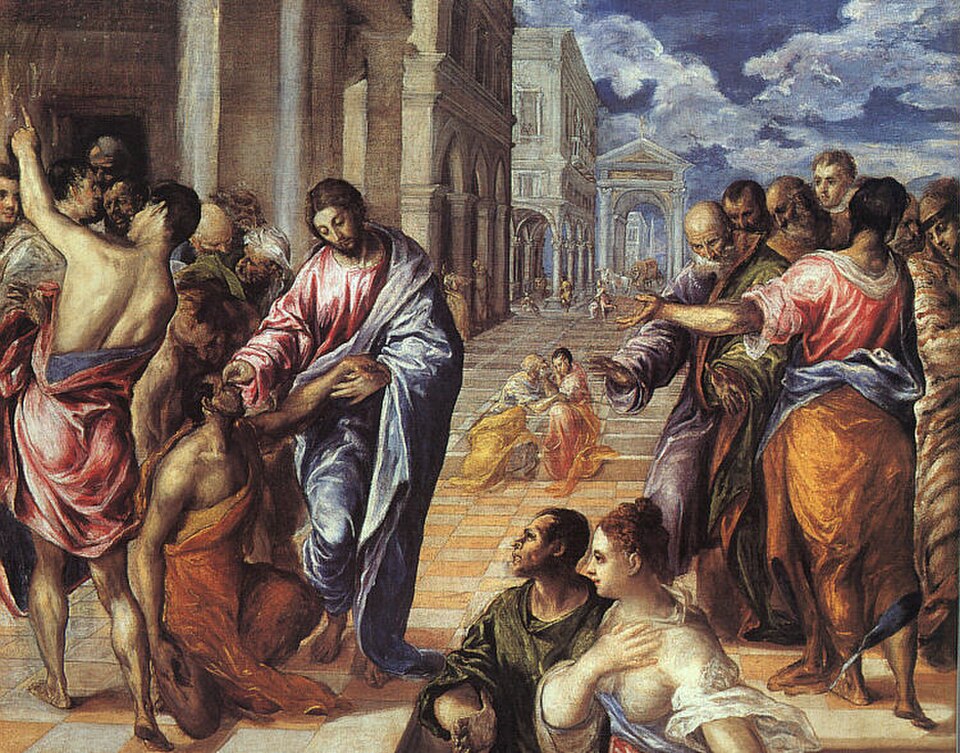
El Greco, Christ Healing the Blind (1570)
So they gaslight him:
Then again called they the man that was blind, and said unto him, Give God the praise: we know that this man is a sinner. (John 9:24)
Sin is brought up again. We are back in the guilt framework. It is what a system like this needs in order to function and survive. One translation says they “hurled insults at him.” Who does he think he’s talking to? Then they reveal how threatened and inferior they feel: “Are you trying to instruct us?” How could he have anything to teach them? They don’t have anything to learn, especially from him. They know it all.
This is what dead religion does to the whole person, healed and in his right mind. The Pharisees are confident that the man is a sinner and that Jesus is a sinner. Jesus never calls him a sinner; only the Pharisees do. The Pharisees say he has been in sin since birth, the complete opposite of what Jesus says about him. And in doing so, they displace their guilt onto him to cleanse their own conscience. He is the problem, not them. When the problem is always out there, always someone else, it takes the spotlight off crippling dead religion.
Having been healed, the man has experienced a new reality, one outside the sin framework. He narrates his deliverance without reference to sin or guilt: “I was blind and now I can see.” He is describing something to them they cannot see.
They are blind to the reality before them, to anything that does not fit within their framework. It is impossible for them to understand anything he is talking about. No one cares about his healing or his vision. He is wrong.
In a way, Jesus’ healing leads him to this very place. One of the most powerful institutions has publicly humiliated, labeled, and scapegoated this man. This is what the blind do to people with vision when they are exposed. The only person in the building who can see gets thrown out. He is discarded, even by his family. Counterintuitively, this is good news.
Dead religion cannot cure blindness because it depends on blindness. If there’s something wrong with you, dead religion promises, the solution is here — you just need to do a little more, be a little more. Wholeness is a threat to dead religion because whole people don’t need it. The arrangement is they have sight, you don’t, and you need them to see. But when you are healed you don’t need the mat, the cane, or the crutch, and you don’t sit and beg anymore. If a healer starts healing a bunch of people, then he might put the whole thing out of business.
Have you ever noticed how many sick, blind, lame, mute, and demonized people are sitting at the door of dead religion in the Gospels? And how disruptive and controversial their healings are? There is a system of dependency there. Dead religion sets its hooks at the site of people’s wounds, then keeps them on the line by promising something it can never deliver. Being healed is threatening because it removes dependency. This is not a place for someone with vision.
If rescue happens outside the religious leaders’ framework, then suddenly their framework is no longer needed. The invisible lines that tied the man to the expectations of those around him, the system of dependency on human systems or criteria, have been exposed and severed. He is no longer of the world but is liberated from it. His being cast out is simultaneously his being set apart, for it is in the wilderness of exclusion that a relationship can begin.
Jung writes:
The individual becomes morally and spiritually inferior in the mass, and for this reason they do not burden themselves overmuch with their real task of helping the individual to achieve a metanoia, or rebirth of the spirit … I can therefore see it only as a delusion when the Churches try — as they apparently do — to rope the individual into a social organization and reduce him to a condition of diminished responsibility, instead of raising him out of the torpid, mindless mass and making clear to him that he is the one important factor and that the salvation of the world consists in the salvation of the individual soul.
If the Pharisees knew of their own blindness, they would have freedom from sin or guilt. Their sin is that they think they can see. Some translations say their guilt remains. Their denial of their own blindness is what prevents Jesus from opening their eyes. All of it could wash away if they could come to grips with how blind they are. Because they can’t, they suffer under the weight of guilt. For judgment he came into the world.
Jesus appears to him the second time the way he did the first time: outside the religious system of the day. Jesus hears that he has been excommunicated and goes looking for him. Jesus is a friend to the excommunicated.
The man has found the real thing, the most essential thing. Something so much better than what he was just kicked out of. In rejection, he gets it. He worships and believes.
Sources:
C. G. Jung, “The Development of Personality,” in The Collected Works of C. G. Jung, vol. 17, The Development of Personality, trans. R. F. C. Hull.
C. G. Jung, The Undiscovered Self, trans. R. F. C. Hull.








“In a way, Jesus’ healing leads him to this very place. One of the most powerful institutions has publicly humiliated, labeled, and scapegoated this man. This is what the blind do to people with vision when they are exposed. The only person in the building who can see gets thrown out. He is discarded, even by his family. Counterintuitively, this is good news.”
Wow. This was powerful. Hits so close to home and comes as a precious reminder that to be ex-communicated from the blind community is a gift, not a curse.
This is the most important exegesis of the scriptures and what they truly say to us that I’ve ever read. It comes to me at a time when those who’ve led me to sight appear to be on their way to creating a new framework of orthodoxy, and even though I’ve believed that in many ways I now see so much I could not in the proud religiosity of my past, I’m desperate not to enter into a new mindset of toxic, blind certainty, and to do as Corrie Ten Boom supposedly said, “to hold all things loosely”, but especially whether or not I think I see.
Thank you so much for this article. I thank God for M-bird.
Brenda and Kent, thank you so much for reading and the kind comments!