




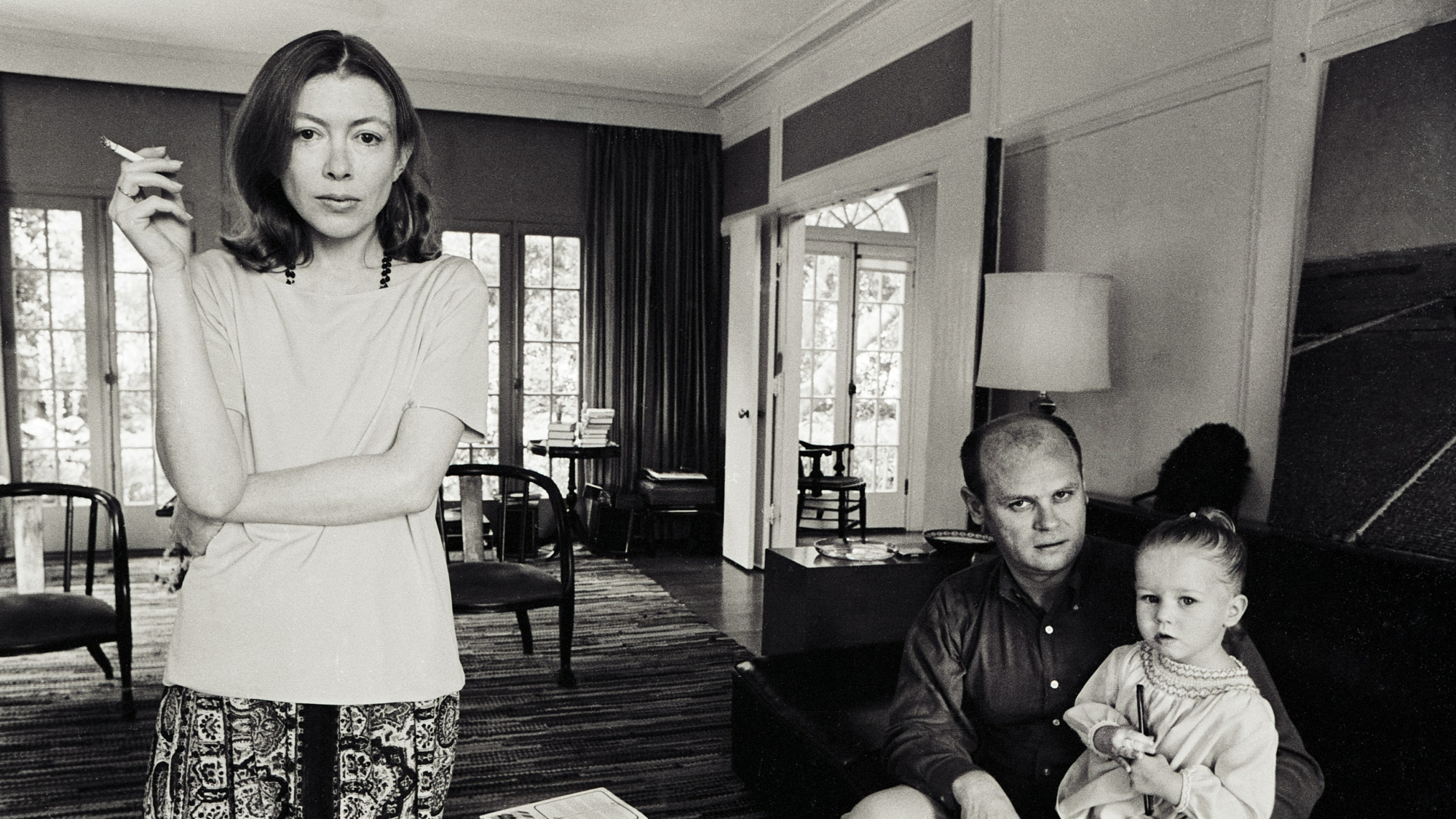
The novelist John Gregory Dunne’s daughter, Quintana, barely a day old — adopted straight from the hospital — was baptized under the bathroom faucet. It was the middle of the night, but John was a good lapsed-but-still Catholic. He couldn’t risk it. Neither him nor his raised-Episcopalian wife, writer Joan Didion, particularly believed in the reality of the faith, the resurrection in particular. Yet something about it must have seemed real to John that night.
As an aside, is it wrong that when I think of Joan Didion, I think of that scene from the movie Scott Pilgrim vs. the World?
It’s probably just me.
Joan Didion’s approach to journalism often makes us wince. We love her clarity, her conciseness. That same clarity cuts both ways, forcing us to look at things we would rather not. In a 2017 interview by David Swick for Lion’s Roar Magazine, Didion’s famous gaze turned towards Christianity. I winced, but there is more to Didion’s story.
Denial of death in our society has reached the point, Didion says, where we share this common belief: “Somehow you’re at fault if you die.” Following John’s death she experienced both blame and guilt. “You berate yourself. The survivors are among those who are afflicted by this belief that ‘they did it to themselves,’ or ‘I could have prevented it.’ There’s still a feeling, an inchoate assumption that if you’re living right, if you’re taking care of yourself, you won’t die.”
She is mystified that the denial of death has us so firmly in its clutches. “It’s very peculiar because this denial occurs most often in Christian nations, but death is at the very center of the Christian story. ‘He that believeth in me shall never die.’” Of course resurrection is at the center of the story, too, “but it’s not a literal resurrection,” she says. “After death I don’t think you’re aware of what John called ‘the eternal dark.’ I don’t think you are you.” And although we know better than to nurture them, she says, “we still have primitive beliefs.”
Hard to be convinced of something like Christianity if you’re not particularly sold on the resurrection. Very little else the church has to say would make much sense in that case. Actually, none of it. In a new collection of Didion’s early pieces, Let Me Tell You What I Mean, one from 1968, titled “Getting Serenity,” we get a taste of her rather stark journalistic approach as she details a visit to a Gamblers Anonymous meeting. Her self-described “harsh Protestant ethic” is now focused on a group of people who are living reality lit by something she doesn’t think exists. Sounds promising!
There was nothing particularly wrong with any of it, and yet there was something not quite right, something troubling. At first I thought that it was simply the predilection of many of the members to dwell upon how “powerless” they were, how buffeted by forces beyond their control. There was a great deal of talk about miracles, and Higher Presences, and a Power Greater Than Ourselves; the Gamblers Anonymous program, like that of Alcoholics Anonymous, tends to reinforce the addict’s own rather passive view of his situation. (The first of the G.A. “Twelve Steps” involves admitting that one’s life “has become” unmanageable. Five steps further, and still being acted upon, one avers that one is ready to “have these defects of character removed.”) “My neighbor introduced me to Hollywood Park, big favor he did me,” someone said that night. “They oughta bomb this Gardena,” a young man whispered to me fervently. “A kid goes in one of those places, he’s hooked for life.”
But of course, mea culpa always turns out to be not entirely mea. Still, there was coffee to be drunk, a cake to be cut: it was Frank L.’s “birthday” in Gamblers Anonymous. After six years on the program he had finally completed a full year without placing a bet, and was being honored with a one-year pin (“Frank L., I want you to remember just one thing, the one-year pin is just a leafmark, just a bookmark in the book of life”) and a cake, a white cake with an inscription in pink icing: miracles still happen, the cake read. “It hasn’t been easy,” Frank L. said, surrounded by his wife, his children, and his wife’s parents. “But in the last three, four weeks we’ve gotten a … a serenity at home.” Well, there it was. I got out fast then, before anyone could say “serenity” again, for it is a word I associate with death, and for several days after that meeting I wanted only to be in places where the lights were bright and no one counted days.
She put her finger right on it. Not simply the affront to self-respect, but that unavoidable association with death. Death as a road to serenity does sound like macabre overkill if there isn’t anything … convincing … on the other side. This aversion to death may sound strange, given that self-protective hum of fatalism throughout her work. Sometimes called grit. Helps tamp down the fear. She’s from California, but that sort of “harsh Protestant ethic,” as she calls it, sounds Midwestern to my Midwestern ears. It’s one of the many ways we avoid dealing with death; practically, not entirely without humor, but just this side of grim. Get’s you through the day. Until it doesn’t.
But something happened between 1968 and 2017. Her husband John and daughter Quintana both died, dissolving that grit into helpless grief for a time, which she wrote about in The Year of Magical Thinking and Blue Nights. Reading the interview with David Swick, we now see someone looking, maybe, possibly, for some serenity. Maybe she’ll find a church that still believes in the resurrection, one that can’t not believe in the resurrection. It has to be for any of it to make sense. Why? It’s not about the denial of death, it’s about Christ’s obliteration of it. Convincingly. Forever. Dead and raised with him, a little version of which was re-enacted under that bathroom faucet in her house all those years ago. The Risen Christ has the effect of lighting things up so bright, there can’t be any darkness, so it’s just now called Day. It makes counting so much easier. Plus, Joan’s got the shades — she’s all set!
featured image via Vox







[…] late great Joan Didion, that famous chronicler of the 1960s, gave a commencement address at UC Riverside in 1975, titled, […]