




Great works of art and literature endure for centuries and even millennia because they reveal truth about the universe and our place within it, or else provide profound insight into the human condition and how to navigate it. But one of the weird things about reality — whether it’s a bug or a feature, you can decide for yourself — is that the universe sometimes reveals its secrets through decidedly lowbrow stuff as well.
Case in point: Scott Pilgrim — the Canadian video-game love-story hybrid spanning Bryan Lee O’Malley’s six-part comics series (2004-2010), a feature film (2010), and a newly-released anime. It’s one of those things that I dearly love, but can also understand why other people hate it. The quirky, frequently surrealist video-game aesthetic (the protagonist literally dies at one point in the narrative, but comes back because he had earlier obtained an “extra life”) is not for everyone. Neither are the Napoleon Dynamite levels of stupid humor (“For the first time, Scott realized that not every Second Cup exterior leads into the same Second Cup interior”).
But most of all, I can understand why people are put off by the characters. As one of my friends exclaimed half-way through the film, “No one in this movie knows anything.” He’s not wrong. Most egregious of all is Scott Pilgrim himself, a 23-year old slacker (“jobless, hopeless”) living in Toronto, mooching off his friends and filling his time by playing bass for an indie band “of subjective quality.” While irrepressibly cheerful and disarmingly naive, Scott seems incapable of taking responsibility for anything. None of which keeps his 17-year-old high-school girlfriend (their relationship is mercifully confined to “hanging out” and playing DDR) from adoring him. “Scott, if your life had a face, I would punch it,” a bandmate informs him.
And this is before he meets the girl of his dreams. Quite literally: Ramona Flowers is a roller-blading American delivery girl who uses the “convenient subspace highway” running through Scott’s rather empty mind to travel three miles in 15 seconds (“I don’t know what that is in kilometers,” she confesses). Scott behaves in ineffably idiotic fashion when they first meet; he later provides a master-class in how to not ask a young lady out on a date. Ramona, on the other hand, carries herself with such self-collection and grace that it’s pretty inexplicable (at first) why she agrees to go out with Scott. Critics of Scott Pilgrim often dismiss Ramona’s character, not entirely without reason, as a “manic pixie dream girl,” i.e., a desirable and even incandescent young woman who apparently exists solely to solve the problems of an average-or-less young man. To be fair, Ramona eventually emerges as a deeply-flawed individual who is fighting her own battles. I find it believable when she later explains her attraction to Scott’s “unassuming” nature as a longing for peace.
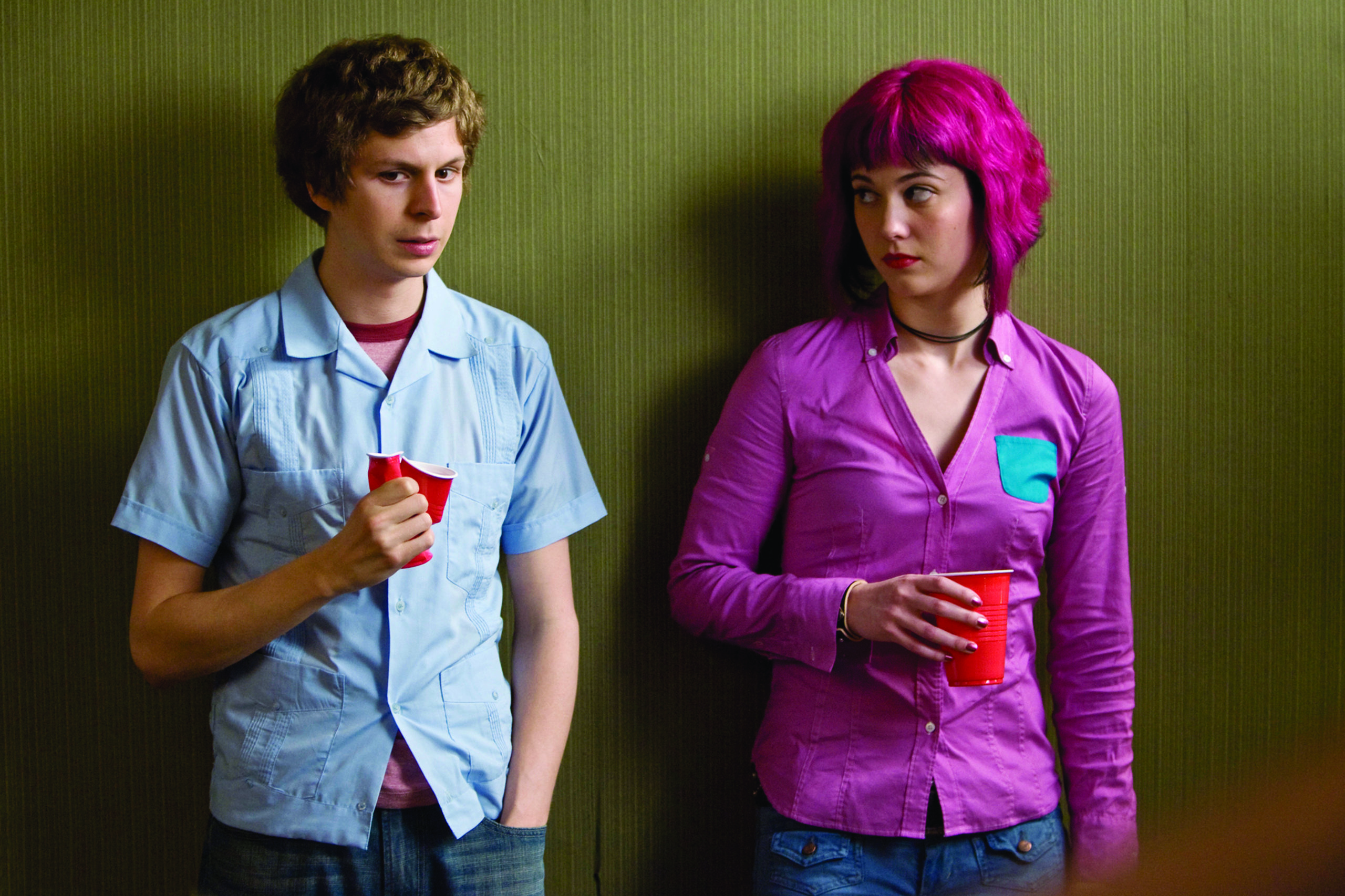
Speaking of battles, Scott soon finds himself embroiled in Street Fighter meets Super Mario style brawls with the League of Seven Evil Exes [1], Ramona’s past love interests spanning from middle-school to the very recent past. In an obvious nod to the “boss battles” of innumerable video games, each fight is harder in the last — both in terms of the gloriously goofy combat itself and in Scott’s growing realization that his carelessness has had real-world consequences for himself and for those around him. By the end of this offbeat little tale, both Scott and Ramona stand on the brink of maturity, with its insistent call to pour out one’s life for the sake of another.
It’s silly and it’s not. Scott Pilgrim possesses emotional heft lacking in the Napoleon Dynamites and Nacho Libres of the world. Part of it is atmospheric; there’s this lightness that suffuses the Scott Pilgrim universe, reminiscent of the best days of college or early adulthood when you actually “did life” with friends in a meaningful sense. “The happiness of being with people,” as Franz Kafka put it in one of his journals, is almost constantly present. But more than anything, Bryan Lee O’Malley is expert at tapping into (as the Guardian’s review of the anime beautifully puts it) “the residual memory of what it’s like to have a crush in your teens or 20s.” It’s a lot of chemicals in your brain making you stupid, to be sure. And it’s also the intense and unshakeable (if only temporary) insight that the universe is an indescribable gift — that moment when G.K. Chesterton stops being puzzling or twee and starts making perfect sense when he talks about how the world is magical to its core, that life itself is a miracle that, against all odds, impossibly exists.
My affinity with Scott Pilgrim, the character, is in large part due to a shared awkwardness that (I hope) is mostly endearing. In other ways, I’m very different from Scott. I’m smart; I’ve been described by several sources as a “workaholic,” which I wore as a badge of honor until very recently. I do my best to take responsibility for my life.
But as I get older, I realize with ever-increasing conviction that everything good in my life is a pure gift that has arrived unbidden and undeserved. That I get to live in a place like St. Louis, a decaying-but-kind-of-regenerating Midwest industrial center populated by absurdly loyal people. That I get to spend time with a rich and frustrating language like Hebrew. That I have friends who will drive 35-plus minutes on a Tuesday night to help me out when I’ve had a bad day. My older daughter, who thinks tardigrades are fascinating. My younger daughter, who talks about “poop nuggets” in church with an irrepressible joy. My wife — the universe made a clerical error in my favor, is the best I can say about that. If you want to punch my life in the face, go for it. I didn’t build it. Shoot, I’ve done my level best to tear it down.
Both the Scott Pilgrim comic series and the film end on a note of hope; the recent anime, in my opinion, somehow transcends the confines of this goofy little story into the realm of real, genuine joy. The soundtrack to the epilogue is a kind of chip-tune rendition of Brian Wilson’s “God Only Knows,” once described by Paul McCartney as “the best song ever written.” Wilson himself doubted that the tune would receive much airplay due its mention of “God.” Perhaps he referenced God only as a figure of speech, but I doubt it. I like to think Wilson was making a sober theological claim about God’s counterfactual knowledge. God only knows what we would be if he let us build our own precious little empires. He doesn’t, though, because he is good, and because “every good and perfect gift is from above, coming down from the Father of lights.”








You’ve persuaded me to check it out, even though anime is definitely *not* my genre. I remember finding the movie enjoyable. That chip-tune rendering of God Only Knows is great!
You note that it’s reminiscent of an exceedingly sweet time in life, college/early adulthood…I remember “doing life” with my friends in a whole different way back then. I can’t help missing it. Everyone I know has moved on from the “philia” phase to the “eros” phase in life. Art like this reminds me, bittersweetly, of a time when I felt in phase with everyone around me.
That residual memory of teenage crushes is bittersweet, too…I remember that delirium and that all-consuming-ness (still preserved in some very thorough journal entries of the era). I sometimes regret not being able to act on those crushes – just like five years too early for people in the upper Midwest to be cool with the whole ‘gay’ thing – but I am reminded that no one’s their best self as a teenager, so maybe I was lucky to avoid embarrassment and disaster.
Thanks for reading! Yeah, I haven’t watched an anime in about 10 years, but I made an exception for SP and I’m glad I did. O’Malley is just so good at tapping into the horror and glory of that time of life. I love how SP is very forthright about the flaws of its protagonist (the dark side of the “nice guy” stuff) without ever edging into cynicism.