It is a difficult thing to watch a person struggle under a curse, even if that person is a world-famous golfer named Rory McIlroy. It is more difficult, still, because most of us know what it feels like to be under the curse of something — something we can’t get out from and wonder if we ever will. So when we see a struggling person finally come unlocked — unburdened and free — it does more than free the person who so desperately needs it; it gives the rest of us hope that such freedom could be possible for us too.
After his triumphs at the past two Masters Tournaments — the first major championship in the annual golf calendar — all eyes will be on Rory McIlroy this week at the PGA Championship at Aronimink Golf Club to see if the curse that has plagued him for over a decade lifts. Among golf fans like myself, there is a belief that (in theology-speak) now that Rory McIlroy is justified, he should be free to play without the fear of failure. Put another way, now that he finally appears to be free, could this week open the floodgates for the historic major championship run that we’ve always thought him capable of?
 A curse isn’t truly lifted until we believe it is. Rory appeared to be reminding himself of this truth repeatedly last month as he won his second Masters Tournament in as many years, joining golfing immortals Jack Nicklaus, Sir Nick Faldo, and Tiger Woods as the only players to win consecutive titles. (For non-golf fans, that’s a really big deal.) Prior to last year’s win, however, Rory experienced a decade-long drought between major championships, plaguing the prodigious golfer once heralded as the heir apparent to Tiger Woods.
Early in his career, golf seemed easy. Rory won his first four majors — all except the Masters — before the age of 26, blowing out fields as he did so. Yet the longer he went without winning his fifth, the weight seemed to compound, and questions began to swirl. “Will he ever actually do it?” Near misses in the 2022 British Open and the 2024 US Open — including a missed three-foot putt that cost him the championship — led us to believe “No, the curse is simply too much at this point.”
To watch someone struggle from the age of 26 to 35 is particularly difficult. It’s the time when society says you should be developing. You should be building upon past accomplishments. You should be capitalizing on your potential. Rory wasn’t simply a golfer who had passed his prime and was now bound for retirement — he was missing out on the prime of his golfing life, spoiling opportunities that would never come again.
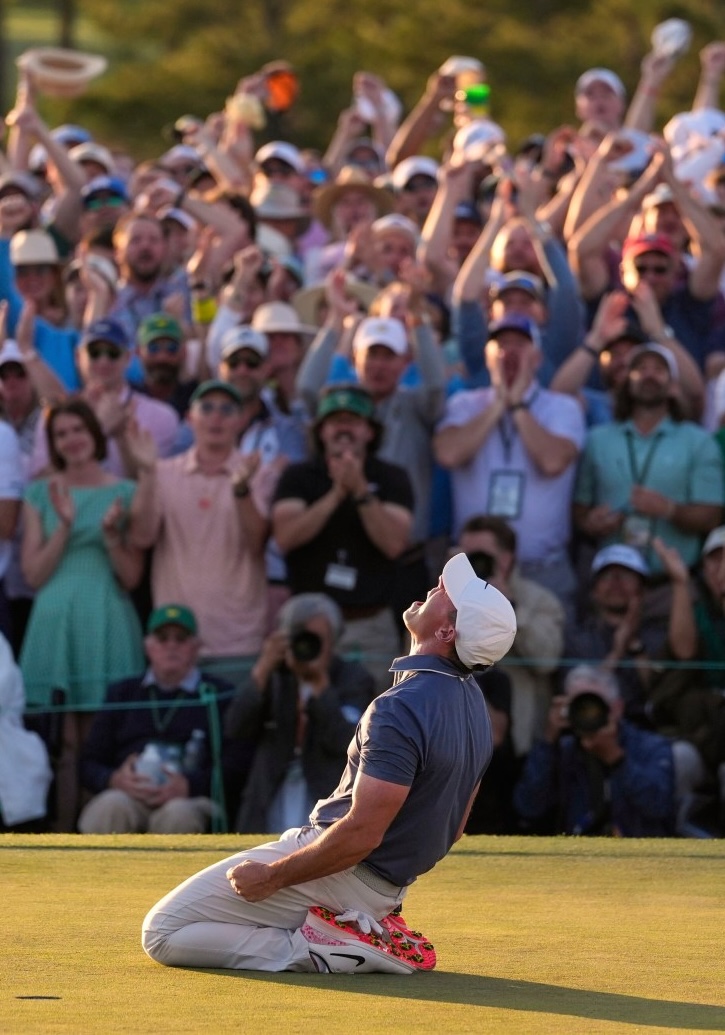
It is no secret that the Masters, held annually in Augusta, Georgia, had been uniquely scarring for him. In 2011 as a 21-year-old, he blew a four-shot lead. For the next fourteen years, he faced the same questions: “Are you finally going to win a Masters?” “Are you finally going to break your major drought?” “Are you finally going to complete the grand slam?” The Masters held a particular unyielding power over the cursed golfer. Last year though, Rory finally won, famously erupting with emotion when his final putt went in. He had finally conquered his demons and, in golfer’s terms, justified himself by heroically winning and thus completing the career grand slam (all four majors). We golf fans began to believe that he’d slain the dragon, that he’d been unlocked — only for him to finish unevenly in the majors that followed.
Rory returned to Augusta this year as the reigning champion, so it was perplexing to watch him as if the decade-long curse wasn’t lifted. After dominating the tournament up to its halfway point, he underperformed on Saturday and almost gave away the tournament on Sunday, leading fans to wonder if the power of a curse was such that not even his first green jacket (the trophy for Masters winners) could lift it. In the lead-up to the tournament, he even admitted as much:
[Blowing the lead in 2011] probably scarred me more than I even realized. I’ve tried to unpack a lot of it … but some of my subconscious movements around [Augusta National Golf Club] … there’s probably some of that still in there. … Maybe I haven’t put myself all the way out there in this tournament in certain points, because if you get close to doing it and then it gets taken away from you … that’s hard.”[1]
As the 2026 tournament progressed, the shadows of the curse emerged, and I marveled at the way he handled it. In his post-round interviews he commented multiple times, “I almost have to remind myself that I have a green jacket in the champion’s locker room.” He even told an ESPN SportsCenter anchor how he planned to unwind after an impressive opening round: “I’ll probably go to the Champion’s locker room right now and have a little drink, put my green jacket on, and then call it a day.” He was saying to the world but really to himself: The curse isn’t over until I believe it’s over, and I’m going to keep reminding myself that it is, even if it means wearing my green jacket all night long.
No matter what setting, there are any number of battles that we fight in our inner lives. These are battles that, even if they are “over,” require us to remind ourselves of that fact. Winston Churchill was perpetually afraid his depressions, or “black dogs,” would reemerge. Those who have experienced unemployment are afraid they’ll lose their job again. Children of divorce are afraid of divorce themselves, even if their marriage is wonderful. In theological terms, those who have been redeemed, loved, and freed by Jesus Christ are likewise prone to wonder in our darker moments if that’s really true.
St. Paul understood this dynamic. He understood that the fear of a returned curse often plagues us as much as the curse itself. We see this in his Epistle to the Romans where he writes, “Since we have been justified by faith, we have peace with God.” He understands that even when the curse has been conquered, we will continue to seek to justify ourselves in all sorts of ways. This may not involve the final holes of a Sunday major. Yet Paul reminds us that our justification by Christ is a passive activity — it’s done for us, not by us — and exists in the past, not the future. The curse that has plagued us is no more. We are unburdened from having to lift it ourselves; we are free!
While he wobbled on Saturday and Sunday to victory, Rory’s continual public insistence “I am justified” (with a green jacket) afforded him the confidence to steady himself and do just enough to win his second Masters. We who fear curses are given the same luxury: we can and should remind ourselves that we are justified — not by our own performance but by that of Christ — and thus our own doubts, curses, and shadows are stripped, in an ultimate sense, of their power. Even for just a fleeting moment that’s worth something; more than a green jacket, even.
I look forward to watching Rory at the PGA Championship this week, and I hope he soars. For as difficult as it is to watch someone who is bound by a curse, it is infinitely more heartening to watch someone who lives, moves, and has their being as one who has been set free.
[1]Rory McIlroy: The Masters Wait. Amazon Prime Video, 2026.