




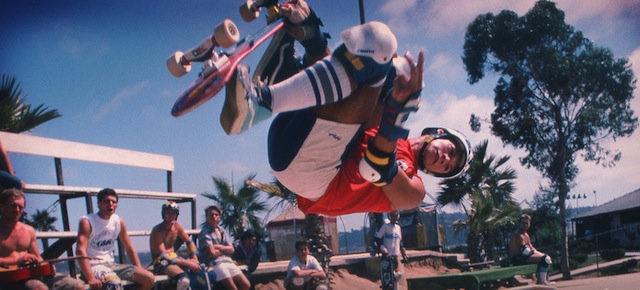
When I was in fifth grade, a category four hurricane swept the city where we were living. The storm was so strong that everyone had to be evacuated. When we returned home, the destruction was considerable, to say the least. No water for days, no power for a week, no school for a solid fortnight. Trees were down everywhere. Our neighborhood had been transformed from a neat little sub-division into a giant playground, a ten year-old boy’s dream. But what I remember most was the reconstruction. It went on for months and yielded a seemingly endless supply of scrap wood–which we knew exactly what to do with: build skateboard ramps. This was the tail end of the “skateboarding is not a crime” craze that swept the country in the mid-to-late 80s, and my brothers and I fancied ourselves the local keepers of the flame.
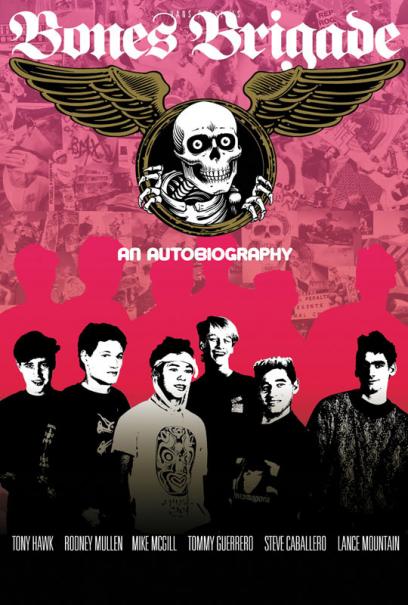 A big part of our obsession was fueled by The Bones Brigade, a pro skateboarding “team” sponsored by the Powell-Peralta company. We bought their signature boards, and we memorized their videos. As far as we were concerned these guys were superheroes. They even had superhero names: Lance Mountain, Tony Hawk, Steve Caballero, etc. The Bones Brigade were a worldwide phenomenon, and it was only a matter of time until someone put together a documentary about them, which is precisely what head honcho Stacy Peralta did last year (you can stream it on Netflix). Much to my delight, the film manages to do the boys and the period justice. And yet it’s more than just a cast of (extremely) colorful characters; there’s a surprising amount of emotional depth.
Two narratives stuck out as particularly–almost absurdly–relevant, that of freestyle mad-genius Rodney Mullen and that of aerial wizard Tony Hawk. It becomes clear that these two guys were in a different league than their peers, talent-wise. They absolutely dominated their respective disciplines. Think Pete Sampras at his peak. They were that far out in front of everyone else. In fact, they won so much that anything but placing first was viewed as a failure. For those unfamiliar with competitive skateboarding, it’s less like biking and more like dancing or diving, with its routines and judges and scores and scales. Consequently, over the entire sport hangs the possibility/spectre of perfection. 10 out of 10 and all that.
But then a funny (though not-funny-at-the-time) thing happened. At the height of their powers, both Tony and Rodney had nervous breakdowns. I’m not kidding. I’ve transcribed their comments, ht JP:
Tony: “I was winning most of the events. I was winning all the overall series titles. But I didn’t like what it was doing to me. It was crushing mentally. Because I wasn’t enjoying it. I would win. “Yeah, I won. That’s what you expected of me. I did it. There you go.” And on the flipside of that, if I didn’t win, if I got second place, “Aw, you suck now, you didn’t win.” It was too much for me at the time. It was really draining, and I wasn’t enjoying skating as much because of it.
Stacy Peralta [Tony’s “coach”]: I think [Tony] was 16 or 17 years old and I got a call from Tony’s older brother, Steve. “Something’s wrong with Tony and I need to come talk to you. Something’s not right” Tony’s not a very emotional kid. This was the first time I’d seen him emotional. The kid had completely collapsed. He refused to speak and only spoke through his brother, who said ‘Tony’s really disturbed and upset and he doesn’t want to compete anymore…’
Rodney Mullen: “[Tony Hawk] won everything, or close to it. That creates so much more pressure because there’s no gratification in winning, there’s only upholding something so you don’t lose it. And it is staggering. It usurps the joy of it. It’s like a Kafka short story: you build something but you can’t live in the house because you sit around guarding it.”
[youtube https://www.youtube.com/watch?v=EE8aAl-81Y8&w=540]
Rodney’s story is very similar but has two added elements: 1. The enormous pressure from his father to hang up his skateboard, and 2. An artistic sensibility that borders on savant-like. In fact, when the other skaters talk about Rodney, their eyes glaze over, and it sounds like they’re talking about a great artist. Someone whose gifts and creativity seem to be coming from somewhere else. For these reasons perhaps, his struggles take on an added weight as he drops phrase after vivid phrase to describe the corrupting power of expectation when it comes to love and creativity (all the while maintaining a sense of awe and gratitude for the gift he so clearly couldn’t and can’t account for):
“‘So you know, this’ll be your last competition’ [my dad told me]. Things had been getting bad around the home, real bad. My sister had been anorexic and I had started to go down a path that way. He just said, ‘That’s it. I’m doing this to save you. I think the skateboarding is making you crazy.’… I withered in a way he could not control. I was spinning. The teachers and the counselors kept asking me, “What’s wrong? Is something wrong at home? Eat!”
My dad is not some evil man. He was trying to do the best he could with what he had. But those are those formative years, those teenage years, when things start to hurt in a different way.
When I found skateboarding, it was the first thing I loved. And it being pulled away from me, hardened something inside of me. Where nothing mattered. Months afterward, [my father] came to me. I was in the garage. And he said, “you know, I think this has been hard on you. You can skate, because I think you need that. But I think what’s wrong with you has to do with the pressure of contests–so you can’t compete. Contests gave me the ability to continue to do what defined me. But what they came to represent was — don’t fail.”
[youtube https://www.youtube.com/watch?v=9hM_SyizEFs&w=540]
Fortunately, the collapse wasn’t the end of the story for either Rodney or Tony. Tony summed up the resurrection that both men/boys experienced in the following statement. The content may sound slightly cliche, but to hear them tell it, these guys had come by their freedom honestly, aka the Hard way. Beautiful:
“During my brief competition hiatus when I was trying to figure out what I wanted to do, I missed it immensely. I did get have to a couple of pretty heavy conversations with Rodney about it. He had come back to competition already and I said, ‘How did you do it?’ He said, ‘I just came back with a different approach, that I didn’t care as much about the results. I enjoy it. I enjoy the skating. If I don’t win, I don’t win.’ I stopped worrying that I needed that perfect competition record to thrive, and I didn’t. I started placing first a lot, but sometimes I placed fifth. It actually became way more fun after that.”
[youtube https://www.youtube.com/watch?v=XIIaJRlr6-Q&w=600]
[youtube https://www.youtube.com/watch?v=KTc1f8u38uw&w=600]








Oh boy, this was my LIFE from grades 4-8 . We were total posers, and yet I have such wonderful memories skating with friends every free moment of our time.
Those Bones Brigade videos were a big part of it. “The Search for Animal Chin” absolutely blew our minds – especially the gigantic vert-ramp nirvana they “discovered” at the end.
DZ, thanks for showing us the gospel here – Mbird at its best!
Very cool article and reflection on these guys! Also brought back memories of my “skater days” when I absolutely worshiped Tony Hawk, Mullen, Matt Hensley, Natas Kaupas to name a few more. “ Shackle me not” H-street crew was epic at the time! I remember rivalries between them (Danny Way) and Tony Hawk. Fascinating to see the depth of emotions from these guys and the desire to escape the pressure of perfection in light of the gosple. Thanks DZ.
For those who are interested, be sure to check out the post JZ did a few years ago on the documentary about Tony Hawk’s rival Christian Hosoi. About as cool a conversion story as could be:
https://mbird.mystagingwebsite.com/2010/08/rising-son-christian-hosoi-thrashing/
Skating defined my junior high / high school experience (these skaters / videos were a huge part of it too). Thanks Dave for posting this!
Sorry for being so late to the party. What I found so great about this post was that I was not a skater. Nor did I want to be. In fact, I lived about as far from the world of skating as you could get, except for the Back to the Future board my best friend and I would ride in her driveway while we were waiting to go to our horseback riding lessons. Nonetheless, in my own ways, I came under the same crushing weight that was described here, the pressure that is created when “there’s no gratification in winning, there’s only upholding something so you don’t lose it.” And, I agree, it is staggering. It does usurp the joy out of it. I was no Tony Hawk, that’s for sure, but the fact that his struggle with the burden of “success” so closely mirrors my own even though they were so so different, comforts me. It tells me that maybe I’m not alone in this wicked fight… Thanks for another great post, David.
I’ll let you all in on my guilty pleasure: I still skateboard. The secret to longevity, though, is that I switched to longboarding and I skate alone. There’s nothing more peaceful to me than carving down a long hill with no other goal in mind than my own relaxation and enjoyment. It’s brilliant.
Best. Mbird. Post. Ever.