





Train Dreams and Hamnet are two films that will stick with me for a long time. Each story is distinct, and yet they felt similar to me. The pace of the plot, the visual style, the dialogue — all struck me as slow.
I have always been drawn to stories with a less-is-more approach, which express or invite a spirit of curiosity, restraint, and patience. Such stories typically leave me with a deeper sense of wonder for my actual life.
In a recent conversation with a friend about Train Dreams, they noted, a bit annoyed, “I mean … for most of the movie, nothing really happens.”
To which I responded, “Exactly.” Most of our days, much of our lives, not much happens. It is a good thing when artists remind us that not only are the simple textures of our days “okay” or significant, they are also beautiful. Like my daughter Annie did with the Praying Mantis.
Train Dreams and Hamnet are also movies about grief. If you watch, bring tissues. At the core of both films is loss. And every January, loss is something I feel more deeply. On January 13th, 2019, my older brother Josh died. The deepest aches of my heart often trace back to losing my brother seven years ago. Both movies were timely, welcomed gifts, compelling me to see the beauty that is my life and, especially timely, the gift of feeling understood.
Grief is a complicated thing to portray. Like Hamnet and Train Dreams, I am most interested in art that avoids Hallmark Sentimentalism on the one hand and Hopeless Cynicism on the other.
Which brings me back to pace. In my own experience with grief and in my own work as a pastor, I believe that hurry is an impediment to healing. There are many ways we avoid sitting in the discomfort of our pain, owning our grief, but here are common strategies I notice: busyness, which says, “I don’t have time to slow down and be sad”; sentimentalism, with well-meaning, sincere, and oftentimes true statements, which says, “It all happens for a reason … It’ll all work out”; and cynicism, unable or unwilling to imagine a future, which says, “There’s no point in moving forward.” Each strategy refuses to sit still in the heartache.
Being still, going slow are things I’ve always admired about the late pastor and writer Eugene Peterson, a mutual hero of my brother and me. In 2015, Josh and I took a trip to Montana to visit Eugene Peterson. I’ll never forget our time with Eugene, his wife Jan, and the way they welcomed us into their home on Flathead Lake. One thing is true about Eugene, and it is that he was not in a hurry. Resisting hurry, alert to the beauty of the world, attentive to God’s activity within the terrain of one’s life were not only persistent themes of Eugene’s writing, they were also virtues he embodied. We experienced it firsthand. In our long conversations that day, Eugene’s comfort with silence was both alluring and unnerving. He never filled silence with chatter or conversational angst. His listening, his silence, the generosity and curiosity of his words and body language — my brother and I were being cared for, pastored. He took us seriously. I told Josh on the drive back to our bed and breakfast, “I’ve never been around anyone more comfortable in their own skin …”
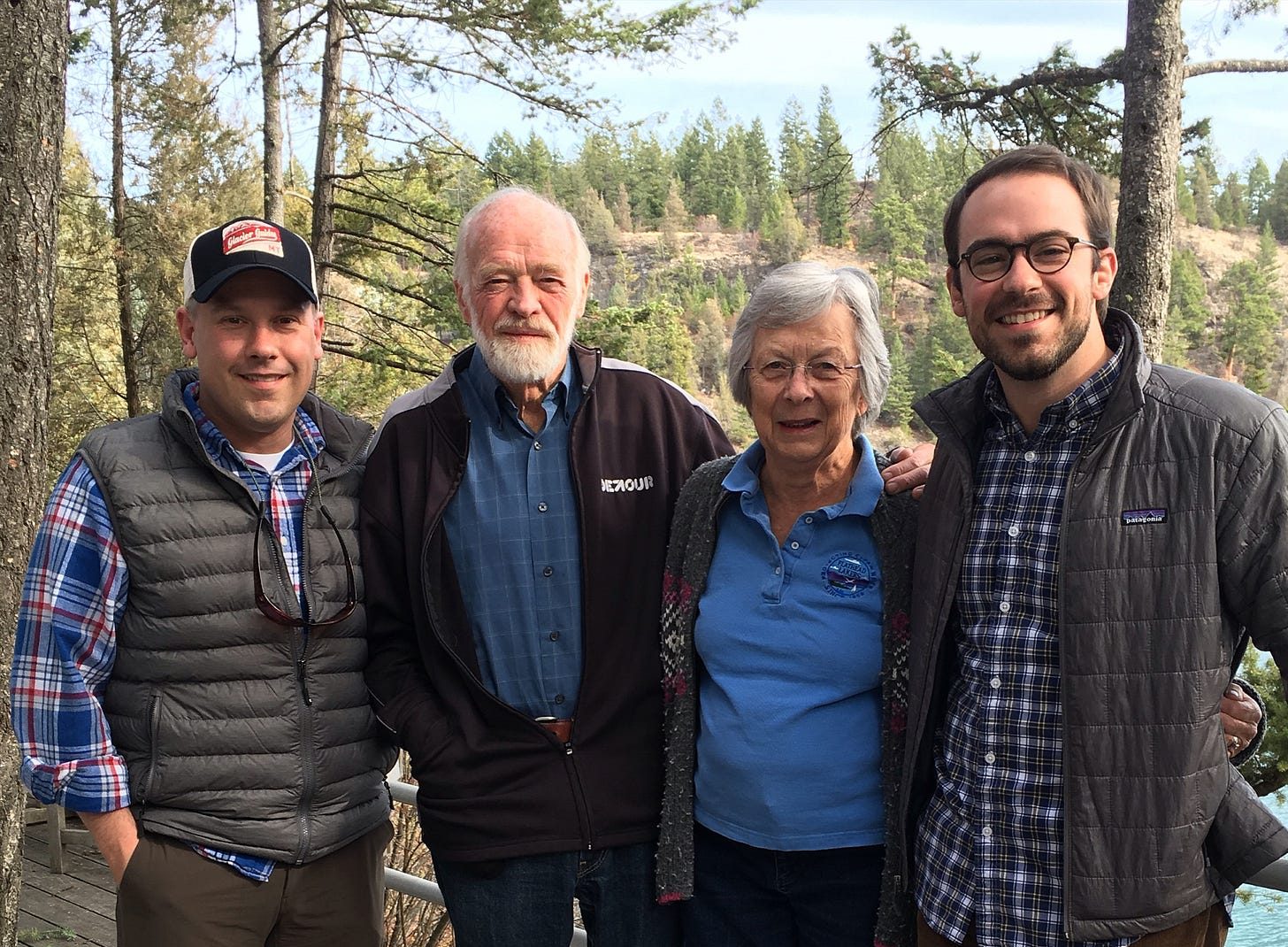
Josh, Eugene, Jan, and me at the Peterson Home, Fall 2015
Going slow enables one to carry grief and cultivate joy. To faithfully steward the crockpot that is your life, your childhood, your future. Allowing yourself to sit in your sadness, feel your anger, and express it to God like a Psalmist, over time, deepens trust and intimacy with the Father who holds your broken heart (see Psalm 13, a go-to lament Psalm, as a guide here). Going slow enough to allow a song, your child’s laugh, or your spouse’s smile to take your breath away will deepen trust and intimacy with the Father who delights to give you good gifts. In a moment in time that praises efficiency, speed, and upward mobility, slowing down is paradoxical wisdom that often feels like death.
And thankfully, God can and will heal us even if we’re in a hurry, but really, blessed are you when you have the courage to go slow.
In Train Dreams there’s an exchange between the main character, Robert, and one of his work companions, Arn. Arn looks up, gazing at sunlight piercing through the trees in the woods…
Arn: “Beautiful, ain’t it? Just beautiful.”
Robert: “What is, Arn?”
Arn: “All of it. Every bit of it.”








Thank you for this. I very much aspire to a life that is paced well, unhurried, and attuned to the rhythm of the natural world rather than the artificial bullet train we’ve created. I do wonder, though, if slowness is, these days, a privilege mostly reserved for those who are economically comfortable enough that they don’t have to hustle for their daily bread. How do people on the economic margins cultivate this? Is it possible at all? It’s one thing to live an unhurried life when you’ve retired to a beautiful house on serene Flathead Lake, but what if you’re stuck in a loud apartment building on the West Side of Chicago, or a run-down duplex in Amarillo, or a dusty trailer on the fringes of Spokane?
Well said. I can’t imagine the financial pressure that an individual let alone families have now a days. I wonder if we have thicker & deeper relationships with a variety of people in economic strata’s we can hold each other despite the comic differences. I know of extended families in the UK that deeply support each other. What happens to those whose family breakdown and fragments even with close physical proximity, I imagine the pain deepens as the walls go higher prevent reconciliation. Pierre, do you know any context where people share life together despite the economic differences. Thanks for your post.
I lost my older brother in 2021; he was 37. Every year I reach/surpass his age there’s a same and a different kind of grief.
Reading the Ruthless Elimination of Hurry recently—many themes overlap with your article here. Comer’s foundational statement, Hurry is incompatible with Love, is compelling and so convicting. I am curious to feel the connection in what you write, tying hurry and grief together. I see how Hurry “protects” me from pain by passing over it quickly. But it prevents me from being present in the pain to see Jesus there, weeping beside me, with a with-ness that transforms my pain. I want to make more space for my grief to see Jesus more.
Beautifully said Luke. I recently read a book by Jerry Sittser called; “A Grace Disguised: How the Soul Grows Through Loss”. The story of what Jerry walks through is compelling, penetrating, and refreshingly honest. It helped me to process grief, loss and lament deeply, and helped me to experience the closeness of God’s presence in silence like never before.
It’s very much an honest retelling of the story of Job. People used to say to me during difficult times things like, “see even Job’s fortunes were restored”. Well meaning but trite. It occurred to me that Job most likely never stopped carrying the grief of the children he lost, even though his circumstances improved.
If you get the book, I hope it ministers to you as much as it has me. God bless…