




It’s strange how the mind works. When I was a child I used to sleep with my door cracked open and the hall light on, so I could see a narrow swatch of wood-paneled wall. I stared at that wood paneling — so popular in the 70s and 80s — every night until my mind could make out shapes and patterns in the faux grains. I could have sworn there was the face of a monkey peering out at me through branches of jungle grass. The nightly ritual must have brought some sense of familiarity and comfort. I can still picture it today.
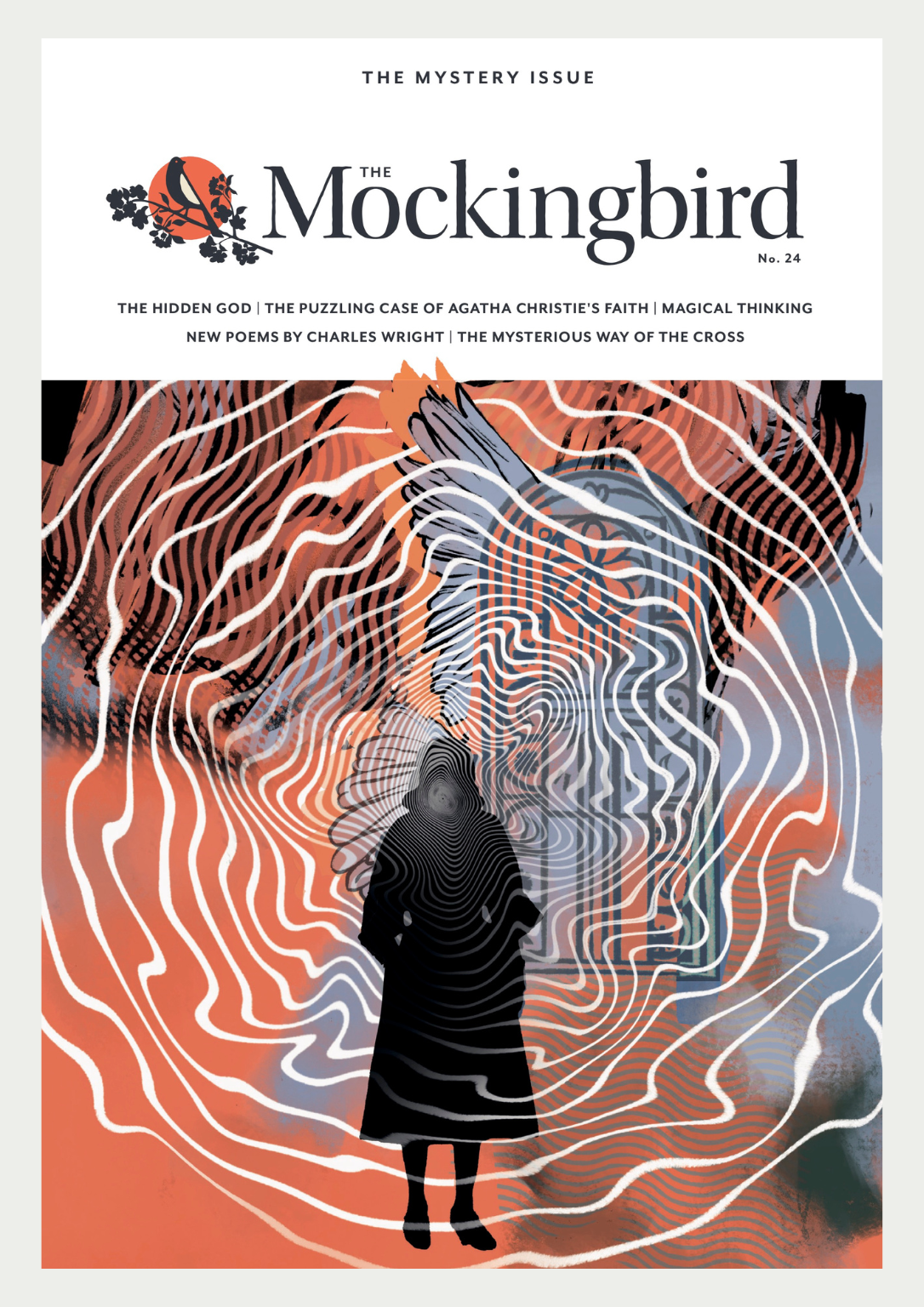
Neuroscience tells us that the neocortex — which makes up the majority of the volume and weight of the human brain — is responsible for our ability to seek out patterns in our landscapes and experiences. Humans are uniquely gifted at finding meaning, whether that be weather patterns, strands of computer code, irregularities in blood samples, or monkeys in grains of wood. This powerful neocortex provides tremendous advantages to the human race, but it does have some drawbacks, especially in times where meaning is elusive — especially, as I found, in times of grief.
Early last year I moved my family from the West Coast back to the Midwest to be near my wife’s family. The move wasn’t one that I had planned, although an astute observer may have seen it coming. My wife’s mental health had deteriorated in recent years, especially as a global pandemic further isolated us as a family with young children. She had always struggled with depression, but this time was different. Her mental state took on a wild, chaotic pattern that psychologists call hypomania. At the height of her mania, she suffered a psychotic break. She spent a week in what locals called Fifth East — the psychiatric wing of the hospital. She was diagnosed with bipolar disorder and sent home.
The professionals assured us that her illness was treatable and even common. Still, we did all we could imagine to ensure her recovery. I resigned from my job and made plans to move to her hometown to be near family support. We found good medical care and followed through on all the treatments. As we started to settle into our new home, we saw positive changes. My mind — so highly vigilant now and attuned for signs of psychosis — observed the patterns shifting. It appeared that the medication was working. Her affect, which had been so flat during the winter months with the new drugs, started to brighten in the spring. We even took a trip to the Virgin Islands to rest from the tumultuous season we’d been through.
In May we attended our oldest child’s kindergarten graduation together. We had driven in separate cars due to the traffic caused by a PGA golf tournament that was in town. We parted ways in the elementary school parking lot with the vague awareness that we would meet back at home. I stopped by a coffee shop and ran into a friend I hadn’t seen in a while. We talked about future plans. Shortly after I pulled into my driveway at home, I found my wife unresponsive — an apparent suicide. I frantically called an ambulance and performed CPR from the dispatcher’s cues. Before they loaded her into the ambulance I heard someone say they’d found a heartbeat. My mind grasped at the faintest ray of hope. Two days later, she was undeniably and irrevocably gone. I was emotionally and mentally undone.
In times of tragedy and loss, especially in the wake of death, we often raise our fists at heaven and ask “Why?” We look for meaning and even purpose in our suffering, hoping that some pattern might emerge that will protect ourselves or those we love from future harm.
The moment I found my wife, my neocortex went into overdrive. Like a hyperactive detective, I turned over every stone for clues, for evidence for why the woman I loved and knew so well — the mother who loved her children deeply — had felt it necessary to take her own life. Yet my fists were not raised to heaven, and my asking was not directed to God. I’d had enough training in theology and psychology to know that the answers I was seeking wouldn’t — possibly couldn’t — be found there, or wouldn’t help anyway. My mind, shaken and shocked by grief, wasn’t looking for a divine or existential answer but a human one: What did I do to cause this?
Every waking moment my mind raced through the evidence and the various scenarios of what might have been. At times, my mind went to the practical. Like Zack Braff’s character in Garden State who wondered how his life would have been different if not for the quarter inch piece of plastic that caused his mother’s paralysis, I turned the minute details of the day over and over again. If I hadn’t stopped for coffee would she still be here? If the PGA tournament hadn’t fallen on this day, we would have ridden together and everything would have been different. Or maybe it would have happened another day? Was the medication to blame? Maybe the whole thing was an accident? Did she really mean to die?
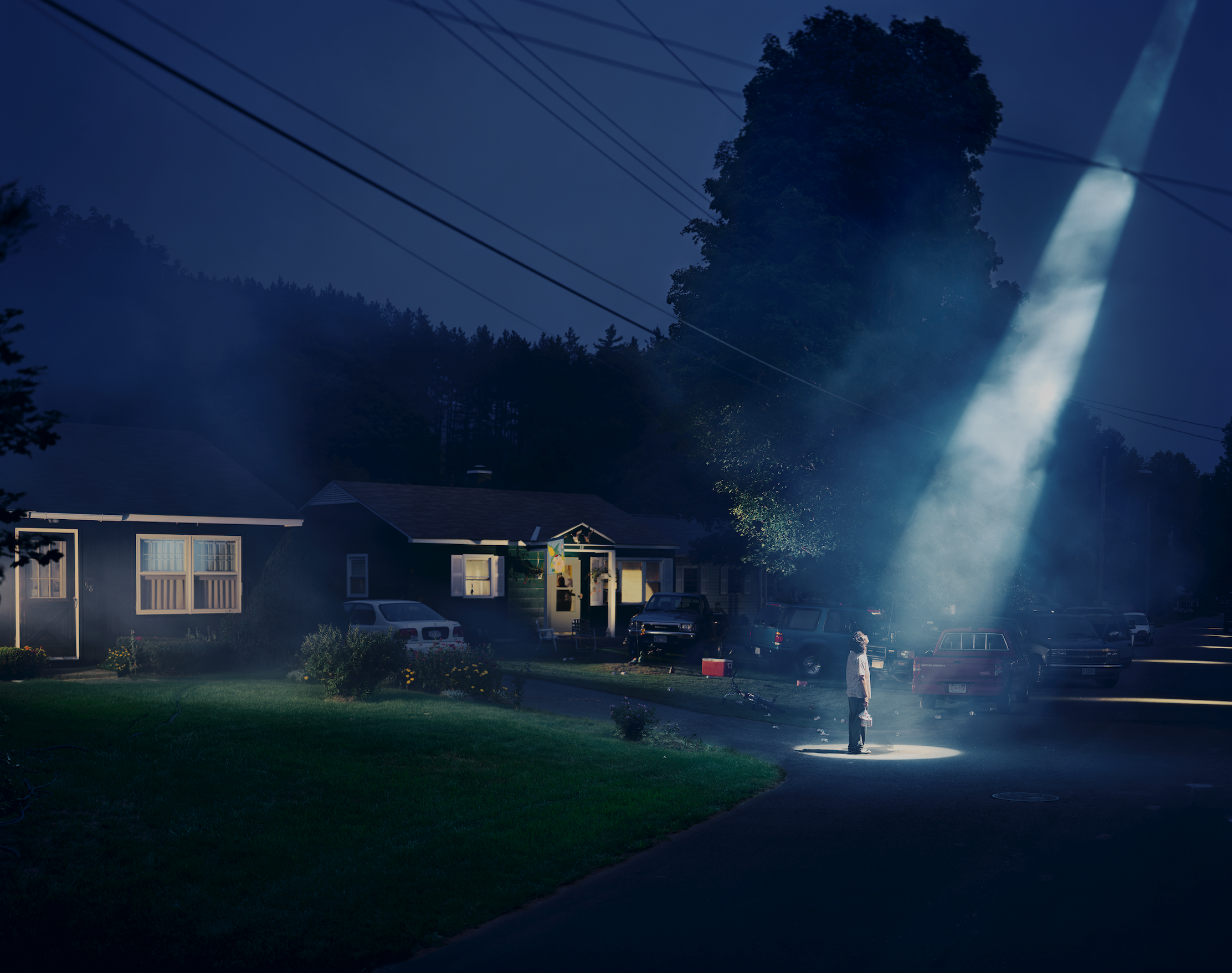
Gregory Crewdson, Untitled, 1998-2002. Digital chromogenic print, image: 48 × 60 in. © Gregory Crewdson.
Mostly though, my mind went to darker places. Was it the fight we had over the weekend? Had she felt my disappointment? Had I been a toxic husband who wore her down year after year? I should have been more encouraging. I should have loved her better, hidden the burden I carried as her caretaker during the darkest months. How did I miss this? I’m trained to see the signs. Did I miss some clue in her eyes or voice? Could I have been more vigilant?
I felt like a giant scale had been erected in my mind to weigh my actions and intent. Every good deed and kind word was on one side, and every harsh word or critical demeanor was on the other. I combed through years looking for evidence and counter evidence for each verdict. At times even more fanciful delusions came to mind. Maybe I’m living in a tragedy and everything I did to avoid this pain created it. Maybe that’s what the monkey was trying to tell me all those years ago — you can’t outrun your fate.
Death is so ubiquitous, and so avoided, that we can sometimes forget how out of control we really are. We never know when he will come for us or the ones we love. Suicide may increase our desire for answers, but searching and blaming is not unique to that manner of death. Neuroscientists tell us that the grieving mind is actively looking for the one who has died, and is reprograming the parts of our brains that have come to expect that person in our lives: in the bed beside us at night, at the kitchen sink in the morning, on the other side of the door when we get home. Perhaps the neocortex and its ability to find patterns can prevent the risk of death, but not death itself. In the wake of death, it has even less to offer. But it tries nonetheless.
My brain’s ability to recognize patterns — once so helpful or benign — now became my torturer. It exhausted me and wouldn’t let me rest. Who could tell my neocortex what my heart already knew? Death is an enemy and a thief; it was the disease that took my wife, not me; this is not the way it’s supposed to be; there are no answers; it just hurts.
C.S. Lewis, in the grief of losing his wife, related it to fear or drunkenness:
No one ever told me that grief felt so like fear. I am not afraid, but the sensation is like being afraid. The same fluttering in the stomach, the same restlessness, the yawning. I keep on swallowing. At other times it feels like being mildly drunk, or concussed. There is a sort of invisible blanket between the world and me.
Perhaps Lewis, too, was experiencing a failure of the neocortex. The neocortex does not know what to do with death, loss, and tragedy. It does not know what to do with those mental knots it can’t untie.
Time, they say, heals all wounds. We of course know this to be false. It is not time but thoroughly processing the grief that provides anything that approximates healing. Yet time does play a role. Over time — and with lots of opportunities to share our tragedies with trusted listeners — our brains stop trying to figure it out. It’s as if we stop trying to untie the knot in our shoelace and learn to live with it. Perhaps that’s when the real work of grief begins. Perhaps when we stop trying to understand the tragedy of death, we can mourn the loss of the one we love.
My grief came most profoundly in moments alone, which were rare for me as a single father of three young, needy, and grieving children. On a Saturday morning in my empty house, sitting by the fireplace, I read Joan Didion’s account on suddenly losing her husband, The Year of Magical Thinking. In her story I saw my own.
Grief turns out to be a place none of us know until we reach it. We anticipate (we know) that someone close to us could die, but we do not look beyond the few days or weeks that immediately follow such an imagined death. … We might expect if the death is sudden to feel shock. We do not expect the shock to be obliterative, dislocating to both body and mind. We might expect that we will be prostrate, inconsolable, crazy with loss. We do not expect to be literally crazy, cool customers who believe that their husband is about to return and need his shoes. … Nor can we know ahead of the fact (and here lies the heart of the difference between grief as we imagine it and grief as it is) the unending absence that follows, the void, the very opposite of meaning, the relentless succession of moments during which we will confront the experience of meaninglessness itself.
Didion’s magical thinking was believing that if she could pore through the autopsy report and understand why her husband’s heart had stopped beating, then she could somehow bring him back; she could reverse the course of death and he would be standing there in her apartment, barefoot and in need of the shoes she’d kept in the closet. She was looking for meaning and control — for magic even — but her grief came most acutely when she realized her lack of control and the meaninglessness of death.
That’s when it hit me. All my searching for meaning, all the weighing of my own responsibility, all the hunting for clues were the ways I was trying to bring my wife back too. It was all magical thinking. I felt my body and mind let go like a long sigh that let in the counterintuitive oxygen of grief.
The human mind is more comfortable with magic than with mystery. Magic offers meaning where none can be found. Magic offers a sense of control, if only we manipulate the right variables. Perhaps my brain had spent so much time trying to unravel the knot because somewhere in my subconscious mind I believed that if I could figure it out, I could fix it. I could undo the fatal flaw in my character, un-say the things that I had said, un-make the bed that I had to lie in. But I couldn’t. That was magical thinking. None of it, not even falling on the sword myself, could answer why she was gone, and none of it could bring her back. And that’s what I really wanted. That’s what we all want. To bring the dead back to life. Dead mothers back to their children, dead wives back to their husbands, dead dreams back to their dreamers.
When I take away the magical thinking — the idea that if I blame myself then I can bring my wife back — then I’m left with the horror and mystery of death. I’m left with the painful reality that when it comes to life and death, I am utterly out of control.
Bedside at the hospital, when the life support machines were not yet unplugged, I put my hand on my wife’s head and imagined the great chasm ahead. If she had not already, she would soon drift from this world into the unknown. I felt a terror like nothing I’d ever experienced. Would she wash up on the banks of Jordan? Would she fall into the arms of her Savior? Yes, I believe so. But we don’t know. We simply don’t know. And not knowing can be a terrifying thought.
Death is a mystery that can’t be solved. Some deaths may have mini-resurrections in this life, but like Lazarus, they will die again. The magic we ultimately need is a resurrection that lasts forever. One that undoes all the bad things, un-kills the dead, un-ties the knot and braids it into something beautiful. But that magic comes not by sight but by faith.
Faith, too, is a mystery. Some have asked me if I considered losing my faith. I think what they’re really asking is, “What good is faith in God if it can’t keep your worst nightmare from happening?” It’s a difficult question, but my answer is something like, “No, I can’t do that. Not now.”
In a way, faith in the midst of tragic suffering is a bind. It’s in the midst of your worst suffering that you need it most. On my darkest days, Christ alone offered what my soul most deeply desired — resurrection. Flesh and blood resurrection. Resurrection of the body and the life everlasting. If I ever want to see my wife again, if I ever want to see her wrap her arms around her beautiful children, I’ve got to go through Jesus. He alone promises to bring her back in the same way God raised his own body from the dead. To give up the faith is to lose the hope of ever seeing my wife again.
That’s the bind. And the only guarantee I have is the mystery of faith itself: Christ has died; Christ is risen; Christ will come again. In some mysterious way, that is enough for me.
Faith is no magical thinking. It does not — or at least it does not often — bring the dead back to life. Faith is a mystery. If we have that mystery, we have something better than magic. In spite of all my losses, I still have faith that Christ will someday rend the heavens, peel back the clouds, resurrect the dead, and un-break the world. And that faith is something I know for sure I didn’t do for myself. That faith is a gift, and I’ll never get my mind around it.








Wow. I am so blown away by your story and, at the same time, relieved to know that others are weary of the phrase “Time heals all wounds.” If we weren’t already defeated by life’s sorrows, we have to live with the guilt of wondering why this claim doesn’t seem to work. I am astounded by your honest revelations and the pain of your journey. I did my DMin work on death and caregiving, seasons when there are so few words, and such a loss for what to say. The resuscitations in the Bible do not always help to encourage; only the hope of a true restoration, resurrection, and the deep healing of our hearts makes a difference. Thank you.
Thank you. This was beautiful.
I am terribly sorry for your loss, and yes, the hope of the resurrection is all we can cling to. Thank You God for Jesus 🙏🏽.
The discussion on magical thinking here and acceptance is really meaningful, and it was helpful to see someone else also going through this. Thank you.