




If you find yourself asking the question, “Does God have a plan for my life?” I bet you’re not doing very well. And in that moment, if things aren’t going very well, if someone asks, “Have you read Jeremiah 29:11?” you might just say, with a smile on your face, “You can save that for someone else.”
At quarter life, you’ve been around long enough to know that surface-level bumper-sticker Bible verses don’t quite cut it when you’re stuck. And they’re no cure for a low mood and exhausted attempts to get out of a stuck spot. Because you’ve seen enough bumper stickers, anyway.
I mean, we’ve all seen Forrest Gump (1994) and know that “STUFF” HAPPENS (you’re the one asking if God has a plan for your life, remember?). We all know that JESUS SAVES. All humanity knows that we need to COEXIST, but that’s become increasingly difficult the more someone throws Jeremiah 29:11 in your face. Because when you’re stuck and you start asking questions like, “Does God have a plan for my life?”, I bet you’ve had it up to here with good and well-meaning advice. Because, well, I bet it’s proven to be mostly ineffective.
What’s hard about being stuck in a juncture in your 20s and 30s is that life doesn’t prepare you much for it. It’s not like there’s a reserve of existential crises to draw on from you when you were eight. And there aren’t many twelve-year-olds going through this type of quandary, either. I mean, think about you at twelve. Did you ask many of the big life questions that you’re asking now? Of course not. And I don’t want to be disparaging of the myriad of childhood complexities that many in 21st-century life face; all very real, all very well-documented, all very fear-inducing for those with young children. But that’s not what I’m talking about now.
What I mean is this: when we were twelve, thirteen, and fourteen — and our entire life before that — life had a way of just keeping us on the tracks and moving forward. Eighth grade turned into ninth, and ninth grade turned into tenth. Football season turned into basketball which turned into baseball, ultimately giving way to summer workouts to prepare you for all three again. (There is a female or non-semi-cocky-jock equivalent to this, I’m certain, but my long-distant teenage self can’t speak to it).
And I’m speaking in sweeping terms because the reality is that at this point, I actually can’t remember that far back. Or at least the specifics. Certain memories come up like short whispers of movie scenes from a life long ago. I had Mrs. Cardwell for AP English. I had a fun lunch table my senior year. I remember running sprints in the dog days of summer on the football practice field, my cotton school-issued shirt soaked through. I pitched really well away against Tuscaloosa County High School. I had a good group of friends. I read Sports Illustrated every night before going to bed. There’s a version of these scenes for you, too.
In this modality of life, in what might seem long ago for some of us, before you knew it, you were singing your high school alma mater for the last time. You might have gone to Mexico with a group, and some of the cool parents or someone’s way-older-brother might have chaperoned. Just a few weeks later, college parties in mysterious basements were fresh on the scene. You might have done some things that you didn’t tell Mom when she asked you how college was going. “Oh yeah, I really like my English 101 professor. No, I haven’t met the girl from Savannah yet. No, I haven’t been to church yet, but my roommate and I are going next Sunday.”
For those four years, maybe it was the high point of life up to that point. Maybe it was a mixed bag. Maybe it was the first time real pain came into the picture, raw with rejection and loss. But you were still on the tracks. One semester led into the next until one day, the dean of your college handed out diplomas on a stage, again, with your whole life ahead.
By that time, when I was 22 years old and someone asked me what I wanted to do with my life, I wanted, in turn, to punch them in the nose. “To hell if I know,” was the honest answer, though, of course, I didn’t say that.
I liked, too much, the tracks life had given me. I feared at a subconscious (but trending towards conscious) level leaving this life of mostly success-laden predictability behind. Do well in school, find a group of friends, be the master of my fate, for the most part. But even amid that fear, I was aware enough to know that I did want my future — wherever and whatever that was — to be good, fulfilling, stable, enough.
With a business degree from a decent liberal arts college and a host of solid summer internships to beef up my resume, the world, I was told, was my oyster. But I didn’t want that oyster — in whatever the “business world” was. And somewhere deep down, even then, there was a desire to explore something different than the track I was paving for myself.
But I got a job working in the commercial insurance industry; I didn’t enjoy it. Then the few times someone asked me what I really wanted to do, knowing I didn’t like what I was doing in my work, the answer was still, “I have no idea, and don’t ask me. We’ve been over this.”
In that time, what I came to know, and what many of us have come to realize at some point, is that by the time you get off the exit ramp of your academic life, whenever that exit is for you, you suddenly realize there isn’t a user manual for life beyond the university level. Or at least a published one, like the school curriculum that gave life a track from the age of five to perhaps twenty-five.
That said, and generally speaking, by the time one finds oneself in their mid- to late-twenties, there is a vague sense that there are some boxes that need checking. Checked for whom, you ask? It’s hard to say. But we feel those boxes, and they typically come in the form of questions with silent comments that, while being silent, are there:
❒ Box #1: “How’s your career going?”
It’s why you or your parents spent so much money on your education. It better be going well.
❒ Box #2: “Do you have a girlfriend?” “Do you have a boyfriend?”
There’s only so much time before this first round of musical chairs ends.
(Speaking for myself, at twenty-four I’d barely had a girlfriend in my life. Taylor Hemphill, if you’re reading this, our few moments in the sun at Hewitt-Trussville Middle School hardly count, I’m sorry).
❒ Box #3: Where are you living these days?
Have you bought a house? Are you at least saving? Better start building equity before this market gets any crazier.
To the person reading this, how’s it going with these boxes? And if you’ve actually managed to go for the trifecta — the hat trick — does life feel complete? If so, I extend the invitation for you to write the rest of this essay.
We start asking questions like, “Does God have a plan for my life?” when at some point we find we’re not checking these boxes, either for the curriculum life seems to expect or even for ourselves, because, after all, it’s not wrong to want these things. But if you have a pulse, it’s been my experience that when these boxes aren’t being checked — or any one of the three — one begins to feel stuck.
Has anyone been there? What did that time feel like? What does it feel like now?
Nick Hornby captures the moment in High Fidelity (1995), speaking through his semi-autobiographical protagonist, Rob Fleming, after being dumped by his long-term girlfriend. Fleming does the good work of adding loneliness to the mix (a fourth box I’ll introduce now marked in all caps – ❒ AVOID). Hornby via Fleming post-breakup says:
I’m here, in this stupid little flat, on my own, and I’m thirty-five years old, and I own a tiny failing business, and my friends do not seem to be friends at all but people whose phone number I haven’t lost. And if I went back to sleep and slept for forty years and woke up without any teeth to the sound of Melody Radio in an old people’s home, I wouldn’t worry that much, because the worst of life, i.e. the rest of it, would be over. And I wouldn’t even have to kill myself.
It’s only just beginning to occur to me that it’s important to have something going on somewhere, at work or at home, otherwise you’re just clinging on. If I lived in Bosnia, then not having a girlfriend wouldn’t seem like the most important thing in the world, but here in Crouch End [North London], it does. You need as much ballast as possible to stop you floating away; you need people around you, things going on, otherwise life is like some film where the money ran out, and there are no sets, or locations, or supporting actors, and it’s just one bloke on his own staring into the camera with nothing to do and nobody to speak to, and who’d believe in this character then? I’ve got to get more stuff, more clutter, more detail in here, because at the moment I’m in danger of falling off the edge. (pp. 58–59)
Hornby’s sentiment presses into the ache of many in modern life. Can theology/God/Christianity offer anything to help?
If St. Peter came to church on Sunday (Peter, that is, at the age we meet in the Gospels), I bet he would go to a 20s and 30s class. I’m near certain he would, at least, be the right age for it.
He would walk in and get a coffee and a blueberry scone. Then he’d introduce himself, “Hi, I’m Simon. But my friends call me Peter.” One of his twelve friends — they’d all be here, too, you don’t get one without twelve — would say, “Because he Rocks.” (Can we expect anything different? It’s a group of twelve guys. This is the way twenty-something wolf packs talk. Even more so, they probably just got back from a golf trip because one of them said two months ago, “Dudes, twelve is the perfect number for a golf trip.” To which Nathaniel replied, laptop already open, “Where’re we going?”)
We first meet Simon Peter fishing with his brother Andrew on the Sea of Galilee. No doubt his profession was what his father did before him, and his father before him, and so on. This is just how things worked in that time, no one asking him, “What do you want to do with your life?” No noses to punch, no confusion to set in. By all accounts at this point, Peter had his three boxes checked:
❒ Box #1: He had a career. He was a fisherman. It’s unclear if he was just a 1099 employee or had a business. The gospel accounts don’t quite square with one another, but we won’t worry about that now.
❒ Box #2: Peter was married. This is alluded to only once in the Gospels, through the mention of his mother-in-law. (Paul would later mention his marital status in 1 Corinthians as well).
❒ Box #3: He might not have a mortgage, but one can assume that he had a home.
To summarize, Peter was a married, small business-owning, close-with-his-grown-brother citizen. He would do well in 21st-century life.
Even still, what is clear enough is that when he met Jesus of Nazareth, the allure of life with him was enough for him to change course. After his first encounter with Jesus, if he didn’t already know the answer or ask the question, Peter would know the answer to, “Does God have a plan for my life?” Because Jesus told it to him. It took just two short sentences:
- “Follow me.” (Easy enough)
- (Okay…What’s the job description? At least the one on LinkedIn)?
“I will make you a fisher of men.”
If Peter was ever looking for “something different than the tracks he was paving for himself,” it’s clear enough that in one person, he found it, and he followed him. For the next three years, this was Peter’s life. No asking, “Does God have a plan for me?” No noses to punch, no confusion to set in. And seemingly by being around the long-awaited Messiah — who was doing indisputable, tremendous work as the embodiment of God on earth; who healed people, fed people, gave sight to the blind, and made the lame walk — Peter wouldn’t have doubted God’s plan for his life. You don’t have to take my word for it. Here is his resume:
________________________
RESUME: SIMON PETER
Experience:
- Jesus Christ chief of staff.
- Missions experience (see Mt 10:1–15, Mk 6:7-13, Lk 9:1–6)
- Authorized witness of miracles.
- Ability to walk on water in the presence of Jesus (see Mt 14:22–33).
- Witness and host of Transfiguration account. Liaison between Elijah, Moses and Jesus of Nazareth (see Mt 17:1–8; Mk 9:2–8; Lk 9:28–36).
- Confessor of Christ as Lord.
- Possibly the Rock on whom Christ will build his church (see Mt 16:13–20; Mk 8:27–30; Lk 9:18–21).
Education:
- Rabbinical school (Hybrid Program).
- Supervisor: Jesus Christ.
- Class of 30 AD.
Residence:
- Ability to move frequently.
Hobbies:
- I like fishing, spending time with friends, and picking fights when needed.
________________________
All of this is true. Some of it may be marginally funny. I want to draw your attention to just one key detail, though. Jesus Christ — the Son of the living God — told Peter, “You are the one upon whom I will build my church.” I might ask you, dear reader, how would you feel if God himself told you that?
There are many responses one could choose from, but I bet, at minimum, that you’d feel like your life meant something. I bet you’d feel like that’s the only box that needed checking.
So it’s no secret that Peter’s significance, his self-worth, his sense of identity were tied to Christ’s earthly ministry. I bet he felt fulfilled. I bet he felt secure. I bet he felt like it wouldn’t end. Because he must have thought, like they all did, mind you, that Christ’s first coming was the only coming. That the first Advent was the ushering in of the glorious era that had been long promised to Israel, a people in subjection to both the Romans (nasty pagan Gentiles) and the religious authority (turncoats in cahoots with the nasty pagan Gentiles).
On a personal level, then, we can understand Peter’s confusion when Christ says, “I’m going to go away.” (I beg your pardon?) We understand his anger when Jesus says, “I’m going to die.” It’s easy to see how he got to the whole incident of (nothing major) striking Malchus’ ear off when Jesus gives himself up to the authorities.
At what point, I’ll ask now, did Peter find himself stuck? Or sliding into stuck-ness? At what point did Peter begin asking himself, “Does God have a plan for my life?”
When did Peter think that his life as he knew it was over? When did he say to himself, “My life is like some film where the money ran out, and there are no sets, or locations, or supporting actors, and it’s just one bloke on his own staring into the camera with nothing to do and nobody to speak to, and who’d believe in this character then?…I’m in danger of falling off the edge.”
It could be argued this happened as early as when he was warming up by the charcoal fire when the little girl said to him, “I recognize you, you are one of Jesus’s followers.” (A claim to which he denied.) Or maybe it happened when some others said, “But wait, you sound like him. Surely you were with him.” He denied this, again, then his body convulsed in sobs.
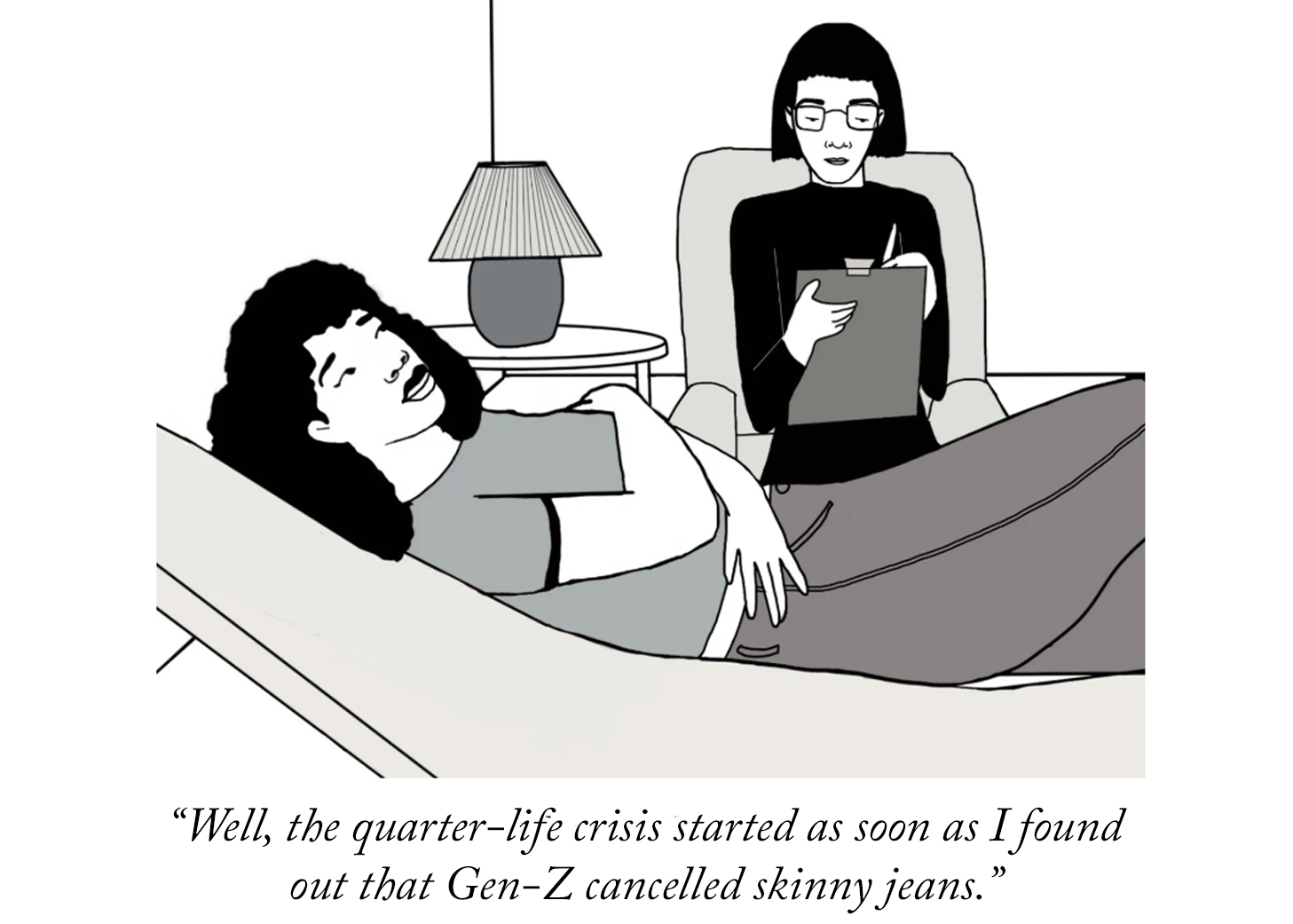
There’s one aspect that we’ve yet to talk about in relation to our three silly boxes, and that is the aspect of shame. Because what cuts most deeply when we feel stuck is not so much that we are stuck, but rather the fear that we’ll never get unstuck. That we’ll never get out of the miry bog, never be able to quite get out of bed with the same bounce we used to, never reach the potential we were supposed to reach. Because if you’re stuck, and you know what it feels to be there, at some point, it can and it will feel like it’s your fault that you’re there.
That at some point a left turn was made when it should have been a right. Because enough courage couldn’t be summoned to ask that one young woman on a date. Because freshman year was too full of fooling around, and the law school that would have made life great sent a waitlist letter and was never heard from again.
And that’s a weight we feel. It’s our fault that we don’t have the life we wanted. The low point usually being found when we no longer find ourselves in our own corner, no longer the master of our fates.
We find Peter again, in earnest, after the crucifixion and resurrection in John 21. He is where we met him the first time — fishing with his guys in the sun, hot enough, even in the early morning, to take off his outer garment.
One wonders what was going on in his mind at the time. How many times had he played over his denial of Jesus? Did he still hear the lashes whip his friend’s back, shrieks resounding? Where did he think his life was going from here? Was the cathartic work good for him? Or did he feel like the impoverished lottery winner who’d spent all his money at a casino and was back working his manual labor job, the same as before? Was it all a dream?
You’ll understand, then, upon seeing Jesus, he leapt into the water, unable to wait for the boat to come back to shore, and swam to his Lord, soaked to the bone. As in his first encounter with Jesus, Christ does not wait for him to ask him, “Do you have a plan for my life?” And this time, Jesus isn’t a stranger to Peter. He approaches his Lord, wet as a retriever from a lake, emerging from his own pit of despair.
In the moment that follows, Peter isn’t chastised, to his own surprise, perhaps. He isn’t beaten down. He isn’t shamed. He is only asked, and then told, this:
“Peter, do you love me? Feed my lambs.”
“Peter, do you love me? Tend my sheep.”
“Peter, do you love me? Feed my sheep…and follow me.”
The last item being the same as it was upon his first meeting — unchanged. And just because he’s a human, Peter looks at John and asks, “What about your plan for his life?” (To which Jesus responds, “Peter, we just had a moment. Don’t ruin it.”)
Only in flipping the page to the Acts of the Apostles, do we know that Peter’s life was never the same.
***
Is anyone wondering by now if Rob Fleming of High Fidelity was left on an empty set where the money ran out? It turns out that his girlfriend, Laura, after a sequence of events surrounding her own stuck-ness, returns to him, seeing something in him that he had not seen in himself: Rob was hers.
As I conclude, I’ll ask three questions:
- Have you been stuck?
- Does God have a plan for your life?
- Most importantly, have you read Jeremiah 29:11?
What is true and what is real for St. Peter and for our real lives in all of their traffic is that God’s plan for us was never predicated on careers, or marital status, or the ability to lock in a 2.9% mortgage rate on a 30-year term (good luck with that ever happening again).
God’s plan for you is a person. It always was. His plan is a person who sees you. Who sees when you’re stuck. Who sees when you feel morally bankrupt. Who sees when you feel like you turned left too many times to ever turn right again. Who always arrives before he’s even asked. Who might just say, as he does to Peter, “I am the plan for your life. One step. One breakdown, one failed relationship, one bout of depression, one victorious moment and one crashing defeat at a time.”
This was the case when he formed you. When you met him for the first time. When you felt alone in your stuck-ness. It is true now. Because God’s plan for your life is a person who desires one thing only. You.








Thank you for these good and true words!
Absolutely spot on.
Thanks, Will!
Though I am in the later twilight years of my life it’s a time of a lot of reflection. I can say with confidence that only in Jesus is there hope of “finishing well”. And that phrase until recently put the pressure on. The “I betters” ran rampant. Will, a very very special essay. I am one who is blessed by the reading. And it contains the perfect words for a great grandmother to pray. Thanks to you and always Mockingbird who puts the Gospel on the streets where we live.
Will, you probably didn’t think your essay would have so much meaning for 70-something year old women. But it made me weep with (what…relief? Deep joy?)and I am so glad that I took the time to set about reading it on my phone before wearily getting out of bed this Sunday morning. Thank you for expressing so beautifully, what we have ALL felt. This is an essay that will stick.
This is wonderful. Thank you! I am going to quote some of this in my sermon on Sunday. You gave words and theology to those stuck moments in life. I sent your article to the 20’s people in my life.
Blessings and Thankfulness
Daniel
Will, thank you for this. As someone in my 30s who has a mortgage, a good marriage, healthy kids, and a career that I (mostly) enjoy, I can promise that it’s not enough, and there are still days where my life feels like a movie that ran out of money. I got very sick of the cliché bible verse positivity for a while, and those clichés are now just starting to sound sweet again. Great job!