




The world’s largest sporting event is drawing to a close this week, and it’s fair to say I caught World Cup fever. I am sports-obsessive. Far on the other side of playing sports, I am fascinated by strategy, coaching, teams, and culture. In other words, what helps teams win? What helps players play better? So I’ve been watching Gary Lineker’s The Rest is Football on a nightly basis and taken in as many games as possible.
A fascinating development emerged during the course of the tournament. While the final four teams could have been easily predicted ahead of time, there have been a surprising number of upsets throughout the tournament. But why? Why have teams like Germany, the Netherlands, and Brazil fallen to upstarts? One explanation seems to be these historical giants played “afraid to lose.” Their upstart opponents, by contrast, played with both feet fully on the gas, dictating their style of play early in the game as opposed to being reactive. They played to win the game.
As explained in this viral X thread, these footballing giants play a “European” brand of football that “optimizes … what is measurable,” tracking pass completion percentage, possession, and positional discipline. European football prioritizes safe, higher percentage plays over riskier 1-v-1 artistry. It’s a system of short passes that slowly accumulates small advantages until they can be decisively exploited. The majority of both Argentina and Brazil’s rosters play club soccer in elite European leagues. This leads them to play a European style, a point made by Alan Shearer last week on The Rest is Football, claiming they’ve lost the South American quality that makes them successful.
Soccer optimization exists within a greater sporting-optimization movement, paralleling a similar development in the NBA, to detrimental effect. In short, optimization suggests that one can develop a perfect theory of how to win based upon the story that statistics tell us. In other words, if a team and its players hit certain metrics during the game — pass completion percentage, expected goals, usage rate — they will be likely to win the game. For the first teams to discover these insights, this may work … until everyone else does it, as Freddie deBoer suggests. (Do college football fans remember how successful Chip Kelly was in the late 2000s and early 2010s? Everyone else ultimately caught on.)
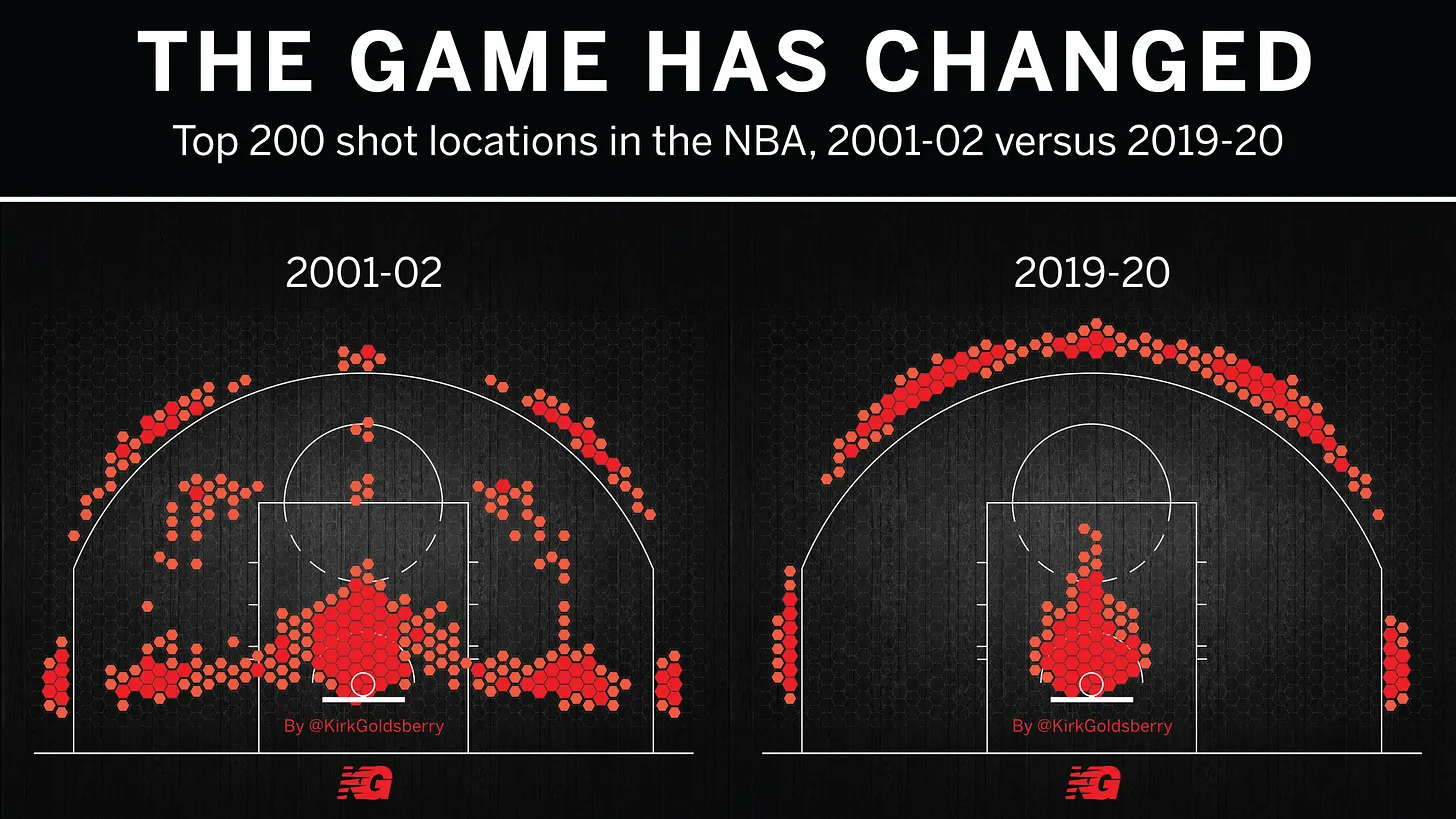
To be sure, no one can argue that advanced statistical models aren’t helpful. They aid in team strategy and individual player improvements and are helpful to tell a different story than what the eye can see. Yet it has the propensity to make clones, whereby every team plays the same, looks the same, and embodies the same character, potentially stripping a team’s identity — the engine that makes it go. When used as the end-all-be-all, it can create environments where players believe they are playing for statistical optimization, not against another team.
Teams that exceeded what was expected of them at this World Cup — Norway, Cape Verde, Paraguay, among others — however, view a game as not only the sum of countless measurable data points that can be combed over exhaustively to try to find an edge, but simply as a game that is “us vs them.” While their backroom staffs doubtlessly use statistical metrics, they also prize winning the game and beating their opponents more than winning the advanced statistical models. This gives individual players confidence to try the harder pass, break on a ball even if it takes them out of position, and win a “duel,” because beating an opponent one-on-one is just what the game is about.
I have been on teams where individual performances were graded after each game with a percentage given to you at the end of watching the game film. While this is effective at drawing attention to mistakes, it also can make a person hyperfixated on being mistake-free, rather than simply playing the game in order to win it. The reality is that elite athletes are better when they are not thinking, lost in the flow of the game and in a complete state of self-forgetfulness.
If there is a gospel tie-in — and there is — it is that too often we can view our lives this way, particularly in a world of life optimization. We can be terrified to make mistakes in our desire to be more sanctified, in our quest for the best version of ourselves, or to take the exact right steps for our future (“Should we invest in this house in this market? Should we?!”). This modality of living puts too much attention on ourselves, characters who were never meant to be the star of the show. Yet if we live in freedom, having been given life to the full (I think this is why Jesus came!) we are free to live in a state of self-forgetfulness, to be free of keeping track of how right or how wrong we are “getting it,” as if someone is going to give us a “life-optimization score” at the end of the calendar year. The gospel exists entirely for our benefit.
I’m hesitant to make this all sound like “the little engine that could” in a different kind of rah-rah speech. And yet I wonder what it might be like to live our lives like these upstart nations against historical giants — nations with countless World Cups to their names. What would it be like to not be afraid of getting it wrong but be told by a coach, “Just go out there and play. You’ve already won”? That almost sounds like a story I’ve heard before. It also makes me feel like I have a better chance at playing freely, and probably a better chance at winning, unburdened from keeping tabs on my performance in real time. It would sound like good news to me.








[…] Playing to Not Lose (William J. Fagan, Mockingbird) […]