




I recently read Mark Allan Powell’s excellent book about preaching reception, What Do They Hear?, where he discusses the impact of social location and personal context on biblical interpretation. Powell’s point isn’t to say that all interpretations are equally valid or that “anything goes,” but rather to show that, for stories where there may be multiple legitimate interpretations, our personal history and social context often incline us to some interpretations and blind us to others. That idea will be old hat to many, but what makes Powell’s book interesting is his research into how specific biblical passages have been interpreted by different people.
Powell does an exercise with his seminary students: he asks them to read a text then close their Bibles, pair off, orally tell each other — as accurately as possible — what the text said, then look back at the text to see what they omitted (or altered!). For example, he asked students to read Luke 7:36–50 about the woman who barges in on the Pharisees’ dinner with Jesus, washes his feet with her hair, and, despite her reputation as a sinner, is praised by him. Jesus signs off with a benediction: “Your sins are forgiven … Your faith has saved you, go in peace” (7:48–50). In retelling the story, not one but two students amended the story with a new conclusion: Jesus telling her, “Go forth and sin no more.” Pretty revealing, that we can be so antsy about our expectations of moral living that we subconsciously amend the biblical text. Powell recalls that when he pointed out the absence of a “sin no more” in the text, both students were “flabbergasted. Both were certain that they had just read those words in the text just a moment earlier” (13).
While I do think those students’ emendation illustrates our universally human “fatal love affair with the law” (Capon), I wouldn’t want to imply they were somehow less capable of objectivity than the rest of us. One could say the comprehensive nature of our sinfulness extends to our handling of sacred things. The word speaks to us when we encounter it, but it struggles to be heard above the din of the presuppositions we bring to it, the questions we doggedly insist on asking scripture even as it’s pressuring us to reformulate them.
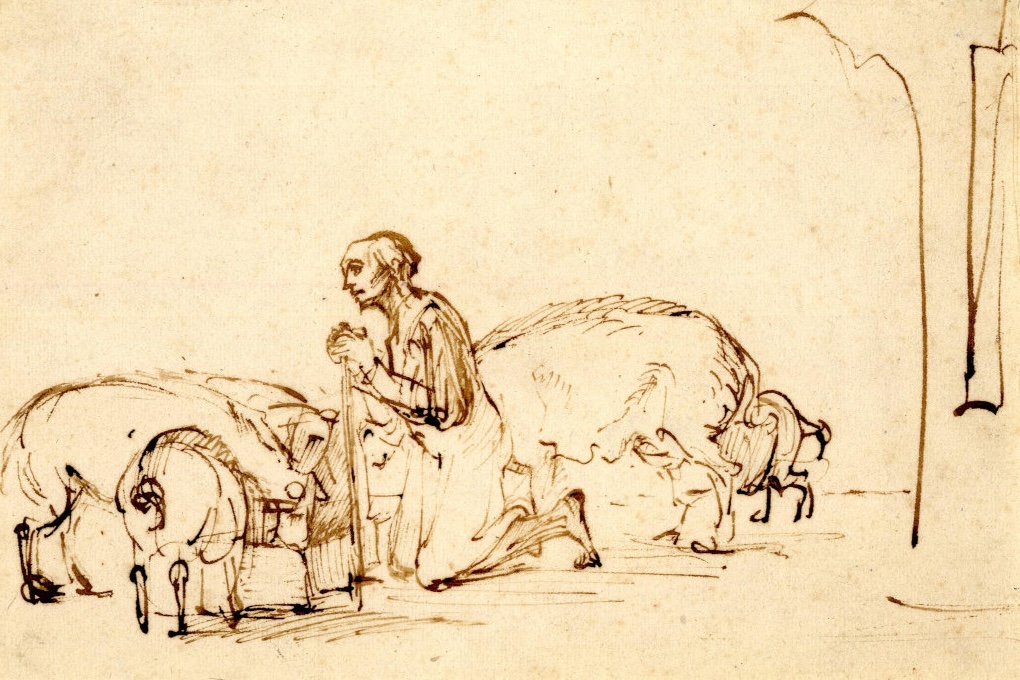
Rembrandt, The Prodigal Son Among the Pigs (c. 1645–1648)
On biblical interpretation, the book’s most interesting feature is its exploration of the Prodigal Son story in Luke 15:11–32. Twelve students read it, and all twelve spoke of the son squandering his money in a foreign land. Zero of the twelve mentioned the second detail in verse 14:
When he had spent everything, a severe famine took place throughout that country, and he began to be in need.
Powell notes that he too thought it was an extraneous detail — but was interested that everyone omitted it. So he did a larger study with a hundred students: about one in six mentioned the famine. Powell notes the students were of diverse “gender, race, age, economic status, and religious affiliation. No single factor of social location seemed to have any statistically relevant impact on” whether the student mentioned the famine. But all of the one hundred were Americans.
On sabbatical in St. Petersburg, Russia, in 2001, Powell surveyed 50 Petersburgians, and 42 (!) mentioned the famine. As Powell notes, the social factors at play are obvious: 60 years earlier, the Wehrmacht had besieged St. Petersburg for about 900 days, leading to acute famine, with more than half a million people dying of starvation and exposure. Interestingly, most Russians did not mention the son “squandering” his wealth. As Powell notes, either factor — the squandering or the famine — could by itself explain the son’s predicament. He asked the Russian respondents if the squandering wasn’t an important factor. Their response was revealing: “So what if he lost his inheritance? … That just means he would be poor like everyone else. Most people don’t have an inheritance to lose. But when the famine came, that was the problem” (18).
We could summarize this divergence —
American version: (i) young man gets inheritance and leaves, (ii) he squanders inheritance, and (iii) he is left in acute need.
Petersburgian version: (i) young man gets inheritance and leaves, (ii) then famine comes, and (iii) he is left in acute need.
As Powell notes, in American preaching, he
ha[s] not heard many American sermons that portray the prodigal as a famine victim — more often, the story is regarded as a paradigm for repentance … Perhaps, then, the famine gets ignored because it was not the boy’s fault, and most sermons that I have heard on this text want to be clear that the boy’s downfall was his own doing. He wasn’t just a victim of bad luck — he went from riches to rags because of his own irresponsible behavior (18).
Powell kept quizzing the Russians: doesn’t the story imply the boy did something wrong? Yes, they said, but the boy’s mistake wasn’t how he spent his money. He was a fool to leave the caring community of the home. “In a phrase, his sin was wanting to be self-sufficient.” (18, emph. added). Then Powell told them about the American students’ responses. “How revealing,” the Russians thought,
that Americans think the great sin was wasting money. They think this because money is very important to them … This boy’s sin was that he wanted to make it in the world on his own. He trusted in the finances and in his own sense of rugged individualism, and he figured that would be enough to get by.
Maybe he would have been okay but for the famine — but famines come. That’s life, and that’s why you can’t make it alone.
But, you might say, our NRSV clearly says he spent the inheritance on “dissolute living,” and the older brother notes he spent it on prostitutes. Right? Powell notes that the word translated “dissolute” by the NRSV (and with similar connotations of immorality by most English translations) can also mean simply “expensive” or “luxurious” — which is how most Eastern translations have rendered it (21). And why we would assume the dour older brother is a reliable witness? Powell notes that while most Western commentaries take the brother’s remark at face value, “Eastern interpreters, virtually without exception, regard brother’s remark as a slanderous and probably baseless accusation” (22).
Summarizing the differences, Powell notes that Western readers typically
regard the tale as a quintessential tale of moral repentance, a story that depicts sin as personal responsibility, illustrates the consequences of such sin, and then locates the key to redemption in an individual decision to reverse one’s course … Eastern readers, by contrast … regard the story as a tale of divine rescue: it is a story that depicts independence as a foolish choice (given the vicissitudes of life), and it is a story that locates redemption in the safe haven that God provides via family and community.
In a word, Western readers tend to see it as a story of “reform,” Eastern ones as a story of “recovery.”[1]
For those of us who believe that American Christianity has been distorted by our culture’s obsession with the individual’s sovereign control over his or her life — and the corresponding weight on choice and discipline as the vehicles of self-making — these differences are revealing. Along with “a severe famine took place throughout the country,” how many other scriptural clauses — even in our best-known stories! — do we silently and unknowingly edit out, Thomas-Jefferson-style, because they complicate our preexisting assumptions? Specifically because they reveal us, at root, as dependent, frail, vulnerable creatures?
We take the boy’s newfound wealth as a sort of baseline, assume that’s the default state of affairs, when really it’s just a buffer — a buffer that the boy spends through and suddenly finds himself “poor like everyone else,” newly at the mercy of the structural factors, like weather, whose fluctuations have radically affected human well-being in nearly every time and place, though less so in our own. Maybe the structural factors in our lives — the things bigger than we are — loom larger than we realize. Certainly the explosion of psychotherapy and other medical interventions in our culture reveals that there are problems in our lives that personal responsibility, however well exercised, simply cannot solve. Maybe, as the Russians thought, our conviction we can “make it in the world on our own” is the boy’s (and our) sin, or at least a major part of it.
Maybe so — but the father in the story doesn’t interrogate the boy, doesn’t ask how he lost his buffer or try to pinpoint cause and effect. Over against the older brother — the beady-eyed diagnostician, the accuser — the father figure simply rejoices that what was dead is now alive, and what was lost is now found. Some of us come back to our Father with head held low, broken by a dozen self-inflicted wounds, while others rush in desperation, pursued by forces they cannot hope to meet and master. The Father takes all kinds, kills the fatted calf — dies himself to any possibility of interrogation, explanation, punishment, or any other of the rightful prerogatives of a wounded dad — and gives himself over to celebration.
[1] Interesting sidenote: on a later trip to Africa, curious to see if Tanzanian seminarians would incline towards the Russian or American interpretation, Powell asked them a quick litmus-test: why did the son starve? A large majority responded: because no one gave him anything to eat. It’s easy to lose one’s money when you don’t know the local customs — it happens often to immigrants — and the Bible asks us to care for the stranger in our midst. He may not have even known that famines happen in that area. The far country was a society without honor because it failed to care for strangers, just as the Pharisees failed to care for sinners, which is, after all, the parable’s immediate context (15:1–3). The kingdom of God, by contrast, welcomes and cares for everyone.








Fascinating! Thanks for this. I do wonder what the Russian/ Eastern interpretation has to say about elder brother who did stay in the bosom of family?
This is a great article, and I can’t wait to read
Powell’s book. The one point I would make is that the older son is not simply an “accuser;” he too is recognized as a beloved son. The father tells him “everything I have is yours.” There is no condemnation. The Father’s grace and mercy extends to everyone.
An even more interesting & explosive look at the parable by scholar Kenneth E. Bailey (now deceased, but at one time recognized as the world’s foremost scholar on the Middle East at the time of Jesus) is that the errant son does NOT return having repented for what he did, but as a still-scheming boy, rehearsing how to con his father into letting him come home, and it is the stunning grace of the Father which brings him to actual repentence. The article is well worth studying. The source I took this from is Christianity Today from some years ago, & can probably be located by googling “Lost Son parable explained by Kenneth E. Bailey.”
You have to read The Cross and the Prodigal by Kenneth Bailey. He has four lectures on youtube. Nothing compares with his research on Luke 15. It is superlative!!!
Will, thank you so much for this article and the highlights of that amazing book.
My husband and I have discussed the prodigal son story endlessly, and feel we know every nuance of it. What a treasure to find yet another lens through which to view it.
Wonderful! Thank you for sharing.
I see that others have mentioned Ken Bailey’s book “The Cross and the Prodigal”. I highly recommend this book. As someone has already pointed out, the prodigal had a plan to earn his way back into his father’s good graces, and his Father would have none of it, and took the shame of the entire village upon himself to deflect it away from his son, and then celebrated. It is the most beautiful rendering of this parable I’ve ever read.
Bailey’s other book, “Jesus Through Middle Eastern Eyes” is amazing as well. He’s got two others I have but haven’t read yet; “Jacob and the Prodigal”, and “The Good Shepherd”.
I’ve sent this to a friend who is facing this scenario now. I mentioned this commentary & sent it to her.
Praying for God’s discernment & grace for her & her family.
Thank you & God bless you ✝️
What a beautiful Father we have through Christ. Blessed redeemer. My Tears flowed in celebration through that last line. Thank you Will~