




As he walked along, he saw a man blind from birth. (Jn 9:1)
Why did Jesus have to die?
As a pastor, that’s a question I’ve heard many times. It’s also a question I’ve asked on more than a few occasions. Why did Jesus have to die?
It’s a deeply theological query. And it’s one we ask a lot in the mainline Protestant church because our crosses are empty, and we often water down the message of Jesus to something like the Gospel According to Burt Bacharach: “What the world needs now, is love sweet love.” Or, the Gospel According to the Beatles, “All you need is love! Bah bah bah bah bah!”
And yet, you don’t kill someone because they love too much.
Put another way, the presumption that love is all we need fails to account for the fact that without a story that conveys the truth and depth of love, we have no idea what love is or what it means to be loved.
And yet, according to the gospel, we know what love is because we know Jesus Christ and him crucified.
Our question, however, still lingers. Why did this first-century poor Jewish man who happened to be God in the flesh find his end on a cross? What is it about his person or his message or his actions that was such that it had to be stopped? Why did Jesus have to die?
Notably, Jesus heals many people in the Gospels. The lame are made to walk, the demons are cast out, the blind see. But no one is ever healed in the same way. In some circumstances Jesus has to heal through touch, whereas in other moments he needs only speak to bring about restoration; and on one memorable occasion healing bursts forth without Jesus meaning it to happen because a woman simply reaches for the hem of his garment.
This is important. It’s important because we’re all different, and we all need different kinds of healing. Although, not everyone gets healed, at least not in the way we want.
That’s strike one for Jesus.
Can’t you hear it? “What’s the deal JC, you healed that blind guy, what about the rest of us? My knee has been giving me trouble for years, and you haven’t done anything about it!”
Similarly, Jesus responds to many people in the Gospels, to their various questions and inquiries, but never the same way. In some circumstances Jesus responds by telling a story, otherwise known as a parable; sometimes he points to a nearby object to make a point; and, more often than not, he responds to questions with questions.
This is important. It’s important because we’re all different, and we all need different words from the Word. But some people get better words than others.
That’s strike two for Jesus.
Can’t you hear it? “C’mon JC, you told the crowds to love the Lord and love their neighbors, but you’re telling me I have to sell all my possessions and give the proceeds to the poor! How is that fair?”
And as Jesus moves through his ministry, he speaks the truth to a whole lot of people in power, but never in the same way. In some circumstances, he accosts those in authority for failing to adhere to the promises they promised to promise; sometimes he claims authority over everything in a way that the powers and principalities are left scratching their heads; and sometimes he so brazenly ignores the rules and regulations in his midst that people are made mad by what he says and does, and they want to kill him.
This is important. It’s important because we’re all different, and we all need a dose of the truth (which happens to be Jesus himself), but we can’t handle the truth. (Thanks, Jack Nicholson)
That’s strike three for Jesus.
Can’t you hear it? “Listen Lord, we were all getting along just fine before you showed up. So what if a few people were falling through the cracks? They probably deserved it anyway. Go preach your kingdom somewhere else. Because if you keep ruffling our hearts, we’re going to pluck out all of yours …”
Jesus, for all of his mercy and might, never goes anywhere without upsetting the status quo, without admonishing those in power, and without flipping over a few tables, literally and figuratively. Jesus comforts the afflicted, but he also afflicts the comfortable.
Oscar Wilde once said, “If you want to tell people the truth, make them laugh, otherwise they’ll kill you.”
Well, the miracle of the man born blind is one of the funniest stories in the strange new world of the Bible, but when Jesus performed the miracle and spoke about it, no one was laughing.
Jesus was walking by one day and he sees a man who can’t, a man born blind. The disciples don’t see the man as such, rather they see him as an object lesson, an opportunity for Jesus to make something clear as crystal rather than clear as mud (that’s a spoiler).
“Teacher,” they say, “is this man blind because he did something wrong or was it his parents?” They’re playing the blame game. But Jesus won’t have any of it. He says, “It wasn’t him or his parents. That’s not how the world works. But today his blindness will reveal the marvelous works of God.”
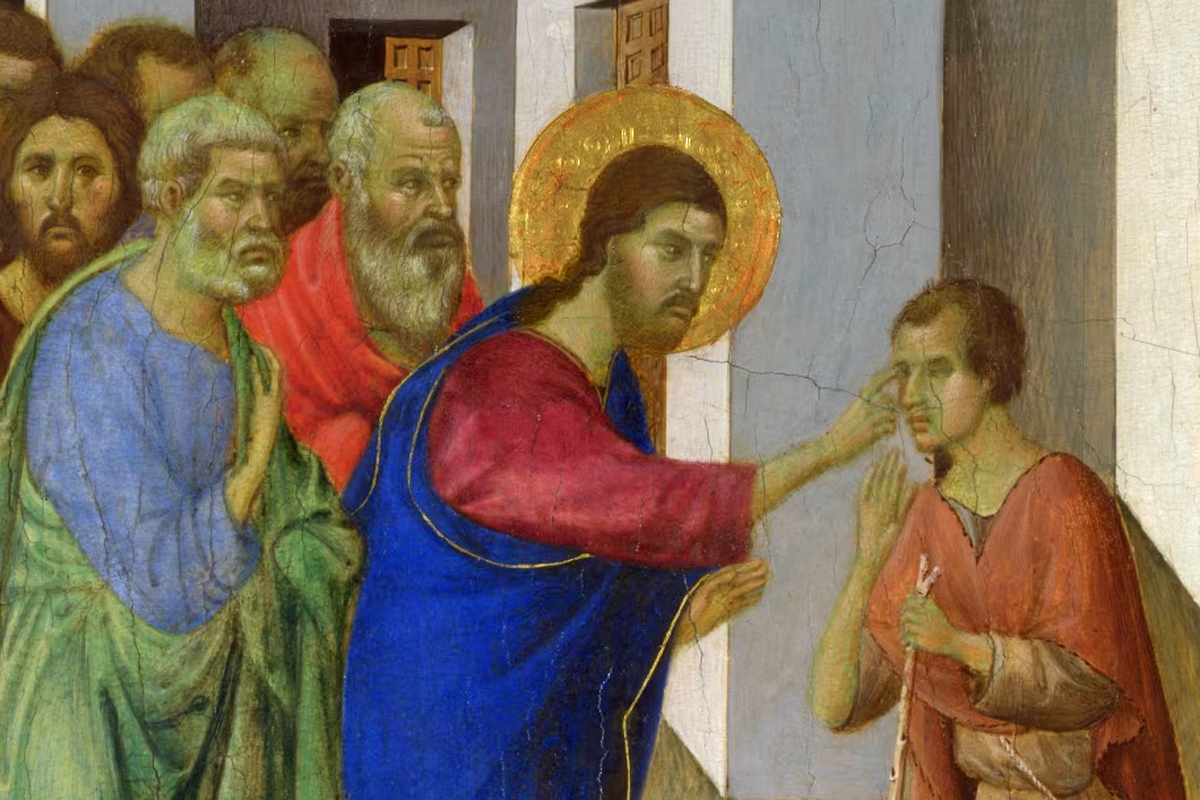
This is where it gets comedic. Jesus promptly spits in the dirt, makes a little mud, and then smears it into the man’s eyes. The man born blind now has clay caked over his eyes. Jesus here, and everywhere else in the Gospel, delights in rubbing mud into the affected area of human need, comforting the afflicted while also afflicting the comfortable.
The blind man goes away to wash in the pool of Siloam, and now he sees.
And what is already a silly story takes it up a notch like it’s an episode of Curb Your Enthusiasm. For, in short order, no one seems able to comprehend the miracle whatsoever. In fact, rather than celebrating God’s impossible possibility, the blind man’s lack of blindness makes just about everyone mad.
First, it’s the neighbors (it always starts in the neighborhood). “Isn’t that the blind guy?” Notice, the only thing they see about him is what he can’t, they don’t even know his name. “He’s walking around like he can see! What’s going on here?” They continue to grumble among themselves before someone finally has the bright idea to ask the man himself.
And then they ask the question we all ask all the time. “How did it happen?”
“All I know is that a guy named Jesus rubbed some mud in my eyes. I was blind but now I see.”
And next, it’s the Pharisees. And the whole scene repeats itself. They grumble among themselves, they have a theological fight about what is and isn’t possible, what is and isn’t permissible, before someone finally has the bright idea to ask the man himself.
“How did it happen?”
“Well, I’ll tell you the same thing I told the last group. This guy named Jesus rubbed some mud in my eyes. I was blind but now I see.”
“That’s not allowed!” they say. “This happened on the Sabbath, and everyone knows you can’t work on the Sabbath. This Jesus is a sinner!” Isn’t it interesting that they don’t celebrate the miracle either? They can’t wrap their heads around the new newness that Jesus brings because they, like Peter and so many others, already think they think everything they’ve ever needed to think.
And next, it’s the rest of the community. The scene repeats itself yet again, but this time they get the no-longer-blind man’s parents involved.
“Yeah, that’s our son. He was blind but now he sees and we have no idea what happened.” And they suggest, for the third time in the story, that people should talk to the man in question about his experience. And so they do. And so he repeats himself, again.
“It was this guy Jesus. He rubbed mud in my eyes. I was blind but now I see.”
“This Jesus is a sinner! He healed you on the Sabbath. Don’t you see what kind of problem this is?”
“Look I just started seeing everything for the first time! I don’t know if he’s a sinner. The only thing I know is that I was blind but now I see!”
“Tell us how it happened. What did he do to you?”
“I’m done with this. I’m not telling my story again. In fact, if you want to know it all so much, why don’t you start following Jesus. You all could be some of his disciples too.”
I always hear this like a middle schooler saying, “If you like him so much, why don’t you marry him???”
They grumble, yet again, and the seeing man says, “This is astonishing. I am a miracle in your midst. Can you not see that I now see? If Jesus weren’t holy, how could he have done such a thing?” And the religious leaders do what they’ve always done and still do when someone calls their authority into question, they kick him out.
And only now does Jesus return to the story. He finds the formerly blind man, and the story of healing comes to completion. The man born blind sees not only the world around him, a world full of fools and failures, but he also sees Jesus, the one who makes a way where there is no way, the one who brings clarity even out of the mud.
But no one else seems to see what he sees. Instead, the neighbors, the religious leaders, and the whole community see only what they want to see. They cling to what they believe is and isn’t possible, is and isn’t permissible, and they do what we’ve always done when we encounter something we can’t comprehend: rejection.
We can’t handle Jesus. We couldn’t then and we aren’t very good with it now. Because the inconvenient truth of the gospel is that we’re still very much like the crowds with all of our questions, we struggle to celebrate any miracle for the miracle that it is, and no matter how loud our “Hosannas” are, even the whispers of “Crucify” are still near our hearts.
We may be able to convince ourselves that we wouldn’t have participated had we been there that day in Jerusalem, but Jesus says whatever we do to the least of these we do also to him.
Thus to have ill thoughts toward others is to do the same to Jesus. Remember: While we were still sinners Christ died for us. Because of us.
Jesus heals the blind man so that he can truly see. The man sees the brokenness of the world, but he also sees how beautiful the world can be because he sees Jesus. Whenever we look at the cross, it’s like God is rubbing mud in our eyes. Grace is amazing, but it’s also kind of grimy. The cross shows us the brokenness of the world and the beauty of the world to come. The cross is a reminder both of our sin and that Jesus is the Savior and friend of sinners.
There’s something that shimmers in the sludge that Jesus places on the eyes of those who cannot see. Today the grimy grace of the cross is getting sloshed over all of our faces so that we can see and receive the truth, the truth that will set us free.
Amazing grace how sweet the sound, that saved a wretch like me! I once was lost, but now am found, was blind but now I see!






