




He himself is before all things, and in him all things hold together. (Col 1:17)
I arrived at the church in Charlottesville (after a long and wild week) full of hope, expectation, and a bit of nervousness. I’m one of those “longtime listeners first-time callers” when it comes to a Mockingbird Conference, and so I had ideas about what it would be like, but I was also unsure of what it would actually be like.
And so, sitting in Christ Church, I did what most people do when they go to a conference: I mingled. Or, as we say in Methodist circles, I enjoyed some fellowship.
Like a wedding where the guests all ask one another, “How do you know the happy couple?” the gathered people exchanged their Mockingbird memoirs. And yet, after meeting a handful of individuals, I noticed something strange about the stories.
“Mockingbird found me when I really needed it.”
“A friend made me read ‘The Family Issue’ of the magazine, and I’ve been hooked ever since.”
“My pastor quoted Dave Zahl’s The Big Relief in a sermon,, and it actually released me from some things that had been burdening me for a really long time.”
On and on the stories went, and the agency of those I talked with was almost nonexistent.
It wasn’t “I found Mockingbird,” or “I subscribed to the magazine,” or “I bought Zahl’s book.” Rather, Mockingbird came like an external word to those who needed it.
Which, incidentally, seemed to be the theme behind the theme “Anchored By Grace.”
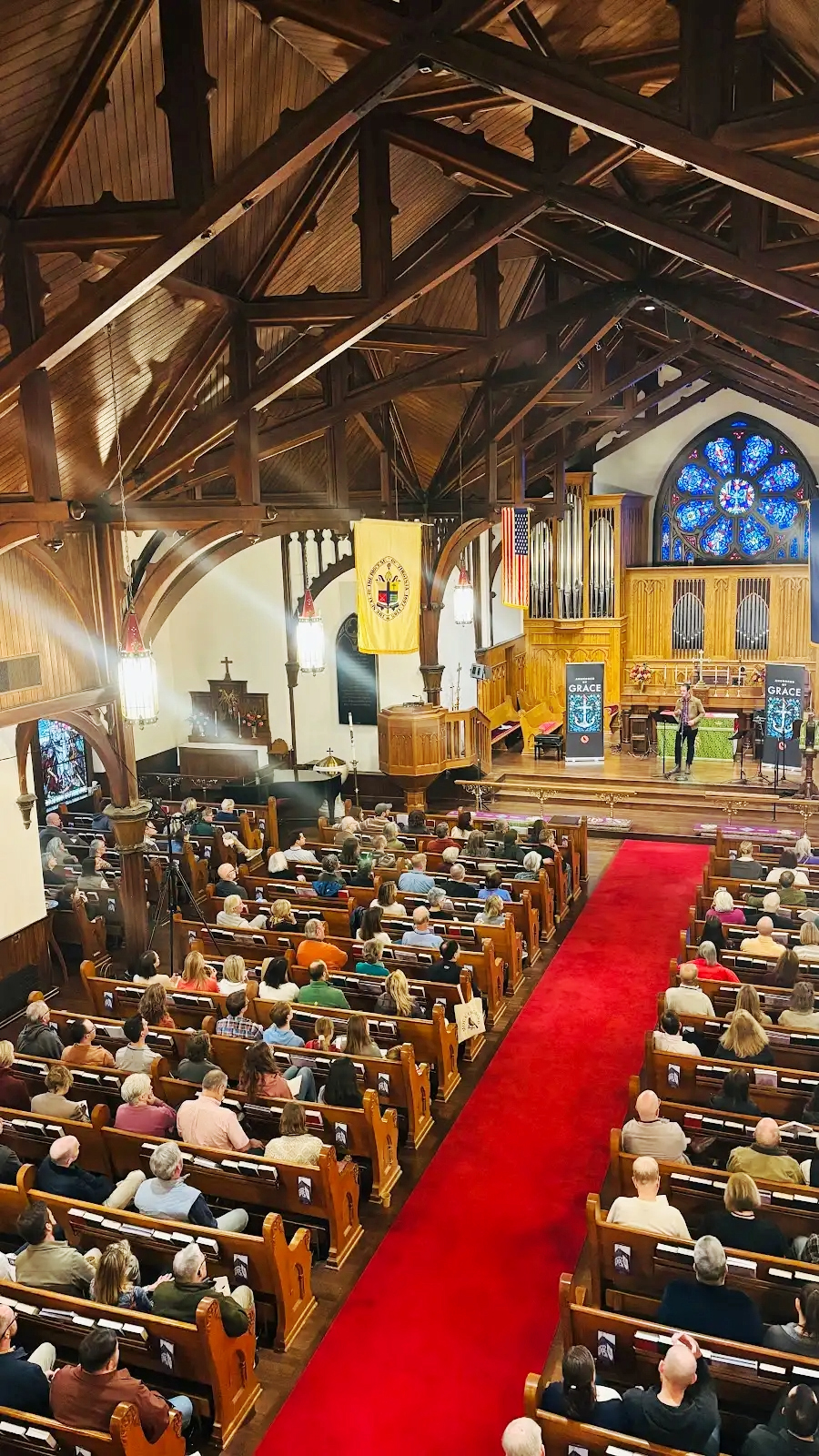 When Paul Walker welcomed us to the conference, he drew our attention to the architecture of our gathering, namely the nave (Latin for ship or boat). Whenever we gather in a sanctuary, we are, in a sense, on the boat with the Lord whose anchor holds fast no matter what waves batter our hulls or hearts. Notably, we don’t have to hold onto the anchor, but the anchor holds onto us.
That’s important because that’s how God works. Over and over again in the strange new world of the Bible, we find stories of God’s agency toward us, ultimately coming down into the muck and mire of our lives in the person of Jesus.
Or, as Robert Farrar Capon, one of the patron saints of Mockingbird, put it:
Jesus always comes to us in the brokenness of our health, in the shipwreck of our family lives, in the loss of all possible peace of mind, even in the very thick of our sins. Jesus saves us in our disasters, not from them.
When Sarah Condon was invited to speak, she confessed how longing is stronger than our faith. With her witty and sardonic charm, she ripped apart the WASP-y desire for the perfect family beach photo while also admitting her own longing for such silliness. And, ultimately, she proclaimed the wondrous truth of the gospel — what we really long for (love, hope, grace, etc.) has actually been there all along in Jesus. Sometimes we just have to slow down enough to see it.
After dinner and drinks, Paul Zach and his menagerie of musicians treated us to a concert of graceful proportions. Through songs familiar and strange, we were given a port in a storm, a refuge amidst the tumult of the world.
On Saturday morning, Amanda McMillen similarly gathered us toward a better understanding of the reason of our gathering, namely Jesus. She spoke of Shūsaku Endō’s Silence and Martin Scorsese’s film of the same name, and the paradoxical nature by which God makes God’s presence known in the world.
Sam Bush, with a rather hilarious talk about all things birds, compelled us to look down and remember that, despite our culture’s insistence on ascendence, Jesus works down at the bottom. And, for what it’s worth, I will forever cherish the proper pronunciation of Gerhard Forde’s last name because it rhymes with “birdie.”
Hannah Anderson, with a subversive subversion of her titled talk “The Physics of Grace” notably demonstrated that grace is the only real thing in the world, and it’s been there all along.
Josh Bascom’s breakout group was all about Flannery O’Connor, whose life and fiction always went to the bottom.
And Dave Zahl wrapped it all up with a talk about what happens when “the anchorman” breaks. With references to the Vietnam War, Martin Scorsese’s Silence (for the second time of the conference), and Burning Man, Zahl proclaimed the truth that our anchor isn’t an idea or a movement but a person. And our Anchorman doesn’t just break the (good) news, he breaks the chains of death.
So much of the conference reminded me of another quote from Robert Farrar Capon:
Confession has nothing to do with getting ourselves forgiven. Confession is not a transaction, not a negotiation in order to secure forgiveness … Forgiveness surrounds us, beats upon us all our lives; we confess only to wake ourselves up to what we already have. We are not forgiven, therefore, because we made ourselves forgivable or even because we had faith; we are forgiven solely because there is a Forgiver.
Grace is the only real thing in the world, and it’s been there all along. And, best of all, we don’t have to do anything to hold onto it, or earn it, or deserve it, because Christ our Anchor holds onto us.