




1. Last Sunday the Mockingbird Book Club read and discussed Gravity & Grace by Simone Weil. The source material gave way to a wide-ranging consideration of the afflictions and consolations of the life of faith. Take, for example, Weil’s thoughts where grace resides:
All the natural movements of the soul are controlled by laws analogous to those of physical gravity. Grace is the only exception. Grace fills empty spaces, but it can only enter where there is a void to receive it, and it is grace itself which makes this void. The imagination is continually at work filling up all the fissures through which grace might pass.
Or these sentences on the consolations (and cautions!) of monotony:
Monotony is the most beautiful or the most atrocious thing. The most beautiful if it is a reflection of eternity — the most atrocious if it is the sign of an unvarying perpetuity. It is time surpassed or time sterilized.
In his recent column on the drawbacks and benefits of boredom, Stan Grant cites the work of Weil, poet and Nobel laureate Joseph Brodsky, and late Aboriginal painter, poet, and philosopher, David Mowaljarlai. He describes the weirdness of contemporary ennui this way:
We are bored. That may seem antithetical to our hyper-stimulated world, but it is stimulation itself that is the problem. We live in and age of instantaneous and continual entertainment and distraction. Meaning is transitory, fleeting, and electrically charged. We are zapped 24/7, wired into each other. In a world of endless choice, what do we value?
We are bored with nature. A sunrise serves as a backdrop for a photograph. We are bored with words, so tweets and posts and threads replace books.
We are bored with each other, so we prefer identity. We are bored with love, so we imagine we can marry “at first sight.” We are bored with ourselves, and Botox and bad television won’t fill the empty space.
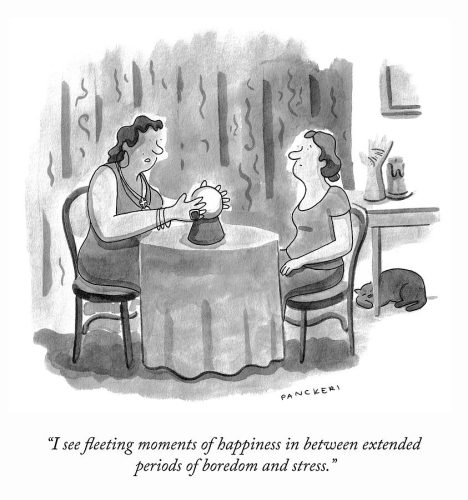
For Brodsky, the answer was to embrace boredom as a “window on time,” and when hit by boredom to “go for it, let yourself be crushed by it, submerge, hit bottom.” Simone Weil went farther; she went to God.
Simone Weil believed that the spirit of Christ entered her, and in the crucifixion of Jesus she saw the possibilities of being human. In the scandal of the cross, the meaninglessness of a death where Christ himself cries out to God in his abandonment, we find the truth of affliction.
Simone Weil told us of the insignificance of affliction: that it reduces a human to a thing. And it is the chill of indifference, the cold hand of fate, that freezes the soul. Yet, in that insignificance is our significance. In the meaninglessness of suffering, in the abandonment of God there is the necessity to reach for meaning; to reach for God, or at least to reach for love, which is where God waits for us.
2. In an age “where meaning is transitory, fleeting, and electrically charged,” Russell Moore asks, How do people actually change? Fun for us Mockingbirds, he cites Simeon Zahl’s essay “The Cure of Souls” from the recent Sickness & Health issue of the magazine. In the essay, Simeon explores various “theories of change” at work within the American church, most notably the “Christian information theory of change,” which “seeks to argue through a particular biblical passage or worldview, followed by a time of ‘application’ that suggests ways the listeners can put the new principles to work in their lives.”
Zahl contrasts this theory with a model of “sacramental participation.” Here, the primary driver of change is not the information embedded in the sermon but the practices embedded in the Lord’s Table or in baptism. A third model involves gearing a worship atmosphere toward a highly cathartic emotional experience, by which one leaves transformed.
In contrast, Zahl argues for what he calls an “Augustinian theory of change.” This one assumes that “human beings are driven not by knowledge or will but by desire. We are creatures of the heart, creatures of love.” He further argues that the human heart is highly resistant to change, often blocking direct attempts to alter it.
As Simeon writes, “The Spirit of God traffics in emotion and desire.” This reality is at the core of the Law / Gospel framework which animates the ministry of Mockingbird. Real change is rare, and when it is possible, it is a gift received. Intellect and willpower aren’t enough. Only through the transformation of our deepest desires is any real change possible, and as Augustinian says,
[The law] commands, after all, rather than helps; it teaches us that there is a disease without healing it. In fact, it increases what it does not heal so that we seek the medicine of grace with greater attention and care.
We are creatures of the heart, and Simeon suggests that we “embrace technologies of the heart that speak the strange electric language of the psyche.” And even Simeon’s admonition to “embrace” is not a matter of bending our own wills, but rather watching (closely and with eyes unveiled!) as God sends forth his Spirit to “renew the face of the ground” (Ps. 104:30).
3. I feel a little like Debbie Downer! So far I’ve shared (the not so novel news) that we’re bored and stubborn. And now I’m here to tell you that we’re arrogant! At The Walrus, Michelle Cyca discusses “The Inescapable Rise of Moral Superiority,” asking: Why does every online discussion terminate in ethical grandstanding?
It has become unremarkable that, for example, an anodyne tweet by a woman who enjoys drinking coffee with her husband every morning would provoke outrage. “This is cute and all but did you think of all the people who wake up to work grueling hours, wake up on the streets, alone, or with chronic pain before posting this?” fumed one person … These exchanges are varied in subject, but what is consistent is how these banal discussions predictably devolve into a fight over moral superiority.
Look at any social media post that has more than a dozen responses; inevitably, one of them will attack the original post on the basis of some perceived moral transgression.
Though the annals of of social media — designed to amplify the most extreme and provocative takes — can serve as a rap sheet for this tendency, “it’s also omnipresent in politics, traditional media, and corporate spaces.” Why the incessant desire to be “impeachably correct,” Cyca asks? The answer: purity aka moral grandstanding.
In their book Grandstanding: The Use and Abuse of Moral Talk, philosophers Justin Tosi and Brandon Warmke argue that we often raise issues of justice and equity not to advance meaningful social causes but to generate positive attention for ourselves by denigrating others. . . . The goal is not to understand but to win. Grandstanding is not just about demonstrating that your position is right but that your opponent’s position — and, by extension, their moral character — is wrong. What was the original point? Who cares: you are ethically bankrupt and here’s why.
The real-world implications of this grandstanding are severe: civil discordance, polarization, missed connections, and the dehumanization of those who simply have a difference of opinion, resulting in sins of commission and omission.
Moralizing is also a way of expressing our dismay at the vast, cruel machinations of society. Like the afterlife points system, we can tabulate the harms of each tiny decision, but we can’t escape our own culpability.
With the preponderance of cable news and social media, the blame game has become high stakes! And everyone is terrified of rooting for the wrong team (in a game that is constantly changing, by the way).
But should this tendency surprise us? In a way, it’s like Pharisaism 101. We’ve always drawn lines to decide who’s in and who’s out, and we’ve always been prone to criticize other’s behavior while valorizing our own. We hate being confronted with our own vulnerability and powerlessness — our low anthropology. (Please, can someone help me get the plank out of my eye?!) Even the church, with its history of purification movements and schisms, has itself been (re)formed by this tendency.
As cathartic as venting one’s outrage can be in the moment, it’s clear that moral grandstanding accomplishes very little beyond the fleeting satisfaction that it brings. Shaming people doesn’t seem to change their behavior, and invoking mass shooting victims in an argument about hamburgers doesn’t move the needle on gun control.
Like Moore and Simeon asked, if strict adherence to the law doesn’t bring about real change, what does? Around here, we tend to think it is the opposite of moral grandstanding, something like hitting rock bottom — and admitting it time and time again. If anything will change a person, it’s not in shining a light on their faults, but rather imputation, the idea that God reconciles sinners to himself by declaring them to be righteous on account of Christ.
In other words, the internet would benefit from giving people the benefit of the doubt, showing patience and love when it feels undeserved. Instead of shaming someone’s behavior, ask yourself what you’d do on your worst day, and then instead of posting a comment of rebuke, go outside and plant a flower.
4. Since we’re blaming the internet for everything, why not add misdefining important psychological concepts to the list? Olga Khazan is calling “boundaries” the “Most Misunderstood Concept in Psychology.”
… even as “boundaries” have taken off, the concept has become misunderstood, joining gaslit and narcissist in the pantheon of misused psychology jargon. When you want someone to do something, throwing in the word boundary can lend the request a patina of therapeutic legitimacy.
While trying to provide a viable working definition for what boundaries really are, Khazan urges that the most important question related to boundaries is not so much about what they are but about what we ought to do when someone violates a boundary? Counter to the tendencies of cancel culture, she suggests the radical idea of forgiveness. After all, if we ended relationships every time our boundaries were violated, “we would not have any relationships.”
With boundaries, add “trauma” to the list of misunderstood and misused therapy words. Despite once being a contested notion, Bessel van der Kolk’s theory of trauma has become the dominant way we make sense of our lives, says Danielle Carr for New York Magazine. Bessel van der Kolk is currently the world’s most famous living psychiatrist and the author of The Body Keeps the Score, which argues that the body tracks trauma physiologically, even if, and despite, one’s memory of a traumatic experience fading.
The book has spent 248 weeks and counting on the New York Times paperback-nonfiction best-seller list. To date, it’s sold 3 million copies and been translated into 37 languages. Understandably, there is concern with lay people misdiagnosing themselves as “traumatized” in their search for a cure.
Our 2023 trauma moment has blossomed out of the scientific foundation of van der Kolk’s theories, though what seems to be germinating often appears to be less his specific neurobiological model than what we might call “traumatic literalism.” If you’re the type of person who gets Instagram ads for online therapy, your algorithm has doubtless ushered you toward the archipelago of #attachmenttheory and #complexptsd. There, you can learn how growing up in a dysfunctional family can quite literally deform your nervous system, as often through “invisible traumas” like “parentification” as through outright abuse or neglect. These ideas, leaping off the scientific legitimacy of van der Kolk’s work, posit a ubiquity of trauma that seems to leave hardly anyone in the “non-traumatized” category.
And yet for many others that have suffered excruciating losses and gross abuses, van der Kolk’s trauma theories are a salve on deep emotional wounds that nestle themselves in shoulder cavities and discs of the lower back. When queried about his therapy, one of van der Kolk’s patients responded this way:
We’re at the beginning of a new scientific epoch, he told me, of understanding the truth about trauma: Finally, humanity can hope to free itself from the cycles that have dragged us through eons of war, violence, and poverty. Someday soon, he told me, finally, we will all become clean.
5. A friend who lives in Europe and I have a running joke going that we call “lazy vs lame.” While he siestas, I sneak in steps. My calendar is blocked with afternoon meetings when Aperitivo hour beckons him to the cafe. To be clear, he isn’t lazy; I’m lame. It’s a boring and embarrassing trope to talk about the United States as a place that mostly values activities insofar as they are understood to be work. We even have the dirty habit of describing summer vacation as labor: “We banked time at the beach.” “I clocked two hours on the trail to recharge before Monday.” “Let’s get massages before our workout.” Last week famous American TikToker Lexi Jordan was roasted for comparing traveling to the Amalfi Coast to “manual labor,” saying that having to travel by plane, train, and ferry to visit the Italian coastline was too hard (cringe).
If our distorted ways of talking about work make you wince, it’s time to reconsider Henry David Thoreau, who, before Joseph Brodsky, reveled in boredom and was suspicious of the Protestant work ethic that he saw supercharging American life. Over at The Hedgehog Review, Jonathan Malesic reviews Henry at Work, a new book seeking to rehabilitate Thoreau’s reputation as a slacker.
Kaag and van Belle acknowledge that Thoreau invites us to consider the “cost” of our work, but they fail to appreciate that as far as he is concerned, any money-making work points our souls in the wrong direction, and so we have good reason to limit it as much as possible. The authors ask, “Supposing we recast our working life as sacred, we may wonder: What are the sacred ends, if any, of these sacraments of service? Why is work sacred?” […]
Rather, they throw everything a person does into the category of “the business of living,” then often equate that business with work. Such business, on their account, includes lending money to someone in need, caring for a sick parent, communing with animals, reading classical poets, gardening, picking huckleberries, and thieving. These activities have work-like elements, to be sure, but if virtually everything we do is work, then the concept loses its analytical power. Why, then, talk about work at all?
From passages like this, you can see that Malesic isn’t totally on board with their interpretation of Thoreau’s journals, which they argue are more important than Walden, but he does suggest that we need Thoreau’s radical counterpoint to the rat race of consumerism as we think through the intersecting problems of economy, democracy, climate, and racial justice.
6. Since nobody knows what boundaries are anyhow, it’s no wonder a “Woman Shocked Friend Keeps Overstepping Boundaries She’s Never Actually Articulated,” even if she swears she has attempted to convey a semblance of communicating her boundaries, which has mainly manifested in indirect passive aggressive quips about the time and talking about how busy she always is.
SAG-AFTRA and the WGA are still on strike, pushing for a contract that restricts AI with the goal of protecting writers and the works they create. Fair enough! But for all of the anxiety associated with AI’s ascent, maybe it’d be easier to let ChatGPT handle the delicate and precarious conversations that keep us up at night?
Looking for a quick way to jumpstart a morning of intense self-examination, order a cup of joe. Forget single-origin pour overs, for the ever-escalating price of a drip coffee and the flip of an iPad, you too can be faced with a cacophony of existential conundrums.
Strays:
- Tara Isabella Burton on the impossibility of authenticity and how we all became a brand.
- Moralism isn’t just ruining the internet, it is ruining cultural criticism (and movies and standup comedy and everything.)
- Danny McBride’s show about a flawed evangelical family is goofy on its face, but unusually eloquent on the subject of forgiveness. Phil Christman on The Surprising Profundity of The Righteous Gemstones.
- B.D. McClay reminds us “that in life everything is happening all the time. There aren’t any turns, there’s no give and take, there’s just an endless series of good and bad events, occasions you either rise to or fail to rise to (or are, in some cases, simply unaware of).”
- “The defining problem driving people out of the church is … just how American life works in the 21st century,” writes Jake Meador.








Great weekender, Ms.Richey. ”moral grandstanding,” is something I can do even when alone and bored, and thinking of injustices that came my way.