




This article is by Alice Courtright:
Splendor, light and life attend Him,
Beauty springeth out of naught.
Evermore from His store
Newborn worlds rise and adore.[1]
On Sunday morning, two of my daughters were sick, so we stayed home from church. My husband, Drew, who is a priest, picked up my oldest daughter, Margaret, between services. I set up my five year old, Lucy, with a Lego set at the table, and went into the kitchen with my toddler, Caroline. I wanted to cook. I held Caroline on my hip, and flipped through recipe ideas on the New York Times Cooking App. I decided on the Apple Butter Quick Bread and the Chickpea Vegetable Soup with Parmesan, Rosemary, and Lemon. Caroline wandered in and out of the kitchen while I put together the soup and whisked the oil and sugar together. When the bread began to bake, the house was filled with the smell of sweet, rising dough and the aromas of the simmering soup — garlic, rosemary, stewing tomatoes. The smells together promised satisfaction and comfort on a cold October morning. The perfect combination for my coughing children. The perfect welcome for Drew and Margaret after church.
I stood in the kitchen, humming and admiring the nourishing soup bubbling on the stovetop, feeling the pleasure of the beautiful meal to come with my family. I breathed in deeply — and suddenly remembered myself. As the Talking Heads sing, “How did I get here?” I don’t really like to cook! Well, that’s not exactly true. I find cooking stressful with my young children hollering to eat and the many chores that need tending in the house. I do like to cook with a clean kitchen, a good meal plan, and time to cut a cucumber into neat little strips. But that situation is hard to come by. So, my husband makes a lot of food for us, and my meals tend to be exercises in efficiency. There was leftover pasta in the fridge from last night’s dinner. I could’ve easily stretched it for lunch.
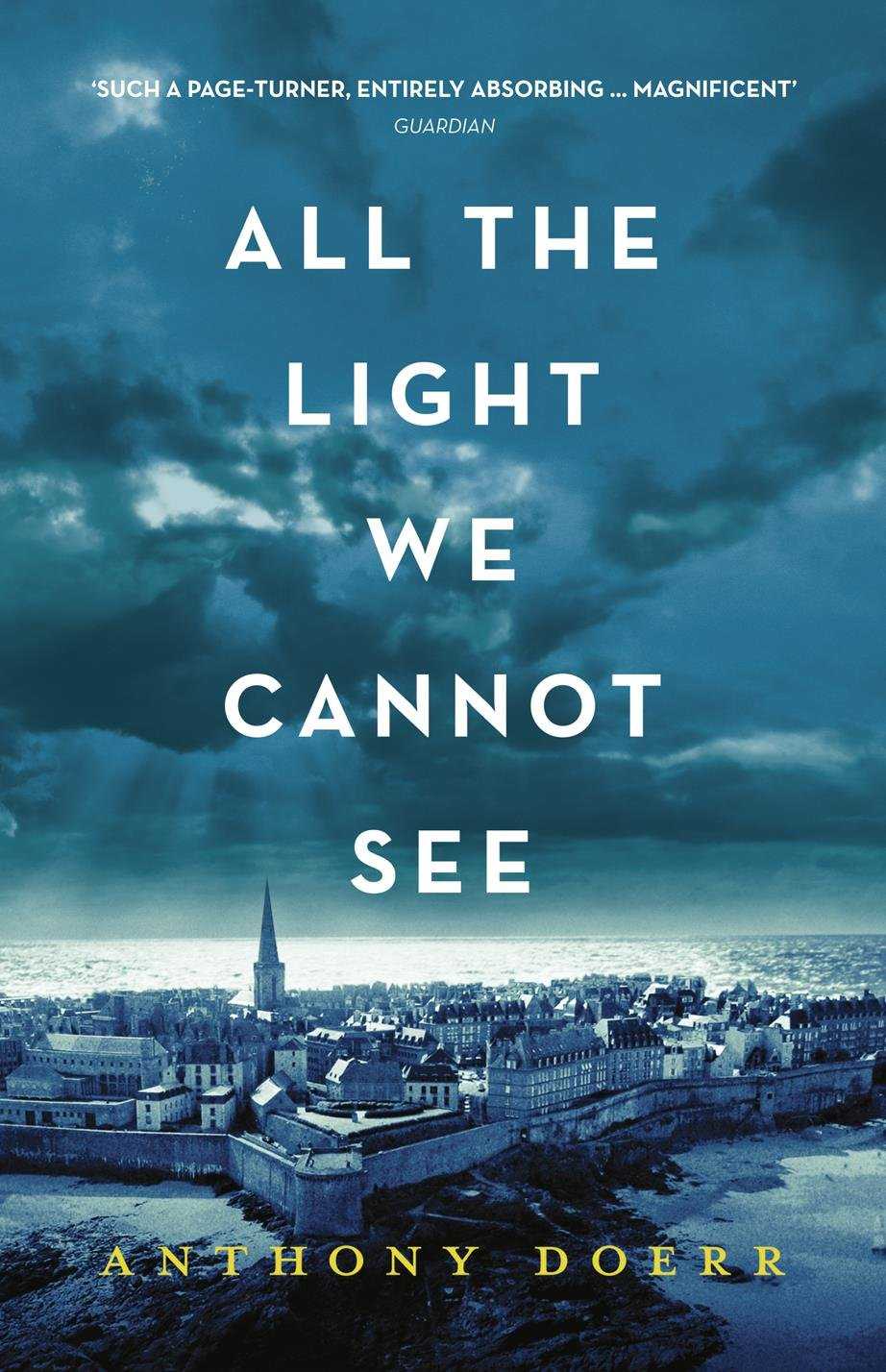
What had come over me? Oh, I thought, it’s that novel you’ve been reading, All the Light We Cannot See, by Anthony Doerr. You’ve been under its spell, staying up late, flying through the pages. One of the characters, Madame Manec, is a resistance fighter in Vichy France, and she’s constantly delivering food to the poor and sickly in her coastal city of Saint-Malo in Brittany. Not just any food: stews and cakes with secret messages in them. Oh, I thought, looking at the soup with surprise. This book is having an impact on me. This book has given me a gift.
I only heard of the novelist and short story writer Anthony Doerr recently. He’ll be the keynote speaker at the Calvin Center’s Festival for Faith and Writing this spring, and has been publishing well-recognized prose for two decades. All the Light We Cannot See won the Pulitzer Prize in 2015 and spent almost four years on the New York Times Bestseller List. When I saw that Netflix was releasing it as a movie (tomorrow!), I grabbed a copy of the book at our small local library. They had two copies on the shelf. I try to keep up with fiction. How had I missed such a well-known read? How had I never heard of such a well-known writer?
For the few of you left who haven’t read the book, or for those of you who read it almost ten years ago, allow me to recap the novel briefly. All the Light We Cannot See weaves the storylines of two ordinary children who become teenagers during the Second World War. Marie-Laure lives in Paris, France, with her father, and loses her eyesight early in the story. Werner, a German orphan, lives in a Children’s Home, in a mining town called Zollverein north of Cologne. Marie-Laure and her father flee their home when the Nazis invade Paris, and Werner becomes a Nazi after going to a military boarding school. Their stories intersect on the coast of France, where they’re brought together by a series of radio transmissions.
The novel is fast-paced and packed with Doerr’s interests. I learned a lot about locks, seashells, geology, and even the life of a perfumer! That was pleasantly edifying, but it wasn’t what kept me up late reading. I was taken with the emotional lives of the children and their narrative arcs from innocence to maturity. I found myself caring about them and needing to know that they were okay, needing to know how the story would end. I crossed into the world of the book, and the book crossed into mine.
What is it that makes the heart open to another — a character, a person, God? The theologian Simeon Zahl argues from an Augustinian perspective that “human beings are driven not by knowledge or will but by desire. We are creatures of the heart, creatures of love.”[2] It’s not knowing that we should or shouldn’t like a book that makes us like it. I tried to read Ulysses in college, but didn’t get far.
I remember the moment in Doerr’s novel that I began to care about Werner. One day, behind a storage shed, he finds a broken radio. Eventually, he’s able to repair it. Each night, he and his sister listen to a Frenchman’s broadcast.
“They hear a program about sea creatures, another about the North Pole. Jutta likes one on magnets. Werner’s favorite is one about light: eclipses and sundials, auroras and wavelengths. What do we call visible light? [says the broadcaster] We call it color. But the electromagnetic spectrum runs to zero in one direction and infinity in the other, so really, children, mathematically, all of light is invisible.”[3]
The program always ends with music. It makes Werner feel “as if he has been launched into a different existence, a secret place where great discoveries are possible, where an orphan from a coal town can solve some vital mystery hidden in the physical world.”[4] The children cannot respond to the Frenchman, but they can receive his stories and the sounds of Clair de Lune. They lie around the radio quietly, listening to the one-way transmission.
When I read this scene, my chest ached with the terrible unspoken longing the children had for a father. I felt their loneliness and need and heartache. I was filled with the desire to reach into the novel and welcome them into my home. But I also felt the profound consolation of the radio broadcast. It came like an unexpected gift from heaven, freely given to those children. It was, as the English writer Francis Spufford describes, the mercy of “something where there was nothing.”[5]
The comfort of the broadcast touched me. But it was more than that—the scene felt healing. In some corner of my heart, a lonely child was consoled.
Anthony Doerr has talked in several interviews about the influence C.S. Lewis had on him as a boy. He loved the Chronicles of Narnia. Doerr said, “My mom read them to my brothers and me and the books blew me away. I remember I kept asking her how they were made. How did these people make this world? It was so intoxicating—the idea that with these cheap materials you could generate elaborate pictures in someone else’s mind.”[6] Lewis’ influence is present in All the Light We Cannot See. The heroine, Marie-Laure, uses a secret door in the back of an old heavy wooden wardrobe. Through it, she reaches an illegal hidden radio in the attic. At one point, the wardrobe is all that stands between her and the terrifying Nazi who is hunting her.
In The Lion, The Witch, and the Wardrobe, Aslan lays down his life on the stone table in order to appease the White Witch. She demands the death of the “human traitor” Edmund,[7] and Aslan steps in to take his place. He is muzzled, shaven, and jeered before the White Witch kills him. His love for Edmund was not conditional on Edmund’s goodness. It was not conditional on anything. Aslan’s love for the Pevensie children was unconditional, even to the point of death.
All the Light We Cannot See builds a world that also values the merciful nature of unconditional love. Marie-Laure’s father loves her in extravagant ways after she’s blinded by congenital cataracts. He carves her a miniature city so that she can find her way around. Werner, on the other hand, takes his love of radio and becomes a promising radio technician. He learns how to triangulate the position of enemy troops through their radio waves. He takes his skill with the radio, borne out of the love he received as a child — and warps it to facilitate ambushes on behalf of the Third Reich. But because my heart was open to Werner when he was a suffering child, I found myself wanting him to find a path to repentance and redemption.
In the end, Werner is desperate, buried under rubble, full of shame and self-hatred. Miraculously, through his dying radio, he hears the same broadcast from his childhood. Listening once more, Werner feels so much joy that his heart is opened, and he’s able to protect, in a small way, one innocent life from death. He is transformed by the non-judgmental, comforting voice of the radio broadcast that comes beside him in a state of powerlessness and agonizing self-recognition. It is a presence he has not earned and does not deserve, and it moves him to his core. His transformation reminded me of the power of the cross. “The power of the cross is not friendship, the love for what is similar and beautiful (philia),” writes Jürgen Moltmann, “but creative love for what is different, alien, and ugly (agape).”[8] In his ugliness, Werner sees the beauty of unconditional love that has been streaming towards him all along. And he risks his life for it.
When the movie comes out on Netflix next month, I’m curious to see how the director will portray the many small worlds I entered while reading the book: the moist grotto with snails on the wall, the benches and smells of a French kitchen, the storerooms of the Museum of Natural History in Paris. I’m looking forward to see the characters acted out.
But more than that, I hope the movie will capture the undercurrent of mercy Doerr cultivated in his novel. I hope it reminds the viewer that there’s beautiful music for not only the forgotten, but also for the human traitor. That grace is not only perpetually streaming toward the characters across their lives, but toward each one of us, no matter who we are or what we’ve done.
Strands of the novel seemed to echo the great hymn: “Amazing grace, how sweet the sound, that saved a wretch like me. I once was lost, but now am found, was blind, but now I see.” Yet the grace of the living and true God revealed in Jesus is a stream of mercy that has, as C.S. Lewis writes, “a deeper magic.”[9] For Jesus is not a fictional solace but a saving reality. He is the one who turns our hearts of stone into ones of flesh, and brings us — in ways we could never imagine — to feast in a new world, in a new creation.








Love this!
A lovely reflection! Now I can’t wait to watch the series. Thanks!
Alice, this is so stirring to me (in the same way that Doerr talks about Lewis) – i’ll be very interested to hear what you make of the movie. Thank you so much for sharing this, though.
We can be told about grace and redemption but don’t really know it till we recognize moments in our own lives or experience it through the palpable emotion and awareness in someone else’s story. Alice has shared that reality sweetly in her personal insight and that of the characters in this novel. I, too, have never gotten around to reading it. But I certainly will before I even consider seeing the movie. She has painted a vivid picture for me and I don’t want someone else’s images to interfere until I can flesh out my own.
Thank you, Alice! Wisdom for the world. So glad to read your reflection and reminder of the strength of finding beauty and the abiding power of mercy. Looking forward to both book and series! Very grateful for your gift shared. Keep writing and sharing!
What a profoundly wise and theologically deep reflection, Alice. This is one of my all- time favorite books, amd one of the few I’ve reread. Knowing your Mom, I can see the gifts she’s passed onto to you. I must admit that I’m hesitant to see the movie. What will happen to my own images?? But…my curiosity will get the best of me. God bless you and your family.
Thank you Alice for this heart opening piece and for pointing out the connections to C.S. Lewis.
Lovely reflection! Spot on, especially meeting people with mercy. Now that you mention it, some of the CS Lewis influences are so obvious I can’t believe I missed them.
Also, a caution to anyone wanting to watch the TV mini-series (especially book readers), as someone who has now watched 2 out of 4 parts of the mini-series, it’s bad. So bad. So far it seems like they’ve changed about 75% of the plot. My husband popped in to see what I was watching and I thought he might enjoy it more because he hasn’t read the book but he noted it was really bad, too. I will finish based solely on morbid curiosity.
This book had me gripped.as well, and the masterful way Doerr speaks about unconditional love and finding peace and solitude in small things is such a great reflection of the amazing grace you reference. Beautiful wreflection!
This makes me want to re-read the book: I missed so many of its messages the first time around–thinking of it too critically, perhaps. I love the way you braid your daily life into your reception of the book–and I love especially this: “That grace is not only perpetually streaming toward the characters across their lives, but toward each one of us, no matter who we are or what we’ve done.” I will carry that through the day. Thank you, Alice.