




Small events, observed with generous curiosity, yield epiphanies.
-Marilyn McEntyre of SacramentoMen go to gape at mountain peaks, at the boundless tides of the sea,
the broad sweep of rivers, the encircling ocean and the motions of the stars:
and yet they leave themselves unnoticed; they do not marvel at themselves.
-Augustine of HippoInstructions for living a life: Pay attention. Be astonished. Tell about it.
-Mary Oliver of Provincetown
I met Augustine in Cambodia.
Earlier that summer, two modern masterpieces — There Will Be Blood and No Country For Old Men — were shot in desolate stretches of West Texas. During the World Cup final, Zinedine Zidane head-butted Marco Materazzi in the chest. Two days later, terrorists set off a series of bombs on passenger trains in Mumbai, killing 209 people. Shakira kept insisting hips don’t lie. Pluto got demoted.
Meanwhile, I was in the middle of a wandering, wondering decade. Those first ten years of adulthood were spent searching for meaning, for belonging, for a faith capable of sustaining me through all the questions I was finding urgent and inescapable.
In Augustine, I found a friend.
***
Five years earlier, I finished high school and enrolled at the local state university. Taking inventory of the Methodist congregation where I’d been confirmed, I decided to find a church with at least a few people my own age. I landed across town at a church that was statistically mega, but aesthetically not — crap lighting, long sermons, startling lack of fog machines.
The place was intoxicating in other ways. Pastors talked about taking the Bible seriously and doing what it said. A lot was said about the Great Commission and the 10/40 window. It wasn’t just talk: the church mobilized and supported more than a hundred missionaries. Having grown up as an MK, the son of Bible translators, these seemed to be marks of a good church.
And, who are we kidding, I had friends there.
While other journalism students spent their nights and weekends the way college students do, I was spending an awful lot of time at church. Pastor Johnny, an intense, angularly bald man from Texas — a former seminary president — made the personal study of the scriptures a recurring theme. One Sunday he put it this way: “Look, when you’re bringing the gospel to unreached people groups, you won’t have anyone there to feed you the Bible. You’ll need to feed yourself. And to stand firm in the faith when the time comes, you’ll need to have learned how to do it ahead of time.”
He didn’t say “if.” He said “when.”
It had never occurred to me I would spend my days making tents in Eritrea or Pakistan. But I took his words to heart with a zeal which, I admit, feels foreign to me now. I began reading the Bible, starting with Genesis and continuing through to Revelation. Then I turned around and read the Bible again.
What I was reading in the Bible — and in a growing range of other books — was broadening my world and beginning to clarify my sense of self. I was finding answers, yes, but was stumbling on more and larger questions. Religiously I’d sit down with my speckled composition book and a trusty Pilot G-2 07. And I’d write.
It was what I called “making sense of life.” I’d ruminate on the latest sermon; about the book I was reading or the documentary I’d seen; about a conversation with a friend who saw the world differently than I did; about a halting, sweaty-palmed interaction with a momentary crush. In excruciating detail I’d wonder about my future, which felt — I don’t know — claustrophobically wide open.
I’d pour it all out on the page: What was God up to? What was the meaning of it all? Where did I belong? And to whom?
I had become, as Augustine would say, a question to myself.
Eventually, the books I was reading and the questions I was asking led me, quite literally, to the ends of the earth. And this is how, at the midpoint of the decade, I ended up in Cambodia: a photojournalist with a Christian NGO, living semi-monastically, a cheap copy of Augustine’s Confessions in my backpack.
***
Before Augustine became the bishop of Hippo — long before he became a doctor of the church — he was a boy in Thagaste, a small town in present-day Algeria, then an administrative hub at the far southern reaches of the Roman Empire. There he grew up between cultures, an indigenous African with Roman citizenship whose family proudly spoke Latin at home.[1]
Eventually, Augustine would become one of the most consequential (and fiercely debated) writers and theologians in the history of the Western church. The author of more than a hundred works including On Christian Doctrine and The City of God, Augustine is nevertheless best known for his Confessions. Part theology, part memoir, part soul-excavating prayer, the Confessions is a peculiar book that defies easy categorization. But the particulars of Augustine’s life — one of which we’ll consider in this essay — offer hints.
In the Confessions, Augustine is paying attention to his life. But he’s paying attention in specific ways; a vain celebrity memoirist he is not. In this genre-defying masterpiece, Augustine is interested in patterns of meaning — evidence of the hand of God in the depths of his soul and the intricacies of everyday life.[2]
That first time I read the Confessions as a twenty-something in Cambodia, I didn’t have much of a frame of reference for Augustine or his ideas besides the obvious: the man was a saint, and the book was a classic. Good enough for me.
One Saturday afternoon, I was invited to join a colleague’s family on an excursion to a river outside Phnom Penh. I took the mass market paperback with me, planning to pick up where I’d left off the night before. There on that sweltering riverbank, while others fished and splashed around, the bright six-year-old daughter of my coworker sat down beside me. She took one look at the cover of my book (gentle reader: it was not well designed), and asked what it was about. I can’t recall what I told her, but she rolled her eyes, stood up, and walked away.
This moment — so ordinary, so inconsequential on the face of it — is one I’ve never managed to forget. I savor the absurdity, never lost on that sassy little girl: me there in the sizzling Southeast Asian sun, reading a dead theologian, while all the well-adjusted people in the group cooled off.
I remember thinking: Pay attention to this, to the strangeness of it. There’s a clue here about who you are, what you’re searching for. Pay attention.
***
I struggle to relate to parts of Augustine’s life. I didn’t grow up in North Africa in the fourth century. I wasn’t an especially promising student, nor was I sent to Europe to study with the crème de la crème. When I think about the licentious womanizing that characterized so much of Augustine’s youth, I recall myself at the same age, not dating very much but playing the class clown to distract myself from the pain.
And yet there is one scene in the Confessions from those same searching years that haunts me in its specificity. It’s the story about the pears. Augustine recounts it this way:
There was a pear tree in the neighborhood of our vineyard, but the fruit weighing it down offered no draw either in its look or its taste. After playing in vacant lots clear till the dead of night — that was the behavior we visited on the town as our habit — we young men, full of our endless mischief, proceeded to this tree to shake it down and haul away the goods. We filched immense loads, not for our own feasting but for slinging away to swine, if you can believe it. But in fact, we did devour some pears; our only proviso was the potential for liking what was illicit.[3]
This short passage comes early in Book II as part of a meditation on the challenges of adolescence. When Augustine steals the pears, he is, he says, “at the very bottom of the abyss.” He is seeking “shame for its own sake.”[4] And he insists this is something worth paying attention to.
Years before that afternoon on the riverbank, long before I could have told you a blessèd thing about Augustine, I, too, found myself at the bottom of an abyss. Not that it would have been obvious to the casual observer. Like many missionary kids, by then I was well practiced at putting on a brave face. Also like so many of my peers, my heart was a maelstrom. “Internal bleeding” comes to mind.
Guatemala, for all its natural beauty and cultural charm, was a scary place in the ’80s and ’90s — even for missionary families with navy blue passports and the certainty we were doing the Lord’s work. I never experienced the detonation of a bomb, but one morning on the way to school, crossing a high familiar bridge, I peered through a hole blown out of it the night before. We never heard gunfire up close, though I recall the anxious whispers after one of my parents’ colleagues was shot, as well as the double gate installed at our apartment complex shortly thereafter. I never witnessed a massacre of an indigenous village, but traveling back and forth to our one-room adobe house in the highlands, we always half expected soldiers or guerrillas around the next bend in the road, never sure what it might take to appease them.
In so many ways, we were fortunate. But no one survives years of lawlessness unscathed. Our family endured a series of armed robberies and several other break-ins. My parents did their best to keep us safe. They moved us from one city to another, one apartment to another, relying on sketchy dispatches about the war and rumors of where it might move next. Village neighbors would warn us of guerrillas camping on the hill across the road. So-and-so had disappeared. Several neighbors’ houses had mysteriously burned to the ground. Finally, after one last invasion of our home by armed men in balaclavas — this time I was the one who opened the door — we packed up what was left and moved to Guatemala City for good.
Back in the relative safety of the capital, life settled into something resembling normalcy. We lived in a second-floor apartment across the street from a noodle factory, whose outdated machinery rattled our cupboards every afternoon. There, in our missionary compound behind ten-foot walls, my parents and their linguist colleagues carried on with their work. With friends I climbed nispero trees, turning the fronts of our shirts into baskets loaded with smooth yellow fruit. We played hide and seek. We built civilizations in the sand.
My older brother, younger sister, and I attended an international Christian school with classmates whose parents ran businesses, led ministries, or — like ours — did Bible translation. Our family worshiped in a leafy district across town at an English-speaking church with pillars and arches and a stained-glass Jesus kneeling in the garden. Diplomats showed up on Christmas and Easter with armed guards who would smoke conspicuously on the front steps.
There in the city, sheltered from the worst of the war, low-grade anxieties and griefs mounted. In a country so volatile, goodbyes were a fact of life. Friends from school were always leaving for places like San Antonio and Saskatchewan. Friendships came to feel tentative, fragile, fleeting.
Home invasions, news of kidnappings, perpetual going-away parties: all of this was a lot to survive. How does a kid cope? I survived by going numb.
During those numbed-out years — like Augustine and like those who had stolen from us — I too became a thief. My pilferage began with ten- and twenty-quetzal bills from the repurposed Parma cheese box on my parents’ closet shelf. I bought junk food at the school store, mostly. One summer, while we traveled around the United States visiting friends and relatives, I pocketed packs of Topps and Upper Deck baseball cards at big box stores.
I never stole much. I always got away with it. Until one day, I didn’t.
I was at the La Torre supermarket on a weekday afternoon. While my dad and sister shopped for Choco Krispis and eggs, I wandered over to office supplies. Scanning the pens on offer — felt tip, ballpoint, gel — my eyes alighted on a seductive rollerball, the kind my parents would have told me I didn’t need. Taking a look around, I slipped the pen into the pocket of my hand-me-down jeans. Smooth as butter.
Moving nonchalantly toward the exit — I was good at this by then — a store manager suddenly materialized and blocked my path. Summoning a security guard, they escorted me past the bananas, through the swinging doors, and deep into the nether regions of the store. They sat me down under a blinding light and told me to empty my pockets. Out came the packaged rollerball. Out came several other pens — all mine, actually, and perfectly functional — as well as enough cash to pay for the pen I’d stolen, several times over. Saying it would be a shame to involve the police, they confiscated the contraband and turned me loose, though not before relieving me of my cash.
Back home, my family none the wiser, I went to my room and closed the door. Burying my face in the pillow, I let out a desperate guttural groan. What have you done? What have you done? What have you done?
I wish I could tell you I wept, but I didn’t. By then, I hadn’t been able to cry for a long time.
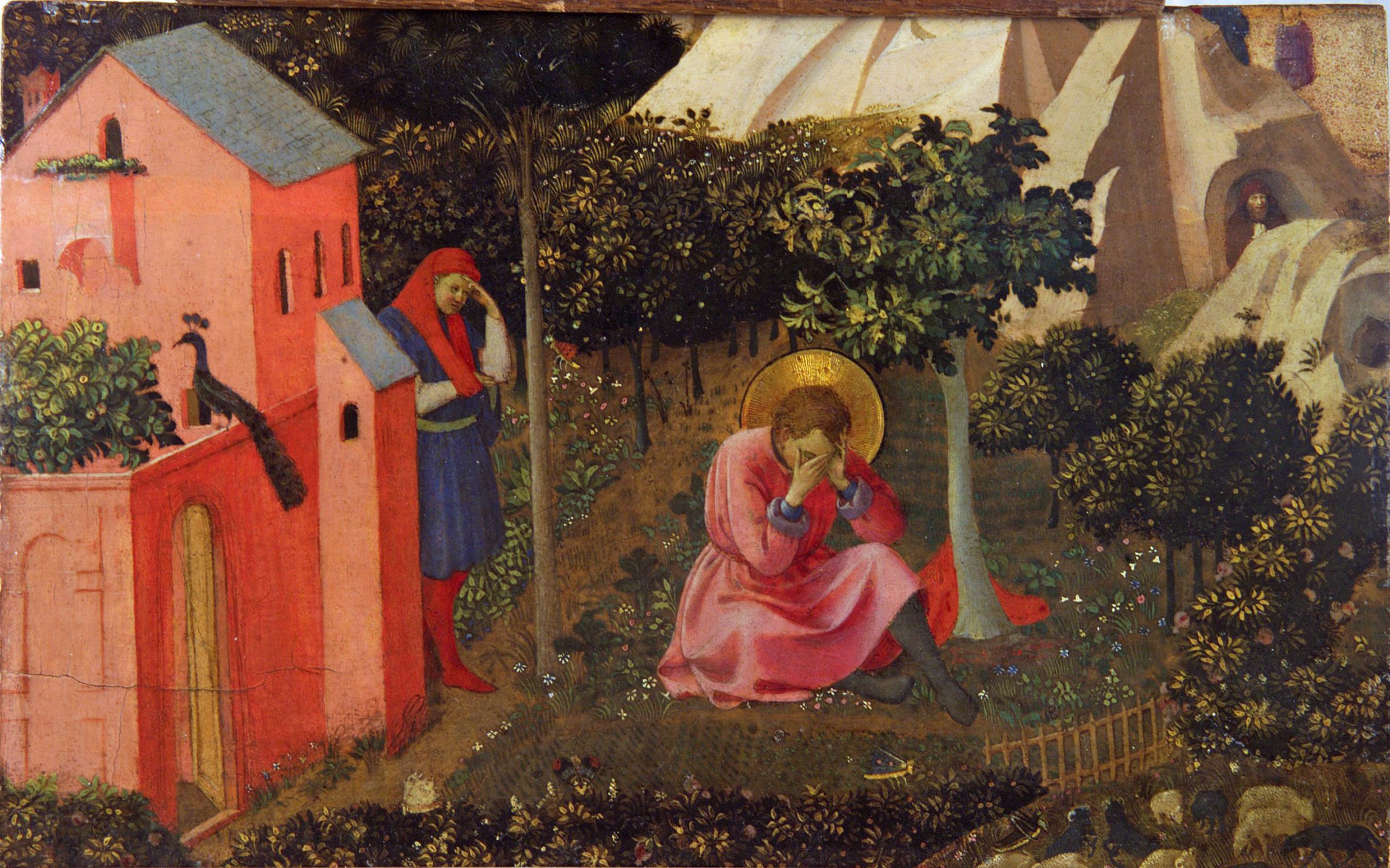
Fra Angelico, The Conversion of St. Augustine
Augustine’s account of his adolescent theft has struck many readers — former Supreme Court justice Oliver Wendell Holmes, Jr. among them[5] — as a poignant and bizarre example of the saint’s overwrought attunement to sin. The woeful Augustine is beset by a guilty conscience, and he’s been warping consciences ever since. Or so the thinking goes.
But is guilt the prevailing theme here? If not, why does he waste ink on teenage tomfoolery? As Augustine reflects on the pears, he names the theft as a sin. But the needlessness and wastefulness of it is what haunts him the most. When I stole the pears, Augustine wonders aloud, what was going on inside me? Why was my heart so restless, so reckless? If not the pears themselves, what was my heart hungering for? What could possibly explain my inscrutable actions?
Book II of the Confessions concludes without any easy answers. Augustine hasn’t figured it all out. Rather, it’s as if he’s saying, I know what it’s like to be embarrassed by past behavior. I know the feeling of wanting to move on, to avoid knowing whatever it was that came over me. But these weighty memories I can’t shake — the things I’ve done and left undone — they have something to teach me about myself. Maybe they have something to teach you too.
Augustine invites me to reflect on even my most painful memories, to turn them over and inspect them with a curiosity fueled by grace. These memories, he suggests, might just offer important clues about the God who made me, who is nearer to me than I am to myself,[6] who loves me enough to rescue me out of my own “region of destruction”[7] and lead me out into God’s own steadfast love.
***
The desire to pay attention to our lives — and to tell others about it — can come from a sense of self-importance. It can be self-aggrandizing. Sometimes it’s motivated by grievance or guilt. Our feeds are full of influencers peddling everything from self-esteem to sex. Too many memoirs and autobiographies plead, Look at me! Envy me! Pity me! Validate me!
We’ve all felt the pull to bend life into self-satisfying narratives. Indeed, the temptation to make meaning of my life without reference to God — or the good of my neighbors — is so strong, so pervasive, it sometimes doesn’t even feel like temptation.
In the Greek myth, Narcissus is a young man with stunning good looks, son of a river god and a nymph. As recounted in Ovid’s Metamorphoses, a blind prophet tells the mother of Narcissus that her son “would have a long life, provided he never recognize[s] himself.”[8] You know how the story goes. Face to face with the waters of a still spring, Narcissus becomes obsessed with his own reflection — without, apparently, realizing he is looking in the mirror. In his obsession, he forgets the world around him. He tunes out its joys and sorrows, the ways he might be of use in it. Self-absorbed, he self-destructs.[9] This is precisely how Augustine defines sin: incurvatus in se, being curved in on oneself.
Here, then, lies the tension. The fictional Narcissus and the real-life Augustine both take a long, close look at themselves. For one, this attention turns fatal. For the other, paying attention is the path to freedom and joy, not just for himself but for untold others who continue to find sustenance in his questions, his words, his prayers.
In Book X of the Confessions, Augustine offers a breathtaking meditation on memory and the limits of self-understanding. In his comment on that passage, Rowan Williams observes that when we say someone lacks self-knowledge, “We don’t mean that she lacks information, or even that she is not given to thinking about herself … Lack of self-knowledge is a failure in moral and spiritual habit, a deficiency in the skills of living according to nature. It is inseparable from failure in love …”[10]
From Augustine I’ve learned to ask what will move my self-knowledge beyond mere information? What will keep attention to my life from warping me as it did Narcissus? Or, flipped around, what would make paying attention to my life — as Augustine did, as we are all invited to do — truly sacred? What are some of the distinguishing marks of this holy, generative practice?
Throughout the Confessions — including the story about the pears — Augustine pays attention to his life in conversation with God. On page after page, Augustine looks back on his life and he wonders. He marvels. He asks questions. Through it all, he keeps returning to God as the fixed point of his life. In doing so, he models for me what it might look like to take the stuff of my life — the painful and perplexing parts included — and offer it all back to God as a prayer.
As Augustine reminds me, my life is given and sustained by God. It is given to me for reasons I will never, in this life, fully comprehend. My life is mysteriously and paradoxically contingent; it is “hanging in the balance of a perfect finished plan.”[11] Meanwhile, as Christians have long understood, our lives are not our own.[12] In gratitude we come to see our lives as gifts to be shared. The twists and turns, the heartbreaks and unmet longings, the glorious and quotidian surprises, all of it — our lives take shape within the broader context of redemptive history; in every moment of every day we are caught up in mysteries of divine love.[13]
The more time I spend with my friend Augustine, the more I see that attending faithfully to my life is helping me — little by little, in fits and starts — to pay better attention to the hopes and fears of those entrusted to my care. Stands to reason, doesn’t it? If I’ve never managed to cultivate a posture of curiosity and openness to my own life, how will I keep from projecting my own inarticulate anxieties onto others? But if I learn to attend to the subterranean movements of my own life, with humility and a corresponding sense of wonder, I might just find the resources to behold the mystery of my fellow image bearer.[14]
***
It’s always fascinated me how in some of the most iconic representations of Augustine, he’s weeping. My copy of the Confessions in Henry Chadwick’s translation, for example, bears an image of our friend in a “region of dissimilarity,” Augustine’s term for the sense of being disoriented in life and disconnected from God. Even more striking is Fra Angelico’s 1430 work The Conversion of St. Augustine, portraying his tear-soaked moment of surrender in a garden in Milan.
Throughout the Confessions, Augustine seems particularly convinced that his tears (and ours) are worth paying attention to. Margaret Miles notes that in recalling the events of his tumultuous younger years, Augustine makes note of “tears of frustration; of physical pain; of grief over the death of a beloved friend; sentimental tears over a fictional character; tears of jealousy; grief over his mother’s death; and tears prompted by the sweetness of psalms sung in church.”[15] His early biographer Possidius describes Augustine weeping at his ordination and again on his deathbed, in the latter case “copiously and continuously.”[16] Augustine’s tears as he lay dying were, as Miles puts it, “richly complex.” He certainly shed tears for his sin, but would have also been “powerfully moved by seeing his life as a whole, by recognizing God’s utterly trustworthy leading in ‘both the bad and the good that I did.’ And the beauty was overwhelming.”[17]
When I was young, I found myself unable to cry, and not for a lack of opportunity. Classmates died suddenly. Others moved away, then I did too. My mom was diagnosed with cancer. A band of terrorists flew planes into the World Trade Center. At funerals and farewells, people around me were crying. I knew, deep down, that tears were a healthy and good response to sad and scary events as well as to unspeakably exquisite mysteries, like fireflies and elote asado. Still, the tears wouldn’t fall.
There in the abyss, entering adulthood, I was numb. I was miserable. I was also self-absorbed.
Coming to this realization scared me to death. It made me desperate to change. A different person in a different set of circumstances may have thought to confide in a parent, a pastor, or a licensed psychologist — those conversations would all come later. In that moment all I knew to do was silently plead: Make me feel again. I don’t care what it takes or how much it hurts. Make me feel again.
***
In the greatness of your mercy and in ways beyond understanding, you answered my prayer, Lord God. You took my numbness and turned it into feeling. You found me curved in on myself and led me out into the land of the living. You woke me up. You made me new.
My God, you have been with me all along. I see that now. You were with me when I drew my first breath. When at ten I opened the front door to masked gunmen, you stood there with me too. When I stole things, and when I carried those heavy burdens for so long, you never turned your back. When friends left, you stuck around. You stayed right here.
When as a family we swam in lakes and the sea, climbed volcanoes, visited pyramids — you shared in our joy. When you placed a love for words in my heart, I felt your pleasure. I keep feeling it. And when you brought Katie into my life — in a staggeringly preposterous way, as is your style, my God — you were giving me the most tangible embodiment of your love.
In returning to me the gift of tears all those years ago, I can’t help but think of the tears of your Son. In the Gospel according to John, we see him crying at the death of his friend Lazarus. Jesus already knows he will raise Lazarus from the dead. So these can’t be tears of hopelessness or despair. Rather, I wonder if they might be tears of lament, Godward tears acknowledging the woeful truth: this world is not the way it’s supposed to be. Might they also be tears of communion — weeping with those who weep, entering fully into human pain — because it’s his pain too?
I think, too, of another scene: Jesus has just turned water into wine. He takes delight in salvaging the honor of the wedding hosts, gladdening the hearts of those who partake. It’s all so gloriously unnecessary. I imagine Jesus standing there, off in a corner by the bougainvillea tree, away from the torchlight. Hand to his mouth, he’s laughing so hard it hurts. The spontaneous tears of your Son — it’s what makes his joy complete.
We love because Christ first loved us. We pay attention because he taught us how.
God of all wisdom, for now we your people “see through a glass, darkly.”[18] So much of your work in and among us will remain beyond our comprehension, beyond the limits of our speech, as long as we live. Still, you invite our questions. You’re not threatened by them. You never grow tired of them. You welcome the good and faithful questions of our early years, and you welcome the questions which arrive later on.
Your servant Augustine said it best: “You stir [us] to take pleasure in praising you, because you have made us for yourself, and our heart is restless until it rests in you.”[19] So when we stray from the flourishing you intend for us — stealing pears and pens — dear Savior, call us back in love. When life is scary or sad — people leaving, dying, disappointing — great Comforter, remind us you are there. When you dazzle us with your gifts — the sight of a bald eagle on a mountain lake, a conversation with soul friends late into the night — heavenly Father, awaken our hearts to sing your praise.
All of life comes from you. So give us the grace to notice. Give us the grace to say thanks.
[1] Justo L. González, The Mestizo Augustine: A Theologian between Two Cultures (Downers Grove, Illinois: IVP Academic, an imprint of InterVarsity Press, 2016), 15.
[2] The Confessions, Rowan Williams writes, is “a work in which the writer’s struggles were worked out on the written page, in which a meaningful life had to be created in words. Augustine is never merely remembering; he is searching for significant patterns, making a biography. Again and again, the questions recur. Why was this so? Where is the hand of God in this or that experience? And yet the question repeatedly modulates into a different key; not, Where was God? but, Where was I?” Rowan Williams, The Wound of Knowledge: Christian Spirituality from the New Testament to St. John of the Cross, 2nd rev. ed. (Cambridge, Mass.: Cowley Publications, 1991), 79.
[3] Augustine and Sarah Ruden, Confessions, First edition. (New York: The Modern Library, 2017), 42.
[4] Ibid., 42
[5] In a widely cited letter, Holmes famously mused about Augustine “making a mountain out of robbing a pear tree in his teens.”
[6] Augustine, and Henry Chadwick, The Confessions, Oxford World’s Classics Ser (Oxford: Oxford University Press USA – OSO, 2009), 193.
[7] Ibid., 34
[8] “Narcissus | Greek Mythology, God, Echo, & Facts | Britannica.” Last modified April 23, 2025. Accessed May 11, 2025.
[9] “Gleeditions | Metamorphoses,” 85–87, accessed May 11, 2025.
[10] Rowan Williams, On Augustine (London New-York (N.Y.) Sydney: Bloomsbury Continuum, 2016), 165.
[11] On the studio version of “Every Grain of Sand,” the mercurial Dylan sings “I am hanging in the balance of the reality of man.” But in live performances that line becomes “I am hanging in the balance of a perfect finished plan.” “Every Grain of Sand | The Official Bob Dylan Site.” Accessed May 11, 2025.
[12] “The Heidelberg Catechism.” Reformed Church in America, n.d. Accessed May 11, 2025.
[13] Thanks to Eric Dirksen for helping to unlock this language for me.
[14] In a book on the wisdom of the desert fathers and mothers, Rowan Williams makes this point: “If we don’t really know how to attend to the reality that is our own inner turmoil, we shall fail in responding to the needs of someone else. And the desert literature suggests pretty consistently that excessive harshness — readiness to judge and prescribe — normally has its roots in that kind of inattention to ourselves.” Rowan Williams, Silence and Honey Cakes: The Wisdom of the Desert (Chicago: Lion Hudson, 2011), 26.
[15] Ibid., 81–82
[16] Ibid., 74, 82
[17] Ibid., 96
[18] I Corinthians 13:12, KJV. As Margaret Miles and other scholars have noted, this is the most-quoted Bible verse in Augustine’s work.
[19] Augustine, and Henry Chadwick, The Confessions, Oxford World’s Classics Ser (Oxford: Oxford University Press USA – OSO, 2009), 3.
Bibliography
Augustine, and Henry Chadwick. The Confessions. Oxford World’s Classics Ser. Oxford: Oxford University Press USA – OSO, 2009.
Augustine, and Sarah Ruden. Confessions. First edition. New York: The Modern Library, 2017.
González, Justo L. The Mestizo Augustine: A Theologian between Two Cultures. Downers Grove, Illinois: IVP Academic, an imprint of InterVarsity Press, 2016.
Miles, Margaret R. Beautiful Bodies: Augustine, Nunc et Tunc. Eugene, Oregon: Cascade Books, 2024.
Ovid. The Metamorphoses, translated by A.S. Kline. Gleeditions.com, 2004.
Williams, Rowan. On Augustine. London; New York; Sydney: Bloomsbury Continuum, 2016.
— — — — . Silence and Honey Cakes: The Wisdom of the Desert. Chicago: Lion Hudson, 2011.
— — — — . The Wound of Knowledge: Christian Spirituality from the New Testament to St. John of the Cross. 2nd rev. ed. Cambridge, Mass.: Cowley Publications, 1991.








Beyond grateful for these words and the man who wrote them. You are a gift, Tim Hoiland.
Thanks, Tim.
What a wonderfully thoughtful and encouraging piece. Thank you for all the quotes and references (so many Rowan Williams books, so little time), and for your openness and honesty and refreshingly graceful prose.
I’ve sometimes found all the piety in Confessions wearying and a little cloying, and that’s my problem, of course. But here I appreciate your own fittingly Augustine-influenced prayer. Thanks again!
Tim, your words and your story have been carried in the wind by the Spirit and have met me, today, in a deeply profound way. Thank you.
Like Augustine, He has given you a heart on fire. It’s all worth it.
Tim,
What an engaging essay. I like how you engage the texts, find courage to be vulnerable, share your own epiphanies.
Such a pleasure to read this, Tim. You reconnect us with the Confessions in life-giving ways. Beautiful piece.
As your former teacher and school counselor, I knew you in your “numb“ years. Thank God, that he has brought you to the place where your writing challenges me to look more carefully, gratefully, and thoughtfully at my life.
Thanks Tim, from a fellow MK who is learning to cry and pray.
Also–I assume you know it but for others who might not–Augustine’s Prayer for the Gift of Tears is wonderful: https://www.lectionarycentral.com/trinity10/Augustine2.html