




Simeon Zahl is a historical and constructive theologian whose scholarship has been, over many years, foundational to Mockingbird’s perspective on the Holy Spirit. When we first imagined this issue, we knew right away that we’d need to get Simeon on the line. As you’ll see, he didn’t disappoint.
Zahl is a graduate of Harvard and Cambridge. Following his doctorate in theology, he completed a research fellowship at St. John’s College, Oxford, and was Assistant Professor of Systematic Theology at the University of Nottingham. In 2018, he and his family returned to Cambridge, where he is now Professor of Christian Theology in the Faculty of Divinity.

In addition to being a foremost authority on underappreciated yet over-teased youngest siblings, Simeon Zahl leads the field on the interplay of Reformation theology and the doctrine of the Holy Spirit. For Simeon, the Holy Spirit is where the idea of God becomes reality — it is God made manifest in the thorny region of emotions and experiences.
Zahl is the author of two books, most recently The Holy Spirit and Christian Experience (2020), a new account of the Spirit’s role in salvation via embodied experience and desire. This followed 2010’s Pneumatology and the Theology of the Cross in the Preaching of Christoph Friedrich Blumhardt, a study of the overlap in Lutheran theology and modern charismatic expressions of faith. Inspired by his interests in Augustine and cognitive psychology, Simeon is currently working on a new book on the theology of sin and its contemporary relevance.
In this conversation, we survey Zahl’s research in layman’s terms, as well as the personal story behind his interest in the Holy Spirit as both a subject of academic study and a real force in everyday life. We talk about the difficulties of discerning the Spirit’s work, the risks of being overly cautious, and the fundamental importance of religious experience.
Mockingbird: Could you tell us how you got interested in pneumatology?
Simeon Zahl: There’s a biographical story, and there’s a more academic/intellectual story. They eventually converge, but I can only see that convergence in hindsight.
First, when I was fourteen, I had a decisive coming-to-faith — or my faith coming alive — experience. I was on a Christian service retreat with my church. And I had this encounter with God, with Jesus, that was very emotional and unexpected. It was clear to me that this was an unequivocally good thing — this was never something I’ve felt the need to problematize. As soon as it happened, I was like, this is for real, and I’ll never be the same.
And then later, when I got involved in Christian ministry, I was asked to help lead my college’s Alpha course. I’d never actually done the course myself, but there I was running it. There was a part where you talk about the gifts of the Spirit, speaking in tongues, and stuff like that. And then you have this time where you stop talking, and you pray for the Holy Spirit to come, which is a potentially very awkward moment for the leader. But that’s what the book said to do, so I did it. It was the middle of the day in a living room at some guy’s house. And all of a sudden, one by one, people started crying — clearly going through something new and life-changing. I had sometimes heard earlier from theologians that I should be nervous about stuff like this, theologically, but right in the middle of that moment I also remember having this intuition — like, I don’t see any opposition between what’s happening here and the Protestant theology of grace and justification by faith. And so I spent the next fifteen years working out, in academic terms, whether that intuition was right, and if so, in what way.
For my PhD, I began studying a guy named Christoph Blumhardt — he was a kind of proto-Pentecostal faith healer, but he also had this low anthropology. And at some point, one of my supervisors said, “You know, what’s really interesting about this guy is his view of the Holy Spirit, not his eschatology,” which is what I had been looking at. And that clicked. It was through studying him that I ended up seeing how the Holy Spirit and the theology of the cross go together.
M: I’m glad you mentioned Christoph Blumhardt. He’s the perfect combo of the things you’re describing, isn’t he?
SZ: He looks like that now. It’s really funny. He’s obscure even amongst most theologians, who wouldn’t know who he is unless they’ve heard about him through Karl Barth. During my undergrad, I was writing a research paper on theology in World War I, and I was reading a book of his sermons. I was like, “Oh my gosh. He’s saying all these insightful things about militaristic nationalism — whoa, guys, war? God? There’s some real problems here.” That was very, very unusual in his context. I remember asking my dad, “Have you ever heard of Christoph Blumhardt?” And Dad said Jürgen Moltmann was a big fan.
One thing I learned from Christoph Blumhardt is that the Spirit is free, creative, and dynamic — and that’s exciting. And that you’re free to be creative when you can trust in the gospel.
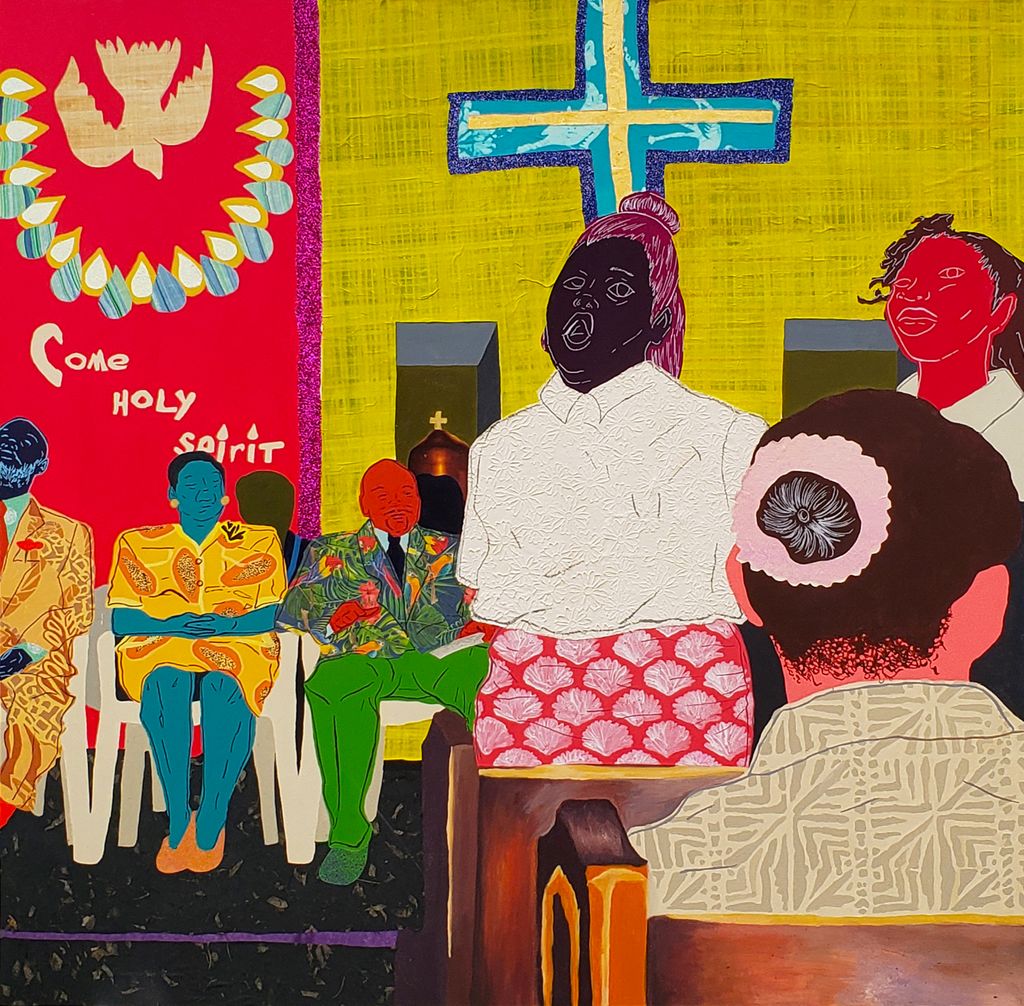
Cydne Jasmin Coleby, Come Holy Spirit, 2021. Acrylic, decorative paper, glitter, and photo collage on canvas, 70 9/10 × 70 9/10 in.
M: Much of your work focuses on the Holy Spirit and Christian experience. Before we go further, I wonder if it might be useful to expound on what “experience” means specifically.
SZ: Yes — it’s one of the challenges with the topic. What is experience? Experience is everything that happens. Doing theology without experience would be like doing theology without being alive.
So it’s important to be as clear as we can. When I’m talking about Christian experience, I mean an experience that makes itself known, in part, through emotional impact on the body at a particular time, or over a particular period of time. It’s not just all the things that your senses perceive; it’s a certain set of feelings traditionally associated with the work of God in the life of a Christian.
That can include the big “mountaintop experience,” like the kind of thing I was talking about earlier with Alpha — you know, these powerful experiences when you’re crying at the altar. Those are clearly experiences that people attribute to the operation of the Holy Spirit; and they’re different from the experience you have eating breakfast, say, because they’re emotionally intense. And because of their intensity, you associate them with God’s agency.
But you don’t want to reduce Christian experience just to these big things. When your faith is built on these kinds of experiences, one of the things that can happen is, you start to feel like you haven’t had any kind of religious experience if in a given week you haven’t had some kind of encounter with God that was dramatic. It’s exhausting to have to have a mountaintop experience every week.
I think that any good account of experience, including of the Holy Spirit, also has to encompass much subtler forms. You can imagine a very low-grade sense of calling, or just comfort and divine presence, or God being involved in things that seem trivial to most people but matter to you. Also, experiences connected with God might be longer in duration, like a mood, a sadness or a feeling of subtle delight in something over a long period of time, not just weeping in a particular moment.
If you think about it, all of that is emotional — the little stuff as much as the big stuff. Irritation is emotional. Boredom is emotional. Emotional experience isn’t just what happens when you get really angry or feel full of fear.
M: Could you say a bit more about how the average churchgoer might identify the work of the Holy Spirit? To acknowledge that the Spirit is, can be, experienced in everyday life.
SZ: Right. I mean, so the problem with saying “I experienced the Holy Spirit” is, the Holy Spirit is invisible. If 2,000 years ago the incarnate Jesus was standing in front of you, you would not be like, “Did I or did I not experience Jesus of Nazareth?” He was standing right there. With the Holy Spirit, it’s not that way.
The Bible uses lots of images and symbols for the Spirit — fire; living water; a dove; and, very famously, wind. Wind, and breath, is not something you see but you feel. And being the kinds of creatures we are, with our biases and our confusions, we get things wrong that are right in front of us, so of course we’re going to get things wrong when we’re talking about an invisible agency.
So that’s one of the great questions for the theology of the Holy Spirit. It always has been. It was raised all the way back in 1 John. The question of how you discern the Spirit. Is it really a true spirit or a false spirit, a spirit from God or a spirit from somewhere else? Is it God or is it the devil, or is it just your own spirit?
It’s very easy as a Christian to be like, I want to do this thing. I think God is calling me to this career that involves prestige or money or power, or to have this ministry that is really big and successful. And you realize, gosh, all of us are feeling called to do the exact same things that all of our non-Christian peers want to do! It isn’t hard to see that we are pretty prone to just baptizing our own desires as the will of God.

Illustrations by Melisa Gerecci.
M: Right. So how do we account for human bias? How do we identify the Spirit’s work while also acknowledging the constraints of misinterpretation?
SZ: Yeah, that’s a very valid, very real concern. Martin Luther, back in the 16th century, was really worried about this — he talked about these people he called the enthusiasts, or fanatics. He said that they were taking all their own dreams and calling them the will of God. And he said that they’d swallowed the Holy Spirit “feathers and all.” What he meant was that they so associated their own subjectivity with what God wanted that they couldn’t believe God might not be wanting what they wanted — that their desires might be sinful, that God might want to disrupt their desires. That God might come in a form that is unexpected or lowly or humble or through suffering. So Luther was very concerned about that.
And, you know, there’s some classic answers to this. One is that God usually tells more than one person if it’s something important. So talk to other people. Also, what does the Bible say? If you think God is telling you to hate a bunch of people, well that seems to not really fit with Jesus’ M.O. Is it consistent with the God that we see in the Bible? In the Bible the work of the Spirit has some specific associations: with salvation; the adoption of people as sons and daughters; sanctification; calling; and then also the fruit of the Spirit (love, joy, peace, patience, kindness, goodness, faithfulness, gentleness, and self-control); and the gifts of the Spirit, the kind of stuff that you see described in some of the Pauline letters, amongst other things. So we do have some relatively specific descriptions of what the Spirit’s work looks like.
I got a good principle from Rowan Williams: He said the work of the Holy Spirit is Christomorphic, by which he means, Christ-shaped. The Spirit is, of course, the Spirit of Jesus Christ in the Bible. You’ll know the Spirit is there when it’s somehow following the pattern of Jesus. The Spirit is there in love. The Spirit is there in experiences of crucifixion, but also in experiences of resurrection. The Spirit seeks out the needy, and consoles the brokenhearted. So when you are wondering if you are hearing the voice of the Spirit, you can ask, is this the sort of thing Christ would do or want? It’s not a bad principle — though like all principles, it is a lot easier to talk about than to actually apply.
I would also want to emphasize that discernment of the Spirit can be slow and complex, not just a lightning bolt from heaven. And discernment always involves a kind of humility that you might well be getting it wrong.
But I would add that there’s a danger in getting so worried about getting the discernment wrong that we never listen to God’s voice at all — that we, in practice, don’t really act like the Holy Spirit is real, at least in any of the ways the New Testament talks about.
I would want to err on the side of trying to listen to the Spirit, and risking being wrong, instead of closing myself off so that I’m never wrong.
M: It seems like many theologians today are suspicious of religious experience (even though one might expect this to be a given of the field). Is that true? I understand Karl Barth had a major influence here.
SZ: It was true for fifty or more years that theologians — especially Protestant theologians — were really skeptical about doing theology in dialogue with experience. That’s a little less true now. But half of Protestants have always had some version of worry about highly emotional or experiential forms of Christianity, going right back to the 16th century.
Karl Barth’s theology brought a new kind of sophistication to this. During World War I, as Barth tells the story, all of his teachers signed this document that said, we theologians support the German war cause. And he realized Protestant theology — the kind of reigning theology in Germany since Schleiermacher — was rotten in its foundations. He said we need to start over again and go a new direction. You cannot have a theology where God wants you to go start World War I, or that says our petty nationalism is righteous and blessed.
So Barth comes up with what is called dialectical theology, which says you have to start from God’s revelation and not from experience. Only God can reveal God’s self. And Barth expressed this position so intelligently and so forcefully and loudly, and he attacked people who disagreed with him so ferociously, that he effectively cowed three generations of theologians — for decades even after his death, they still heard Barth’s voice saying don’t do theology with experience. Even theologians who might have wanted to didn’t know how to anymore.
It seemed like you had this choice between basing all of theology on an experience of yourself, like Schleiermacher supposedly had done, or rejecting the role of experience entirely, like Barth.
What I’ve tried to say is that this is a false choice. When you’re talking about the Holy Spirit, you’re inevitably talking about experience, because of the way the Holy Spirit is described in Scripture — all the acts and encounters with the Spirit, the Spirit’s involvement with people’s emotions, and the fruit of the Spirit in Galatians and elsewhere. So when you move away from experience in theology you’re inevitably moving away from a theology that takes the Holy Spirit seriously in the way that the Bible does.
 M: It doesn’t seem to me that when people talk about “law and gospel” theology (a more Lutheran paradigm), they are always thinking about the Holy Spirit. But at least in your writing, these things are inextricable. What is the Holy Spirit’s role in law and gospel theology?
SZ: The work of the Spirit in Christian theology is always basically where the reality of God becomes a reality in your life. Whenever the rubber hits the road, the right way to talk about it is the Holy Spirit — when God actually encounters you, whether it’s through the Bible or through an experience or whatever it might be; through the Eucharist, for a lot of people.
The Holy Spirit is the one who bridges that gap between the divine theological realities and the real life that you live. So in those terms, the Spirit is going to be involved in the law and the gospel insofar as it’s actually God’s work to convict and forgive and save a real and specific person.
It’s easier to think of the Spirit as involved with the gospel: bringing good news to you, making the good news real to you, making you feel and know and trust, to give assurance and consolation, to give the gift of faith that Jesus died for your sins, and you’re forgiven, and you can go forward in freedom.
But the Spirit is also in the experience of law. In Luther, that’s explicit in a few places and implicit in a lot of places. We talk sometimes about the uses of the law, that the law is used to convict you of your sins in order to prepare you to hear the good news of the gospel. But if the law is being used, who is the user? It’s not the preacher. The preacher can try to use the law, but it may not work. A lot of preachers try to convict you, but you end up cold to it. Luther talks about this very insightfully. And sometimes when a preacher isn’t trying at all, they will say something and it speaks — convicts — very powerfully. That’s because the user of the law is the Holy Spirit. And so whenever the law is actually getting traction in a real human heart, that is the work of the Holy Spirit. Just as whenever the gospel is actually getting traction on a situation or in a human heart, that is the work of the Spirit directly and explicitly.
M: Is there also a sense that discerning the law from the gospel is a dynamic art, guided by the Spirit? I feel like sometimes what’s supposed to be gospel can be experienced as law and vice versa.
SZ: Absolutely. Any preacher who’s ever tried to generate a feeling of conviction of sin in a congregation knows just how hard it is — how easily the words fall flat or don’t connect. Just saying, “Listen up everyone! This is what sin is. You shouldn’t do it!” rarely moves the needle.
Partly this is because human beings resist the law by nature. We hate being judged, and the law only connects, only breaks through our defenses, when it is conveyed with a kind of authenticity and compassion that cannot be faked. I think of that wonderful line in Hebrews, about Jesus being a high priest who can sympathize with our weaknesses, who was tempted just as we are. Compassion comes from knowing what sin and suffering are actually like, not from reading about it. And in my experience, it is conveyed as much in the tone of voice and body language as it is in the actual words you say.
The other aspect, though, is that true preaching of both the law and the gospel connect emotionally, and emotions are the most complex and mysterious aspects of our experience. Who knows why this word, at this moment, cuts me to the heart, when another day the same words leave me cold? I certainly don’t. As Augustine said, we are mysteries to ourselves, and nowhere is that more true than in our deep emotional life. So it’s hard to preach the law and the gospel, because human beings are very emotionally complicated and opaque, which means it is harder than we think to predict how our words will land. What was intended to be compassionate and freeing might be heard as judgment, just as what was meant to be a hard-hitting truth might actually be experienced as freeing, as making you feel understood.
Luther has a great line on this in his Table Talk. He says something to the effect of “You’d think I would be good at distinguishing the law from the gospel at this point in my life since I’ve been studying and thinking about this topic for so long. But even I still don’t know how to do it. Only the Holy Spirit knows this art.” I think this is absolutely right. We are not very good at knowing how to connect with hearts. And we are so quick to use the law, in particular, in ways that are counter-productive — harmful or angry or self-righteous — without even realizing we are doing it. But the Holy Spirit does “know this art.” The Spirit is really good at bringing the law as well as the gospel to bear in ways that are genuinely compassionate and illuminating and freeing and transformative. And the Holy Spirit is real, the Holy Spirit really does do this! We can all think of examples in our own lives. But it’s not up to us. I find that thought comforting.
That said, just because it’s hard doesn’t mean we shouldn’t try. The most important thing a preacher can remember, I think, is that whatever you are trying to say, you need to connect with the heart, not just the head.
M: Another thing you talk a lot about, especially in your second book, is the importance of delight, and desire generally. Why do these feature so prominently in your theology?
SZ: Well, the Spirit of God traffics in desire. I’m drawing here from the theology of St. Augustine of Hippo, who stands behind a great deal of the Reformation theology that we talk about at Mockingbird. In Augustine’s view, human beings are fundamentally creatures of desire. We’re always desiring things. And sin, for Augustine, is disordered desire — desire going in the wrong ways or in the wrong proportions. Whereas holiness, righteousness, is good desire — desire for the right things in the right proportions.
And Augustine says, you only desire something if it delights you, if there’s something attractive about it — including sin. Sin is attractive, it can delight. But ultimately, holiness, righteousness, and salvation are also matters of delight.
He thinks that the way God repairs our disordered selves is by generating within us the desire to do what’s good — to desire God, and to love people rightly. You don’t change someone by scaring them into doing it. You change someone by attracting them toward change, which is fundamentally the work of the Holy Spirit.
That doesn’t mean any good feeling is from the Holy Spirit necessarily, but it does mean that when real, lasting goodness is being drawn out of you by God, it feels easy. Augustine said the one thing that sanctification can’t be is “difficult but possible.”
No, in a given instance sanctification is either easy, or it is impossible. That’s the implication of what Augustine says about desire, and that’s coming out of his low view of human nature and his high view of the Holy Spirit.
M: In the last century, there’s been a major upsurge of charismatic believers. What is the power and promise of that movement? Are there pitfalls or things to be wary of?
SZ: It’s true, both globally and in my own context, that where the church is growing is through very charismatic or Pentecostal expressions of Christianity. Globally there are over 500 million people who are probably best categorized as Pentecostals. And in 1900, there were none. So what that means is that these Pentecostal/charismatic forms of Christianity are working. They’re appealing to the modern person, for whom being an atheist is a genuine option.
Theologically that makes a lot of sense to me, because for all the critiques you could make of Pentecostal/charismatic churches, they take the Holy Spirit very seriously. They say that God is a living reality who can and will encounter you in your life, on Sunday, right now, in your actual point of need. They have an understanding of God that’s unapologetic.
They also recognize the importance of embodied emotional experience. God is not a head-game, not a concept, not a tradition you read about — God is a living reality and agency that you feel, a presence. The music and the altar calls are all designed to help foster, generate, create conditions for an emotional experience of the Holy Spirit. And the reason that’s so successful is because that’s where people live, in affect and emotion — and desire, just like Augustine said.
It does open up problems. One is, getting it wildly wrong. Confusing your own fleshly desires for God’s desires. Thinking that the sign of God’s blessing is that he’s buying you a yacht. You know, that’s a real issue in forms of Pentecostalism. Too often, there’s not much self-critical discernment.
Or there’s that dangerous kind of optimism: If the Holy Spirit’s on my side, everything’s going to be fine. I’m going to never struggle with sin again. And then, of course, life doesn’t bear that out.
Those are manageable problems, I think, in light of the goodness and the power of this movement. You know, the Pentecostals were on the radio before anyone else. They had women preachers a hundred years ago when no one else did. They had racially integrated congregations right at the beginning — although that hasn’t always been true since. But generally, because of the living, active reality of God, you’re free to say, who knows, maybe we’ll do something different now. They’re creative. There’s this playful thing about the Holy Spirit. That kind of energy is exciting, and it’s really missing in a lot of the older, confessional mainline churches.
M: Alongside all of this, there’s also this resurgence of interest in monastics, mystics, and a more Catholic-leaning faith, at least in my own social sphere. Is that related to the rise of charismatics?
SZ: There’s a commonality between the appeal of very experiential forms of Christianity and the more liturgical, ritualized, spiritual-practices-based forms of Christianity. And that is: they take bodies seriously. They take embodied experience seriously. They’re not just telling you concepts or saying, if you can just read enough of the Bible, then everything will be fine. They’re saying, take a different posture with your body in prayer, set up rituals, make use of these prayers you can pray regardless of whether or not you feel it, align yourself with these ancient rhythms, which have a wisdom we have forgotten. There’s still something about the body that is connected with this.
Pentecostal spirituality can be exhausting, and I think people find liturgy attractive who are exhausted by forms of piety where you have to encounter God powerfully every week, where you have to reinvent the service every week based on what you think God has told you to do. So being able to say ancient, biblical prayers that you don’t have to come up with … it’s a relief. And there’s an intellectual depth that people desire from these older traditions, which I think is not a bad thing.
I guess my worry with those is about yet another kind of optimism. That’s another commonality — they risk being over-optimistic about just how much change spiritual practices can offer you. And about the power of habit formation — how successful spiritual disciplines can be at generating Christian virtue. Those are very attractive ideas when they work, but they don’t do as well sometimes with the deepest impasses of life, the deepest resurgences of sin and brokenness.
M: Who are some of the non-academic authors who most influenced your thinking on the Holy Spirit?
SZ: A book that I associate very closely with the Holy Spirit is Theophilus North by Thornton Wilder, which begins with a moment of calling. A generic (but sort of religious) spirit of play descends on Theophilus before he goes into Newport, Rhode Island, where he engages in these very creative, very powerful ministries to all the different broken people in that town. It’s a story of a sort of creative ministry that begins with a moment of — as I see it — inspiration from the Holy Spirit.
I’ve also thought a lot about T. S. Eliot’s play The Cocktail Party — specifically the encounter between Edward and an “unidentified guest” we later learn is called Reilly. Edward begins confiding slightly drunkenly to this stranger at a party about all of his troubles. And then this guy suddenly starts responding, telling him maybe he needs to do certain things, telling him what is really going on with him. And Edward is like, whoa, whoa, whoa, I didn’t ask you to give me advice. I just wanted to confess. And Reilly says: “To approach the stranger is to invite the unexpected, release a new force, or let the genie out of the bottle. It is to start a train of events beyond your control.”
What he’s saying is, once you’ve brought me into the picture, you are no longer in control of the story. This is what it is like with the Spirit. The minute you confide to the unknown stranger, you cease to be the main agent. Now you’ve let the genie out of the bottle and set in motion a chain of events beyond your control. And that is exactly what happens in The Cocktail Party. That’s the story of the play. As it turns out, this stranger is benign — the stranger ends up being, in a real sense, the agent of Edward’s salvation. In the analogy, Edward has turned to the Holy Spirit — to the living reality of God — without fully realizing it or thinking it through, and then suddenly all these things start happening that are not what he expected, that make him uncomfortable at first. It’s freeing, but also scary. There’s something risky about opening yourself to the Spirit — and yet, the Spirit is benign. The Spirit is always in your corner, whether you like it or not.








What a beautiful and rich interview. Thank you! Now…if I could just get Simeon to have a conversation with my Jesuit Spiritual Direction instructor. 🙂 I’m in the middle of learning St. Ignatius Rules of Discernment, and needless to say, they’ve been so helpful. (i.e., Simeon’s first experience at 14 of faith coming alive would be a “consolation without cause.”
Or another favorite, Rule 13 (which I like to call the “F you Satan rule”): “When the enemy of our human nature brings his temptations to you, he wants and desires that they be experienced by you alone and struggled with in secret. But when you choose to reveal these temptations to a spiritual director or spiritual companion and ring the temptation into the light of Jesus Christ, the evil one, who is only comfortable in the dark and has no power in the light, knows his deceits and temptations are fully frustrated and withdraws.”
Anyway…meaty stuff that I’m still chewing on
Fantastic interview. The point that we should perhaps err on the side of listening for the Spirit is counter cultural (at least in my world) and very well taken. I wonder how much has been lost through fear that emotion is unreliable or that distinguishing the Spirit from one’s own projections is simply too difficult.
The little bit of acute pneumatic experience I’ve had in my adult life has had to come completely out of left field. Walking into a certain church near Orlando, a greeter asked me, “Are you ready for a miracle today?” It totally disarmed me—a miracle was the last thing I was thinking about that particular Sunday morning—and the ensuing church service hit like a freight train. Hoping Simeon’s work can help us channel more of that power in more ‘mainstream’ American church contexts.
I grew up Lutheran but I treasure the fact that I have had some very unLutheran experiences with the Holy Spirit including “swallowing some feathers.” This is one of the richest treatises on the Holy Spirit I have ever read.
The joy of the Spirit is that he is with us every step of the way on this journey that he has called us to embark upon.
Great interview. I recently finished Simeon’s latest book on The Holy Spirit and Christian Experience. I’ll need to read it again soon.
Also reading Unapologetic by Francis Spufford and finding echoes of what Zahl wrote.
Started my odyssey of faith, outside of the church, being impacted, really impacted, by experiences with the Living God. I was raised Roman Catholic and lived the idea that God was impassible, which is completely at odds with significant portions of scripture. Exodus 34:6-7 has become a cornerstone of a personal reformation. But that impassibility, as I see it, has been driven down into many faith streams and communities. If our Father, is impassible, how will we act? Heard someone say “theology creates culture” many years ago. Our idea of our fathers shapes our identity, and so in my estimation much of western civilization has been created in that image. Myself included. I’ve been stuffing emotions for over 5 decades, and oh my does that super ball bounce back. Our culture is increasingly plagued by anxiety and poor emotional and mental health. My loosely held conclusion is that impassibility lies at the root. In Matthew 23:37-39 and Luke 13:34, Jesus laments over Jerusalem. He also as we know wept. But men in the west are taught that’s effeminate. And the Greco-Roman paradigm we’ve imbibed has taught us stoicism is the way for men. The prophets were not stoics. God’s only 3rd person description of Himself in Exodus 34:6-7 is full of emotional characteristics. He loves in a way we can’t even imagine, but even we mere mortals knows that to love someone is to hurt as well. Went from hyper-charismatic, to reformed with a significant charismatic dimension, to a deconstruction of faith that never bottomed out (thanks be to God), to a reconstruction of an understanding of scripture from more of a Hebrew-Aramaic mindset. I appreciate the scope of this article thats takes into account multiple streams of faith that have contributed to the churches continued existence. All of the various experiences I’ve had I realize have been conducive to my being on the path all my life now (almost). I think my history, which is the history of, well, all of us, reflects God’s continued management of His creation and of His people (all of them). The Holy Spirit has continually disrupted history, and certainly no less my life. I think in many ways mostly to move us to the answer of Jesus high priestly prayer, that we would all be one, as He and the Father are one. All of these conclusions are held loosely. I appreciate the opportunity to bring them into the light, and apologize from my lack of brevity. Feeling as if I’ve received answers to question I’ve had since 15 years of age (now 65) has left me feeling more willing to share my thoughts, less concerned about mean peoples responses, and more willing to be vulnerable in the light. Iron sharpens iron. Thanks for that opportunity. I love the way Mockingbird makes me think and reflect.
Great stuff, Simeon – thank you!! Loving all the responses here too.