




Editor’s note: This essay appears in Issue 26 of The Mockingbird print magazine, now available to pre-order! Additionally, we are thrilled to be hosting Elizabeth as one of the speakers at our May conference in New York City. Come out and see us!
A few years ago, I was in a grand old building on the Strand, itself one of London’s grandest old streets. About fifty people had entered through the Palladian arches (built in 1774), passed under the banner advertising “21st Century Enlightenment,” and gathered in a vaulted hall. We had been invited to contribute to one of the many research projects undertaken by the Royal Society of Arts, Manufactures, and Commerce. The finest minds from across academia, healthcare, and policy were assembled to discuss something usually outside the organization’s secular, intellectual remit: spirituality. The unsaid subtext was, “How do we rescue this seemingly unavoidable concept, which research is increasingly showing the utility of, from woo and the credulous religious and make it respectable again?”

They had invited the wrong person. Although at the time I led a serious and credible think tank, I have found gatherings like this always bring out my mischievous side. I care less and less about being respectable. This whole project seemed to be missing the point. The suits, the detached analytical language, the PowerPoint presentations. Not my bag at the best of times, but particularly when applied to a subject as deep, tender, and rawly human as this. I listened as well as I could to the eminent psychotherapists and sociologists, peered dutifully at the charts and graphs, while mainly wondering how we could crack this room open and get to the real stuff.
All of which meant, when I got up to give my presentation, I junked my script (it had no graphs anyway, but I had at least tried to play the game with some research citations). Instead, I started with, “I pray in tongues.” I explained that praying in tongues is like one part of myself speaking a language that a different part of myself doesn’t understand. It releases things that need releasing, allows me to connect with the divine, precisely because it gets me “out of my head.” “Let’s talk about that,” I said.
That did it. The energy in the room instantly shifted. People looked up from their notes and devices, and sat straighter. Who was this weirdo? But also, this sounded interesting.
More recently, I was in a different gathering. This time with Christians, mainly North American, in a retreat center in Texas. Each session started with a few beautifully arranged old hymns which were sung sincerely but sedately in our rows, hands by our sides. Except I was not sedate. Despite my best efforts not to cause a spectacle, my arms jumped around, and I found myself muttering in tongues. Worse, during the talks my hands kept twitching and shaking whenever anyone said something especially profound or moving. All weekend, I felt like my body was an antenna which had been too sensitively tuned.
In one of the coffee breaks, another attendee, an eminent public intellectual who had had a mid-life conversion and was new to these kinds of gatherings, sidled up. Very politely, he asked if I had a form of Tourette’s. “I don’t think so,” I said. He paused, clearly wanting to ask what the physical jerks were about, but didn’t want to be rude. “Honestly, I still don’t fully understand it,” I told him, “but to the best of my understanding, this is just … the Holy Spirit.”
I am forty years old. I am in what philosopher Paul Ricœur calls my second naïveté with my faith, and somewhat surprised to find myself still being the weirdo in rooms like these.
Like many people, I have returned to the place where it all began. I became a Christian through a “dramatic ecstatic encounter” in my teens. Notice that respectable academic phrase? I am used to trying to explain it to people for whom it sounds bonkers, and for whom the phrase “I had an experience of the Holy Spirit” makes even less sense. At a youth festival I had been invited to by a church-going friend, I prayed, “God, if you are there, would you show me?” and then spent an hour (or five minutes?) flat out on the floor of the arena. I can’t tell you what happened in that time, because it was beyond language, but I stood up a Christian, changed at what felt like a cellular level.
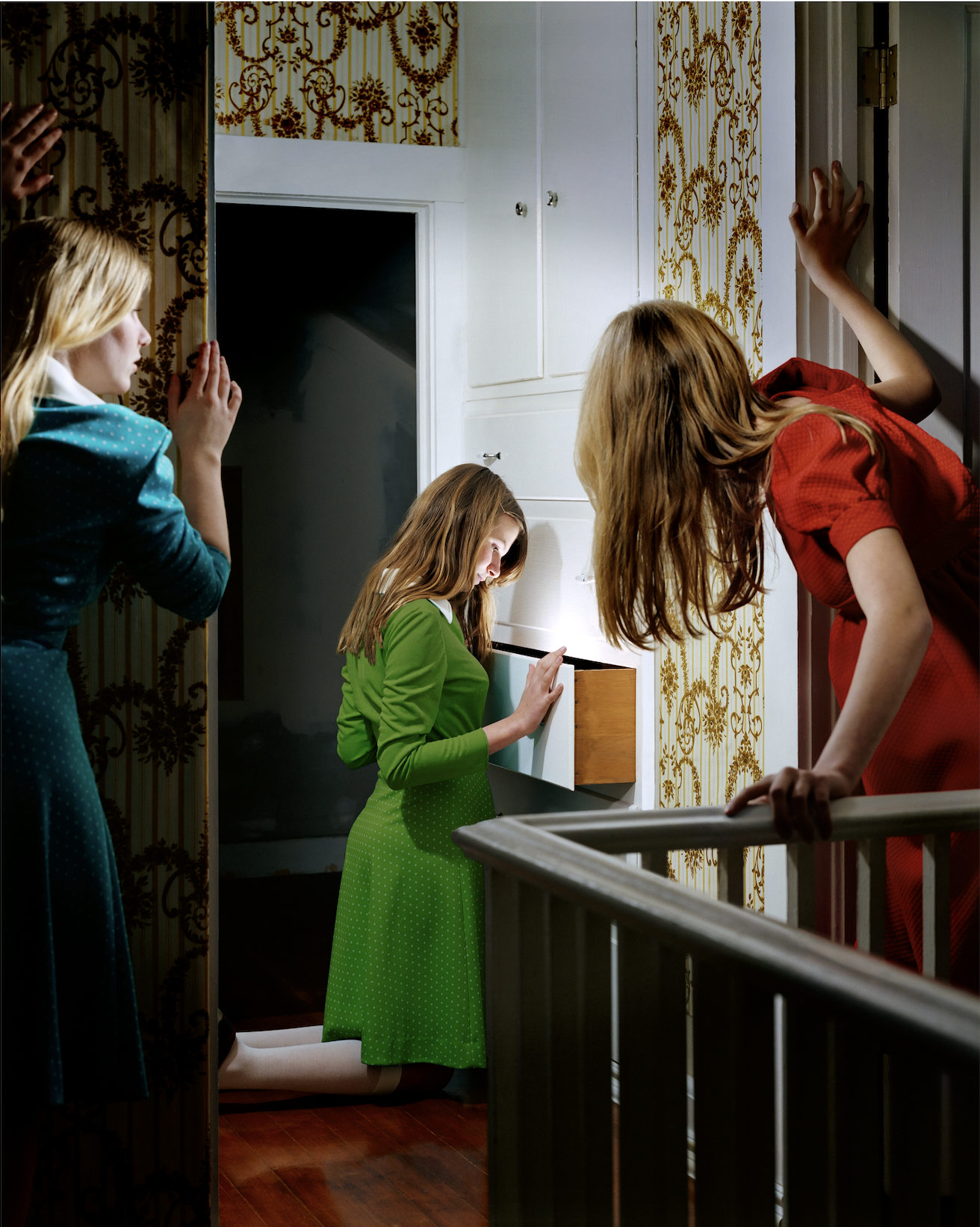
Holly Andres, The Glowing Drawer, 2008. From the series “Sparrow Lane.” Chromogenic dye coupler print, 25 x 20 in.
My early years in church were defined by speaking in tongues, dancing ecstatically with praise flags, and getting “words of knowledge” for people. These, honestly, were pleasant but vague (“I see a waterfall, God’s love is pouring over you,” or “I see a flower, you are as beautiful and precious as a flower”) in the same way horoscopes often seem — applicable to anyone. Mainly though, these charismatic practices (as I learned they were called) were a source of deep beauty, comfort, and joy. I felt like I was being continually reconnected with the Source, spiritually and emotionally reorientated and reset. I needed them.
Until my twenties, when it all fell apart. My complete lack of intellectual underpinnings meant I was ripe for what is now called a “deconstruction.” (Then it was just a “crisis of faith,” “a dark night of the soul.”) I came to realize that nothing I had believed in made intellectual sense. It all clashed with my new, highly educated persona. Christianity itself, and especially these embarrassing emotional outbursts, were something I would do well to grow out of if I wanted to take my place in the world of ideas. I decided I would shake off this whole childish fantasy, read Sartre in dark bars while drinking martinis alone. (It is no accident that I saw Sondheim’s Company around this time: “I want to get all dressed up in black … and go sit in some bar, at the end of the counter, and drink and cry. That is my idea of honest-to-God sophistication.”)
My faith felt unsophisticated, unintelligent. I wanted instead ironic, cynical, restrained, smart.
I did read some Sartre, but crying alone in bars is, it turns out, quite boring. My brief attempt at atheism just didn’t stick. It didn’t suit me. I am temperamentally ill-suited to nihilistic languor. More fundamentally, I could not seem to shake God off. Whoever I had met on the floor of that arena was not going to let me go.
My practice was different the second time around. As I edged my way reluctantly back into church, I was chastened, suspicious. I sought out minor key lament. Sincere but sedate seemed the safest option, and so I followed the well-trodden path from charismatic evangelicalism to contemplative practice, packing away all my noisy, four-chord guitar worship band CDs in favor of silent retreats.
But something in my spirit was still not satisfied. Worshipping without using my body felt stilted and constrained. I didn’t just want to intellectually assent. I wanted encounter. And for me, for better or worse, that has most often happened in embodied, sometimes embarrassing, emotionally demonstrative ways.
I do not, of course, believe that the Holy Spirit moves only in these “charismatic practices.” I just seem to need them. It took me a while to admit this. I was helped when I came to understand some of the history — specifically, the way charismatic experiences have often been treated with suspicion and disdain both by secular skeptics and other Christians. Jules Evans, in his book The Art of Losing Control, records the tendency to observe them “with a mixture of amusement and horror, as a regression to primitive irrationalism, like the flagellate craze or dancing manias of the Middle Ages. No wonder, critics sneered, [charismatic practice] was so common among women, the working class, ethnic minorities — these groups were naturally more unstable, emotional and credulous.”
Well. That line alone freed me. Get me “Unstable, Emotional, and Credulous” on a T-shirt, I thought, and surrendered in one go my internalized shame.
I am trying to follow a figure who was most often found with those on the edges, not at the center of power. Jesus gave, as far as I can see, zero Fs for respectability, for the acclaim of a detached intellectual milieu, whether secular or theological. Yes, ecstatic experiences are open to misuse; yes, so many of the settings for them are loud and flashy and over-hyped, but still. Honestly? I like the idea of Evensong better than the reality. I sometimes find it boring. I understand the importance of more formal liturgies and use them daily. But I also need to get out of my head, like the Queen Weirdos that were the medieval mystics.
I have learned that you don’t have to pick a lane. You don’t have to pick just one thread from the glorious tapestry of the church. I can keep reading my Rowan Williams, still pray the Jesus Prayer and Compline and go on silent retreats, but also speak in tongues, weep on the floor, and dance at the back of church. You’ll find me there, wearing my new T-shirt, waving my flag. Has anyone seen my CDs?








I love love this. As someone who has been undergoing deconstruction”, and coming from a charismatic background, it’s freeing to know that I can be me. I can enjoy the worship raise my hands pray in tongues dance jump, while also enjoying the more quieter side of my faith. Truly it’s all about relationship and to have relationship there has to be encounter and holy spirit can encounter us in such a myriad of ways that I don’t want to limit what he’s doing in anyone’s life including mine!
Thank you, thank you! I told a charismatic once that I was a Charismatic Calvinist. They asked what a Calvinist is? I told a Calvinist, and they said, “You can’t be!”. Thank you for sharing that I can pray Puritan prayers , be blessed by Luther’s writings, recite the Jesus prayer and speak in tongues, and have words of knowledge and discernment…
Thank you so much for this. You’re also describing me. An Episcopal priest, I can lead any BCP service flawlessly. Next month I’ll be on retreat at my fave Abbey (in Pecos, NM, which used to be “charismatic “ but is no longer). But I also have ecstatic experiences (can include shaking, crying) of the Holy Spirit. And tongues (like when my head doesn’t know quite what to pray, nor how to put it in normal words). I have served on the Board of a local Christian non-profit where the leadership is known for celebrating the charismatic gifts of the Spirit. So many ask me how I can possibly fit in. All I can do is shrug and say we follow the same Jesus. And he is not predictable.
What a light touch, a not-take-myself-too-seriously delight in the writing, while being challenging and even profound. I really look forward to hearing Elizabeth at the May NYC conference.
Thank you for your delightful, honest, and perceptive article – which I found “by accident” or so it seems. It resonated with me because I too have taken the “well-trodden path from charismatic evangelicalism to contemplative practice” with lots of detours along the way. I smiled when I read of your appreciation for Rowan Williams (one of my gurus) and the liturgy of Evensong. I do, however, thrive on the music of Evensong, including that strange animal called “Anglican Chant”, but I can totally understand how the music isn’t for everyone.
Anyway, describing my early background as Charismatic is, perhaps, putting it too mildly, as I was raised according to Sister Aimee’s brand of Pentecostalism. While re-examining those childhood and teen religious experiences with formerly Pentecostal church/journal mates, I have realized that one of the few silver linings from that upbringing has been, ironically, the practice of speaking in tongues. It is automatic for me in intense situations. Whether or not I’m doing it the prescribed way doesn’t matter because I know God knows my heart and intellectualized words are not getting in the way. It is like scat singing. The syllables may be improvised and even nonsensical, but they are driven by the Music itself. The wisdom of tongues is, perhaps, also confirmed by therapeutic practices that allow one to return to their inner child through improvised babble, tuneful or spoken. The goal in this sort of musical therapy is for the client to express something deep within. It is like many of the heartfelt Charismatic practices, such as dancing, etc. which, as you wrote about so eloquently, allow one to bypass rational constraints.
I am disappointed to read such nonsense. People flap around on the floor and speak in tongues through group hysteria, nothing more. For people like me, the Society of Friends seems like one less option. In 1992 I discovered the teaching and path of the Buddha. This is the true path for me and those who simply wish to see reality more clearly. Prophesy and fortune telling do not.
I love the humor here, balanced by genuine, incisive critique. Will be thinking about this for a long time!
Well well now you’ve done it. Let the spirit out of the ole
Bag have you! There are many of us closeted gifts of the spirit beings, and I now after 30’yrs of being part of a church where gifts of the spirit were often part of worship to almost never now part of an episcopal church we love dearly. Our hands occ sneak up in the air, not wanting anyone to faint. Not sure tongued will ever enter the sacred atmosphere ,
We are all His children
Thank you for writing this! I came to faith in Jesus through a Spirit-filled Episcopal Church. Been a part of the dancing, the flags, etc. Even wrote a paper on charismatic spirituality while in seminary! I also saw the unfortunate manipulative abusive side of that spirituality, which launched my own deconstruction. But there was a deeper, loving healthy formation underneath that – and it held firm. I still pray in tongues, especially during sermon writing! Guess this is the place where closeted tongue speaking Episcopal Priests come out…