




If you’ve been on TikTok, Instagram, or any women’s online magazine in the past five years, you’ve probably come across one, if not all, of these various skincare trends. There’s dewy skin, glass skin, skin that looks like a glazed, Krispy Kreme donut — all in the name of achieving “flawless” skin.
We’ve all been there. We spot a wrinkle. A blemish. A pore the size of a crater that we need to spackle with concealer before we can leave the house. So, we find ourselves down the rabbit hole of skincare ranging from pouring on acid solutions to protecting our skin’s barrier.
The quest for perfect skin is no better exemplified than when you step into a dermatologist’s office. When I walk into my primary care office, I’m advertised about eating a healthy, plant-based diet and getting regular exercise. When I walk into my dermatologist’s office, I’m advertised about how to anti-age and erase my skin’s imperfections.
“I saw ads for all of the following beauty procedures: Botox, skin fillers, non-invasive cool sculpting fat reduction, radio-frequency wrinkle reduction, laser skin rejuvenation, liposuction, and upper and lower eye rejuvenation,” Renee Engeln, an award-winning professor of psychology and director of the Body and Media Lab at Northwestern University, recalled about one of her dermatologist visits.
This is a symptom of a much bigger problem. And according to Engeln, who wrote Beauty Sick: How the Cultural Obsession with Appearance Hurts Girls and Women, never before in human culture have we been so flooded with nonstop beauty messages and images.
“There is nothing ‘natural’ about the current beauty climate,” she said. “In the same way that abundantly available sugar can have a negative impact on our health, abundant images of highly idealized female beauty can make us sick.”
While there may be nothing natural about the evolution of our beauty standards, it is intentional. For each advertisement we see, whether in an office or a drugstore, we’re shown how we’re falling short then given a solution. And it’s making a fortune.
According to Statista, the United States is the most valuable beauty and personal care market in the world, valued at nearly $98 billion in 2023. Personal finance site Mint.com estimated that the average woman will spend $15,000 in her lifetime on makeup. And the number of cosmetic surgeries on women in the U.S. increased by 538 percent between 1997 and 2015.
So, with all of the money we’re spending and solutions we’re being sold to achieve flawless skin, why are we seeing rates of inflammatory skin conditions like eczema increasing and the prevalence of psoriasis more than doubling between 1979 and 2008?
First, let’s start with soap.
Soap: The Biggest Beauty Scam of Them All?
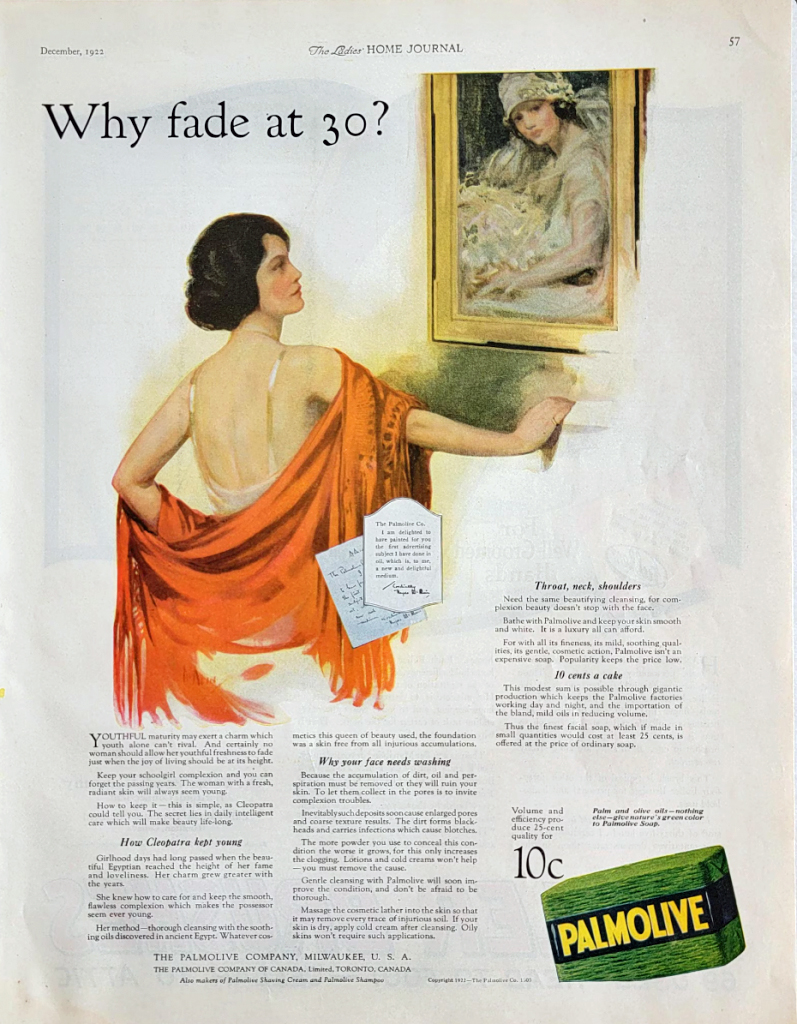 In order to really dig into this, we have to go back to the early 1900s to explore the history of soap. Yes, soap.
Two-thirds of Americans report showering every day, according to Harvard Health Publishing. That usually enlists the help of soap. But soap wasn’t always that big of a staple in people’s lives — or that easy to come by.
In fact, according to James Hamblin, a board-certified preventative medicine physician, former staff writer at the Atlantic, and author of Clean: The New Science of Skin and the Beauty of Doing Less, into the late nineteenth century — and later for much of the world — store-bought soap was a luxury good.
Soap also had an extremely ugly recipe. So, let me describe it to you in detail.
For thousands of years, farmers would make soap themselves after slaughtering an animal. They’d take its skin, cut it into strips, and then let it crackle over a roaring fire until the white fat would melt off and boil into brown lard. Once that happened, they’d mix rainwater and wood ash together with the lard. And voilà! You have soap.
Generally speaking, soap was primarily used for laundry back then. In the rare circumstances when you were covered in dirt or grime that wouldn’t come off with a bath of water, soap did the job.
Fast forward to 1924, and the slogan “Keep That Schoolgirl Complexion” first emerged on a bar of soap. Soap became so popular, its advertisements funded a whole new genre of daytime radio shows for women called “soap operas.” Colgate-Palmolive, one of the first companies to mass produce soap, would go on to become a $20 billion company.
Soap became a symbol of cleanliness, purity, youth, and beauty. But it also became less like soap for the sake of selling beauty.
According to Hamblin, “A soap, by definition, has a highly basic pH of 10.3. This is by design. The less basic a soap is, the less well it binds to the oils we seek to remove. Dove has a pH of 7, because of the addition of the emollient. This makes it less drying. In other words, it is less able to bind and remove oils. In other words, it is less good at its job. It is the nonalcoholic beer of soaps.”
But while the global market for soaps, detergents, deodorants, and skin care products soared into a trillion-dollar industry, the promise of purifying our bodies of the outside world is questionable.
“As the scope and intensity of global cleaning practices has escalated, we’ve been oblivious to their effects on the trillions of microbes that live on our skin,” Hamblin said. “The vast majority of our skin microbes seem to be not simply harmless but important to the skin’s function and, so, to the functioning of our immune systems.”
Hamblin’s main point is that the skin is pretty excellent at doing its job. Left to its own devices, “Skin can be torn wide open and heal itself back together in a few days’ time. Skin can keep us from fatally overheating by drenching itself in liquid that causes heat to radiate more quickly into the adjacent air. Skin is no less vital than our heart or spine or brain. Without it the floods that compose us evaporate, and the outside world pours into us and infects us and we quickly die.”
For millions of years, skin has learned to adjust to surrounding environments and maintain its own equilibrium. Today, our regular soap regimens involve stripping away protective oils and microbes multiple times a day, leaving our skin drier and more porous, which allows more of the outside world to come in.
So, if we look at the science of skin and the history of soap, what we’re taught on TikTok doesn’t make much sense. Which raises the question, how did we get here?
Skincare Trends — From 3-Step to 10-Step Routines
According to Jessica DeFino, a beauty reporter and critic interviewed on Sounds Like a Cult’s “The Cult of Skincare” episode, the skincare industry took off after the Industrial Revolution, when products could be mass-produced and mass-marketed as a one-size-fits-all approach to beauty.
“Helena Rubinstein and her brand were really foundational in this. She was the person who first came up with the idea of skin types in the early 1900s, just totally based on a marketing thing, not on scientific fact at all. And it became foundational to the dermatology field. That’s how powerful it was. Even today, dermatology and studies are based on this idea of skin types. That’s totally just a marketing ploy,” she said.
According to DeFino, Clinique in the 1960s was one of the first brands to come up with the three-step skincare system to cleanse, exfoliate, and moisturize, also a marketing movement with no preexisting dermatological research.
But tracing back to Hamblin’s argument, our skin shouldn’t need that much maintenance. In fact, some of the beauty trends we’re seeing, like glass skin, are actually signs of damaged skin.
“One of the telltale signs of over-exfoliation is that the skin looks ‘plastic,’ ‘shiny’ or ‘waxy,’ which means it reflects light easily, as the outermost protective cell layer is gone and all the young, proliferating cells are exposed to the environment,” Dr. Neil Sadick, a board-certified dermatologist with Sadick Dermatology in Manhattan, told DeFino in her article for Fashionista regarding whether or not you should “feel” you skincare products working.
“That is obviously a bad thing, as not only are you sabotaging the young cells by exposing them to environmental triggers, but you are also at great risk for serious infections and epidermal damage. ‘This look is incorrectly associated with a ‘glow,’ which it is not,” Dr. Barbara Sturm, an orthopedist who does extensive work in skin care, told DeFino. “It is the sign of injury.”
Yet, women will go through so much pain just to attempt to achieve these beauty ideals. Here are some customer product reviews DeFino reported finding:
“‘It burned like a motherf*cker,’ reads one Sephora customer’s review of The Ordinary AHA 30% + BHA 2% Peeling Solution… accompanied by five shining stars.”
“’I have sensitive, acne-prone skin and it stings for about two minutes upon application,’ reads another, this one about Drunk Elephant T.L.C. Sukari Babyfacial 25% AHA + 2% BHA Mask. ‘This is by far the best facial I have ever tried!’”
“‘I ended up getting some burn spots.’ (Five stars.)”
“‘The stinging is a little scary.’ (Five stars.)”
“‘It scared me so much the first time I used it, I washed it off immediately.’ (That one still earned four stars.)”
All of this reminds me of one horrifying tale we were collectively traumatized by in theatres for 2 hours and 20 minutes last year — but not traumatized enough.
The Substance — an Ignored Cautionary Tale
I can’t write about the beauty industry and not talk about the movie The Substance. If you haven’t seen it yet, don’t. It’s a modern-day cautionary tale steeped in the grim magic of old fairy tales much like the Brothers Grimm’s “Cinderella,” where her evil stepsisters mutilate their feet to fit the glass slipper, or like Hans Christian Andersen’s “The Little Mermaid,” in which her agonizing transformation to land legs meant every step felt like walking on knives. In other words, it’s extremely grotesque and gory.
The Substance follows once-famous actress Elisabeth Sparkles who has been forced from her long-running TV show due to her age. Desperate to reclaim her youth and beauty, she turns to a mysterious black-market serum that promises a “younger, more beautiful, more perfect” version of oneself. But the miracle elixir doesn’t just restore her — it splits her, creating Sue, a younger, more perfect version of herself with terrifying consequences. As the two selves battle for control, the film exposes the monstrous underbelly of society’s obsession with perfection, offering an unsettling critique of the impossible beauty standards that demand women stay forever young — or disappear.
Months after watching it, I still feel extremely queasy when I think about the film. But as this sick feeling has settled, another more familiar one bubbled up, something I believe most women have felt at some point in their lives. The feeling we get when we walk past a mirror — pausing to judge and assess whether we meet some invisible checkpoint before we can be seen by the rest of the world. And if we don’t, the feeling of self-loathing and shame that keeps us hiding behind makeup and paying small fortunes to tailor our bodies to meet a standard we were never intended to meet.
In fact, 70 percent of women in England reported that they do not leave their house without cosmetics, according to a British study published in 2010. More disturbingly, nearly 70 percent of UK bosses were less likely to employ a woman who didn’t wear makeup during their interview, according to a 2013 study done by UK beauty retailer Escentual.com.
I teared up listening to Demi Moore’s acceptance speech at the Golden Globes for her award-winning role as Elisabeth Sparkle in The Substance. She said to nearly 20 million viewers, the highest viewership in five years, “In those moments when we don’t think we’re smart enough or pretty enough, or skinny enough or successful enough, or basically just not enough — I had a woman say to me, ‘Just know, you will never be enough.’ But you can know the value of your worth if you just put down the measuring stick.”
Yet, the irony was that amid all the award-show attention, instead of empowering women to put down the stick, it gave them more to measure.
According to DeFino’s Substack: “The Substance is a Fairy Tale (But So Is Beauty),” while the film celebrated five Oscar nominations, the Oscar nominee’s gift bag included a $25,000 gift certificate for liposuction. Charlotte Tilbury sponsored Moore’s Oscars look using 29 products, including their Magic Serum Crystal Elixir that promises to be the “supercharged secret to your skin’s best future!” Wellness brand Sakara posted a promo for its Daily Elixir, selling it as “like ‘the substance,’ but legal, effective, and 100% not scary at all.” And to top it off, Ulta aired a commercial proclaiming that “beauty is about possibilities.”
This all proved Renee Engeln’s theory: our culture is infected with beauty sickness, too addicted to the sugary promises of our skin serums to even care to notice.
“In the end, these ads capture consumers’ imaginations in a way The Substance cannot. Better, younger, perfect will always be more compelling possibilities (if less realistic) than dermatitis, dysmorphia, death,” DeFino said.
It’s time for us all to wake up from our culture’s fairy tale of beauty before we meet a version of Elisabeth Sparkle’s nightmarish end.
Beauty, a New Religion
I’ve been on the quest for perfect skin before.
I struggled with acne most of my life, even into adulthood. During the pandemic, I tried to achieve flawless skin. You could catch me skipping a stillness time or my daily spiritual rhythms, but you would never catch me skipping makeup removal or washing my face before bedtime.
I recently read Elizabeth Oldfield’s book Fully Alive: Tending to the Soul in Turbulent Times. In her chapter about where we find our worth and dignity, I was stopped by novelist and essayist David Foster Wallace’s words:
“’In the day-to-day trenches of adult life, there is actually no such thing as atheism. There is no such thing as not worshipping. Everybody worships. The only choice we get is what to worship,’ Wallace said. Worship your body and beauty and sexual allure, and you will always feel ugly. And when time and age start showing, you will die a million deaths before they finally grieve you.”
Beauty is now identified as a form of self-care. Whether we like it or not, these routines and practices have become a form of worship, one I fear will perpetuate these harmful beauty standards and rituals for generations to come, training them younger and younger. In fact, we’re already seeing this today.
According to Vice, little girls weren’t writing to Santa for dolls last year. Instead, many parents reported skincare as a top priority on their Christmas lists — including girls as young as eight. Among these products were serums to reduce wrinkles, $55 eye creams, and products much too harsh for children’s skin.
Nothing is natural about that.
We’ve allowed this industry to define what beauty is for women. It’s time we redefine it. And while the true definition of beauty has to do with aesthetic pleasure, I don’t find this definition satisfying at all.
When I came across Theologian Mary Shawn Copeland’s words in Oldfield’s same chapter about where we find our worth, I finally found the definition I’d been looking for: “[Beauty] is living up to and living out the love and summons of creation in all our particularity and specificity as [God]’s human creatures made in [God]’s own image and likeness.”
While I’m bombarded with messages about beauty standards I must live up to as a woman in my 30s, this message silences them all.
Beauty isn’t glass skin or showing no signs of aging (aging is a privilege by the way). Beauty is recognizing the dignity, value, and belovedness that every person holds — regardless of whether we have pimples, smile lines, crow’s feet, or look like Sue at the end of “The Substance.” How beautiful is that?
A New Standard for Beauty
Last year, I chose to switch dermatologists. I sat in a beige waiting room with harsh overhead lighting and no advertisements displayed anywhere.
My appointment was for a skin cancer screening. She talked me through how to identify suspicious moles, to protect my skin from harmful sun damage, and diagnosing what was some mild eczema.
While I didn’t come out with a goodie bag, I did come out with the relief that I was in the clear for skin cancer and that my skin was doing a mostly good job of protecting my vital organs. And I think that’s beautiful.








Beautiful. Restorative. Healing. Every single thing God created is beautiful, and every human person especially so because humans are beautiful images of Him. May this piece give many, many women and girls freedom to be beautiful!
So so so much this. Thank you. May there be a revolution in beauty.
Hi, Kelsey! I’ve had lifelong moderate/severe chronic eczema & usually it’s tolerable, but this week I had a pretty bad outbreak that left me with a swollen face that looked like a pumpkin. My skin is doing better now but I faced some deep feelings of shame & embarrassment this week about how I looked. Anyway, I wanted to let you know how timely & how comforting your essay was to read. (Also, as someone who’s always wanted to try to achieve the “glass skin” trend but who’s too afraid to try due to my sensitivities, it’s good to know it isn’t really the sign of healthy skin I’d always thought it was!) Thank you for sharing this!
I wish I had the information and wisdom of this article 50 years ago, Kelsey. Well researched and written. Love that you referenced Elizabeth Oldfield!
All so true and beautifully written. Thank you made my day, hopefully all women will come to realise their God given inner beauty.
Kelsey,
Thank you for your article—it was a compelling read. After finishing it, I encouraged my wife to take a look as well. Without knowing who wrote the piece, she asked, “Was this written by someone in her 30s?” I said yes. She replied, “It’s all about perspective. When you’re 60 and working alongside 25-year-olds, it’s a different story.”
That comment really stuck with me. The conversation around skincare shifts dramatically depending on where you are in life. What feels empowering or optional in your 30s can feel like a necessity in your 60s, especially in a professional environment where youth is often unconsciously equated with relevance.
On a related note, I remember Sarah once saying that by the time she turned 80, she’d feel she had lived long enough. But again, perspective matters. My 87-year-old mother-in-law still mows her own lawn and lives independently. Her vitality challenges that notion entirely.
Thanks again for sparking such a thoughtful conversation.
I’m not sure how we get off of this train.
As another reader points out, it only gets worse as we get older, going way beyond Botox to procedures like Co2 Fraxel, which “even out” your skin and also require you to stay inside for days, continuously reapplying antibiotic cream and ointment to burned skin.
I don’t have the guts to wave the white flag myself, but I am committed to not spending money with brands and retailers that tell my 14-year old niece she needs a beauty routine with as many steps as years of wisdom.
Beauty is recognizing the dignity, value, and belovedness that every person holds — regardless of whether we have pimples, smile lines, crow’s feet, or look like Sue at the end of “The Substance.” How beautiful is that?
LOVE! Great read!