




This interview appears in the Home Issue of The Mockingbird magazine. To receive your copy, order through our store, or subscribe here!
What we learn from Christian Wiman are the knots and nots of belief. In his poetry, the “glitch” (his term) between word and world transforms our felt realities into syntax, image, and metaphor, purging us of the luxury of our distractions. Wiman doubles down on the sound and sense of language, writing — as the subtitle of one of his most widely read books has it — the “meditations of a modern believer.”

I’ve been returning to his work for two decades. In all his writing, from his editorials when he was editor of POETRY magazine to his poems and his cutting literary-personal writing, I feel the pulse of the adage that we read to know we’re not alone. To read Wiman is to encounter some of the best literature we have from a living writer. He renews our language and, through it, our lives and the life of faith as we understand it through our language.
The world in Wiman’s work is the actual world, the world “charged” with God’s being, as Hopkins said. But the actual world is also the world where we feel God’s absence as much as God’s holy and intangible presence. More than once as I’ve read his work, I’ve felt I was reading a prayer I’d been searching for, a steppingstone across the void.
Wiman writes from suffering, from what Simone Weil calls affliction. And he’s been candid about his rare disease, his hardscrabble family, and his griefs and longings, reminding us that while what we have to say might not make any difference, how we say it may just count for something.
In the essays, vignettes, litanies, and poetry in his newest book, Zero at the Bone (2023), Christian Wiman writes against despair. He takes us through his memories of rural Texas as well as his revisions of those memories into his present-day life as a professor, husband, father, and patient, choosing integrity and tenderness — forgiveness even — over and against the tell-all posture of mass market memoir.
Returning to his responses for this interview, I’m struck by how he gazes unflinchingly at our most intense experiences of faith and doubt, even bringing in the flinches, winces, and shrugs we sometimes pretend don’t haunt us through our lives. In the end, what we have is a literature of devotion, of love, of God, family, the earth, and the mind — and of the longings that keep us on our toes. Here we have a voice that helps us be at home in the mystery of God.
The following interview was conducted over email.
— Andy Eaton, interviewer
***
When I pick up Zero at the Bone, I am drawn immediately to the title as well as the structure of the book. The title comes from Emily Dickinson (“But never met this Fellow / Attended or alone / Without a tighter Breathing / And Zero at the Bone”), and the structure is a numbered combination of poetry and prose. Could you tell us how you arrived at these things?
The title and the form came simultaneously, about seven years ago. I realized that everything I was working on had a similar source (despair) and aim (to fight it), and I also realized that I didn’t want to split it up into separate books, though I couldn’t really think of a model for the book I had in mind. It couldn’t simply be an anthology of disparate writings (boring), so besides imposing a mostly invisible pattern — every tenth entry is related to Dickinson, a major essay anchors each of the five sections, one collection of quotes for every ten entries — I began writing things that talked to one another and deliberately filling in the blank spaces. All told, it took ten years. I feel incredibly lucky to have an editor — Jonathan Galassi — who trusts me.
Dickinson herself presents a kind of rich complexity of spiritual life, an almost obsessive hunger for God apart from the binding agent of religion, which seems increasingly shared among contemporary believers or even “nones.” I guess, for you, when do you find a voice like Dickinson useful, and when (if at all) not?
Oh, there are definitely times when I can’t read Dickinson, and I never find her a calming or consoling presence. (Except insofar as greatness itself consoles, the gratitude one feels that such creations exist at all.) The Atlantic Monthly editor Thomas Higginson famously said, after meeting Dickinson, that he’d never been around anyone who “drained [his] nerve power” so much. The work is its own gravid magnet, and I can’t read it if my own nerves are rattled.
That said, I am always hungry for poems that make me feel the possibility of — even the presence of — God, though I find that the poet’s particular religious belief has little to do with this.
Have I answered your question? I guess I don’t really seek out the kind of spiritual-but-not-religious work you’re pointing toward, though it’s impossible to avoid in contemporary writing. Some of it’s good, most of it’s bad, same as all writing.
For me, an abiding question since childhood has been, “What is real?” One thing that seems true to poetry is that it cries out and gives a home to the inexpressible. In a religion of belief, like Christianity, there is often a consensus about which expressions of belief are and are not proper, which might hinder crying out. Could you speak to the possibilities of what poetry affirms for the religious?
Well, I have to start by saying that I don’t think Christianity is a “religion of belief,” though Lord knows that’s what I was taught it was. Tomáš Halík says somewhere that he doubts God really cares whether we “believe” in him. What he cares about is the nature of our love. Whatever one thinks of this, it is useful for displacing the corrosive and constricting emphasis on belief. Faith is what matters. It is quite possible, even common, to believe in God and not have faith (my besetting sin). I also think it’s possible to disbelieve in God and yet have faith. I can think of many poets as examples of the latter.
After a reading I gave once at an MFA program, a young poet came up to me to dispute something I’d said. It was about the way that so much poetry, even determinedly secular poetry, aspires to or even incidentally creates a sense of transcendence, and how that suggests something about the nature of reality: a certain excess is inherent to a thing’s thingness (I was much more eloquent, I hope), and we don’t see the world unless we see more than world. He said that sense of transcendence was simply “built in” to the form, in the nature of language. This seemed, to me, to exactly prove my point. Why is poetry this way? Because reality is this way. Why is reality this way? Because God made it and lives within it. What does that suggest poetry can do for our spiritual lives? It can remind us that we have them, first of all, even if it’s just that little frisson of wordlessness that goes through an arrangement of perfect words -(“Azure lobelia props up the heart / that extra hair’s breadth happiness is” -Peter Cole).
I’m partial to R. P. Blackmur’s definition of metaphorical freshness in poetry: It enlarges our perception of available reality. Which brings me back to the very interesting way you have framed this question: What is real? My own persistent existential question is: “How does one love God?” (Aside from Jesus’s answer to Peter: “Feed my sheep.” Jesus clearly means something other than physical action when elsewhere he echoes the original Deuteronomic injunction.) Could they be the same question? There is no answer to either, and yet we know the answer to both, and know the answer can only be ours. Acting on that knowledge — be it prayer, poetry, or whatever form one’s truest attention takes — is faith.
That kind of knowing reminds me of a talk Miroslav Volf gave one summer at Yale Divinity School, where you teach. His inquiry was into the metaphysics of heaven on earth, the earth itself as God’s home. At least, that is what I understood him to be saying. Which leads me to the idea of home itself, and the anthology of poems you edited called Home: 100 Poems. What notions of home were alive in your approach to that book? How do you find yourself thinking about home these days?
Simone Weil, who for better or worse has probably been the single most important writer in my life, said this: “We must take the feeling of being at home into exile. We must be rooted in the absence of a place.” I have now lived in my current house in New Haven longer than I have lived anywhere in my life (ten years), and I still find Weil’s statement completely apt. I admire the kind of rootedness that someone like Wendell Berry or Flannery O’Connor describes, but it’s never been a part of my life. In that anthology I wanted to test my own rootlessness against all kinds of ways of being in the world, and I wanted to explore what poetry and its particular way of knowing and experiencing life had to say about “home” — both in the physical sense, which is what I have been describing, and in the existential one, which is what Weil is gesturing toward. I suspect that, even for those who do feel rooted in one place, the existential sense of placelessness still obtains. There is some sense of exile — from nature, from other minds, from “God who is our home” (Wordsworth) — inherent in consciousness itself.
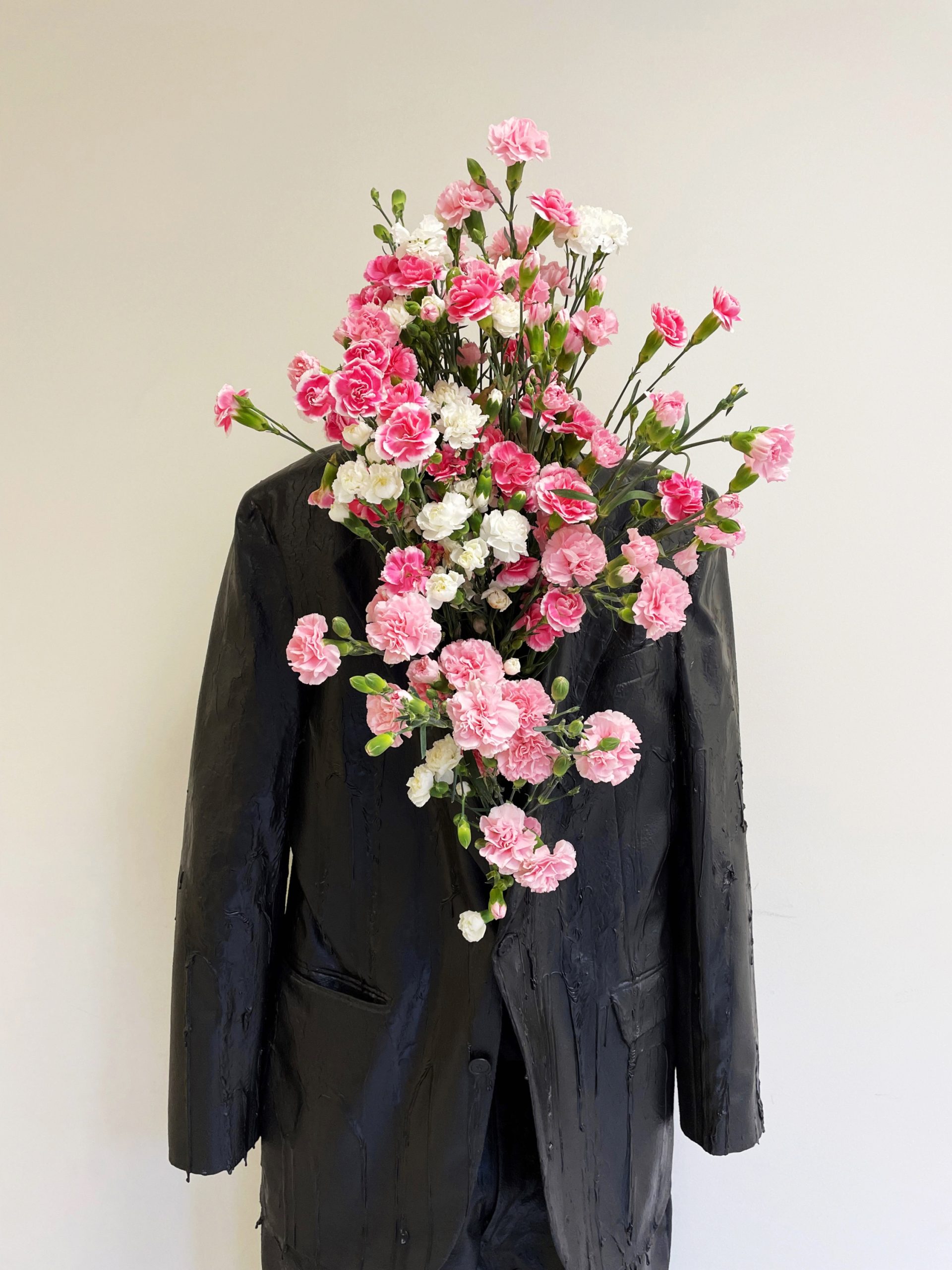
Andrew Hendrixson, Everything Contains Some Silence, 2021. Acrylic, wooden armature, suit, and flowers.
Many poets in that book seem to fit your description above (“to disbelieve in God and yet have faith”). You often use the term “accidental theology,” and in Zero at Bone you discuss the comic nature of now teaching at “church school,” having found both church and school arduous as a youngster. (Yes. Who didn’t?) I’d love to hear about any moments that stand out to you when you were audience to a theological accident emerging on account of teaching or working within a seminary.
Oh gosh, there are so many. For a number of years, before my teaching partner Maggi Dawn moved back to England, I taught a course called “Poetry for Ministry,” and both of us would periodically get notes from students attesting to the ways that the poems we had read were at work in the world. A young Air Force chaplain wrote me about using Robert Hayden to get young servicemen and women to talk to each other about what their personal memories had to do with their current missions. A hospital chaplain told us about consoling a dying patient with Seamus Heaney and Lisel Mueller. There were many such stories. And I remember a non-fiction writing class once in which an excerpt from a Baldwin essay led to a candid, painful, and useful conversation about the theological implications of suicide, which was a pressing issue for more than one member of that class.
Your mention of Miroslav Volf, who is a close friend of mine, reminds me of a time when we taught a course together called, simply, “Suffering.” (I write about this in the book.) We read Baldwin for that course too — his masterpiece “Sonny’s Blues” — and that story pushed us beyond the theology we were reading. Or perhaps it’s better to say it catalyzed the theology we were reading, both illuminating and defeating it. Some people talked about the story within their own lives as tools, almost — or using the story as a tool for their own predicaments. That’s not a diminishment of literature; it’s an enlargement of it.
This reminds me of Dickinson’s famous quote that she knows something is poetry when the top of her head comes off or her body goes cold. Do you resonate with that sense of poetry’s energy?
Absolutely. Reading poetry is a physical, visceral experience for me. To be sure, there are some poems I like perfectly well that don’t twitter the liver (as it were), but the true ones, the ones I know I’ll keep with me forever? Those I feel like a drug.
Your first book is titled The Long Home and is, if I may, one of my favorite books of yours. Would you mind saying what — if anything — those early poems of family and landscape mean to you now?
The long poem at the heart of my first book means a great deal to me personally. It took me four years to complete, and it’s where and how I learned to be a poet. It’s also in the voice of my grandmother, whom I still miss every day. But it’s not a success in the end. I had a notion that I could create a form that extended over a vast space, but I didn’t have enough ability to give autonomy and a tensile strength to the verse at a line-by-line level. I got better as the poem went on, but much of it is just too weak at the level of the line.
What landscapes feel like home? Has this changed over the years?
The only landscape that will ever feel like home to me is the barren west of Texas. That doesn’t mean I like it. It’s just where my soul was forged, and something of that bitter immensity is who I am. I like trees, though, and would never want to live there again. I have no sense of home now, other than the people in my life, and perhaps this one little house that my wife has made such a nice place to live. (I have zero ability for such things.) New Haven is just somewhere I came for a job.
Seamus Heaney once said, “I regard many of the things I know and have to tell about as deriving from my Catholic minority background in Northern Ireland, but I don’t regard that as a circumstance that determines my audience or my posture.” Do you relate to this notion of the poet being able to dislodge religion from the political in the life of writing, especially when having a wide audience or being interviewed, giving lectures — being visible — or indeed, in the making of a poem? In what ways is being a Christian, and the kinds of American Christianity pervasive today, something that you are alert to as a public voice?
The one time I met Heaney, he told me that he felt caught between the form of Christianity in which he’d been raised and some new dispensation that seemed emergent but ungraspable. It seemed to trouble him, which was a surprise to me since you’d never guess this from his work, which seems to comfortably live in that space (and even to help the latter to emerge). I feel the same way, actually, though I have taken a step Heaney couldn’t or wouldn’t: I do call myself a Christian. I do live toward God through Jesus. I detest the phrase “Christian poet,” though, because it smacks of limitation and piety and just gives me the willies. At the same time, I have allowed my work to be included in Christian anthologies, because I don’t want to deny the name. It would be disingenuous for me to say, at this point in my life, that I’m unaware of my public self when I’m writing or speaking. But I don’t think it inhibits me. I’ve been honest with my allegiances, enmities, and confusions. I’m just muddling along from one day to the next like everyone else.
In what ways do you find yourself relating with, or to, the Bible? Michael Edwards’ The Bible and Poetry arrived at our house recently. I’m moving through it slowly, in part because it’s a book I’ve been waiting to find, and I’m not anxious to find the end of it. He is so able to reveal the essential poetic nature of scripture, and therefore a poetry at the heart of experience. And yet poems are often given the place of being additions, decorations.
I actually reviewed that book for Commonweal. Like you, I found it wonderfully provocative and consoling (and wished it were longer). Parts of the Bible are extremely important to me, and I read it constantly. But I also think its status as a kind of sine qua non in Christianity, especially among Protestants, is a mistake. Parts of it are flat-out insane. If we could all learn to read like Michael Edwards, it would be a tremendous relief and release for Christianity as a whole. That’s not going to happen, so I, yet again, just muddle along with my own idiosyncratic engagement with this weird, beautiful book.
Is there a particular condition, feeling, mood, or thought that settles in for you when a poem is arising or is right?
Yes, there is a particular feeling that I have learned to recognize, but I find it hard to describe. Reality and language — or maybe the seam between them — suddenly seems charged in a different way. It’s almost as if consciousness became tacky, adhesive, and certain apparently random things — a word here, a gesture or inflection, rhythms — began sticking to it. Then there is a period of time — sometimes long, sometimes very brief — when you have to both pay attention and not, home in on those bits while allowing them to grow or change, and also remaining receptive to other parts of reality they attract. Almost forty years of doing this and I don’t understand the process any better. Maybe less, actually.
That said — and this is related to the question above about visceral reading — I’ve written poems that were less mysterious than this. I’ve hammered some out, and some have taken literally years to emerge, and I certainly wasn’t doing any mystical listening during all that time. Poetry is a craft as well as a conjuring.
What rituals or plans do you make for reading, if any?

I’m a chaotic and undisciplined reader, until I’m not. For the most part, I read intensely but flittingly. That is, I concentrate very hard on the things I read, but I also abandon most of it. And then sometimes something really takes hold, and I’ll read deep in one direction, every scrap of one writer, say, or everything about the first verse of John. It’s a mix of whim and instinct, with the occasional mania thrown in. I admire serious scholars, who can be so methodical and disciplined in their reading, and I’m often so grateful for them (right now it’s Carlos Eire and his wonderful and meticulously-researched They Flew: A History of the Impossible, which is about levitating saints!). It will make you question your “epistemic reality,” as he calls it, and the kinds of experiences we perhaps unconsciously preclude in our own lives. But I am, alas, a magpie.
Is there a poet or writer (or more than one) you would recommend to readers of Mockingbird — people who are thinking about grace?
Fanny Howe is one of most important writers in my own life, especially her prose, and I find people outside of the literary world (and even outside a particularly intense corner of that) haven’t read her. Tomáš Halík has written several lucid and provocative books about sustaining faith in a time that seems inimical to it. I return often to Elizabeth Hardwick’s little novel Sleepless Nights, not because she talks about faith (she wasn’t religious) but because she makes me see the world more clearly, and I always find that to be the first step of faith.
Do you feel at home when writing?
What an interesting question. At first I thought of all the agony I go through when writing — the difficulty beginning, the lack of trust and self-doubt, the many, many false starts and disappointments — and wrote: No! But then I remembered that yesterday as I traveled to the West Coast, all through the airports and taxis and even under the conversations I was having, I was nagged by the poem I’ve been trying to write, how I was eager to find a quiet space to work on it, and how relieved I felt when I was finally able to. Home? Probably not. But a respite from the relentless between.
What are you working on now? What is next for you?
Well, aside from that poem (the difficulty beginning, the lack of trust and self-doubt, blah blah), I’m writing an introduction for the diaries of the 20th-century poet Anna Kamieńska, which will be published next year. Now there’s a writer I’d recommend to readers of Mockingbird. You can already find three pieces of these diaries online (see the Poetry Foundation’s website). Kamieńska was heavily influenced by Simone Weil, but she’s much earthier, much more immediate and candid, and also funny. The book will be a revelation to readers alert to the presence of God in literature.








This is awesome. Thanks so much, Andy! You did a great job.