




In the sci-fi world of Star Trek, Captain Kirk would boldly go where no man has gone before in his starship, the U.S.S. Enterprise. In the real world, William Shatner, the actor who portrayed Captain Kirk, had his own adventure into space courtesy of rocket company Blue Origin. The actor playing the captain who dubbed space to be “the final frontier” got to explore the final frontier himself. Is there a better example of the modern trend where science fiction becomes science reality?
For so many people, outer space represents a specific kind of hope, and William Shatner’s Captain Kirk embodies that hope. Elon Musk has famously shared his desire to die on Mars, believing that the technology needed to achieve that goal would kickstart a new age of human possibility. Pop-science magazines declare with hope that Europa, one of Jupiter’s four moons, likely has stores of water just below the surface, making it ripe for colonization. In our wildest imaginations, large spoked wheel space stations rotate in earth’s orbit, providing the launching point for extraterrestrial exploration into the cosmos. Even C.S. Lewis got into the mix. In his Space Trilogy, Lewis imagined that we’d find a universe imbued with an Edenic closeness to God, and by exploring them we’d awakened to the great spiritual battles taking place on our own planet.
So when Variety offered this headline last week, it turned a lot of heads: “William Shatner: My Trip to Space Filled Me With ‘Overwhelming Sadness’.” In promotion of his new memoir, Shatner gave Variety an excerpt describing his trip aboard Blue Origin and the profound impact it had on his spirit. His trip to space was not, as he expected, an experience of mystery or magic or connectedness. In fact, it was quite the opposite:
We got out of our harnesses and began to float around. The other folks went straight into somersaults and enjoying all the effects of weightlessness. I wanted no part in that. I wanted, needed to get to the window as quickly as possible to see what was out there.
I looked down and I could see the hole that our spaceship had punched in the thin, blue-tinged layer of oxygen around Earth. It was as if there was a wake trailing behind where we had just been, and just as soon as I’d noticed it, it disappeared.
I continued my self-guided tour and turned my head to face the other direction, to stare into space. I love the mystery of the universe. I love all the questions that have come to us over thousands of years of exploration and hypotheses. Stars exploding years ago, their light traveling to us years later; black holes absorbing energy; satellites showing us entire galaxies in areas thought to be devoid of matter entirely … all of that has thrilled me for years … but when I looked in the opposite direction, into space, there was no mystery, no majestic awe to behold … all I saw was death.
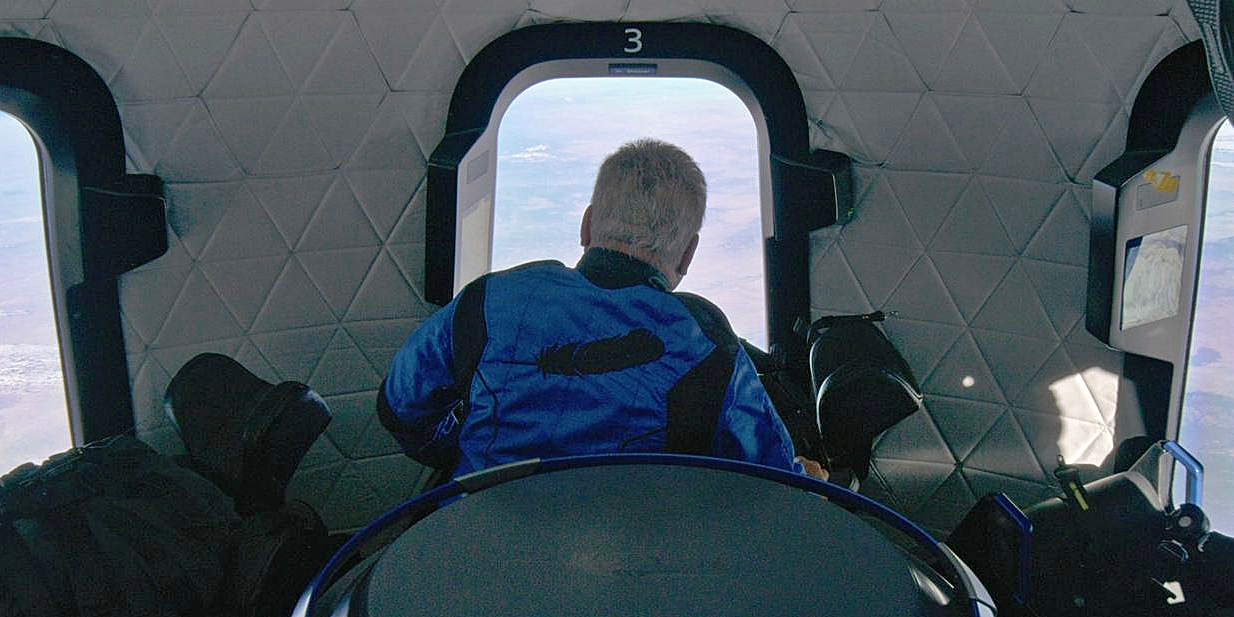
I saw a cold, dark, black emptiness. It was unlike any blackness you can see or feel on Earth. It was deep, enveloping, all-encompassing. I turned back toward the light of home. I could see the curvature of Earth, the beige of the desert, the white of the clouds and the blue of the sky. It was life. Nurturing, sustaining, life. Mother Earth. Gaia. And I was leaving her.
Everything I had thought was wrong. Everything I had expected to see was wrong. […]
fIt was among the strongest feelings of grief I have ever encountered. The contrast between the vicious coldness of space and the warm nurturing of Earth below filled me with overwhelming sadness. Every day, we are confronted with the knowledge of further destruction of Earth at our hands: the extinction of animal species, of flora and fauna … things that took five billion years to evolve, and suddenly we will never see them again because of the interference of mankind. It filled me with dread. My trip to space was supposed to be a celebration; instead, it felt like a funeral.
I learned later that I was not alone in this feeling. It is called the “Overview Effect” and is not uncommon among astronauts, including Yuri Gagarin, Michael Collins, Sally Ride, and many others. Essentially, when someone travels to space and views Earth from orbit, a sense of the planet’s fragility takes hold in an ineffable, instinctive manner. Author Frank White first coined the term in 1987: “There are no borders or boundaries on our planet except those that we create in our minds or through human behaviors. All the ideas and concepts that divide us when we are on the surface begin to fade from orbit and the moon. The result is a shift in worldview, and in identity.”
How humbling and sobering it is to see Captain Kirk himself struggle with the fragility of the human race. Shatner’s grief in realizing that there is no hope or magic beyond our atmosphere is stark, the death of a specific kind of interstellar hope and its own unique grief.
Ursula Le Guin, the American author who regularly engaged with sci-fi worlds and themes, wrote that the great purpose of science fiction (which she abbreviates as SF) is to distance ourselves from reality so that we might know reality better.
And distancing, the pulling back from “reality” in order to see it better, is perhaps the essential gesture of SF. It is by distancing that SF achieves aesthetic joy, tragic tension, and moral cogency … We are forced, in so far as we can continue to read the book seriously … to think about ourselves: our moral assumptions, our ideas of heroism, our desires to, lead or to be led, our righteous wars.
As the lines between science fiction and reality continue to blur, it sounds like William Shatner experienced Le Guin’s distance in real life, not through the lens of a novel or movie. He and others who have rocketed to the stars have been overwhelmed by the fragility of the human race, and humbled by the futility of our passions. To that end, C.S. Lewis may have been more right than we expected. We may not have met anthropomorphic alien otters or rocky space giant wizards, and we may not have regained an Edenic relationship with God. But we certainly have been made aware of the great spiritual battle taking place on the earth’s surface (and in our hearts as well).
Which is to say, the astronomical heavens may not give us much hope, and human sinfulness may not give us much hope, but there is hope to be found in the one who made the heavens and earth. I’m told his son went on a mission to a brave new world and died on a strange and foreign planet. That story, however, has a much happier ending: it turns out the real fiction is death.