




A typical arrangement in religious systems is one in which authorities claim the right to tell other people who they are, what’s wrong with them, how they should live and make choices, and where they stand before God. These dynamics are at play in Jesus’ parable of the Pharisee and the tax collector, where Jesus flips the arrangement and offers a social critique of the religious authorities of his day. The same dynamics are still at work today.
The gospel gives us something like a formula for self-righteousness: trusting in ourselves that we are righteous and despising others (Lk 18:9). They’re different, but I think they are intimately linked as a self-reinforcing loop. A loop that Jesus dismantles.
Jesus tells the parable to a group that is caught in this loop. They understood righteousness as something established by obedience to the law. It was a lens passed down for them to look through. This is the trusting in yourself part. If I do this, then I’m righteous.
Self-righteousness also needs a relationship with someone where there is superiority. It might be an individual or an entire group of people. But there has to be something or someone to be compared to that occupies the inferior position. This is the despising others part.
The parable is about two men going to the temple to pray, one a Pharisee and the other a tax collector. The Pharisee is a respectable member of the community, religious insider, and a trained expert in the practices and obligations of his religion. The tax collector, on the other hand, is an outsider, someone regarded as morally suspect, a deviant.
The Pharisees “belonged to a retainer class, a group of people above the peasants and other lower classes but dependent on the governing class and ruler for their place in society”.[1] They functioned almost as a society organized around the firmer, more systematic observance of the Levitical laws of purity.[2] The Pharisees took a stricter position than the Sadducees, believing the unwritten laws were just as necessary as those written in the books of Moses.[3]
“The Pharisee stood and prayed thus with himself, ‘God, I thank thee, that I am not as other men are, extortioners, unjust, adulterers, or even as this publican’” (Lk 18:11).
Here’s another man who has come to the temple to pray, and the Pharisee is thanking God that he’s nothing like him. The Pharisee is judging the tax collector, but he also has a whole list of people he’s ready to judge.
The Pharisee’s role provides a well-developed system for evaluating other people. He knows what righteousness and unrighteousness look like. Because he possesses special knowledge, he assumes he can identify the tax collector’s spiritual condition. Rather than disagreeing with the man’s behavior or profession, he interprets who the man is through his own system of understanding righteousness.
A person can incorporate the framework of a group until it becomes that person’s orientation toward the world. That person then brings that system of evaluation to new situations, interpreting what he encounters through the perspective he has acquired.[4] The knowledge and assumptions acquired within a social group can become an “unquestioned and unquestionable guide” to interpreting the social world.[5]
People learn the social meanings of roles, including how to assign categories and the behaviors regarded as signs of membership.[6] The Pharisee’s training, understanding, and role establish, in his mind, the entitlement and authority to make judgments about other people. He assumes he has special insight into who other people are and where they stand before God.
As soon as the Pharisee sees him, he knows what kind of man he is and what’s wrong with him. He doesn’t have to know him personally, understand the man’s circumstances or what brought him to this point. The framework tells him everything he needs to know about him, and his category supplies the interpretation. It’s easy once he knows the man is a tax collector. However, “man is not the role or identity which society thrusts upon him.”[7] Knowing the man’s social role, profession, or deviance is not the same thing as knowing the man.
Why does he need to look at another person this way? What purpose does it serve?
“I am not as other men are.”
The Pharisee is in a special category in comparison to “other men.” And, to the Pharisee, the tax collector is not another human being who has come to pray. He’s something less than that. If the Pharisee’s understanding of himself depends upon that inferiority, what happens if the tax collector is no longer regarded as inferior?
The Pharisee cannot experience or express his righteousness without comparing himself to other people. When a person’s religious identity depends on being superior to others, the role requires someone he can regard as despicable. The comparison is how this type of self-righteousness operates. The Pharisee is establishing his moral identity by “building his self out of invidious comparison to the morally weak.”[8]
The supposedly virtuous can “actually develop a stake in the existence of deviant others.”[9] A person who understands himself as righteous in contrast to the morally deficient needs people to remain in their position. The Pharisee is personally invested in the hierarchy and in being the person who knows better.
He depends on the extortioners, the unjust, the adulterers, and the tax collector to remain in their positions because his social identity and righteousness depend on the deficiencies of others. Their personal choices and failures serve a purpose in his life. If he can’t expose the tax collector, then he risks being exposed.
What happens to the authority of the Pharisee doing the diagnosing if he is wrong? Or if the people don’t need it or care for it? The Pharisee has something to lose if the arrangement changes.
It is typical of some religious communities to “work to establish social institutions and not to see through them.”[10] When religious institutions move from liberation to conformity, the institution can become a means of adapting the individual to social or religious respectability in order to keep the institution going. The Pharisee’s religious convictions govern his own conduct, but they also determine what is right for other people.
At times, moral condemnation is not used to eliminate deviant behavior but rather to reaffirm the importance of the rules and standards by which people are judged. The rules encourage conformity and social adaptation, and thus reinforce the institution. Enforcing those rules also gives the Pharisee purpose and a cause. Condemning others becomes a way of reassuring self-righteousness and maintaining the hierarchy and standards.[11]
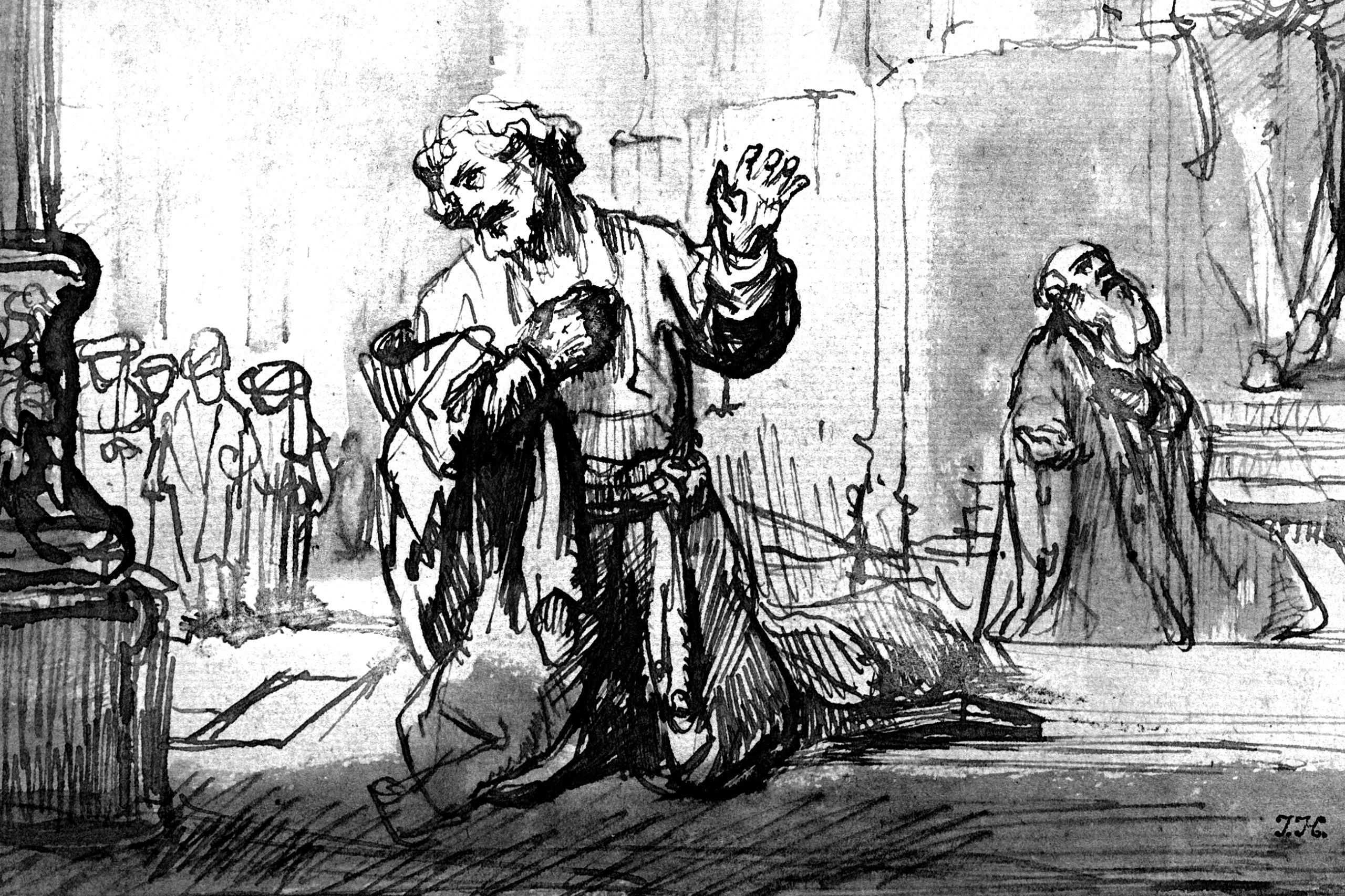
The Pharisee continues his prayer: “I fast twice in the week, I give tithes of all that I possess” (Lk 18:12).
That’s a lot of “I” in the Pharisee’s prayer. I thank. I am not. I fast. I give.
He’s observing the practices he names. He’s abstaining from the deviant behavior he identifies in others. His prayer is an account of his righteousness.
In contrast, the tax collector doesn’t bring up anyone else. He doesn’t place other people into categories. He doesn’t attempt to establish his own standing by comparing himself to someone else. He could easily do what the Pharisee is doing in his prayer. “Lord, I thank you I’m not like the judgmental Pharisee”.
Instead, he prays: “God be merciful to me, a sinner” (Lk 18:13).
And Jesus says: “I tell you, this man went down to his house justified rather than the other” (Lk 18:14).
The Pharisee wants us to focus on the tax collector. He wants us to look at the man through his religious framework and through the man’s deficiencies. But Jesus turns the examination toward the Pharisee and attacks the basis of the Pharisee’s professional authority by overturning his judgment. For those hearing the parable, this means they no longer have to depend on the Pharisee’s judgment of them to know where they stand with God.
Jesus’ justification of the tax collector dismantles the distinctions that the Pharisee uses to establish his superiority, thus dismantling the Pharisee’s understanding of himself, and what he has built his life upon. The man who thinks he is a professional righteousness spotter doesn’t know what God’s justified looks like. Couldn’t pick it out of a lineup. The very knowledge that gives the Pharisee so much confidence is a hindrance.
The text doesn’t tell us the tax collector has changed or somehow become a better person. But the way Jesus speaks about him is completely different than the way the Pharisee does.
In the Pharisee’s prayer, the point of comparison is himself, and that is the standard he uses to measure other people. The problem is the measuring! Jesus removes the point of comparison. The entire system through which the Pharisee understands himself becomes irrelevant. Despite what he thinks about himself, he does not have the authority to pronounce judgment upon another person’s standing before God.
The tax collector, on the other hand, isn’t comparing himself to anyone. He’s asking for mercy. The man necessary to sustain the Pharisee’s understanding of himself no longer occupies the place assigned to him.
Romans 4:5 speaks of God as the one who justifies the ungodly. The extraordinary thing about justification is that it doesn’t depend upon someone satisfying the standards by which other people or groups measure righteousness. God’s justification of the man isn’t governed by the Pharisee’s interpretation. Justification doesn’t require the tax collector to be any different than he already is. Justification has nothing to do with how he lives his life.
The person the Pharisee despises is the person God chooses. The one he regards as inferior is the one God justifies. There is nothing that can be done to change that. It just is. Being accepted in the beloved is not something that can be undone (Eph 1:6). Righteous is something we are made (Rom 5:19).
Hearing this parable would have been completely countercultural for Jesus’ audience. If the tax collector goes home justified and the Pharisee doesn’t, then God is not who they thought he was. And the Pharisees are not who they thought they were.
There’s another danger here. It’s possible to read this parable and congratulate ourselves for not being like the Pharisee. It is easy to recognize his self-righteousness and begin to feel superior for having recognized it. The categories can change, but the comparison remains, which is the problem. We have found another person to occupy the inferior position.
The point is to question this way of looking at other human beings and the authority we assume in pronouncing judgment upon them.
[1] Anthony Saldarini, Pharisees, Scribes and Sadducees in Palestinian Society (Michael Glazier, 1988).
[2] Louis Finkelstein, The Pharisees (The Jewish Publication Society of America, 1962).
[3] Solomon Zeitlin, Studies in the Early History of Judaism, vol. II (KTAV Publishing House, 1974).
[4] Tamotsu Shibutani, “Reference Groups as Perspectives,” American Journal of Sociology 60, no. 6 (May 1955): 562–569.
[5] Alfred Schuetz, “The Stranger: An Essay in Social Psychology,” American Journal of Sociology 49, no. 6 (May 1944): 499–507.
[6] Albert K. Cohen, “The Sociology of the Deviant Act: Anomie Theory and Beyond,” American Sociological Review 30, no. 1 (February 1965): 5–14.
[7] Alan Watts, Psychotherapy East and West (Pantheon Books, 1961).
[8] Cohen, “The Sociology of the Deviant Act: Anomie Theory and Beyond,” 5–14.
[9] Cohen, “The Sociology of the Deviant Act: Anomie Theory and Beyond,” 5–14.
[10] Watts, Psychotherapy East and West.
[11] Cohen, “The Sociology of the Deviant Act: Anomie Theory and Beyond,” 5–14.