Whenever you try to talk with your friends about Big Ideas like “justice,” the results tend to be unsatisfying. Everyone understands the concept, of course — but everyone seems to understand it differently. One person talks in terms of resource distribution, another about rewards and punishments, and a third about repairing the damages from past harm.[1]
No worries, you think. Maybe we don’t need a strict definition of “justice” to talk meaningfully about it. And who cares about vague abstractions, anyhow? Accordingly, you proceed to bring up a specific case: a convicted criminal now facing a sentence for stealing in order to feed his family …
“‘Criminal?’” one friend objects. “Why are you calling him a ‘criminal’?”
Taken aback, you explain that you are using the standard definition — someone duly convicted of breaking a law, particularly a serious one.
“That’s a terrible definition,” your friend retorts. “The real criminals are those who create unjust economic conditions that force desperate people to break the law.”
“Yeah,” another friend else chimes in, “and unjust ‘laws’ aren’t really laws at all.”
The conversation subsequently plunges into confusion.
It occurs to you that maybe we as a species should just stick to building bridges and playing soccer.
***
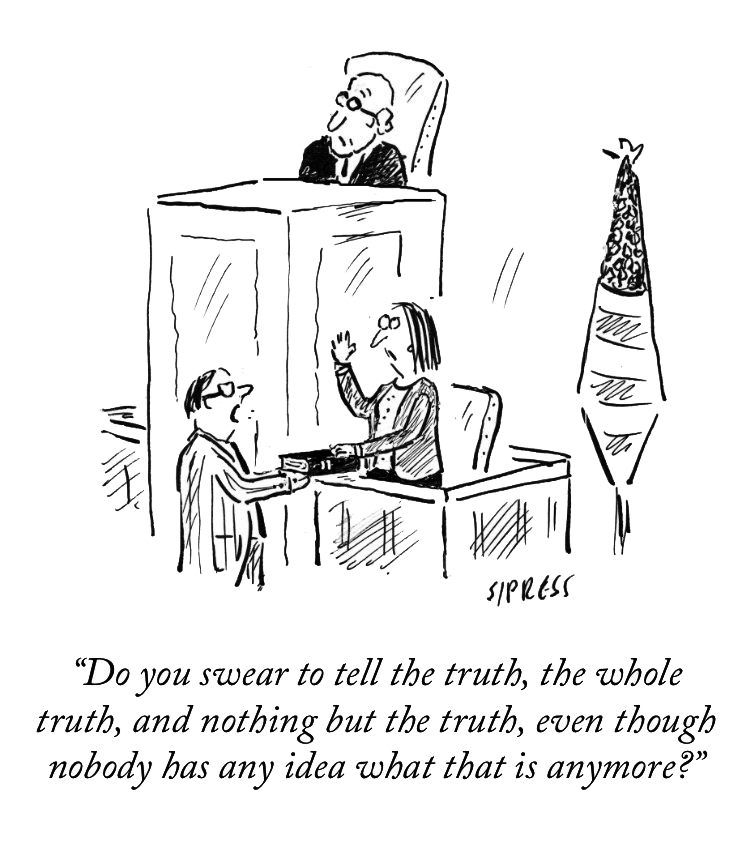 But we won’t. We’re incurably addicted to metaphysics, ethics, theology, political science, and all the rest. As long as humanity is around, we’ll keep making capital-T Truth claims that the world is or should be a certain way.
What does change is the basis of these claims. Very roughly, in the West this basis has shifted from scripture and church tradition to reason then to the fractured landscape of postmodernity. Given the slippery, unstable nature of language and the ubiquity of cultural bias, the postmodern attitude finds the doctrines promulgated by church and Enlightenment alike naïve at best and insidious at worst.
Whether we’re reconstructing the history of ancient Israel, arguing for the merits of one economic system over another, or envisioning a just society, the language that we use to convey our thoughts is not our private property or even a stable, metaphysically rooted entity. Language is rather a shared, conventional system whose connotations and ambiguities are outside our control. What we succeed in communicating is not Truth but culturally conditioned perspectives, which themselves are open to interpretation.
If this is indeed our condition, ideally it would lead to a great deal of humility and care in the exchange of ideas. If Truth is gone, then at least the wars and discord it has engendered could go with it.
Out in the streets, however, it’s pretty hard to consistently treat our own views as merely one perspective (and a linguistically unstable one at that) among millions. We all know what it’s like to share a deeply held belief only to have our interlocutor nod sagely and reply, “Well, that’s certainly an interesting way of looking at it.” We’re not trying to be interesting. We’re trying to find firm ground, or maybe a light in the darkness.

Let’s try a thought experiment. Imagine that we come across a deeply compelling Narrative (which could be anything from MAGA to Marxism, decolonization to distributism[2]). The Narrative cuts through the noise and makes sense of an otherwise hopelessly ambiguous world. Indeed, it clarifies the world so effectively that any “evidence” adduced to challenge the Narrative must be the product of ignorance at best, or, what’s more likely, of malign forces.
But one day we come across a critic who seeks to relativize the Narrative: “Yeah, well, you know, that’s just, like, your opinion, man.” Perversely, he might not only question the factual accuracy of the Narrative but also dare to suggest that we adherents of it are pitiable victims of our cultural biases, or even that those visionaries who constructed it might have done so for nefarious ends or personal gain. The Narrative is then in danger of being relegated to the status of “ideology,” or, worse still, of just another “interesting point of view.” The miasma of confusion and chaos looms once again.
What can we do to bolster and defend the Narrative? Our crafty opponent will exploit the linguistic ambiguities of political theory; he will put perverse slants on historical facts and purport to show how they are open to interpretation. But there is one thing he can’t touch: our experience. We’ve seen what we’ve seen. We’ve heard what we’ve heard. People can talk all they like, but we know what we know. And we know that the Narrative accords with and illuminates what we have experienced.
Sure, our opponent might ramble on about how experience itself is shaped by our biases or preconceptions, or how other people in other parts of the world have radically different experiences from our own and therefore reach radically different conclusions. But we can’t speak for them. Who knows what lies and propaganda those people have been subjected to? Moreover, in our experience, people can get so messed up by bad ideas that they can’t even see what’s plainly in front of them. And what’s plainly in front of us is that the Narrative makes sense of our frustrations in an elegant, comprehensive manner — and it gives us clear guidance on how to rectify them.
***
Experience is irrefutable, at least in one sense. If anyone doubts that you’ve had the experiences that you’ve (truthfully) recounted, then they’re most likely acting from dishonest motives.
In the past, however, experience was not generally considered enough by itself to carry the weight of one’s Narrative (or worldview, or theology, or whatever comprehensive intellectual structure one used to make sense of the world). It’s not that anyone deemed experience useless, but it could not bring one to Truth without scripture, the church, reason, or perhaps the scientific method. But scripture and the church are long gone as serious sources of authority (at least in large swaths of the West), while reason has drowned in the slough of linguistic difficulties and cultural contingencies, and even science itself doesn’t typically produce the kind of metaphysical, ethical, and political knowledge we crave.
So, that leaves us with experience, which now has to work a double shift.
Hence the rise of that fascinating little phrase “my truth.” My truth is ostensibly subjective, set in contrast with Truth. The phrase often appears when survivors of injustice or abuse step forward to recount their experiences. People tell their truth when they speak of things like churches with toxic work environments, or sexual harassment from bosses, or encounters with racist police officers. My truth also covers rituals, practices, or mindsets that have helped the speaker find some measure of stability or peace.
But why has my experience taken upon itself the weighty, fraught title of my truth? I think this is partly an effort to shield the truth-tellers from bad faith accusations of falsehood. That’s understandable.
But it’s also problematic. Calling something the truth makes a claim upon its hearers, but in this case the nature of the claim is not always immediately clear. Where my truth becomes tricky is when it’s used to say not only “I expect you to believe that I really experienced these things,” but also to imply, “And I furthermore expect you to accept the conclusions I’ve drawn from my experiences.”
You can’t disagree with someone’s experiences like you can with their opinions or beliefs. If that person truthfully recounts growing up in poverty — and the attendant feelings of fear, shame, and anger — then it doesn’t make any sense to reply, “Oh, well, I think you’re wrong,” or even, “Yes, I totally agree with you.” If, however, they go on to say, “Our economic system is irredeemably unjust and should be scrapped and replaced with another,” then the conversation has moved into the realm of legitimate agreement or disagreement.
My truth, however, is in danger of conflating my experience with my beliefs, particularly in the case of deeply held beliefs formed by intense experiences. There is a tacit assumption that our interpretation of our own experience is — if not infallible — then at least authoritative. If, for example, I have suffered greatly from poverty has led me to believe capitalism is irredeemable, then the label of my truth makes it hard for me to distinguish between these two ideas. My interpretation of what capitalism is and how it has failed is magisterial — to question it feels not so much like disagreement as a personal attack.
Recently, American Eagle hired Sydney Sweeney to model a new line of blue jeans. Their ads include a tagline about how she has “good genes jeans.” To some, this is a straightforward combination of good old-fashioned “sex sells” with an atrocious pun. Others sense an insidious promotion of Aryan ideals, including eugenics. There is probably a lot of daylight between “this is harmless” and “this is evil,” but it’s hard to get there. I would imagine that many of the interlocutors are working from past experiences: on the one hand, of being criticized or even demeaned for political incorrectness; or, on the other hand, of seeing others or even finding themselves subjected to Eurocentric standards of beauty. To give ground, to admit the possibility that one’s interpretation might be inadequate or overwrought, is to invalidate one’s own experiences — and thus, to some extent, one’s own personhood.
In this environment, disagreement is not merely received as “You are wrong about this topic.” It’s felt as “Your experiences — your pain, even — are trivial.” If my views are the authoritative interpretations of my experiences, then criticism of my beliefs feels not only personal, but also existential. Criticism is, in fact, felt as an assault on the last bastion of truth (Truth?) that I have left.
And if this bastion falls, what then? Where else could we possibly go?

“Well,” you might think, “this is a Christian website, so I’m pretty sure you’re going to say ‘Jesus.’ As if the whole Christian Narrative hasn’t been picked apart and problematized since, like, 1700.”
Which, yeah, pretty much. But let’s think for a moment about one of Christianity’s central claims: that the Word became flesh. That the Logos, the organizing principle of reality, became man and dwelt among us.
Or, more accurately, let’s think about the implication of this claim if it turns out to be right. Our efforts to find Truth may have failed, but what if it’s Truth that finds us? If Truth is a person, as Christianity says, then this opens a new path of knowledge — knowing and being known as persons.
To be sure, propositional claims (metaphysical and historical) are vital to Christianity. Stating these claims is a task fraught with the usual cultural biases, linguistic ambiguities, and conflicting subjective experiences. But, if the Incarnation is true, then the task is not hopeless. If God’s Word became man and spoke a human language, then human language can say meaningful things about the God who has so revealed himself. The interplay between linguistic signs is not infinite if the Infinite let himself be seen, touched, and even described with the clumsy, vague, ever-changing system we call language. There will always be some pattern of words that sticks.[3]
Of course, you could say that this is just an elaborate attempt to expand my truth (my religious experience in this case) into something universally valid and, frankly, a bit colonizing. And maybe you’re right.
Weirdly, though, my truth of being claimed by Christ, when I attend to it, frequently reminds me that my truth is usually pretty self-serving and shallow, that I’ve drawn exactly the wrong conclusions from experience. The Truth is invasive but not destructive, challenging but not cruel, comforting but not excusing. It won’t leave me alone. It’s usually not what I want.
I want to claim the truth, but the Truth claims me.
[1] Attempts to abstract the precise thing shared by all these definitions — maybe “Making things the way they should be” — are too broad to be very useful, and in any case, they end up being circular. How do you go on to define “should” without smuggling in notions of “justice,” the very thing you were trying to define in the first place?
[2] G. K. Chesterton’s pet political theory and a personal favorite of mine.
[3] Which is why we have scripture — which, of course, is infamously susceptible to a bewildering variety of interpretations. But since God’s Word lets himself be understood by human language, then it means that our language is capable of (imperfectly, but truly) speaking of ultimate realities. Interpreting scripture well is a difficult enterprise, but not a hopeless one.