




On Wednesday, December 4, 2024, a masked gunman shot UnitedHealthcare CEO Brian Thompson in the back on a street in midtown Manhattan. Thompson died from his injuries while the gunman fled Manhattan. After a five-day manhunt that captivated the world’s attention, police arrested a 26-year-old in Altoona, Pennsylvania, and charged him with Thompson’s murder.
The killing was a brazen and shocking act, particularly because it took place in daylight hours on a public street in one of the largest cities in the world. It has also opened up a fissure in our public discourse between people who lamented the killing and those who seemed to either condone the killing or outright celebrate it. As with any high-profile news item, there was a rush to fit the event into pre-existing political and economic narratives: in some corners, the act was representative of the disorder and chaos of our current political moment; in others, it was a righteous warning shot from the disaffected masses toward the insulated rich and powerful; elsewhere, it was the desperate act of a victim of the health care insurance industry against one of its supposed perpetrators. There was a sports angle (a Division I swimming pool in Maryland bears the name of the accused shooter’s grandparents), a “rationalist” angle (journalist Robert Evans claimed on X/Twitter that the accused was part of the so-called “gray tribe” of rationalist, libertarian-leaning thinkers), and even a reading angle (the accused had an active Goodreads account that was quickly plumbed for evidence of his dark turn).
Missing from all the reportage about the killing is any high-profile discourse from a Christian viewpoint. An initial reticence to comment is probably commendable in any fast-evolving situation involving a lot of unknown facts. Moreover, besides a family heritage steeped in Italian Catholicism, the accused didn’t appear to have any particular religious motivation or practice. As a result, any religious “angle” to the event seems to have been quickly discarded as a possible motive or source of perspective.
It seems unmistakable that there is little room or appetite in the public imagination for much, if any, sober or considered reflection on what happened to Thompson and the accused. There are much more salacious and clickable headlines to be found in regurgitating the reflections of Reddit and X users who lauded the killing with punny, morbid reactions (thousands of people had made some version of a “pre-existing condition” joke within hours of the murder). Just last weekend, Chris Rock went on Saturday Night Live and compared Thompson to a drug dealer, joking that “sometimes [drug dealers] get shot.” Other commentators have continued to dig into both Thompson’s and accused shooter’s personal histories, searching for exculpatory or damning evidence in turn.
The tragedy of this particular murder has made evident the contours of a debate about suffering in a post-Christian society. Public reaction in the United States has been consumed by a widespread conversation about whose suffering counts more, and voices on all sides have accused others of extraordinary indifference to suffering, whether it’s regarding millions of denied claimants or one man whose children will now grow up without a father. Cold-blooded murder has always fascinated us — just observe the widespread popularity of podcasts, TV shows, and novels about it — but this one seems to have opened up a new level of permissiveness for conversation about the justifiability of murder.
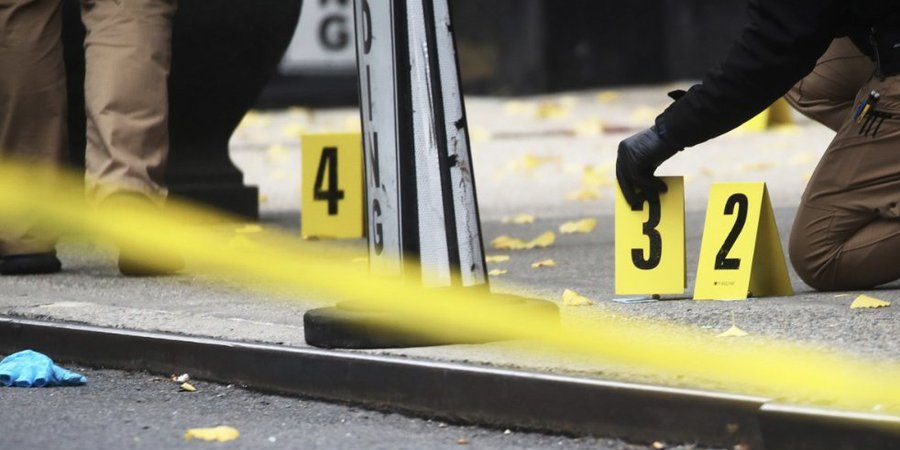
There is a concept in epistemology called the theory of black swan events. Developed by writer Nassim Taleb, the theory describes a high-impact event that seemed completely impossible until the moment it occurs, after which people grasp at explanations for why it was actually predictable. Examples might include the September 11 attacks, the election of Donald Trump as President, the Challenger explosion, or the collapse of the Surfside condo tower in Florida. Thompson’s murder could well be thought of as a black swan event: the brazen and vicious murder of the CEO of a major American company on a city street might have seemed impossible until it happened, and after the fact, public discourse has been frantically working to justify not just the probability of the event, but even to say it’s surprising it didn’t happen sooner.
A Christian response to any event, black swan or otherwise, should proceed from one question: where can the love of God be revealed in the midst of our suffering? In this case, it seems clear that the accused was suffering, either in body, mind, or spirit (perhaps all three). Thompson’s family and loved ones are certainly suffering now. And millions of Americans are suffering from chronic pain, acute medical conditions, financial hardship, or a combination thereof. The murder of Brian Thompson ought to remind those of us who comprise the church that our witness to God’s love calls us to accompany those who suffer. We should lament the tragedy of a young man alleged to have committed a premeditated murder. We should weep with the family of the victim. We can acknowledge and hear the stories of people who have suffered due to lack of health insurance coverage or denial of their claims — we ourselves might be some of those very people. And we must also never abandon one of the core convictions of our faith, one so fundamental it was etched into stone tablets and echoed repeatedly in the Gospels: murder is wrong. It has always been wrong, an offense to our Creator and to our shared humanity. We cannot let our witness be silent on this score, nor can we fail to let our lamentation be known.
Tragedy will always be a fundamental aspect of the human experience. We cannot prevent the irruption of suffering and death into our lives. But we can cling to the goodness of our Creator and remember that he suffered with us, unto the point of an agonizing death of his own. In this season of Advent, perhaps our starting point should be to proclaim the story of Jesus coming into the world to save us from the judgment of sin and the finality of death. As we celebrate his first Advent and await his second Advent, let us make this our response to an exhausted public that doesn’t know what to do with its own suffering, one that struggles to see past an endless cycle of vengeance and retribution and bloodshed. Let us be agents of God’s peace, weeping, watching, and waiting with those who mourn, exulting in what God has done for us, and proclaiming the “thrill of hope” coming to us in a manger who breaks the chains binding our weary world.





This is powerful and profound and I thank you for it, Peter.
Well written, Peter! Yours is a voice and perspective we rarely hear these days. Thanks for sharing your insights.