The past month of professional sports in the United States has delivered an unending string of hits: a down-to-the-wire WNBA Finals, a thrilling baseball postseason culminating with a historic Dodgers vs. Yankees World Series, and the usual compelling spectacle of NFL football. With all of this happening, you’d be forgiven for not paying any attention to off-season tennis (30 Rock’s “Tennis Night in America” gambit notwithstanding). The U.S. Open ended almost two months ago, and the pro tour has shifted to Asia and Europe ahead of the season-ending finals, in which the top eight players on the men’s and women’s tours will compete for the year-end championship.
One player who won’t be present to compete for that trophy is Caroline Garcia. She isn’t necessarily a famous name in the United States, but the French player has been ranked as high as fourth in the world and was an unexpected but deserving victor at the 2022 WTA Finals just two years ago, capping off her best-ever season on tour. This year, however, after a string of very mediocre results, Garcia announced in late September that she would be shutting down her season.
It’s not so unusual for pro tennis players to end their season early. The schedule, after all, is famously grueling, and many players prefer to recuperate from injuries, rest, and train at home rather than continue flying around the world to grind out late-season matches. The reasons Garcia cited, though, were striking: she said she’s been suffering mentally from the demands of the professional tennis lifestyle. She wrote on her X account that she’s been fixated on her failures and how they don’t match up in her head with what she says she expects of herself. “I’m exhausted from the anxiety, the panic attacks, the tears before matches. Tired of missing out on family moments and never having a place to truly call home. I’m tired of living in a world where my worth is measured by last week’s results, my ranking, or my unforced errors.” Of course, as any pro athlete often is, she’s still a competitor at heart and plans to start preparing for 2025 “early.”
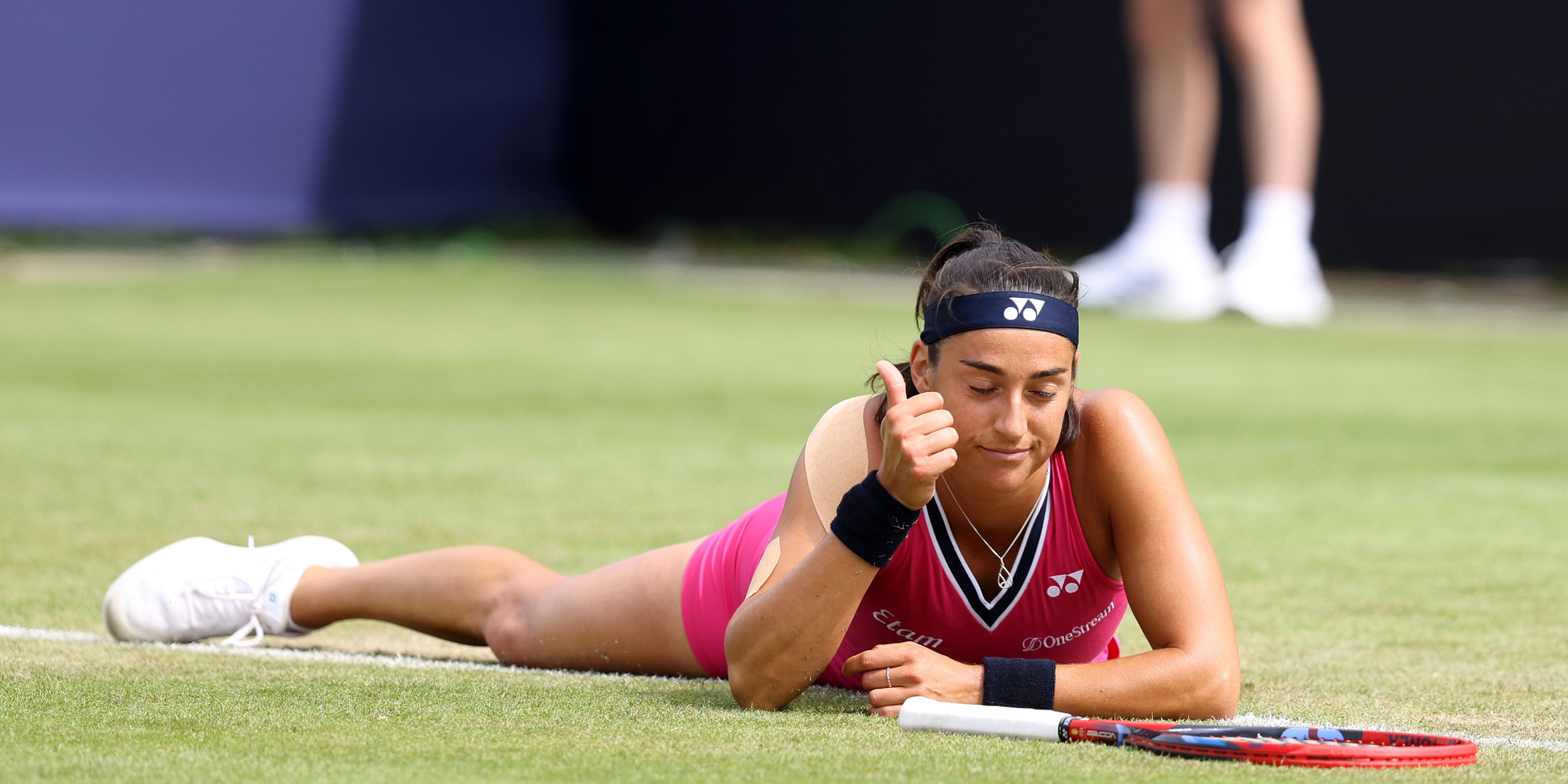
Perhaps you’re chuckling at the juxtaposition. It’s amazing how frank and honest a person can be in one minute about the pain of trying to live up to impossible standards, and then in the next minute to see them double down on the lifestyle that produced that crushing weight in the first place. Maybe if I just prepare more, train harder, get ready earlier, it’ll be better next year. In this sense, Garcia is all of us. She isn’t the only one suffering under the weight of the Law in her professional life, the weight of expectation, the weight of an enduring mismatch between imagination and reality.
Given the kind of year Garcia had on tour in 2022, perhaps it’s inevitable that she’d experience a letdown. Any regression to the mean would be unsurprising, but the feeling of bewilderment and incompleteness that accompanies it is especially potent. The phenomenon known as the hedonic treadmill, which posits that major life events (both positive and negative) don’t really affect our baseline level of happiness very much, may be to blame. Under this theory, we will inevitably return to that baseline after any high or low. It’s a familiar idea, the feeling you get after reaching a long-sought goal in life and immediately wondering, “OK, now what?” It could be anything: getting the promotion you wanted at work, receiving a raise, finally getting married, completing a marathon, climbing a mountain…there’s no end to the list of things we could accomplish in life that can’t be tempered by our fear that we’ll never be so happy/successful/powerful/respected etc. ever again.
Just knowing that such a phenomenon exists doesn’t do much to help us in the midst of our self-defeating patterns and exhausting pursuit of new and novel successes in life. It’s a treadmill we can’t ever seem to step off, a slog from which we are unable to free ourselves.
This place of desperation is a familiar one to Jesus. He knows all the contours of our self-defeating tendencies, our grim determination to repeat old patterns, our over-confidence in our own willpower. That’s where Jesus meets us and says, “Come to me, all you who are weary and heavy laden, and I will give you rest.” We hear his voice in the place where we are most wounded and tired, beaten against the shoals of the world, barely afloat. This is where he extends his hand to meet ours.
So often, though, our reaction to this good news is less a sigh of relief and more a show of defiance. “Easy for him to say,” we think. “This is how it has to be. After all, how else are we supposed to reach number one in the world??” Being number one at anything — much less becoming the best women’s tennis player in the world — can certainly be a noble goal met with good intentions. But, as with anything we pursue, we must count the very real costs as well. The goal may be worthy, but we should also remember that getting there almost certainly won’t be the apotheosis we think it is. Jesus reminds us that worldly success has serious limitations and points us away from a path that seeks salvation in our own accomplishments. Our worth is not to be found in our ranking, our results, or our errors, be they forced or unforced. It is the God of the universe alone who points to each of us and calls us his beloved children, made in his own image, and from that every ounce of our true worth flows forth. God calls us his own and makes us worthy of the sacrifice of Jesus on the cross.
Caroline Garcia’s particular struggle may be steeped in the weirdness of professional tennis, but its contours are familiar to all of us. After ending her season, though, she found a deeper note of grace. Speaking on a podcast she hosts with her fiancé, she said, “For too long, I’ve let tennis consume me, rid[ing] the emotional highs and lows of every result. But I’m more than that. I’m a woman with values, talents, passions, flaws, and strengths. I’m not perfect, but I’m doing my best.” That sounds a lot more like how Jesus would put it.