




Her not-so-secret crush sent a letter accompanied by a bottle of champagne. The sender suggested it was something that Joan Didion and her husband John Gregory Dunne could “sit and sip quietly by candlelight.” One might call that rizz, a quality her crush, John Wayne, possessed in abundance. Wayne and Didion had met on the set of The Sons of Katie Elder while she was writing a piece for The Saturday Evening Post, titled “John Wayne: A Love Song.” I’d like to think Joan read the letter with her best “Howdy, pilgrim” impression, if not aloud, then at least in her head. I know I did. Go ahead, read it.
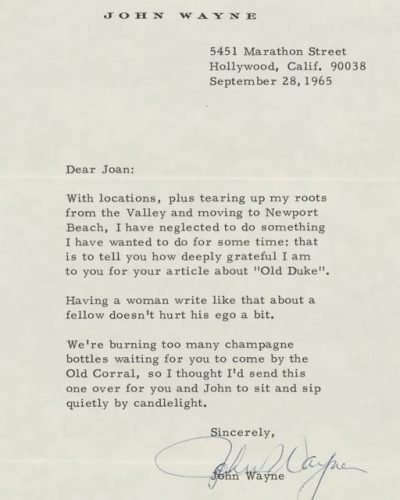 Told you.
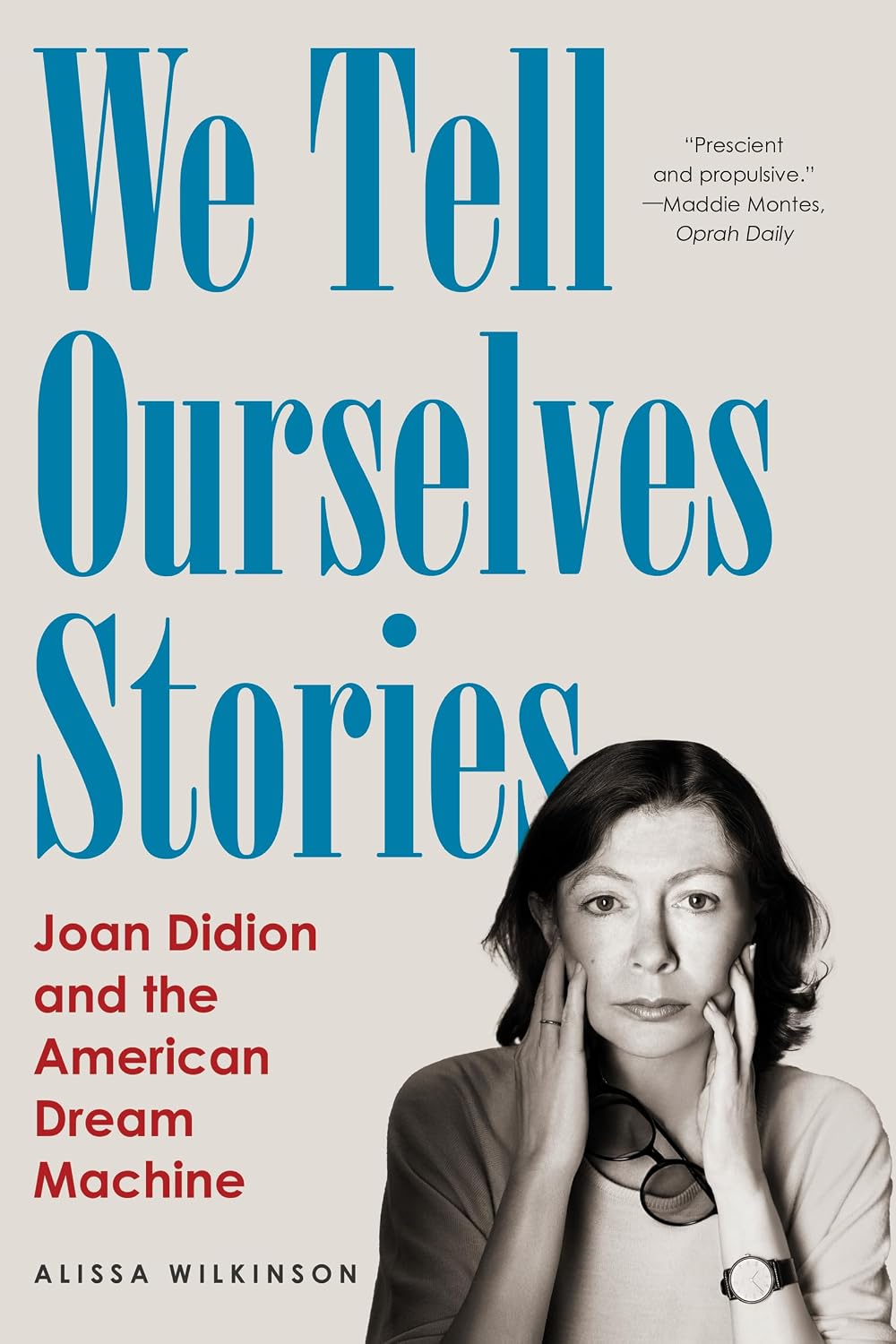
We Tell Ourselves Stories: Joan Didion and the American Dream Machine by Alissa Wilkinson, author and film critic at The New York Times, uses Didion’s connection to Hollywood to see how the moviemaking industry shaped American life, from relationships to politics, morality to personal taste, and the competing forces influencing them. Wilkinson follows Didion as she becomes the ultimate Hollywood observer from her perch as a screenwriter. John Wayne also makes several cameos, serving as a cultural avatar or time traveler from an earlier era of filmmaking. Didion and Dunne wrote several feature film screenplays, Panic in Needle Park, A Star is Born, and True Confessions, among others, cementing their position in Hollywood. Stories were what she and her husband told to live, to pay the bills, to connect with the world around them, but they also served a purpose far beyond being merely a means to an end.
Stories, as Wilkinson explains the phrase that inspired the title of the book, helped Didion survive.
Examining the human need to make sense of existence is Didion’s whole project. “We tell ourselves stories in order to live,” the first line of The White Album, is probably her most quoted sentence. It’s also her most misquoted sentence. […]
But Didion meant to be anything but inspirational. The paragraphs that follow that famous sentence are an anxious woman’s attempt to piece together a world that seemed to be flying into chaos in the late 1960s, the period covered in the essay. We concoct stories so we can keep on living; we pleasantly delude ourselves so as to ward away the terror. We look for patterns and symbols, links that will give some meaning and order to what feels dangerously like madness. We take messy reality and craft legends around it that reassure us.
For Didion, this was built into the business designed to make sure we all dreamt the same dream together, projected above our heads in lights. But what she saw went further: show business had given us vocabulary not just to entertain ourselves, but to understand our own lives.
Show business, as Didion calls it, and politics often go hand in hand, because they both start with mythmaking, the collective dream. Where those two powerbases actually meet, and who ends up holding hands with who, can be rather shocking. To wit: Joan Didion was an unexpectedly and unapologetically die-hard fan of the late Senator Barry Goldwater. Particularly for a person so deeply ensconced in Hollywood’s liberal fortress of the 1960s, Didion’s politics often come as a bit of a shock to her readers. Her background as a native-born Californian Republican and her love of John Wayne (whose politics and political activism Wilkinson also explores in the book) makes it slightly less shocking when readers also discover she wrote for the conservative magazine National Review in the 1950s and ’60s.
 Didion eventually left the Republican Party after Goldwater’s failed run as a presidential candidate and the party’s backing of Nixon. The party’s later offerings didn’t lure her back to the fold, either. The essay she wrote for The Saturday Evening Post in 1968, titled “Pretty Nancy,” about Nancy Reagan during Ronald’s tenure as Governor of California, gives one a sense of what she thought of them. Oof! Wilkinson does a masterful job of deciphering the sweep of America’s political history during Didion’s life, which could be tedious reading in the hands of a less skilled writer.
But, since we are talking about Joan Didion, this cannot just be about Hollywood, politics, American history, or even the writing life. It’s about what’s revealed when those things are exposed to the patented Joan Didion “sandpaper treatment.” Suddenly, within a sentence or two — sometimes less — the boring beige surface paint of banality is scoured away, revealing something stark and troubling and beautiful: real life. In researching for this piece, I came across a 1977 interview from The New York Times by Sara Davidson. Her question to Didion about religion pulled things into a different direction, away from politics, toward ultimate reality — which gets us right down to where we live.
Q. What has been your experience with politics?
A. I never had faith that the answers to human problems lay in anything that could be called political. I thought the answers, if there were answers, lay someplace in man’s soul.
Q. Are you as skeptical about religion as you are about politics?
A. I am quite religious in a certain way. I was brought up Episcopalian, and I stopped going to church because I hated the stories. You know the story about the prodigal son? I have never understood that story. I have never understood why the prodigal son should be treated any better than the other son. I have missed the point of a lot of parables. But I like the words of the Episcopal service, and I say them over and over in my mind. There’s one particular phrase which is part of every service: “As it was in the beginning, is now, and ever shall be, world without end. Amen.” It’s a very comforting phrase to a child. And to an adult. I have a very rigid sense of right and wrong. What I mean is, I use the words all the time. Even the smallest things. A table can be right or wrong.
Q. What about behavior?
A. Behavior is right or wrong. I was once having dinner with a psychiatrist who told me that I had monocular vision, and there was no need for everything to be right or wrong. Well, that way lies madness. In order to maintain a semblance of purposeful behavior on this earth you have to believe that things are right or wrong.”
Didion’s rather unnuanced and overly literal reading of the parable is not dissimilar to that of the disciples present at the time of the original telling, or the disciples presently, myself included. And yet, notice the phrase that comforted her, from a child to adulthood, “As it was in the beginning is now, and ever shall be, world without end.”
Something changed in the years since that 1977 interview. Her husband John Dunne suddenly died in 2003, followed by her daughter Quintana’s death in 2005, the same year her book, The Year of Magical Thinking, was published. The childhood comfort she found in the words were now rewritten into a nihilism-tinged axiom as she sought meaning in the loss of control she felt after John’s death.
I found earthquakes, even when I was in them, deeply satisfying, abruptly revealed evidence of the scheme in action. That the scheme could destroy the works of man might be a personal regret but remained, in the larger picture I had come to recognize, a matter of abiding indifference. No eye was on the sparrow. No one was watching me. As it was in the beginning, is now and ever shall be, world without end. On the day it was announced that the atomic bomb had been dropped on Hiroshima those were the words that came immediately to my ten-year-old mind.
Death reveals and shrouds simultaneously. Comfort is hidden by uncertainty, while the new reality of loss and pain is thrown into sharp blinding contrast. Didion reported her experience with magical thinking as she navigated the stark realities of her loss. Grief becomes the great destroyer of illusions, and certainty becomes one of its first victims. Something has to fill the void.
Wherever Joan’s eye turns, whether it is politics, movies, Martha Stewart, or life and death, we want to read what she has to say. Because of this, the icon status she achieved fairly early on in her career cannot have been an easy burden. I may be a bit presumptuous with that assumption, so I decided to ask an expert on the subject: Alissa Wilkinson. Here’s what I asked her:
Didion always felt a bit like a prophet to me, maybe a proto-prophet. The disillusion that prophets often prompt in us allows reality to start peeking through. Auden, who I know she admired, would be another example of this type of writer. As Christians, we believe that the ultimate reality we are drawn to, spending our lives trying to find, has a name, and is already found. Moreover, that we have been found. While Joan may not agree with my conclusion, I have come across many Christ followers who find her lifelong attempts to see what’s really happening behind our constructed narratives extremely helpful. Do you think she was aware of her influence, confident in her own viewpoint, which kept her from being bogged down by self-doubt? Or put another way, did she think of her work as of use to others similarly engaged in pulling back the curtain; that this was part of her vocation?
Wilkinson’s response didn’t disappoint:
After years of reading Didion, I think she would likely have been very wary of any suggestion of things like influence or vocation, which would sound self-important to her, like just another story we tell ourselves in order to convince ourselves of something. The best example of this that I know is that she expressed confusion later in life about the way that people, particularly women, sought her out for advice; she seemed to believe that she was less equipped than anyone to offer wisdom. (In fact, the only place I can really find her doing that with any kind of confidence is the 1975 UC Riverside address.)
I think Didion considered herself more of an observer — her criticisms, as you may note, particularly in her political writing, almost entirely consist of describing what she sees. In essays like “Fixed Ideas” she does say prescriptive things, but in a descriptive manner. If I can read between the lines, it feels like she was immensely bogged down with doubt, and John (her husband) was important to her in part because she always felt that she had someone backing her up. Reading “The Year of Magical Thinking,” you can see exactly what happened after he died, though she of course was self-aware of it. And I believe she would have balked at the idea of being influential, even as she knew that she was widely read and admired. She was not a traditional journalist — she’s one of the most important figures in New Journalism — but she had a reporter’s modesty about what she was doing, just watching the world and trying to figure out what she thought about it.
She did however very much believe in responsibility to the reader to tell the truth as she saw it, and believed that showed up in the craft of the sentences as much as the words themselves. Again: a reporter’s instinct.
There’s often a temptation to try to fit Didion into Christian terms, but I think a lot of her ideas about the world were actually formed, for better or worse, in an attempt to correct for a kind of unseeing piousness and refusal to face the truth that she might have experienced in her youth in church. This shows up in “Year of Magical Thinking” again (just look at the last few lines). That doesn’t mean that her core insights were not, at base, important and perhaps vital ways of seeing the world that fit with a truly Christian perspective. But she had a horror of “thought-terminating cliches,” and I suspect she initially developed that horror sitting in pews.
“The last few lines” Wilkinson is referring to includes a heartbreaking reprise of the phrase Didion used earlier in the book, “No eye is on the sparrow.”
Wilkinson’s reticence to “fit Didion into Christian terms” is a point well taken, and one to learn from. Matter of fact, it helped to crystallize some of my own thoughts on the topic. For myself, as a Christian, it’s impossible for me not to think of Joan — or anyone else — in anything but Christian terms. Joan also engaged with distinctly Christian language and phrasing throughout her work and interviews. This doesn’t make her a Christian, but even in her attempts to steer away from the blandly offensive pap of her early church experiences, she was still wrestling with the faith. It’s particularly sad to me because Didion had a lower — and more accurate — anthropology about herself and others than many Christians do.
But I also believe that, in the words of Isaiah (55:11) the prophet, God’s word doesn’t return void. Neither do the words of God that followed Joan since her childhood. Instead of thought-terminating cliches or nihilistic worry stones, they are words of life, transcending our abilities to alter them to our perceived reality. I don’t know what happened in the years between 2005 and her passing in 2021, if those phrases from her youth comforted her once again. I do know the words she repeated, “In the beginning” was God, and in him is life, a Word that cannot return void, a Word without indifference, demonstrated by Christ’s love on the cross, the hope of the resurrection, a Word without end, is now and shall ever be.
Here we repeat, with Joan, “Amen.”







Thanks Josh, always good to hear about someone who doesn’t fit the boxes.