




“It is just here, among the ruins and the bones, that we may rejoice in that perfected Work that is not ours.” This line from the end of The Sea and the Mirror sounds a theme: honest need marks the when and where of pardoning mercy.
The Sea and the Mirror (1944) by W. H. Auden is a sort of extension of and meditation upon The Tempest by William Shakespeare. Just as Auden understood The Tempest to be, this poem is, he told his friends in two different letters, “my Ars Poetica,” a poem that is “really about the Christian conception of art.” The Sea and the Mirror may not be Auden’s most approachable poem (even by the standards of the long poems he wrote around the time of the Second World War), but it does speak what the poem calls a “real word” of honesty and mercy.
The poem opens as the curtain closes. A drama company has just completed a production of Shakespeare’s The Tempest. The actors, still in character but after the end of play, talk, give speeches, and address the audience. Their words are the poem. (All of Part III is a long speech by Caliban that imitates the prose style of Henry James. Again: not the most approachable of Auden’s poems …)
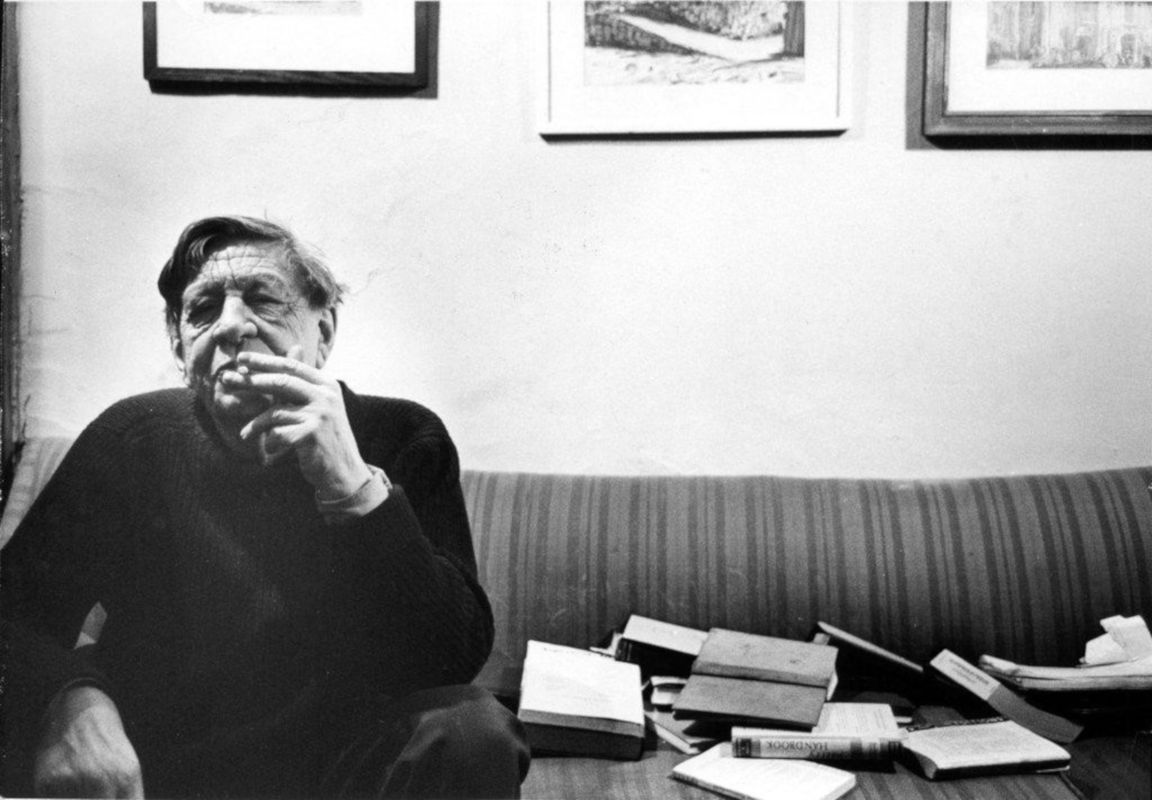
This premise — a poem that is a kind of play after and within a play — is part of the way Auden communicates his analysis of human living: we are “born actors,” beset with an “incorrigible staginess.” Auden had listened to and learned from Shakespeare, who in the voice of Jaques in As You Like It says, “All the world’s a stage, / And all men and women merely players.” In Thornton Wilder’s analogous description, our “hunger for esteem” and “thirst for praise” means “life becomes a series of postures before a mirror” (The Ides of March, 1948). We pose and deny and distract and utter our lines, all the while refusing to see or hear or face our honest and actual condition. The painful and comedic thing, as Auden recognized so clearly, is that this kind of living is a tragedy: “born actors” though we are, the performance is a flop, the imagined and hoped-for laurels and love fail to arrive. Our acting, in the end, is an audition for a role we never get. “Life,” as Auden has Antonio says, “is a dream in search of grace.”
But art — and Auden admitted to wondering if it might be “absurd” to explore the potential and limits of art within a work of art — is a kind of acting or artifice that can unmask actors and opens our ears to the “real Word.” The first word of that real word is: “pardon is needed.” We are exposed, vulnerable, mortal, failing, hurt, and wounding — we always were. In Auden’s images:
We do at last see ourselves as we are, neither cozy nor playful, but swaying out on the ultimate wind-whipped cornice that overhangs the unabiding void — we have never been anywhere else, — when our reasons are silenced by the heavy huge derision, — There is nothing to say. There never has been, — and our wills chuck in their hands — There is no way out. There never was …
“Our daily familiar life” too often is, as George Eliot saw, “but a hiding of ourselves from each other” (Janet’s Repentance). But “just here,” Auden suggests, as the play is interrupted and exposed and actors are unmasked and unhidden — “at this very moment” and “for the first time in our lives” — we can hear “the real word.” As Part III opens, “having dismissed our hired impersonators” we can listen, not to the lines we speak as “born actors,” but to that “Wholly Other Life.” The real word is not that we’ve improved — the hurt and acting and wrong are still there and only more evident. But we hear that we are blessed “with them” by the Other whose name is “Mercy.” (To borrow from another play, “Forgiveness, can you imagine?”) This is the “music which explains all and pardons all,” the music of mercy that in Gonzalo’s words says, “To the lonely — ‘Here I am’” and “To the anxious — ‘All is well.’” (If this sounds strangely like Augustine, Auden’s notebook with a draft of this poem also has notes on the Confessions.)
This theme of the coincidence of recognized need and divine mercy is summed up by Caliban near the end of the poem: “It is just here, among the ruins and bones, that we may rejoice in the perfected Work which is not ours.” It is, after all, to dry bones that God’s love says “live” (Ezek 37), and it is at the tomb that God, by grace, opens the grave (John 11; cf. Easter!).
Maybe this is why Oscar Wilde says, “Ah! Happy those whose hearts can break/And peace of pardon win!” He then asks, “How else but through a broken heart, may Lord Christ enter in?” (The Ballad of Reading Gaol). The unmasking of actors and the facing of the reality we feel but fear opens cracks in the human heart. But those cracks, it seems, are often the paths love takes. Mercy and hope live and love at the site of honest need. “Just here, among the ruins and bones” — “with our hired impersonators dismissed” — it is finally and actually the person rather than the actor with whom the “Wholly Other” is relating . And just here, the Real Word is spoken to the real person: mercy, pardon, and a love that sees and stays and never stops.
This mercy, this love, this Wholly Other, this perfected Work also has a name: “nothing can separate us from the love of God,” the “perfect love” who is “Christ Jesus our Lord” (Rom 8 and 1 John 4).







This was excellent. Thank you for your insightful work. I immediately ordered Janet’s Repentance.
The Lord is near to the broken hearted and saves the crushed in spirit. Thanks for your article
Thank you for this beautiful and encouraging piece. It reminded me of Leonard Cohen’s “Anthem”
Ring the bells that still can ring
Forget your perfect offering
There is a crack, a crack in everything
That’s how the light gets in
I love it when after reading those whose grasp of the deep and command of language, leaves me with nothing to say at all, but thank you…