




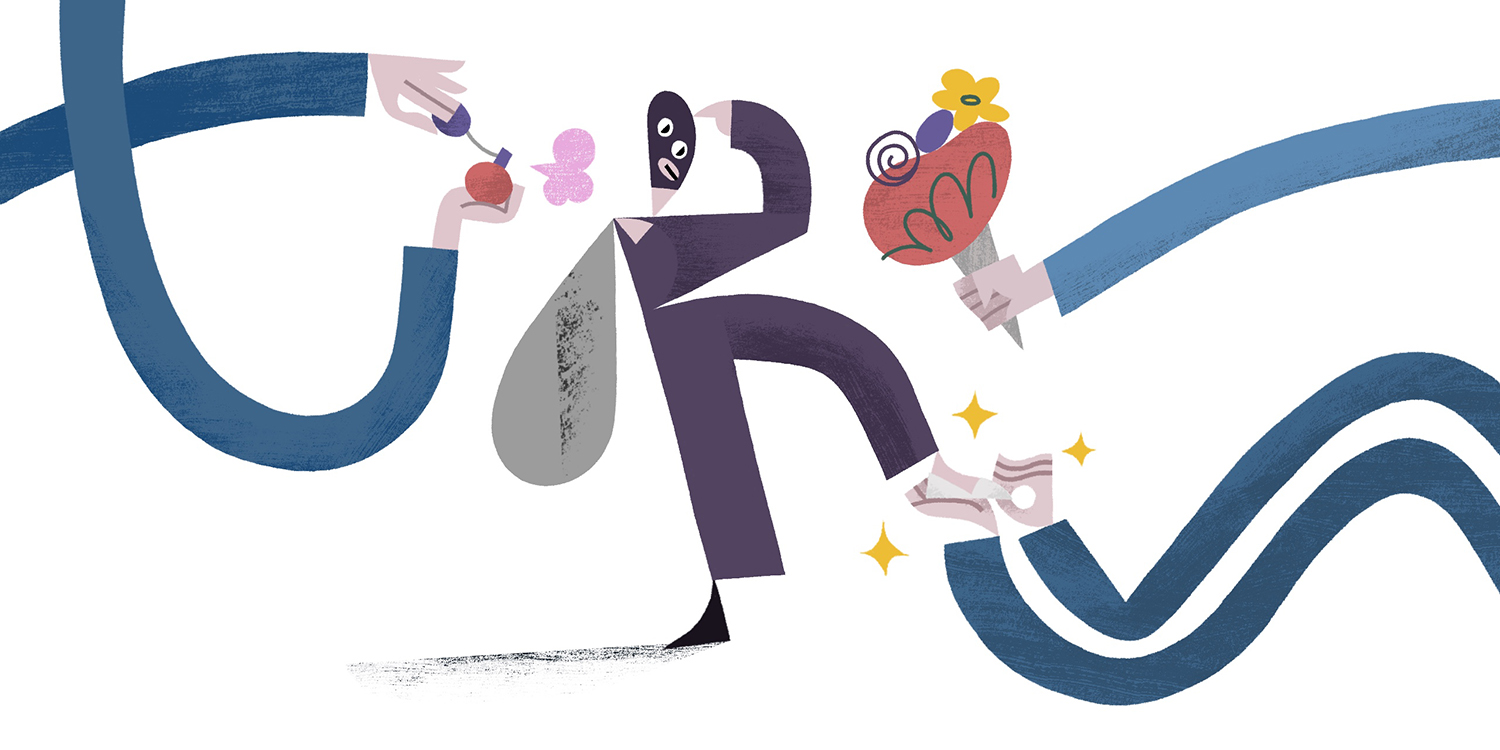
In the Season 2 Christmas episode of Ted Lasso, the players are merrily handing out gifts to one another in the locker room when one of them — the show’s erstwhile villain and perpetual dolt, Jamie Tartt — ducks into the coach’s office. Jamie has forgotten to buy a Secret Santa gift. But before he even finishes explaining his predicament, a gift almost magically appears — wrapped, and with a bow on it. A stunned Jamie slowly reaches to pick up his miraculously prepared gift, stares at it for a moment, and then offers this nonsensical Tiny Tim parody with an air of reverent gratitude: “God bless me … everyone”.
Jamie doesn’t “deserve” to be bailed out. He doesn’t deserve to be blessed, but he is anyway. In a small way, the silly scene thus captures the essence of the “Christmas spirit” — and most basic message of Christianity — that grace is shown to all regardless of “just deserts”.
Most popular modern stories, however, are not written in the spirit of Christmas. To state the obvious, the stories we tell tend on some level to be moral fables, rewarding those who are good and/or punishing those who are bad. And such cosmic meritocracy is especially pronounced in children’s stories, not least the many exuberant fairy tales set to animation over the past 85 years by Disney. This tendency towards mind-numbing moralism in children’s stories is hardly surprising. We all grew up hearing such tales ad nauseum, to the point where we probably just assume that that’s how children’s stories — and maybe all stories — are supposed to work.
What may be surprising, however, is that children’s stories haven’t always been so predictably moralistic. In fact, there was a time in European folk history when “fairy tales” did not actually reinforce a karmic vision of the universe but instead projected a jarring kind of moral anarchy. At least, that is, according to a fantastic recent episode of Malcolm Gladwell’s Revisionist History podcast called “Little Mermaid Part 2: The Fairytale Twist,” the second in his three-part “forensic analysis” of the 1989 blockbuster that kickstarted the Disney renaissance.
While all three Little Mermaid episodes are worth a listen, in this particular episode, Gladwell mostly zooms out from the film — itself very loosely based on the fairy tale by Hans Christian Andersen — and instead examines the broader history of European fairy tales. The episode revolves primarily around his conversation with Angus Fletcher, a neuroscientist turned English professor who Gladwell enlists to help develop a “theory of fairy tales: why they matter, why they work, and why sometimes they don’t work at all.”
The first thing Fletcher points out is that there are “actually two categories of fairy tales: the original kind and the modern kind.” Among the earliest recorded fairy tales are those of 16th-century writer Giovanni Straparola, who, more than two centuries before the Brothers Grimm, published a collection of 75 folk stories called The Facetious Nights. Here’s Fletcher:
There are these two amazing things that we start to see in Strataparola’s fairy tales […]. The first is that good luck happens to people who are fools […] — and by “fool” I mean an actual fool. I mean somebody who is so dense in the story that he says terrible, rude things to everybody he meets, is an inept fisher person, has no apparent positive qualities whatsoever, and then ends up a prince.
What’s more, such strokes of luck don’t merely happen to “fools” but to people who are actively “bad.” A classic example Fletcher highlights is the ancient fairy tale of Adamantina, a poor country girl who is sent to market one day to buy food for her starving family. Here’s his rundown:
Adamantina goes to the market with the family’s last money, and does she buy food? No. She makes a whimsical purchase of a doll that she sees because she happens to like this doll. And she takes this doll home with her and her older sister is so distraught that she has this breakdown: “Oh my goodness, this is the end of the family! You’ve ruined the family! It’s all over!” [But] lo and behold, the doll turns out to be a magic doll and it spits forth money.

This is just the first of a series of bizarre things that happen to Adamantina and combine in the end to more-or-less make all her dreams come true. Yet, as Fletcher emphasizes: “Adamantina does not deserve them at all. She’s not virtuous, she’s not smart, she’s not nice, she’s not kind.” She wins the lottery of life and does nothing to deserve it.
This fits the older “original” model of fairy tales that Fletcher refers to as “fairy tale twist stories.” Straparola’s stories “almost always end with fairy tale twists.” Here’s Gladwell and Fletcher:
MG: For thousands of years people sat around the fire and listened to storytellers, and what are the narratives that survive […]? Stories in which heroes did not deserve their fate.
AF: Audiences wanted to believe that life could suddenly go from bad to good.
MG: It’s not simply that […] there could be a sudden twist. It’s that the twist would be unrelated to the disposition and character of the protagonist, that I didn’t have to meet a certain qualification to be eligible for this good fortune.
However absurd they may seem, “fairy tale twist stories” are clearly grace stories, which means they make sense only in the context of a universe characterized either by utter randomness or by God’s utter mercy and unconditional love (or both?). Straparola basically shoots happy endings at people from a t-shirt cannon.
According to Fletcher, even as Europe remained overwhelmingly “Christian,” fairy tales took “a dramatic turn” away from grace in the 17th century. All of a sudden they went from “twist stories” to “poetic justice stories”. Here’s Gladwell and Fletcher:
MG: The key figure [in this shift] was the French writer Charles Perrault. He read the fairy tales that had been collected by earlier writers and loved them — wanted to share them with the world — but Perrault thought they needed a little tweaking.
AF: He said, “You know what, these tales are so primitive. They were written before the Age of Reason, they were written before the Enlightenment. And reason tells us that all these instances in which good things are coming from bad can’t happen because life follows this logic that’s been created by God.”
So what does Perrault do before passing these tales on to posterity? He completely changes them. He makes it so that “good things only happen to good people and bad things happen to bad people,” which is essentially the way fairy tales have been told ever since.

The example that Gladwell and Fletcher use to illustrate this “poetic justice” model is the classic tale of Cinderella. We all know some version of the story: Cinderella’s mother dies and her father remarries. She gets stuck being tormented by an evil stepmother and evil stepsisters, but always “remains pious and good.” At some point, she’s given a magical dress, goes to a ball, catches the eye of a prince, runs away, leaves behind a glass slipper … bla-bla-bla … they find her, the slipper fits, she marries the prince and lives happily ever after.
The point is her “virtue is rewarded.” And what happens to the evil stepsisters? Well, “they get attacked by pigeons that peck out their eyes.” Poetic justice, right? Sure, dreams come true, but only for “beautiful, angelic” people like Cinderella, and never for evil, ugly stepsisters. According to Gladwell and Fletcher, when Disney made Cinderella in 1950, they “went all in on poetic justice,” and “ever since then all of Disney’s fairy tales have had that same story model […]. It’s this inheritance of the Enlightenment.”
Okay fine, but don’t we all prefer poetic justice? I mean, I love Disney. Who doesn’t? Don’t kids and parents alike enjoy stories with good moral lessons where the good guys win? Isn’t that just what people want?
Well, it turns out that children don’t inevitably prefer the most morally predictable narratives. Fletcher and his team have actually done tests measuring the emotional responses of children to different types of stories and it turns out that kids may deserve more credit than we give them. Here’s the excerpt:
MG: Fletcher does his top secret analysis of little kids watching Disney movies and he thinks he knows what he’s going to find — the kids [will] prefer Cinderella. They don’t want the moral anarchy of the “fairy tale twist”. And sure enough, the kids squeal with delight. […] [They like] the characters, the adventure, the humor […]. But they struggled with the idea that good always comes from good and bad from bad. Why? Because your child is perfectly capable of extrapolating what all this means.
AF: What [a child’s] brain processes is, well, bad things are happening to me. Why […]? They’re happening to me clearly because I’m bad, and if bad things happen to bad people and I’m bad then worse things are going to start to happen because there’s no way for me to turn this train around. And what we see is that these stories generate what’s called “catastrophizing” […] [which] is when you become convinced that there’s no way to break the cycle of bad feeling.
According to Fletcher’s research, this negative effect is initially “masked” in Disney fairy tales because the “immediate emotional effect” of watching the (supposedly) happy ending of a Disney fairy tale movie is to feel good because the end is so (seemingly) positive. But over time there’s actually this “corrosive negative effect” that comes from extrapolating those karmic themes, a kind of “post-Disney hangover.” We might say that this anxious “doom” effect children experience is simply a natural response — however subconsciously — to the oppressive weight of the moral law, which we all know we can never live up to.
Interestingly, Fletcher also tested children’s emotional responses to “fairy tale twist stories.” What he found, by contrast, is that “those kinds of stories defeat catastrophizing,” because they send kids a very different message: “Bad doesn’t always come from bad. Good can come from bad. Just relax, life is not logical.” And apparently, as a result, kids tend to prefer these kinds of outcomes. As Gladwell summarizes, “kids prefer […] Adamantina to Cinderella.”
So maybe it’s the adults and not the kids that are so attached to these “poetic justice stories.” Maybe the outcomes of children’s stories — or stories in general — don’t always have to be so insufferably predictable, so insufferably righteous. And maybe we’d all feel a little better if we learned to see characters in our stories differently, with more complexity and compassion.
Of course, it’s not like it’s easy to magically shift all our thinking away from law to grace. In fact, it’s incredibly hard because we’ve spent so much of our lives immersed in the former: We “punish” people when they’re bad and “reward” them when they’re good. When we watch movies or shows, we generally want to see that same karmic paradigm at work. We relish it. It’s the way of the world. I don’t watch The Lord of the Rings hoping that the Orcs will eventually have a change of heart or fall in love and live happily-ever-after. I want to see poetic justice.
Grace is profoundly countercultural and thus counterintuitive, and perhaps always will be. But it is possible for us to at least begin to rethink the kinds of stories we tell and consume, and that might help us all to experience God’s grace more freely, and also to recognize that we too can sometimes be Orcs, or Jamie Tartts, or evil stepsisters. As Jesus said, God “makes his sun rise on the evil and on the good, and sends rain on the righteous and on the unrighteous.” And that is good news.
The artwork for this article was created by Mikey Karpiel.








[…] from Season 6, unpacking and rethinking the classic story of The Little Mermaid. I wrote an Mbird post about it ages ago. It’s definitely worth a listen, perhaps especially if you either loved or […]