




The children are always ours, every single one of them, all over the globe; and I am beginning to suspect that whoever is incapable of recognizing this may be incapable of morality. -James Baldwin
In her autobiographical book, A Well-Trained Wife: My Escape from Christian Patriarchy, Tia Levings recounts how her abusive husband moved their family into remote, rural areas and into increasingly fundamentalist churches — until they landed in a fringe Calvinist sect that advocates severe corporal punishment, not only for children but also for wives. The church they attended is affiliated with the Idaho pastor Doug Wilson and his hard-line Communion of Reformed Evangelical Churches, which Pete Hegseth follows, and which promotes the creation of a Christian theocracy, the removal of voting rights for married women, and a sanitized vision of Southern slavery. (In addition to Amazon Prime’s Shiny Happy People: Duggar Family Secrets, I highly recommend CNN’s documentary episode “The Rise of Christian Nationalism” for several jaw-dropping reasons, but partly to witness Wilson’s narrow definition of womanhood: “Women are the kind of people that people come out of.”) At one unnerving point in A Well-Trained Wife, a meek and mild mother at the church takes Levings aside, drops her smiling façade, and issues a warning:
“Promise me you won’t move off-grid, Tia. We tried that once. It’s break-you hard, and there’s no one coming in an emergency.” Her directness felt like she’d just broken the fourth wall, the way an actor on stage breaks away from the dream of the story to address the audience. Years later I’d look back on this moment and count it as one of the times women looked out for each other, going along with the patriarchal game to a point, but breaking rank in hours of real danger. (176–77)
Levings’ husband, who demanded to be called “my lord,” nevertheless moves the family into a remote area of Appalachia, where they unsuccessfully attempt a homesteading lifestyle. Noticing that the family lacks a source of heat, a kindhearted neighbor does provide some assistance when he drops off a large stack of firewood: “Ma’am, I noticed you ain’t had a plume o’ smoke outta that chimney since you moved here. Ain’t right for you and those babies to be so cold” (181). As she stacked the wood, Levings reflects that her life “seemed centuries old, and that it wasn’t 2006 at all but actually 1886, and how in all our churches Little House on the Prairie life had been the plan all along” (181). Despite the neighbor’s help, the entire experience escalates into such horrific abuse — not only of humans but also of animals — that Levings and her children ultimately flee in the middle of the night to escape the nightmarish situation.
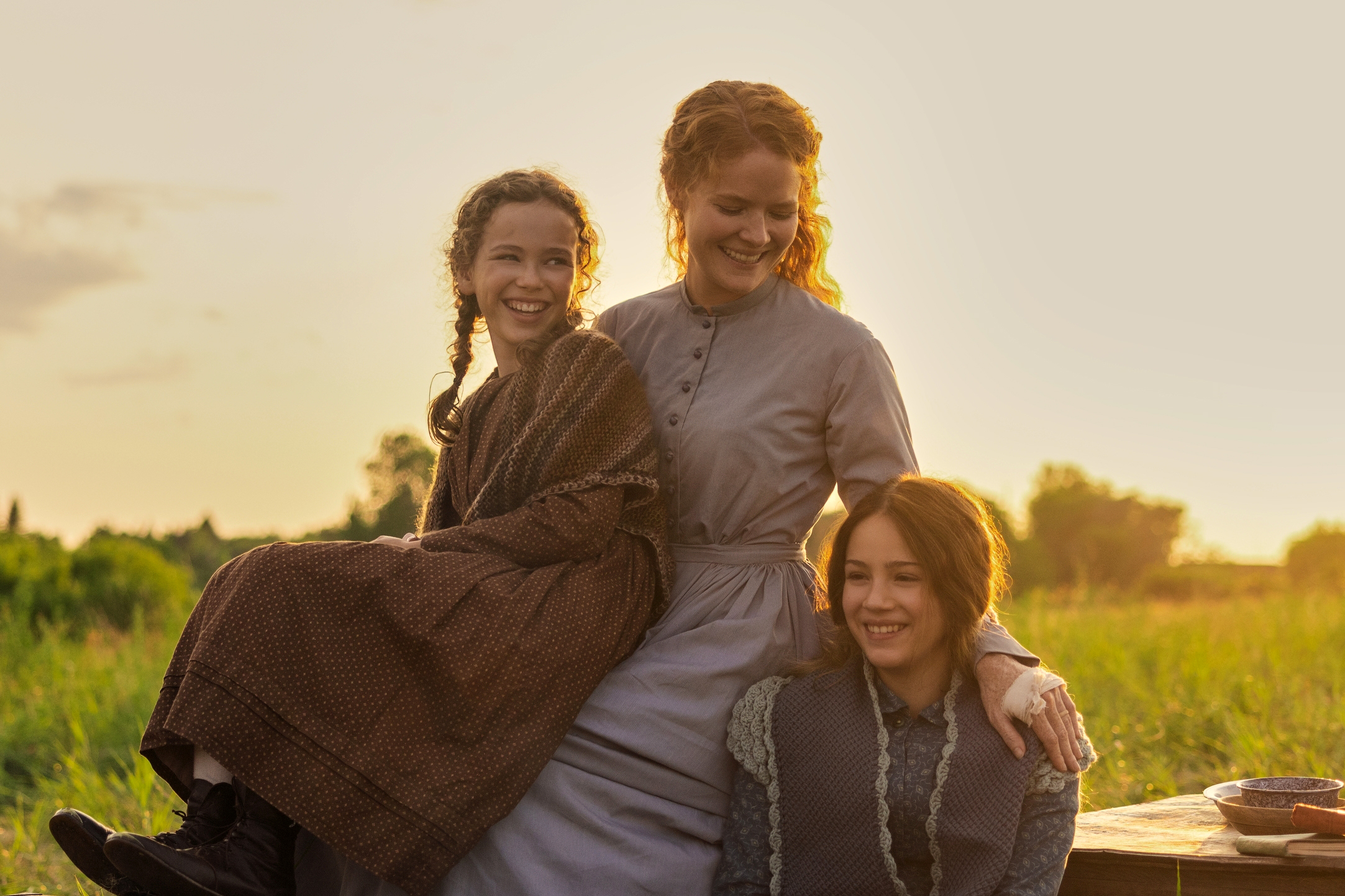
I was reminded of these moments while watching Netflix’s recent adaptation of Little House on the Prairie, which opens with a newfound focus on Caroline Ingalls, foregrounding her terrified reaction after barely surviving the crossing of a flooded river in a covered wagon. This occurred after her husband, Charles Ingalls, decided to move away from the supportive network of extended family in Wisconsin to establish a new home on the Kansas prairie. The show is tedious and depressing — I agree with Sarah Larson at The New Yorker, who calls it “sunlit” and “joyless” — and so far afield from the charm of the original as to be nearly unrecognizable. The showrunner Rebecca Sonnenshine has opted to depict this fan fiction in a manner reminiscent of the genre of social realism, but the books defy that plot-driven representation, instead falling closer to soft-hued nostalgic realism or even magical realism, in which the natural world has a supple supernatural overlay, as evidenced when Laura falls asleep listening to the music of the stars. The sensory appeal of the books is also staggering, and I don’t recommend listening to the audiobook of Farmer Boy on an empty stomach because the mouth-watering descriptions of food will cause you to pull over at the nearest restaurant! Little House in the Big Woods, with its episodic nature, songs, and tall tales, certainly defies easy generic categorization, and the exuberant effervescence of the dance at the grandfather’s house during maple syrup season is one of the finest scenes in the entire series, demonstrating the joyful communal fellowship of the extended family.
Why Charles Ingalls wanted to drag his nuclear family away from that supportive network and into an isolated homesteading experience remains a mystery to me. In the book, the family settles 50 miles outside the town of Independence, Kansas, in the middle of a vast empty plain, squatting illegally in Indian territory, where they interact with a couple of far-flung neighbors, a handful of Native Americans, and an African American doctor. In the show, they appear closer to town and have a constant stream of interactions with so many people that the isolation of the original is downplayed. This is particularly emphasized in the show when Laura gives a pivotal speech during the town fair: “Independence is actually a funny name for a town like this. The prairie is so big, and we’re so small. The truth is none of us can make it alone out here. We need each other. Independence isn’t about self-reliance, or liberty, or freedom, or any of those things. It’s a place to come together.”
This speech reveals that Sonnenshine has a vision quite antithetical to that of Rose Wilder Lane, who encouraged her mother, Laura Ingalls Wilder, to write the Little House series, which she then edited according to her ideology. Lane was a staunch libertarian who opposed FDR’s New Deal policies, was friends with Ayn Rand, and supported the genesis of the Libertarian political party through her friendship with Roger MacBride. She promoted rugged individualism and self-reliance, deleting any mention of the government assisting the Ingalls family, even though they accepted tuition assistance for Mary to attend the College for the Blind in Iowa and also relied upon the Homestead Act to acquire land.
With the lens newly focused on Caroline Ingalls, the show is taking part in a wider conversation and recent critique of contemporary “tradwife” influencers on social media, famously exemplified by Hannah Neeleman of Ballerina Farm, who perform traditional homesteading lifestyles while often wearing gingham dresses in an idyllic, rural setting. Needless to say, this aesthetic is inspired by the pioneer lifestyle of Little House on the Prairie. Books like Caro Claire Burke’s Yesteryear (2026), Tara Westover’s Educated (2018), and Tia Levings’ A Well-Trained Wife (2024) unveil the reality and ugly underbelly of such lifestyles, while Caroline Ingalls herself demonstrates the hard labor involved in pioneer life and being dependent upon the whimsical vicissitudes of the seasons. Surely we already knew that farm life is incredibly difficult and challenging? But for a generation of younger women being sold a glorified and glossy aesthetic of the tradwife lifestyle, it’s worth scratching the glamorous surface to see what lies beneath.
Yesteryear and Educated
When placed within the historical context of late nineteenth- and early twentieth-century novels like Little Women, Anne of Green Gables, and even Gone with the Wind, the Little House series contributes to an ongoing motif in which every tomboy had its counterpart. Every high-spirited and vivacious Laura, Scarlett, Jo, or Anne found its counterpoint in the blind Mary, the kind Melly, or the domestic Meg and Diana. These two visions of girlhood were ceaselessly set in oscillation, but advocates of the latent cult of domesticity and their contemporary tradwife sisters often make it seem like Laura, Jo, and Anne were just a developmental stage on the road to marriage. (Scarlett and Melanie are such extreme examples of this duality that they blow the whole motif apart, perhaps satirically so.) While it’s better than the virgin/whore dichotomy, most women would certainly welcome a wider range of options.
Other contrapuntal conversations emerge as Netflix’s Little House places communal interdependence in contrast with libertarian ideologies, drawing attention to the proclaimed self-reliance of the contemporary homesteading movement. The performative independence of online homesteaders and tradwife influencers quickly deteriorates under closer scrutiny, revealing that the ostensibly rustic simplicity of Ballerina Farm is supported by an unseen labor force, the wealth of JetBlue’s founder, and massive social media earnings. In her analysis of “Cottagecore” — a subset of these pastoral lifestyles, with an emphasis on a folklore aesthetic — Lara Prendergast notes that “privileged humans have always hankered for the simple and rustic,” recalling the curious case of Marie Antoinette, who enjoyed dressing up as a shepherdess while servants performed manual labor in her mock village. For young women entranced by these traditional lifestyles, Jennie Gage issues a warning: “The people pushing the tradwife life have never lived in poverty. They’ve never actually struggled. They don’t know what it’s like to be a woman who then loses everything,” she says. “The people that are selling it … really don’t have any idea what that looks like in the lives of everyday, working-class people.”
Spoiler alert! The novel Yesteryear is twistier than a rattlesnake, and it’s worth reading first if you don’t want to encounter revelations below.
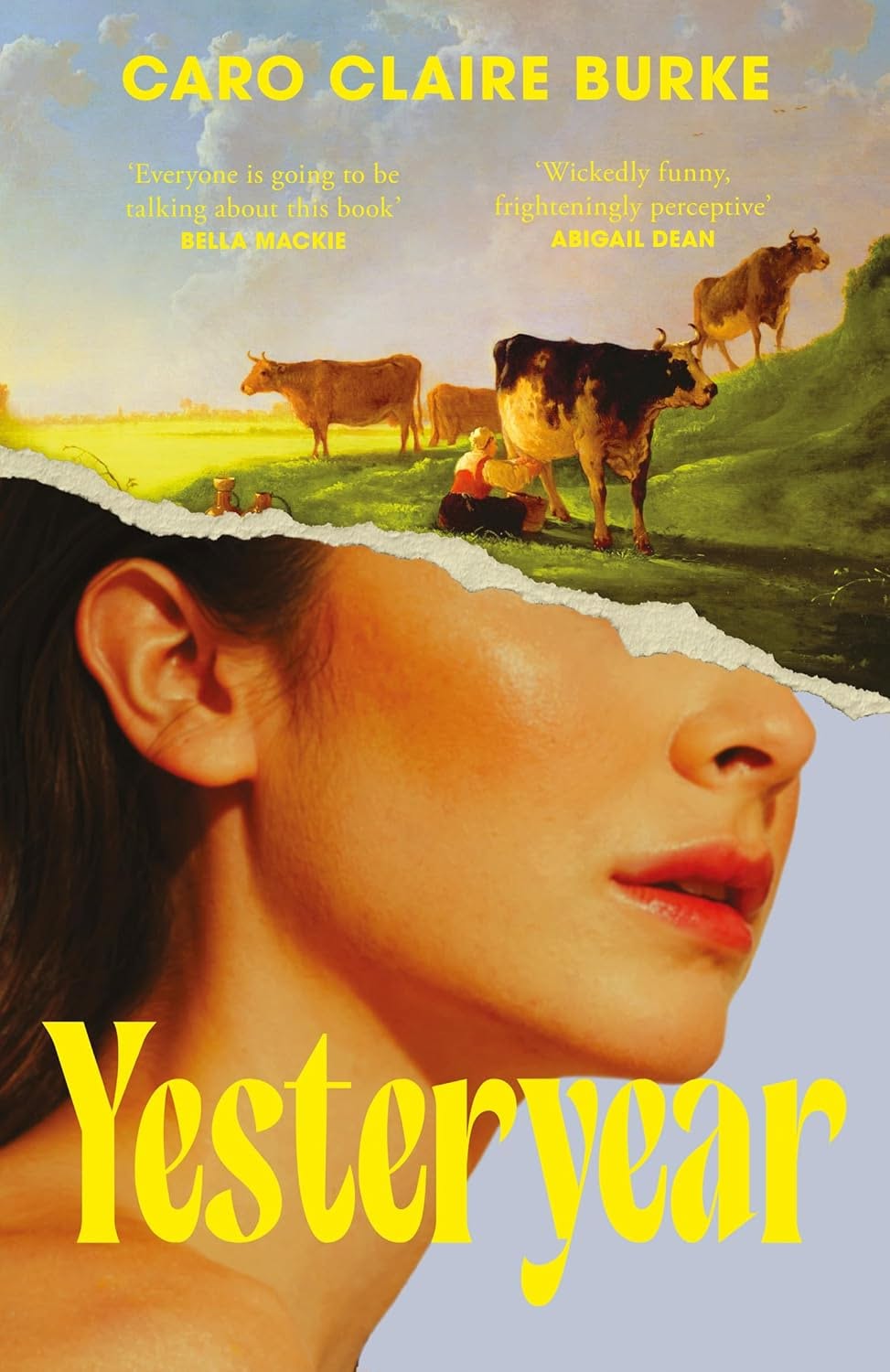
While several critics have drawn parallels between Hannah Neeleman and the protagonist of Yesteryear, who marries into a wealthy family, I suspect that Ruby Franke is a closer parallel, and I’ll return to that later. Yesteryear is a mixture of genres — part satire, part psychological thriller — with elements drawn from The Truman Show, The Twilight Zone, Gone Girl, and Don’t Worry, Darling. The protagonist, Natalie Heller Mills, is a hypocritical antiheroine and an unreliable narrator, but it’s not until late in the novel that we are shocked to realize that she has likely been speaking most of her deranged thoughts aloud. Even more horrifically, a second reading of the novel reveals that she has listened silently while her college roommate was sexually assaulted. And why does the family’s livestock keep mysteriously dying? It’s a blink-and-a-miss moment, but Natalie’s husband, Caleb, killed a bunny when he was younger, and the implicit suggestion haunts the underlying narrative. The guy is a nasty villain by the end of the book, and this is the first inkling that something disturbing lurks beneath his lazy man-child exterior.
Natalie’s wholesale performance of the tradwife aesthetic on Instagram causes her to neglect her own children — accidentally leaving one in the car while she goes shopping; forgetting to feed them dinner because she’s too busy videotaping a new recipe; glad to hire nannies so that she doesn’t have to interact so frequently with her offspring. The severe disjunction between the reality and the performance ultimately leads to a psychotic break and psychogenic fugue state in which she imagines that she has been transported to 1855, still in rural Idaho. Her children and husband look like uncanny doppelgangers: “I frowned, trying to see straight. Squinted down to see two boys looking up at me. I looked up and past them to find two barns, two houses, two sets of two nannies playing with two sets of children. I blinked rapidly, lifted my head back, and stared up into a pair of snake-eyed suns, which blazed madly from a double-helix sky” (315–316).
A similar bifurcation of identity and reality repeats in the memoir Educated, where Tara Westover describes staring into her multiplied reflection in a three-paneled bathroom mirror, but for her, it’s a redemptive moment in which she refuses to succumb to her family’s gaslighting, even if it means being estranged for telling the truth about the abuse she has suffered: “I shattered the illusion I’ve been building so carefully for the past year. The fake past, the fake future, both gone.” At the end of the memoir, she states that she has left behind the girl in the mirror with her “fractured mind”: “The decisions I made after that moment were not the ones she would have made. They were the choices of a changed person, a new self. You could call this selfhood many things. … I call it an education” (328–329). Reading Westover’s memoir about her rural Idaho childhood was a harrowing experience because most chapters contain an injury or near-death experience, presided over by paranoid parents who refused to seek professional medical treatment and who endangered their children’s lives — no seat belts, two car crashes, multiple head injuries, internal and external burns. I breathed a sigh of relief when I finished the memoir.
There’s no such hope of escape for Natalie in Yesteryear’s refractive simulacrum and simulation, and her core of selfhood never repairs or reunites, as evidenced when she pastes her expression into a performative smile, even when her children are taken away. Critics have rightly noted that Burke’s representation of fundamentalist Christianity in the novel is shallow, hollow, and misunderstood, and the mere fact that the family never attends church is fundamentally absurd for fundamentalists. (The author sought to avoid irritating any particular sect or denomination, though I’ll note in passing that the Trinitarian jokes border on the blasphemous, so it’s an irritant to all.) Yet the total isolation of the homesteading family struck me as the least believable aspect of the novel because rural neighbors often form a substantial network of support: farmers care for one another, looking after one another when the crops fail, checking on one another to ensure the survival of the community. The fact that no neighbor has checked on Natalie for years — not even her mother or sister — beggars belief. (See, for instance, Levings’ kind neighbor in Appalachia, or the doctor who arrives in the nick of time to saves the Ingallses from malaria, or the neighbor who helps Charles Ingalls construct his log cabin.) The conclusion, where the eldest daughter finally comes to rescue the other children, is a powerfully redemptive moment and a harbinger of things to come.
From Tradwives to Tradkids: The Children Write Back
In her review of Yesteryear, Levings writes, “Perhaps only horror beats can tell this vital underbelly [of the tradwife performance] well. Where others see barefoot toddlers and rosy pink cheeks, my mind fast-forwards ten years to the stories of abuse and neglect that will populate a new generation of memoirs. The trad-kid exodus is coming, and yes, you can quote me on that. I … loved Yesteryear’s ending. It’s absolutely coming true. With Ruby Franke, it already has.”
Levings is referring to the exposé written by Shari Franke, titled The House of My Mother: A Daughter’s Quest for Freedom (2025), which participates in the same genre as Tara Westover’s Educated. Shari is the eldest daughter of Ruby Franke, who is a former family vlogger and parenting influencer, who ran the popular 8 Passengers YouTube channel, in which she documented her life as a strict mother of six children. (The aesthetic was more suburban than rural, but much like the Neeleman and Westover families, the Frankes are members of the LDS Church.) Ruby fell under the pernicious influence of Jodi Hildebrandt, cofounded an online life-coaching company with her, and both were later sentenced to prison for severe child abuse. They were arrested after Franke’s malnourished twelve-year-old son escaped through a window and ran to a neighbor’s home to plead for help. In the midst of such an appalling story, a glimmer of light emerges because the courageous child knew he could turn to a neighbor, who would immediately call 911 after seeing the abuse he suffered. On the other hand, Shari Franke had reached out to Utah authorities and child welfare services multiple times over the years, but no assistance was forthcoming — until it was almost too late. “Thank goodness for our Springville neighbors,” Shari Franke writes, “my loyal allies in this fight. They were right there with me, leaving food on the doorstep of our house in case the kids were hungry, making call after call to DCFS, voicing their concerns about the kids being left alone for days on end … without proper food or care” (259).
I look forward to one day reading the history of the contemporary homesteading and home education movement, which I’m certain will be just as complex and variegated as the history of standardized public education. In the meantime, I’ll continue to follow the theme of human interdependence rather than self-reliant isolation, and I’ll continue to follow the connecting thread of the unsung heroes: the neighbors who checked in, who delivered food or firewood, who offered emotional support and kindness, who literally came to the rescue. As they followed Jesus’ commandment — love your neighbor as yourself — they demonstrated that sympathy and empathy may be the starting points, but compassionate action is always the end goal. They remind us to put down our phones and cameras and check on one another, ensuring that all our children, everywhere, are safe.
Kathryn Stelmach Artuso, Ph.D., is a freelance journalist, a specialist in transatlantic modernism, and the author of Transatlantic Renaissances: Literature of Ireland and the American South.