




A new monthly devotional series exploring poems about paintings:
The relationship between the verbal and visual arts, particularly poetry and painting, spans a complex and convoluted history, in which some critics have envisioned parallels between the “sister arts,” while other critics have witnessed a competitive relationship between the two forms of representation. Is a picture worth a thousand words? Or does poetry spark a more expansive imaginative vision for the reader? Can the form of a poem reflect or imitate the lines of painting or the plasticity of sculpture? How might the temporal arts of music and poetry intersect with the spatial arts of painting and sculpture?
This new monthly devotional series will explore poems about various artworks, spanning from Homer’s “Shield of Achilles” to the present day, though it will focus primarily on poems about paintings, an intertextual genre known as ekphrasis — more broadly defined as verbal representations of visual representations. Engaging in an integrative, interdisciplinary pursuit that blurs the boundaries between temporal and spatial realms as well as artistic and sensory divides, the series also seeks to open a hospitable and ecumenical space that merges secular and sacred aesthetics. Neither a traditional devotion nor an academic analysis, the series will contest conventional genre expectations, and we hope you enjoy this experimental adventure.
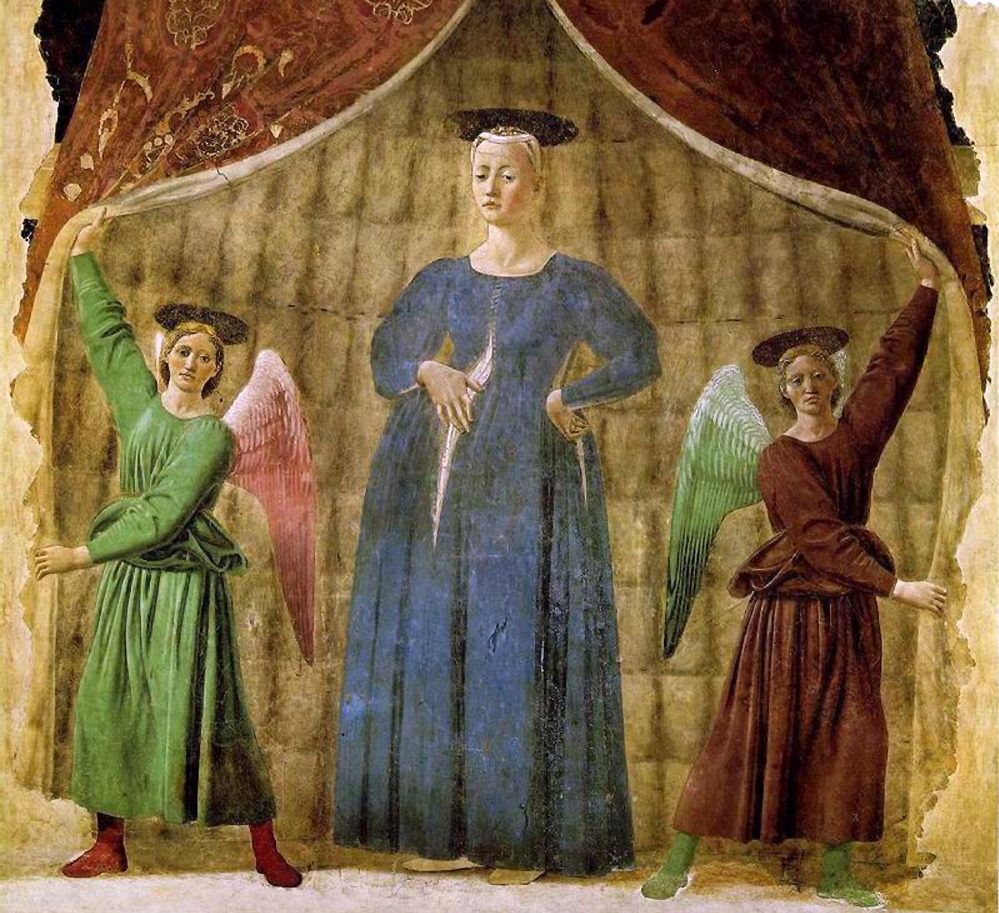
And the Word became flesh and dwelt among us, and we have seen his glory, glory as of the only Son from the Father, full of grace and truth. (Jn 1:14)
Madonna del Parto by Piero della Francesca (c. 1460), currently housed in the Musei Civici Madonna del Parto, Monterchi, near Sansepolcro, Italy. The fresco survived several earthquakes, including one in 1785 at the Church of Santa Maria di Momentana near Monterchi, where the only remaining structure left standing was the wall on which this fresco was painted.
“San Sepolcro,” by Jorie Graham
In this blue light
I can take you there,
snow having made me
a world of bone
seen through to. This
is my house,
my section of Etruscan
wall, my neighbor’s
lemontrees, and, just below
the lower church,
the airplane factory.
A rooster
crows all day from mist
outside the walls.
There’s milk on the air,
ice on the oily
lemonskins. How clean
the mind is,
holy grave. It is this girl
by Piero
della Francesca, unbuttoning
her blue dress,
her mantle of weather,
to go into
labor. Come, we can go in.
It is before
the birth of god. No one
has risen yet
to the museums, to the assembly
line — bodies
and wings — to the open air
market. This is
what the living do: go in.
It’s a long way.
And the dress keeps opening
from eternity
to privacy, quickening.
Inside, at the heart,
is tragedy, the present moment
forever stillborn,
but going in, each breath
is a button
coming undone, something terribly
nimble-fingered
finding all of the stops.
I have been living with this poem for many years now, trying to understand it, even as it eludes me with its mystery and complexity. Like Rainer Maria Rilke, I suppose I am hoping to “live along some distant day into the answer.” I am comforted when I read theologians also floundering to comprehend one of the deepest mysteries of the Christian faith, of an eternal being who descended into time and space, of the Word who was made flesh and dwelt among us. The poem and the painting shock me out of my habitual, automatic perceptions of Christianity to reveal a new awareness and appreciation of the incarnation and birth of Jesus, enabling me to see these events with the wonder of a child’s eyes.
In another publication, I offered an analysis of these artworks, though they both remain beyond my grasp, reminding me of Søren Kierkegaard’s claim that the incarnation defies human comprehension to such an extent that any contemplation of it ultimately leads to the “crucifixion of the intellect.” And yet I join with others who have sought to fathom the miracle and the mystery, especially in their artistic representations of the event:
A glimpse into the simultaneity of God’s vision recurs in Jorie Graham’s ekphrastic poem, “San Sepolcro,” which imaginatively describes Piero della Francesca’s [Renaissance] painting Madonna del Parto, one of the few representations of Mary about to go into labor. Graham offers a profoundly defamiliarizing vision of the “scandal of the Incarnation,” of an eternal being in the womb of a woman, as she juxtaposes the “pregnant moment” of life with death, frozen in the static painting, with the larger implications of Christ’s own birth and death seen simultaneously … The poem slowly leads us from the exterior to the interior, from the public to the private, and then explodes open into the paradoxes of eternity. Such paradoxes are reflected in the mirrored angels at the sides of the painting: are they closing the curtain for Mary’s privacy, or opening the curtain to reveal her to us? Like Keats’s Grecian urn, which the speaker cannot help but bring to life (“forever panting and forever young”), the oxymoronic imagery of “forever stillborn” has negative connotations of the painting frozen in stasis, but the speaker cannot keep temporality, in the form of her breath, from intruding. The diction of “quickening” and the concluding church organ metaphor is laden with connotations of terror and awe: each breath the speaker takes is a gift, yet one at the mercy of a higher power. (Artuso, “The Word and the Wheel” 508-510)
Art critics often discuss the frozen “pregnant moment” of a painting, just before an action’s advent, which an ekphrastic poem usually brings to life in its sequential narration, but this poem is troubling that tradition while also toying with the term “present moment.” Other critics have noted that the pomegranates on the drapery of the pavilion symbolize Christ’s passion, while the pavilion itself suggests Mary’s associations with the tabernacle or ark of the new covenant. I am also inspired by Cristina Cervone’s work, which examines annunciation paintings that depict the simultaneous overlap of incarnation, crucifixion, and resurrection imagery.
These multifaceted aspects apply to the title of the poem as well, which proliferates into multiple associations, as it is the name not only of Piero della Francesca’s hometown, near the painting’s location, but also of Jesus’ tomb, the holy sepulcher. Even the mind itself, when cleared of thought, becomes a black, blank slate: “How clean/ the mind is,/ holy grave.” In its contemplation of the dazzling darkness, the mind is also wholly grave. And whatever we are we seeing “through to” — likely revealed in the elusive referent of “it” in line 19 — the peculiar placement of the double prepositions leaves us breathless in anticipation of the wintry scene, with its “ice on the oily lemonskins” and the imagery that combines the ancient and the modern—the symbolic rooster and the assembly lines, the wings of angels and the wings of airplanes. The speaker has whispered the invitation to us, to journey inside to view the painting, to witness the Nativity scene, at once frozen in time and transcending time — like the poem and the painting themselves.
That’s certainly not a conclusive analysis of these astonishing works of art, but I’m hopeful that it opens a window onto the vastness as we meditate on the miraculous event of the incarnation and its representations in the hands of human artists and in the pages of our greatest theologians. Throughout the centuries, the church has constantly pushed back against any Gnostic interpretation that denies Jesus’ incarnation and bodily resurrection. Even today, let us guard against neo-Gnostic tendencies among technocrats who seek to reduce embodied interaction in their preference for artificial reality, and let us remain wary of abstractions like “collateral damage” that seek to minimize bodily existence.
The incarnation prompts us to remember that Christians believe not just in the immortality of the soul after death but also in the grand finale — the transformational resurrection of the body — “a new bodily existence in a newly remade world,” leading not to a “meek acquiescence to injustice in the world but to a robust determination to oppose it” (Wright, Surprised by Hope 41, 27). The incarnation reminds us that the faceless, nameless stranger we may argue with online has both a name and a face, a body and a soul. It reminds us of the terror of the unwed mother and the untold stories of countless women who have miscarried and silently remember and mark with each passing year the day their child would have been born. It reminds us of the simultaneity of God’s vision: that the pain of Mary in childbirth is juxtaposed with the pain of Christ’s passion, and then the joy of his bodily resurrection. And then — it surely bears repeating — the joy of his bodily resurrection! May these reminders help us see it afresh, and may we never tire of hearing it: God became flesh and dwelt among us.
Prayer: Heavenly Father, we praise you and thank you for the great gift of your son Jesus, the eternal Logos who clothed himself in human flesh and walked among us. Though we may not fully comprehend the incarnation, we are forever grateful that the one who spoke the universe into being is not an impersonal force but a real person who knows us and loves us. Please guide us with wisdom as we embody empathy and convey compassion to those around us and to those in need of your healing touch. In Jesus’ name, Amen.








Thank you for this beautiful essay. I know just little enough about art, theology, and poetry to be dangerous, and your thoughts here, along with the links, give me much food for thought. The intersection of words and paintings is where I feel closest to grace, and this moves me forward.
Thank you so much! I’m glad to hear that you liked it….
the last words in your response resonated for me and moved me. thank you.
It’s a joy to find someone else who stands adoring and speechless before the Incarnation.
Sadly, we want to understand, dissect, analyze.
Spirit made flesh is a mystery, not a problem to be solved. Thank you for this reverential post.
Thank you, Lance! I also appreciate your allusion to Flannery O’Connor and one of her best statements.