




“We’re trying to walk each other home to wholeness. None of us are well until all of us are well.” –Greg Boyle
“When will our consciences grow so tender that we will act to prevent human misery rather than avenge it?” – Eleanor Roosevelt
“When you pull into the parking lot, tell the guard that you’re here to see ‘G,’” Christy Juarez tells me over the phone.
I pause in confusion.
“That’s what we call Father Greg,” she says, chuckling.
I was on my way to downtown Los Angeles to interview Fr. Gregory Boyle, the Catholic priest and founder of Homeboy Industries, which is the largest gang intervention ministry in the world. Offering an “exit ramp” from violence for more than 10,000 men and women a year, including high-risk youth and recently incarcerated individuals, the wraparound program provides rehabilitation, employment, education, counseling, and tattoo removal. And that’s barely scratching the surface.
In his book Tattoos on the Heart: The Power of Boundless Compassion, Fr. Boyle mentioned that Homeboy Industries is like the “United Nations of gangs,” where former enemies become friends as they learn to work side by side — in jobs ranging from cooking to painting to solar panel installation. Suffocated by contemporary coverage of religious nationalism in the news, I was desperate to catch my breath and to witness any alternative to our current crisis, anything at all that bore a resemblance to the teachings and person of Jesus of Nazareth.
As I pulled into the parking lot, a couple of men surrounded a man in a chair — and then I saw that the man was getting a haircut in a makeshift barbershop set up outside. Stepping out of the car, I stumbled in surprise as the sole of my shoe fell off. I threw it away as I hobbled inside, hoping that the thin veneer on the bottom might last at least an hour.
When I entered the office, I was met with a vibrant blast of energy, as the whole room thrummed with enthusiasm while people bustled about their jobs, beaming at one another — jostling, joking, and working hard. This is no exaggeration, and there is no other way to say this: the place was LOUD, and it was full of JOY. Tony Campolo reminds us that the kingdom of heaven is a party, and I had just stepped through a doorway into the liveliest sanctuary, filled to the brim and overflowing with the movement of the Holy Spirit.
“It’s always like this. There’s nothing but love here,” said Octavio Blanco as he guided me on a tour of the facilities, noting that the excitement was always high, but this week held a special appeal, as they were preparing to celebrate Fr. Boyle’s 71st birthday on May 19th — even concocting plans for commemorative cookies bearing his likeness. A year ago, after President Biden awarded Fr. Boyle the Presidential Medal of Freedom, which is the nation’s highest civilian honor, the city of Los Angeles declared May 19th to be “Father Greg Boyle Day.”
Standing outside the rounded glass entrance to Homegirl Café, Blanco shared some of his life story, ranging from drugs and shootings to a coma and resuscitation. When he hit rock bottom, sleeping under a bridge and seeing demons, Fr. Boyle reached out and invited him to a rehab facility — and his life was forever transformed.
The theme of transformation recurred at regular intervals as Blanco recalled the early days of Fr. Boyle’s ministry, when the Jesuit priest first entered the aptly named Boyle Heights in 1986, where he pastored the Dolores Mission Church in the poorest Catholic parish in the city. (There appears to be no familial connection between Fr. Boyle and the Irishman who founded the neighborhood, just a serendipitous overlap.) The church was located amidst the territories of eight gangs and sandwiched between two notorious public housing projects, Pico Gardens and Aliso Village. The years spanning 1988 to 1998 are often referred to as the “decade of death” in Los Angeles, when nearly a thousand people were killed each year due to gang-related violence. When L.A. Police Chief Darryl Gates initiated his controversial Operation Hammer, with its aggressive sweeps in poor neighborhoods, it sparked incidents of police brutality and stoked the fires of fear and anger, which culminated in the beating of Rodney King and the explosive riots of 1992.

Fr. Boyle sought to help gang members escape the cycles of violence when he initiated “Jobs for a Future,” but he often received threats in those days from people who thought he was soft on crime, even from members of the LAPD. Those days are fortunately long gone, partly due to altered policing strategies and partly due to Angelenos witnessing the power of Fr. Boyle’s compassionate ministry, which offered rehabilitation and employment to high-risk youth. In those early days, the mothers of gang members often took the lead in quelling violence, conducting peace walks with Fr. Boyle around their neighborhoods when tensions threatened to erupt into frenzy.
After the 1992 riots, Fr. Boyle started Homeboy Bakery to provide further employment — after all, “nothing stops a bullet like a job” is one of his ministry’s most famous mottos — but he suffered a severe setback in 1999 when an electrical fire burned the building down. By that point, he was a beloved figure with a landmark ministry, and so many donations poured in that he was able to reopen the bakery in a larger building in downtown Los Angeles. The initial shoestring budget expanded exponentially to today’s $40 million operating budget, while homicides in the city of Los Angeles fell dramatically in the decades after the turn of the century — cut in half and then cut in half again.
Homeboy Industries seamlessly blends social services with social enterprise for former gang members and inmates, who can obtain skills and employment in a supportive environment, while taking advantage of a variety of free programs, including classes, legal services, mental health counseling, GED completion, tattoo removal, and work-readiness training. Working with a case manager, trainees must first test clean for drugs before they enter the 18-month program, where they are paid to work, to learn vocational skills, and to take classes on topics ranging from co-parenting to anger management. In addition to the bakery and the café, the available enterprises for trainees include administration, customer service, catering, merchandise, farmers’ markets, silkscreen and embroidery, electronics recycling, and solar panel installation. Other offshoot industries include diners at L.A. Airport and City Hall, a new pet grooming venture in Pasadena, and Homeboy Groceries, which produces salsa and guacamole, sold in grocery stores.
“Yes, they also get paid to be in class, but it’s not only about that,” said Miguel Lugo, who works in community relations and was eager to chat with me. “It’s about two rival gang members sitting in the same class together, sharing different things about their life, and getting to see each other as human beings, not as rival gang members. The bigger picture is that they can learn how to love each other and how to be next to each other and not kill each other.”
“Have you seen reconciliation happen in those classrooms?” I ask.
“We see it every day here,” he replied without hesitation. His enthusiasm is contagious, and his eyes light up as he enters the rhythmic intonations of a preacher and a poet.
“The best way I can describe what Father Greg did here — he built a water hole in the middle of the desert.” He continued, “He built a water hole in the middle of the desert, so the flowers are blooming right here. All the people that you see as they come in are thirsty; they come in just needing a little bit of work. A lot of people might speak about kinship, a lot of people might speak about love, but we see Father Greg do it every day.”
“I see many people come minister to the homeless and try to bring Jesus to the people, but they were not offering a cup of water. They were not offering a bite to eat when they see that they were hungry. Many people come out of church and straight out of church, they jump over a homeless person. You have to live like you walk with Christ. Or try to walk like your grandma is next to you at all times. If your grandma was next to you, you will be kind to everybody.”
Images of peace walks with mothers and grandmothers flood my mind.
***
While I wait for Fr. Boyle to arrive, I wander into the Homegirl Café and settle down with a cranberry muffin and a hot tea, admiring the paintings on the wall, which were created nearby. Across the street from the café is the Homeboy Art Academy, which was founded in 2019 by artist and former gang member Fabian Debora and hosts arts education programs, seeking to foster healing and transformation for individuals making the transition from incarceration or gang involvement. The academy collaborates with schools, juvenile halls, and parks and recreation to provide an alternative space for at-risk youth — even hosting intergenerational programs where community members teach about their cultural heritage and various civil rights movements. The classes offered include visual arts, photography, music production, theatre improv, creating writing, and poetry.

Staff members Marcos Luna and Christy Juarez
When I return to the front desk, where the acoustics echo in exultation, Marcos Luna, another veteran staffer, is also delighted to chat with me. He shows me a dramatic photo of his former days — a face covered in tattoos and eyes hardened by trauma. Like Miguel mentioned, it’s one thing to talk about the radical power of God’s transformative grace, but it’s an entirely different experience to witness this firsthand in the face of a man whose smile is now as wide as the sky and whose eyes glow with kindness. Not a trace of a tattoo appears on the smooth skin of his face, nor a hint of anything other than joy in his clear eyes. Like Miguel, Marcos’s language contains the cadences of poetry as he describes Fr. Boyle’s ministry.
“He never closes the door, never closes his heart,” he says. “But I never knew what was the teachings of his journey. Now I understand: the more he does, the more he gives.”
This generosity and open-door policy is on full display, literally and figuratively, because the door and wall to Fr. Boyle’s office is entirely made of glass, situated on the ground floor near the main entrance and intake station. When he finally arrives, I spot his bald head and white beard as he is shepherded through the crowd. My initial thought is that Santa has entered the building, and the party is just getting started, but I quickly realize the analogy is totally erroneous because Fr. Boyle’s generosity and unconditional love knows no bounds and certainly does not keep a record of wrongs.
He immediately jokes that I have his “divided attention,” because everyone in the office who walks by pauses to wave at him or wants to give him a hug. Due to his busy schedule, I am fortunate to catch him for half an hour, and in that time, I witness a flurry of constant activity, steadied by his calm compassion and composure.
One notable priority is that a staff member’s friend has recently been released from prison and is now seeking to become a trainee. He passes the drug test, and Fr. Boyle welcomes him into the program, asking him to sit down to chat for a bit, and then hands him his business card and a check to help him get on his feet.
“Okay, son, we’ve got you a check so you can get some clothes and stuff. Call me anytime you need anything. Just don’t share the number with everyone, all right?” he says with a chuckle.
Fr. Boyle explains to me that it’s important for his staff member to have a victory by helping his recently imprisoned friend find healing and wholeness. Without pausing, he hands out more checks for his assistants to distribute throughout the building, designed to help people with rent, groceries, and utilities. A donor drops by to say hello and is warmly welcomed, like everyone else who comes through the door. His name is Andy Pleatman, and he has come to visit the Homeboy Art Academy across the street.
“I used to teach at a maximum-security prison,” Pleatman said, “but I realized I couldn’t change the system. So I decided I always wanted to be an entrepreneur and go into business, and I made a commitment to myself that I would make money, but our company is owned by charity, and all the money we make, we give away, and we give back to communities.”
He pauses for a photo shoot with Fr. Boyle before racing off to catch a flight.
I try to start the interview, but we’re interrupted again as Fr. Boyle smiles at someone outside his office.
“He just wants to give me a hug,” he says. Giovanni Martinez comes in to tell Fr. Boyle that he loves him.
“I love you, too. You’re the best son ever. All right, son, have a good, safe weekend.”
Fr. Boyle turns to me as Giovanni leaves. “He’s a trainee here. He’s had some issues with violence and fighting, and so he was happy to give a good report.”
There’s a brief respite to ask questions, so I tell him I’m interested in writing a series on alternatives to religious nationalism, inspired by figures like Dorothy Day, Dr. King, Elie Wiesel — and Fr. Boyle himself. I don’t see Christ’s heart of compassion in the prosperity gospel or religious nationalism, but if Homeboy Industries is truly like the United Nations of gangs, I wondered if this could offer a model for reconciliation on a larger scale.
He nodded in agreement. “We often say around here that we’re the front porch of the house everybody wants to live in, so it’s a microcosm, and it’s not so much an organization, but it’s an organism. Everybody here has multiple enemies, people they used to shoot at, and so it’s intense, but in no time at all, there’s a bond that’s deeper than even anything they’ve ever known, in their family, or certainly in their gang.”
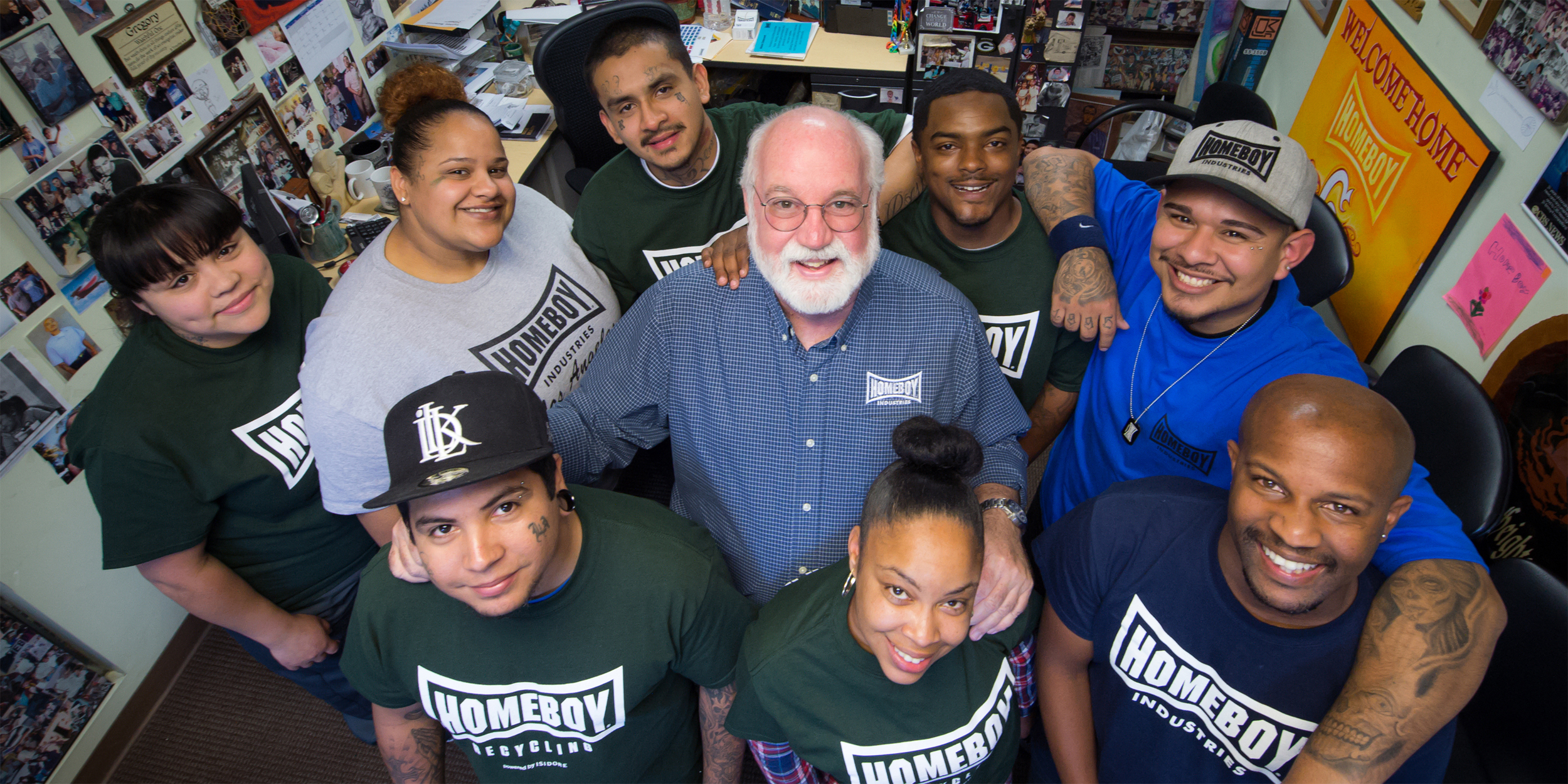
He launches into his favorite theological touchstones — the motifs that frame and define his life’s work. A brief glance at his books and interviews reveals his favorite words and phrases, repeated like a musical refrain: “kinship,” “compassion,” “mutuality,” “a community of cherished belonging,” the “spacious, expansive love of God,” and perhaps most importantly, “unshakable goodness.”
“I’ve always said that the two overriding principles that you have to embrace here is that everybody’s unshakably good, and there are no exceptions to it, and that we belong to each other, no exceptions,” he said. “If we were to embrace that, all complex social dilemma would just dissipate; it would just go away. Now, people think that’s naive, and yet you can tell that’s at the root of what keeps us from each other, because we think there’s an ‘us’ and a ‘them.’ And so how do we obliterate, once and for all, the illusion that we’re separate? Pope Leo talked about challenging mass deportations and things like that, because it creates this division that separates us and says that there are people who need to be removed. But demonizing is always the opposite of God.”
I try to ask more questions because I’m suddenly caught off-guard by this theology of unshakable goodness, but a camera crew arrives on the scene, wanting to capture Fr. Boyle’s “Thought for the Day,” which will be shared on his birthday with the employees of Homeboy Industries — an ongoing and beloved tradition in which staff and community members take turns sharing their daily meditations. I’m invited to sit in on the filming, and what happened next is nearly indescribable, so I’ve included the video here, along with part of the transcript below. Here Fr. Boyle reflects on his birthday, the election of a new pope, and Homeboy’s healing ministry of redemption and reconciliation:
Here’s my thought. Yesterday, a pope was named, and he was from Chicago. His name is Bob, and he was a missionary for 20 years, and I think this altered his heart, and I think he’s the real deal. And in his remarks yesterday, he talked about how we need to build bridges. And bridges exist to connect one piece of land to another piece of land, isolated pieces of land, land where people are excluded or discarded or demonized or left out. And this is what you do for a living here at Homeboy Industries for the last 37 years: you build bridges for the whole world to see that bridge-building is viable and possible. Somehow, we’re called to and challenged to build bridges so that there is no us and them just us, and this is what you do for a living …
Many years ago, there was a homie named Youngster who I took to Homeboy Silkscreen. I thought he was ready to work. I introduced him to his co-workers. Half of them are rivals, enemies. He shakes their hand. He looks them in the eye. I think to myself, ‘Great,’ until he gets to this guy named Puppet. And when Puppet and Youngster are in each other’s vicinity, they mumble something. They stare at their shoes. They don’t shake hands. Well, I know they’re enemies, but he just shook hands with a whole bunch of enemies. Well, I find out later that this is a hatred that’s really quite deep and beyond which neither of them thinks they can get past. And I said, ‘Look, if you can’t hang working with each other, let me know now. I’ve got a bunch of people who want this job.’ And they didn’t say a word.
Six months later, Puppet leaves his home to go to a corner store not far from his house, and he purchases something. But on the way home, he decides to take a shortcut, and he dodges into an alley, and suddenly, unexpectedly, he’s surrounded by ten members of a rival gang, ten against one, and they beat him badly. Someone finds his body, takes him to White Memorial Hospital, where he’s declared, effectively brain dead, but they keep him alive on machines for 48 hours so they can get a straight flat line, indicating that there is no brain activity. I went and I anointed him, and I’ve seen a lot of horrible things in my life, but nothing compared to the sight of this young man with his head swollen many times its size. It was horrifying. You could barely train your eyes on it.
So that first night, in the first 24 hours, while he was in the hospital, I’m alone in my office. It’s eight o’clock at night, and the phone rings, and it’s Youngster, Puppet’s co-worker from the silkscreen factory, and he says, ‘Hey, that’s messed up about what happened to Puppet.’ I said, ‘Yeah, it is.’ And then with a certain kind of eagerness, he says, ‘Is there anything I can do? Can I give him my blood?’ And we both fall silent under the weight of it, until finally he breaks the silence, choking back his tears, and he says, with great deliberation, ‘He was not my enemy. He was my friend. We worked together.’
Now I ask you, does that always happen at Homeboy Industries? Always. Any exceptions? I can’t think of one, and you can’t think of one, and that’s because you’re bridge-builders, and that’s about the only thing we need to do right now in our country and in our world, and in this city that we love, is build bridges and connect people in kinship who live over here, and some live over here, so that we can no longer feel ourselves demonized, discarded, excluded, and forgotten, but members of one belonging, cherishing community. So you are my happy birthday gift. So thank you for all that you do.
All of the questions I had come to ask faded away. Blinking back tears, I thanked Fr. Boyle and all the staff members I had met for this glimpse into their ministry. I had come in search of Christ’s heart of compassion and had found someone willing to give their blood, in an echo of Christ’s own sacrificial love — someone who had learned to love his enemy and then was willing to sacrifice for a friend. It was more than enough — for an interview and for a lifetime. As I stumbled into the parking lot, the remnants of my shoes falling away, I knew it was time to remove them altogether. I was standing on holy ground.








Thanks for this, Kathryn. Fr. Greg is an inspiration. I had hoped to visit Homeboy Industries when I was in LA last summer, but didn’t get the chance. Hope to someday.
Thanks, Joey! It’s a wonderful, miraculous place.
This is INCREDIBLE.
“kinship,” “compassion,” “mutuality,” “a community of cherished belonging,” the “spacious, expansive love of God,” and perhaps most importantly, “unshakable goodness.”
Now retired, I worked with troubled youth, the addicted mentally ill, violent sex offenders, sex offenders and finally, a job as a program review coordinator for a state’s prison system, auditing files and programs for their efficacy.
My frustrations were always more with the bureaucracy than our clients (with the exception of some of the violent sex offenders). I worked with many Christians also working for the betterment of our clients. One result was clear: Many of us (counselors) began to understand that state money or even noon-profit organizations considered the effective treatment of clients (or those incarcerated) to be a matter of less concern than the typical pork-barrel politics which tends to consume those in power to make changes.
My spirit sang with joy at the reading of this article! I pray God will continue to bless this huge ministry, whose size is indicative of the power of God,
Thank you, Michael and McKenzie!