




Thomas Stearns Eliot was one of the greatest writers of the twentieth century, and he knew it. He was born in St. Louis, Missouri, but did not let that inconvenient fact stop him. For while the boy the world would come to know as T. S. Eliot was not born an Englishman, he was born to be an Englishman. Like a pauper who suddenly realizes his father is the king, Eliot came to understand his destiny lay on the other side of the water.
The son of a Boston Brahmin family, he followed a well-worn course to a Massachusetts prep school, undergraduate study at Harvard University, and then on to Europe just in time for World War I. He hunkered down at Merton College, Oxford — as one does — and eventually moved to London. There he took an English wife with the wonderfully English name Vivienne Haigh-Wood, renounced his family’s New England Unitarianism to gain membership in the Church of England, and renounced his U.S. citizenship to become a subject of the United Kingdom.
Simultaneously, he was fueling the modernist literary movement with his pen, first with “The Love Song of J. Alfred Prufrock” (1915) and then with The Waste Land. (1922) He took a job as director at the publishing firm Faber and Gwyer (later Faber & Faber), where he promoted the work of English poets, including W. H. Auden. His marriage quickly soured, his wife suffering from ailments of body and mind. In 1933, he legally separated from but did not divorce her, his Anglo-Catholic principles forbidding the latter.
While his marriage had been failing for some time, the immediate instigating factor may have been a year spent back in the U.S. teaching at Harvard University. During a visit to California, he saw an old friend named Emily Hale whom he had known while in graduate school at Harvard. Back in 1914, before departing for Europe, he had declared his love for Hale, but she did not return the sentiment, so there was no proposal of marriage. Two decades later, after Eliot had separated from his wife, Hale joined him for a series of summer retreats in Gloucestershire.
By that point, Eliot was deluging her with letters that expressed his affection in poetic terms and used her as a sounding board for his work. He saw her as his muse, the Beatrice to his Dante. Hale found herself swept up in the experience, and for the first time she returned Eliot’s feelings, asking him to divorce his wife so they could marry. But Eliot would not budge on the issue of divorce and believed the unsatisfied longings of his heart were fuel for the fire of his poetic expression.[1]
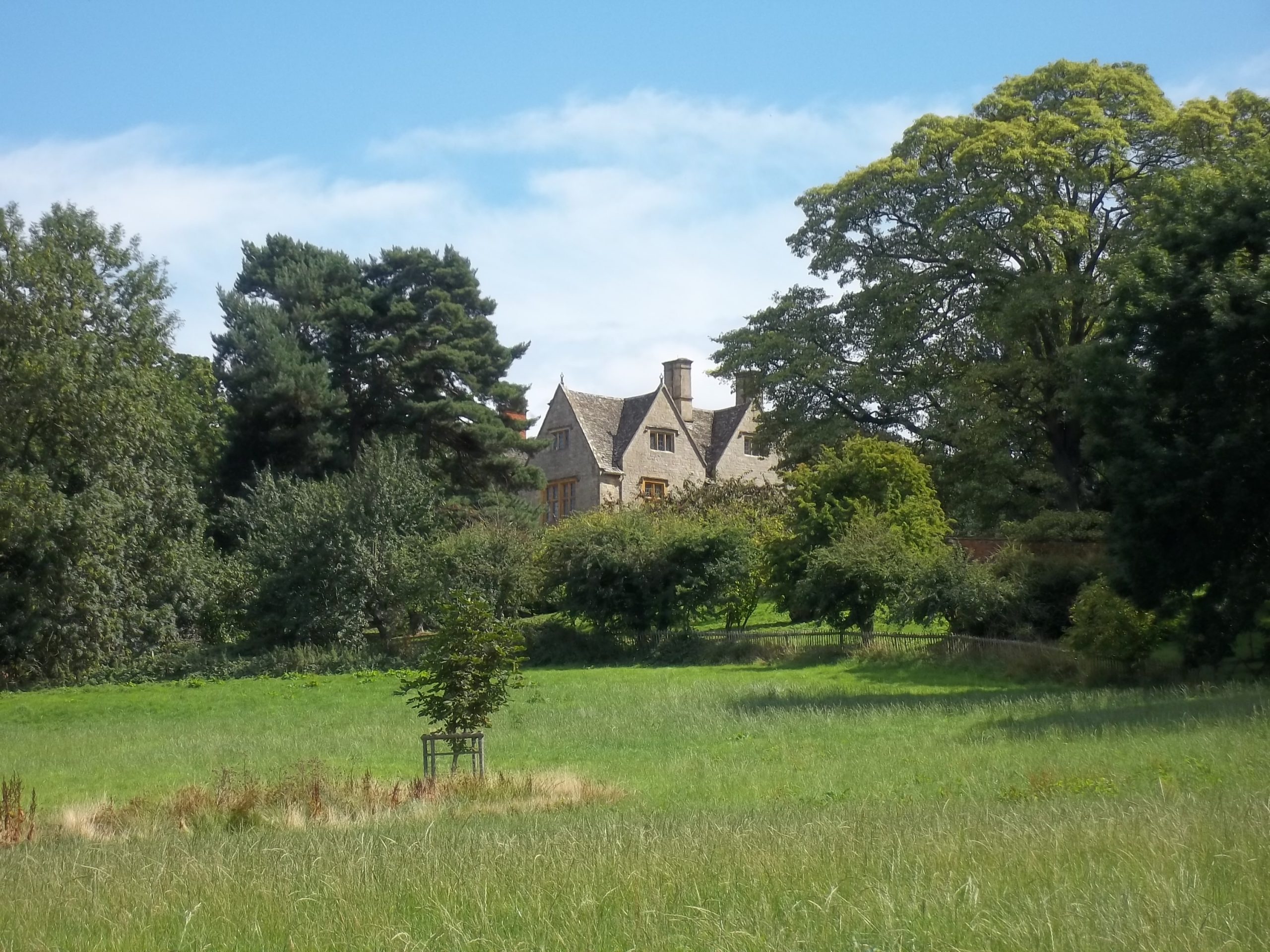
One summer day in 1935, the two of them visited Burnt Norton, a manor house that received its name when a previous owner had, either due to intoxication or mental illness, burned the place down. By the time Eliot and Hale arrived, it was being used as a school. There was nothing of great historic importance for them to see, but the visit impacted Eliot deeply. He was inspired to write his poem “Burnt Norton,” which would become the first of his Four Quartets. He may have been a world-renowned poet, feted at London’s poshest dinner parties, but in “Burnt Norton” Eliot revealed his essential vulnerability, ultimate regret, and longing for redemption.
***
The poem begins with a major theme of the Four Quartets: the nature of time. By 1935, Eliot was a middle-aged man with a failed marriage, no children, and a heap of regrets. After so many years of estrangement, he was suddenly close to the woman who had turned him down: the woman with whom he could have built another life. This prompted him to meditate on the nature of linear time — the possibilities it creates and destroys. The poem opens solemnly.
Time present and time past
Are both perhaps present in time future,
And time future contained in time past.
If all time is eternally present
All time is unredeemable.
What might have been is an abstraction
Remaining a perpetual possibility
Only in a world of speculation.
What might have been and what has been
Point to one end, which is always present.
Immediately, Eliot raises the possibility of redemption but in a negative context. If time is never allowed to pass, we can never move from one thing to another, growing and changing and breaking and mending. If time does not move, our days cannot be redeemed. This implies that our time must be redeemed — that what has been, what is, and what will be cry out for consolation. Past and present both create the future, carrying with them our hurts and disappointments.
This present existence tortures us in two ways. First, it knocks us about with sufferings and failures. Second, it taunts us with unfulfilled promises, things we meant or wanted to do. We are aware of both the misery of our present situation and the possibility of a better situation somewhere out there, in a land that can be reached only by hope. We long for that other world, a superior existence perpetually denied us. Thus, we cry out for time to be redeemed.
Eliot assures us these experiences and longings point toward a single end which is always present. Here it may be useful to note the dual meaning of the word “end”: it can be the final item in a series, or it can be the purpose for which a thing exists. I suspect both meanings are intended, for as we will see, Eliot believes the movement of time presses us toward our ultimate longing and the purpose of our existence.
The scene now shifts. Eliot and Hale stand in the middle of the manor house’s garden staring at an empty swimming pool. Reality and imagination blend together, giving momentary life to possibilities that can only ever exist in their minds.
The surface glittered out of heart of light,
And they were behind us, reflected in the pool.
Then a cloud passed, and the pool was empty.
Go, said the bird, for the leaves were full of children,
Hidden excitedly, containing laughter.
Go, go, go, said the bird: human kind
Cannot bear very much reality.
These children playing in the garden — laughing and hiding in the bushes, peeking out behind them and disappearing as soon as they appear — are probably the children Eliot and Hale would have had together if they had married. This is surely one of the chief torments of time’s unrealized possibilities: the children we were never able to have. Like Eliot, I have found myself imagining children never brought into existence, wondering what my life would have been like had they been realized; and like him, I have found it best to “Go, go, go” away from what I cannot bear. It will break your heart if you linger too long, for there is no redemption in memory but only in time’s end.
When I think of the past, I tend to chide myself. “You should have done this rather than that,” or perhaps most often, “You should have done that earlier.” It is possible to imagine a different version of myself: a better version who made optimal use of each decision. Perhaps this person would have more children, more money, or more achievements. Perhaps she would be more famous, confident, or righteous. But none of us are optimized, for time past is the long record of our failures to achieve our end, and time future will continue the sad pattern we have begun.
Only in time can a wrong be righted, for only in time can one experience metanoia: a turning from one path to another, a movement toward the end that was always intended. This turning, which we call repentance, does not belong to the stationary moment but to the great dance of linear time in which we cease to be one thing and become another. Aligned at last with our purpose, we experience goodness here and now: the purification of our loves, the beginning of our redemption, the breaking in of eternity. Yet this turning cannot erase what has been in our past, nor does it bring an end to our suffering. Our ultimate redemption lies beyond.
No, repentance is not enough. That is the saddest tale of time. Repentance reorients us toward the end of this existence, changing our minds from one mode to another, but it cannot make us what we are not: it cannot move us into another existence. We are temporal beings, mutable and frail, unable to transcend the nature we bear.
Yet the enchainment of past and future
Woven in the weakness of the changing body,
Protects mankind from heaven and damnation
Which flesh cannot endure.
Yes, Eliot has judged rightly, for we are embodied beings, which is to say not only that we bear flesh but that we are bound to linear time. In our present existence, we are connected to every point on the timeline, for between birth and death we have lived them all. What we cannot do is break free of time. Eternity is lethal to time-bound flesh, whether in hell or heaven.
However, it is equally true that time cannot be redeemed by simply abandoning it. There must be a meeting of time and eternity — a redemption that can simultaneously embrace past, present, and future.
But only in time can the moment in the rose-garden,
The moment in the arbour where the rain beat,
The moment in the draughty church at smokefall
Be remembered; involved with past and future.
Only through time time is conquered.
***
Eliot moves now to a scene he must have witnessed thousands of times: a commute on London public transit in a double-decker bus, over the crosswalks commanding pedestrians to look right and left. Here people move at rapid speed while sitting perfectly still. Here the bones of kings and treasures of kingdoms pass unnoticed as we numb ourselves with the newspapers in our hands (in Eliot’s day) or the smartphones in our palms (in our own day).
Only a flicker
Over the strained time-ridden faces
Distracted from distraction by distraction
Filled with fancies and empty of meaning
Eliot realizes most of us will never think about time as he does. (He even calls this the “twittering world” long before Twitter came to devour our moments!) We may never think about time at all, except to observe that we have too little of it to do A, B, and C, the million and one tasks that occupy our days and the million and one developments that steal our attention. But for those of us who perceive our need — for whom the grief is too fierce to be ignored — there is only one way to escape the pains of our past and the shame of our present. The wounds we bear require the balm of Gilead. We must make the turn of repentance, which means not so much rising to heaven as descending into the depths.
Descend lower, descend only
Into the world of perpetual solitude,
World not world, but that which is not world,
Internal darkness, deprivation
And destitution of all property,
Desiccation of the world of sense,
Evacuation of the world of fancy,
Inoperancy of the world of spirit
Here, Eliot follows the path of the mystic, specifically the Christian mystic in the tradition of Dante Alighieri. In his Divine Comedy, Dante is forced to descend into the lowest parts of hell before climbing back up the purgatorial mount into heaven. Even a philosopher openly hostile to Christianity, Friedrich Nietzsche, sent his Zarathustra on an Untergang (“going under”) in pursuit of higher truth. In this, he could not have been more Christian.
We who are bound to linear time can only move backward and forward. We cannot descend into time or ascend from it, which is to say we cannot enter this existence, this nature, and then depart it. Our lives begin and end in time. But what is our ultimate end? Does it belong to time or eternity? Toward the conclusion of the poem, Eliot seems to provide an answer.
Desire itself is movement
Not in itself desirable;
Love is itself unmoving,
Only the cause and end of movement,
Timeless, and undesiring
Except in the aspect of time
Eliot contrasts desire and love: the former moves (for it points toward something we hope to obtain) while the latter does not. In fact, he declares that love is “the cause and end of movement,” which is to say that, if our present existence is movement, its end is love. Love is the force in which we live and move and have our being. It is the purpose that defines us — the thing for which we continually yearn. For love is eternal.
In his letters, Eliot called Hale his “one Fixed Point in this world” and declared that their love had “something eternal about it.” In their relationship, he found some of the truth but not the whole. For when Eliot’s wife finally died, he found himself changed. He declared he could never marry Hale: that she would be his muse rather than his wife, for if they were to marry, he would no longer have the fire of unconsummated desire to light the way toward intellectual greatness. Thus, all love between flawed human beings fails in the sad passing of time. In a message he left to be read when his love letters to her were published in 2020, Eliot was unrepentant. “Emily Hale would have killed the poet in me.”
The yearning of love denied grants us a taste of eternity, but it is not eternity itself. Only in consummation is love fully realized. Love cries out for union, not only of body but of soul. It longs to be joined with eternity. The meaning we seek cannot be produced in time’s covenant but calls out to eternity as deep unto deep, longing for salvation.
So, love descended from heaven to earth, uniting its eternal nature with things temporal. Here I refer to love not as an abstract concept but love as a person: the eternal God who became mortal, the timeless one who lived and died in time, descending into hell that he might raise us up to heaven.
This eternal one, Jesus Christ, has united himself with us as flesh with flesh, taking on our death that we might share in his resurrection. For that is the only way to redeem our time: not in repentance alone but resurrection of body and soul. Flesh and blood cannot inherit eternity, no matter how hard we work at it, no matter how many times we repent. Only that which is eternal can exist in eternity.
Repentance is righteous, yes, but we ought not strive to achieve this on our own, nor ought we to presume that we can make ourselves fit for eternity. Our only hope is in the Redeemer of our days who descended to ascend. Only in him is time conquered.
Eliot did not spell all this out in “Burnt Norton,” but it is the direction in which his thoughts tend. In future articles on the other three of the Four Quartets — “East Coker,” “The Dry Salvages,” and “Little Gidding” — I hope to demonstrate how Eliot’s themes of time and redemption point toward an ultimate salvation found only in resurrection.
[1] See this excellent article in the New Yorker for more details about their relationship.








Wonderful. I needed to read this today, thanks.
The writer of Ecclesiastes says that “God has set eternity in the human heart.” I think often about what this means, what it can possibly mean. This piece is a rich addition to that exercise. Thank you for it.
Reminds me of my past. “The moments of happiness. We had the experience but missed the meaning and approach to the meaning restores the experience in a different form.”
Thanks, Amy!
Thank you Amy! I’ve carried the Four Quartets in my heart for years without words. I was delighted to read your words on Burnt Norton and look forward to future articles. Then could you do For the Time Being by W.H. Auden? 😊