




In the early 1990s, Japan’s astonishing economic ascendancy ground to a halt as the country’s real estate bubble burst and its stock market crashed. With the fall of the old “job for life” system and the resultant shame of prolonged unemployment, large numbers of young Japanese retreated from society. With urbanization having already begun to decay the traditional multigenerational household, the overall impact was a “loneliness crisis” that plagued Japan even before the ubiquity of the internet.
Loneliness is a socioeconomic phenomenon, of course, but it also takes on philosophical and even spiritual aspects. Human connection frays for all kinds of reasons, but what makes it so fragile in the first place? What, exactly, is wrong with us? In the mid-’90s, a depressed, isolated, middle-aged Japanese man probed these problems with (what else) an anime about giant robots that continues to draw and confuse audiences both in Japan and the West.
Neon Genesis Evangelion, which celebrated its 30th anniversary last year, is the brainchild of the famed artist and filmmaker Hideaki Anno. The titular “Evangelions” are 75-meter-tall biomechanical cyborgs that, for certain metaphysical reasons beyond the scope of this piece, must be piloted by emotionally compromised fourteen-year-olds. They do battle with “angels,” bizarre creatures who, unlike their biblical counterparts, are biological entities genetically near-identical to humans.
Evangelion’s protagonist, Shinji Ikari, begins the series set on a quiet life until he is summoned to Nerv, the UN “special agency” which constructs and deploys Evangelions. He complies in order to see his estranged father, who happens to be Nerv’s commander. Called upon to pilot an Evangelion, Shinji sees this as the one possible avenue to receiving his father’s attention.
His fellow pilots, Rei Ayanami and Asuka Langley Soryu, also seek actualization through piloting. Rei, a girl stoic to the point of apparent impassivity, pilots simply because it is her purpose; she sees herself as a tool for a greater cause. By contrast, Asuka, a prodigious German redhead, is loud, driven, and abrasive. She never makes a secret of her own motivation: If she’s the best, then she’s impossible to ignore no matter what anyone might think of her personality.

The three pilots bounce off of each other. They bicker, win battles together, and eventually seem to tolerate or, perhaps, even enjoy each other’s company. It’s easy to imagine a trajectory of a love triangle forming as the war intensifies and pushes the teenaged pilots closer together. A shared struggle is the answer to isolation!
This is a trap.
People continue to watch Evangelion thirty years later, and may be watching it thirty years from now, precisely because it rejects the expected trajectory and the easy answer. About halfway through the series, it becomes clear that you, the viewer, have been lured into a sci-fi-flavored meditation on the impossibility of real, lasting human connection. The giant bio-cyborgs, the eldritch abominations they fight, the technobabble, and the arcane lore — all of this is nothing more than window dressing to Evangelion’s navigation of human loneliness.[1]
The show’s thesis statement is the so-called “Hedgehog Dilemma,” casually cited early on in the series. Two hedgehogs need to huddle together for warmth, only to find themselves wounding each other with their quills. In the same way, my need for intimacy necessarily exposes the contents of my heart, creating disgust in the very person for whom I reach. Intimacy sows the seeds of its own destruction.
Although every character in the show (except for perhaps the pet penguin) finds themselves caught in some form of the Dilemma, the relationship between Shinji, our not-all-that intrepid protagonist, and Asuka, the temperamental German, provides the sharpest example. The first half of the series has them carrying on a very adolescent and occasionally delightful “will they or won’t they” dance. After the halfway mark, however, the floor drops out and their relationship devolves into a spiral of resentment.
Both fear that being known would entail rejection. The prodigy hides her crippling performance anxiety behind an aggressive, arrogant exterior, convinced that anyone who sees the scared, insecure girl underneath would turn away from her with contempt. Her frequent insults (“pathetic,” “stupid,” “useless”) turn out to be the exact verdicts she passes on herself. For his part, Shinji withdraws into his own head when he discovers that his success as a pilot does almost nothing to change his father’s disinterest. He accordingly responds to the redheaded pilot’s vitriol with passivity and avoidance, which only worsens the cycle.
It’s unnerving how bad Anno lets it get. The feature-length film End of Evangelion (1997) provides an alternative conclusion to the series in lieu of the infamously abstract original ending. The film reveals that the Evangelions were only secondarily combat systems. Their true purpose is to bring about a state called “Instrumentality,” in which humanity merges into one consciousness. Finally one, having escaped the prison of individuality, there is neither loneliness nor hatred.
Shinji and Asuka (who still struggle to remain individuals) are thus thrown headlong into perfect intimacy — complete knowledge of the other. No secrets remain between them, and all is light. The results are catastrophic. For him, being fully known does lead to rejection; his failures had finally compounded into something too despicable for her to tolerate. That which he had greatly feared had come upon him.
But Shinji — miserable and ashamed though he is — realizes that to give in and reject individuality (that is, the self he actually has) is the same as embracing death. This he will not do. He would face loneliness or hatred rather than surrender the self and thereby the very possibility of love, even if love never actually finds him. And so he renounces Instrumentality and returns to live alone on a beach in a strange, apocalyptic landscape.
The end.
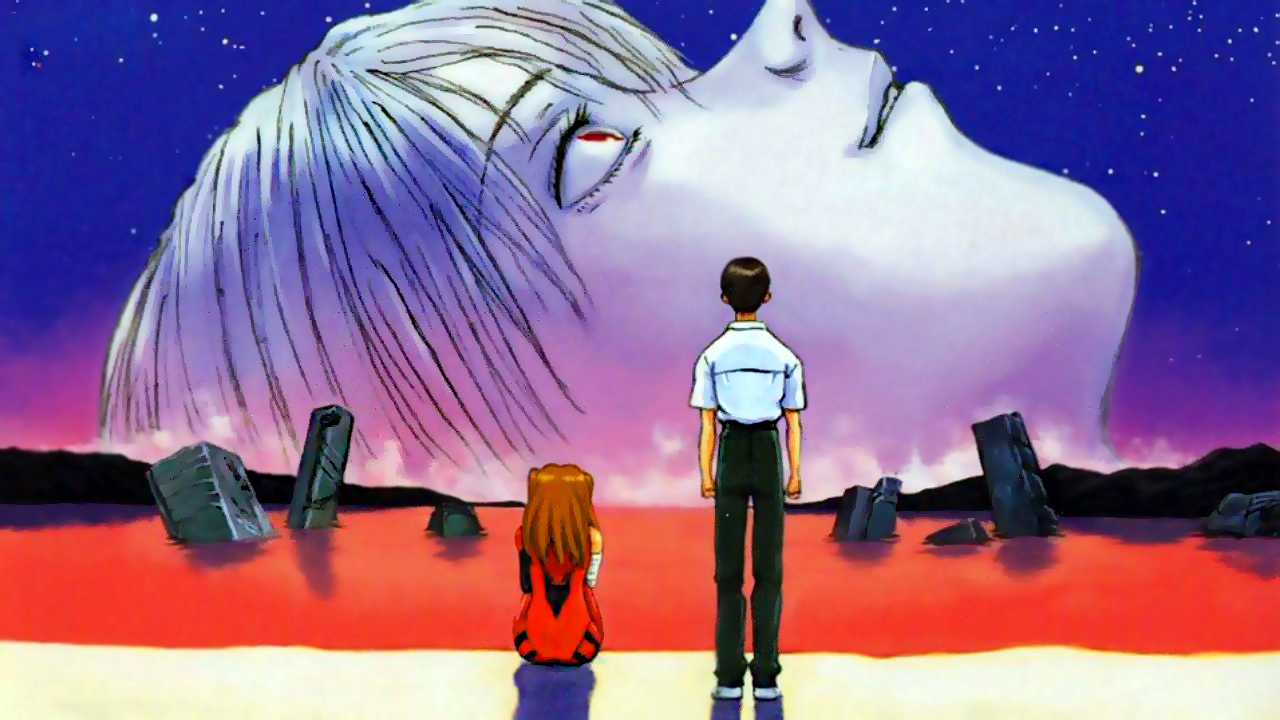
Except that there’s a weird little two-minute coda entitled “I Need You.” Another figure emerges from the collective merge onto the beach: a betrayed, exhausted, almost inert redhead. These two (lone?) survivors make a twisted parody of Adam and Eve waking up in a ruined world.
There is no reconciliation. For a moment, the old hatred continues to burn: The frantic, half-crazed boy begins to strangle his former love interest and comrade. She responds by tenderly caressing his face. As he “snaps out of it” and begins to weep, Asuka delivers the film’s closing line, generally rendered into English as “How disgusting.”
“To know as I am fully known,” as St. Paul put it, is both a hope and a horror. We flee from being fully known (that is, fully exposed), only to crawl back from the cold reaches of loneliness to the fire that surely will burn us. Caught in the Dilemma, no wonder it’s tempting to meditate or medicate the burden of the self away.
While the Evangelion franchise offers no solution other than a dogged resolve to be with each other even if it kills us, whispers of another way still remain. Early in the film, Shinji’s commanding officer gives him her cross pendant as a kind of good luck charm moments before she is killed. It’s this pendant that Shinji contemplates before permanently shouldering the burden of individuality. How this is to be interpreted is unclear; Anno has stated for the public record that the franchise’s pervasive use of Christian imagery is simply to create a mysterious vibe for Japanese audiences (exactly how Western works use, say, Buddhism).
Even so, it’s remarkable that, at this pivotal moment, a Japanese film chooses to trade on the Christian symbol of reconciliation between God and man. Christianity, after all, rejects both the dissolution of human individuality into the divine, as well as the notion that humans can work their way into intimacy with God. Our natural state is one of “alienation”’ from God and, by extension, from one another.
The cross directly confronts the disgust that keeps us apart. Alienation is not solved by pretending that the barriers aren’t that serious. It’s not even solved by “radical empathy.” As Evangelion shows, the other might well enter into your deepest thoughts and feelings — only to find you loathsome. This is why Paul declares that Christ became a “curse” by hanging on the cross, absorbing all of the contempt of the law on our behalf.
Anno’s Evangelion is that knowing and being known are essential to being human, but they involve heroic risk and the real possibility of catastrophe. He’s not wrong. The good news of scripture, however, is that Christ has already taken the risk, passed through the catastrophe, born the shame, and has risen again.
Though we might look out at the world and declare, “How disgusting,” he sees it for what it is and pronounces it “beloved.” To be in Christ is to be fully known — and not despised — regardless of whatever contempt we bring to the equation. While this love does not provide a complete escape from the loneliness of this world, it does offer a shelter from the inevitable conditionality of our relationships. His is an impossible love that we can only faintly approximate. Others may shrink back in disgust, but he remains unmoved in his devotion. We may yet be lonely, but we will never truly be alone.
[1] It’s well-worn Evangelion lore that, while Anno always intended a psychological turn after the halfway point of the series, the shift is all the more abrupt and jarring due to scheduling and budgeting problems, which forced the creative team into adopting a more abstract and dialog-heavy approach to the story. The last two episodes of the TV show take place entirely in psychological space and are infamously unrelated to anything that is happening in the show’s “real world” — they are essentially illustrated treatises on the nature of being and the relation between one’s self and other selves. What resolution there is remains intentionally vague — which resulted in a massive backlash from the show’s fanbase and eventually led to the film End of Evangelion (1997).








Thanks for writing this, David. I tried to start watching NGE once, but it wasn’t doing it for me at the time (anime beyond Studio Ghibli is generally a stretch for me). I’ll have to give it another go, though.
Wow! NGE is my favorite anime and perhaps even my favorite TV show ever. Never expected to see it front and center here. I watched this when I was in early high school (and deep into an anime phase), and although I did not initially understand it, it stuck with me in a way that all good art does. I revisited a few years ago and since then have often meditated on it. It has such a melancholic soundtrack and atmosphere, which only enhances that profoundly tragic (but perfect) ending. Except for maybe Dark Souls 1, no other piece of media has impacted (no pun intended) me as deeply.
What a great read this was David! Thank you so much for writing it. I really enjoyed every bit. I knew some things about NGE but not that much. No I can comprehend it and put it to real world applications. I also enjoyed the theological themes you brought in to reference. It brought a lot of meaning to the piece. I love Japanese anime, but perhaps this one might be a bit dark to watch.
God Bless!