




It’s about time. Plunge through the indecipherable past. Panic over the perishing present. Flinch before the inevitable future. Santa smacks children. A miner mauls youth at a dance. Androids ambush investigators of a Halloween mask factory. Despite how we pacify our uncertainties by persuading ourselves that time can be controlled and commodified, time manifests itself as a collapse of past and future into a pervading present, exposing our lack of agency. Stumbling through yesterday, today, and tomorrow, you slip through the days, rotating through a repetition that refuses resolution and reveals repression, a bending of your perception.
Disoriented by the absence of order we perceive in the world, we often find ourselves out of step with time or in a time that is not our own. Imposing a linear construct on our experience, we are nevertheless infused with a sense of time as elliptical and textured. As Christians, time is patterned from the past through redemptive events, produced in the present through formative practices and projected to a future of restored humanity. Existence is not a mere sequence of events but a communal story chronicled by the church and Christ. Narrating creation and carrying out its completion, God orders the cosmos and arranges it around seven days — the origin of our week. Therefore, we have chosen seven films to coincide with such a foundational structure. Re-creation is also governed by time as we participate in the renewal of heaven and earth by worshiping at the inception of another week and rehearsing the moments of kingdom come. At Advent, we acknowledge the darkness permeating creation as we light a candle against the void. During Lent, the priest smears our foreheads with ash to dredge up the dread of death. On Easter Sunday, our inclinations are futural as we enact the promise that Christ will reanimate our corpses with his.
Travel through a temple of time with us. As you slink into a succession of scenes and shots where beginning and end are blurred, peek through your fingers and plead; there is no clock. Instead, face a screen illuminated through the darkness by a whirring projector that ticks away a night where every second counts. The viewer may obviously watch the film on any day they choose, but order here matters if the participant is to be the final girl/ guy. As you celebrate each new season, crumble before the fiend that frightens every festivity. In every gift, a curse crouches. At every dance, a crazy creeps in the corner. Stuffed in every turkey, human remains fester.
The Past
- The Advent Calendar (2021)
- Rare Exports: A Christmas Tale (2010)
- Midnighters (2017)
We begin our film year with what denotes the start of the church calendar: Advent. While Advent is past historically, the practice of anticipation is repeated annually. Resisting secular time that defines the year by doing and accomplishing — what we construe as resolutions — Advent is a time of waiting. Every year, we reimagine the incarnation, and, in doing so, recapitulate the sense of longing and looking that inherently reveals the ineffectuality of the Law and the corruption of the flesh.
However, in Patrick Ridremont’s The Advent Calendar (2021), this waiting is warped. Eva (Eugénie Derouand) is a paraplegic and former dancer, and in the opening scenes, we see her in a swimming pool. Her disability is a metaphor for her own brokenness and the water symbolizes a redemption and the need for renewal. The promise of rescue comes in the form of an Advent calendar that her friend Sophie (Honorine Magnier) brings her. Instead of aiding her in a watch for the Messiah and deliverance, it is an inversion — the gift is a curse and imposes on her a law. In fact, the calendar has three explicit rules.
- “Dump it, and I’ll kill you.” Once Eva accepts the gift, if she tries to discard it, she will be destroyed.
- “Eat all the candy, or I’ll kill you.” Opening each door, Eva discovers candy. If she refuses to eat, she will die.
- “Respect all the rules until you open door 24, and you’ll be free.” Upon adhering to all the instructions behind each door, she is promised a freedom, one that will prove to be eternal even.
In essence, instead of being a gift, the Advent calendar provides 23 commands that oblige Eva to obey. How often do we make a law out of the gift that is the gospel, basing our own participation in God’s kingdom on our evangelical fidelity or righteousness? Conversely, we are often duped into accepting laws as gifts. What makes that transaction so believable is that the Law given at Sinai was a gift, freely delivered by God. The gift is invariably good; it is in our hands that it becomes polluted and distorted to become a list to merit God’s love.
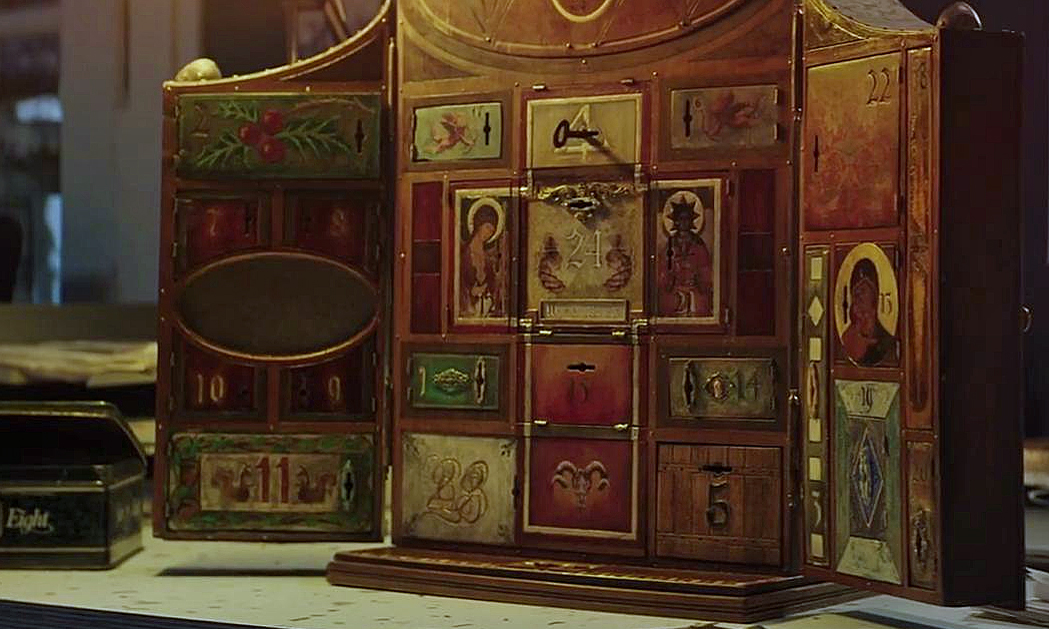
Throughout the film, Eva eats these pieces of candy (one is even of a baby Jesus), and they are sacramental in nature. As she chews on them, she is contracting herself to offer a sacrifice in order to receive the fulfillment of a desire. These take many forms: a man who takes advantage of her dies in a fatal car crash when she wishes for his comeuppance, a nurse she is attracted to falls in love with her when she slips one of the candy pieces in his drink, and she even reconnects with her father, a sufferer from Alzheimer’s, when she swallows one of his favorite pieces of candy that the calendar dispenses. Watching these transactions take place overwhelmed me with how the law is so alluring and enticing in my own life by teasing me with the “if only I …”
If only I engage in more meaningful conversations with my children, then I will have their love and admiration.
If only I read and wrote more, then I would have a meaningful legacy to leave the world.
If only I prayed more, then my daughter would not be sick.
If only I prayed more, then my daughter would not have died.
At the heartbreaking center of The Advent Calendar (2021) and our own fusions of gospel and law is the fact that such syncretism sells us a product that never arrives, and, in the process, distorts our hearts into a craving of what is not the good life. Like Eva, we believe that the law will elicit love. Like Eva, we believe that the law will bring justice to those who have wronged us. Like Eva, we believe that the law will reunite us with the Father. Also, like Eva, we bargain with ourselves and sacrifice strangers, friends, and family to earn what can only be given without conditions.
Ultimately, like Paul in Romans 7, it is the self that is our enemy and that becomes clear as the “Ich” (“I” in German) etched on the back of the wooden calendar — the deformed, humanoid creature that spawns whenever a rule is not obeyed or to dispense with one of the victims — is an embodiment of Eva. Also telling is the fact that Eva’s name itself means “life” in Hebrew and “bearer of good news” in Greek. Ironically, Eva is death personified, and her allegiance to the law of the Advent calendar is antithetical to the gospel. Similarly, her friend’s name, Sophie, which is Greek for “wisdom,” mocks the viewer in that the calendar she gives Eva is foolishness. The “Ich” monster dictates to Eva a worldly wisdom when it demands, “If you will walk, you must kill.” While Eva does obtain a life of walking through her unholy sacrifices, it will involve a hell of living with the knowledge of the innocents she murdered. Alternatively, she can erase her memories and return to the past, a convenient deus ex machina that diminishes the power of the movie.
In the opening scene of Rare Exports: A Christmas Tale (2010), an American archaeologist is enforcing moralism (he even reprimands one of his underlings who cusses) while his foreign corporation exploits the land of a remote Finnish village to dig up the authentic Santa Claus, an ancient being entombed in a mountain. Such an excavation parallels the extractive practices of exploitative capitalism, where natural traditions and local resources are commodified for profit. Threatened by the encroachment of global consumerism, the community ekes out its existence on the periphery, unaware of how the hollowing of the mountain is also a hollowing of their myths. Disregarding the well-being of the villagers and the consequences of unearthing such a dangerous entity, the operation is symbolic of how corporations prioritize profit over people and creation.
Our child protagonist, Pietari (Onni Tommila), is engrossed in studying the Santa of local folklore, a figure that is much grimmer and inflicts punishment on children for slight offenses. Desiring to be spared from Kris Kringle’s ire, Pietari pleads with both his onscreen and real-life father, Rauno (Jorma Tommila), to spank him. Pietari and his friend Juuso (Ilmari Järvenpää) cut a hole in the fence to spy on the dig. Such a boundary violation alludes to Adam’s own boundary violation of eating of the fruit of the tree of the knowledge of good and evil as well as his subsequent banishment from the land.
Capitalism here corresponds to legalism in that both are transactional and meritocratic. Both conceive of humans and creation as incidental and in economic or quantitative terms; value is not understood in terms of worth but currency, which is traded for product. Reducing humans and creation to materials that can be designated a specific cost or utility is a demythologizing or disenchanting of the world. Seeing through the attempt to desacralize the world, Pietari says at one point, “The Coca Cola Santa is just a hoax.”
When Pietari’s father ensnares what his son believes to be Santa, the adults, including Piiparinen (Rauno Juvonen) and Aimo (Tommi Korpela), seize upon this as an opportunity to negotiate for losses sustained from the corporation’s killing of their reindeer. The trio only set the ransom at 85,000 Euros, which is equivalent to the exact cost of their losses. In other words, they do not seek profit. What they soon discover though is that they did not abduct Santa, but one of his elves, and that a horde of Santa elves have been rampaging through the small town, stealing radiators and children to bring to their Yuletide master who is thawing in a block of ice. Abandoning their pursuits to receive financial compensation, the adults follow Pietari’s lead instead and devise a plan to save the children by luring the elves away from the barn and exploding Kris Kringle with dynamite. Indeed, it takes a child to restore our wonder and awe and maneuver us away from money. Sanitizing Santa and rebranding him as a figure designed to sell products is an attempt to domesticate and tame creation and culture in a way that is a dark inversion of the mandate of Genesis 1:28, stripping folklorish tradition of its supernaturalist and human qualities.
Eroding Pietari’s childlike innocence, exploitative capitalism malforms him from a curious boy who explores the traditional Santa Claus myth to one who uncovers the dehumanizing realities of exploiting the myth that is a necessity of consumer culture. The training of the captured elves by Pietari, his father, Piiparinen, and Aimo is a satirical take that even the magical and mystical can be subdued and exported as “Rare Exports.” Co-opted by economic interests, these elves transform into another marketing opportunity, flattening creation and its obdurate wonder into goods to be packaged and sold. Cynically, we might interrogate if the church has matured beyond the corrupted childhood it shares with Pietari (Finnish for Peter) and if we will dislodge this false rock that the Western church has been built on.
Like The Advent Calendar (2021), Midnighters (2017) commences with a countdown — to midnight and the beginning of the secular year. Lindsey (Alex Essoe of Starry Eyes fame) and her husband, Jeff (Dylan McTee), barrel down a country road after leaving a company New Year’s Eve party when they hit a pedestrian. Tell me you have heard this story before. After attempts to revive the man fail, they decide to keep his body in their garage. When Lindsey’s younger sister Hannah saunters home, she is assailed by the definitely not-dead man in the garage. After some struggle, Hannah guns down her attacker, condemning the three further. What follows is twist after twist and a continual shifting of allegiances that, to give a generous assessment, is symptomatic of the sisters’ unresolved trauma and dysfunctional relationships with men. In particular, Hannah is entangled with abusive men, and perhaps her palindromic name is a signifier of being trapped in a time loop.
Does the movie work? No. It features characters that not only act without motivation, but often in contradiction to previously stated motivations. Performances are one note and contrived, and the inclusion of a torture scene seems to exist only to justify its self-proclaimed horror categorization. Include the “cops-are-so-incompetent” trope alongside a cliché underground criminal organization plot beat, and you can probably imagine the rest. And, while not traumacore per se, its use of trauma as a throwaway backstory for the sisters is shallow and demeaning of actual trauma. For our purposes though, it exposes the truth that if we do not confront our past pains, we repeat the cycle of violence in our relationships and in how we relate to the world.
Law, economic exploitation, and trauma are all historical horrors that we perpetuate on ourselves through reliving and reiterating them. Imprisoned by these self-destructive constructs, we are ensconced in a past that detaches us from present grace. Every second counts, and if we are to ensure that we are not entrapped by the liminality of being between what was and what is — let alone what is to come, then we dispense with any notion of a past which was great. Nostalgia haunts us with a past that is an irretrievable good, while regret possesses us and demonizes us with wrongs that can never be righted. Before our incursions on the past, there was an older, ancient evil gestating.
See you next time for Present terrors: My Bloody Valentine (1981) and Critters 2: The Main Course (1988).
Followed by the Future: Halloween III: Season of the Witch (1982) and Thanksgiving (2023).







