This essay appears in the latest issue of The Mockingbird magazine.
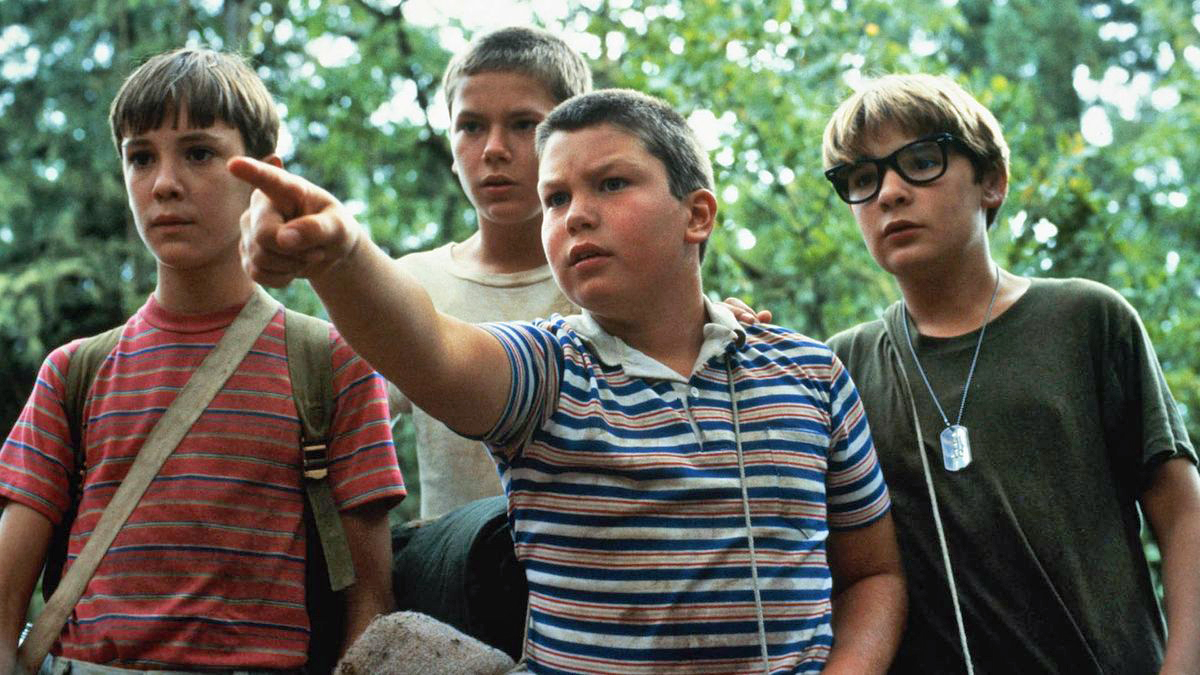
At the opening of Rob Reiner’s classic coming-of-age film Stand by Me (1986), we meet lead protagonist, Gordie Lachance, sitting in a jeep, reflecting on a news clipping about the untimely death of his childhood friend, Chris Chambers. Two kids ride past on bicycles, deepening Gordie’s recollection of what it was like to be a kid while a voiceover narration takes us back in time to the town of Castle Rock, Oregon. There, two competing groups of boys — Gordie’s pre-teen group and their rival teenagers—embark upon a quest to recover the body of a classmate who had gone missing.
Early in the film, one of the boys, Vern, is hidden beneath his porch seeking a buried yet misplaced treasure. He overhears that the teenagers have inadvertently discovered the body’s location. As he observes the older boys, we see Vern’s eye framed by the porch lattice, indicating the barrier separating their realms of childhood and adolescence. In Stand by Me, it’s the former that more faithfully, and with nuance, depicts maturity.
As characters, the older adolescents develop very little. Throughout the film, they value power, strength, and winning. We see them chicken-racing down country roads, smashing mailboxes (playing “mailbox baseball”), and talking about girls, but we never see beyond the facade of their insecure posturing. Gordie’s group, by contrast, curses profusely, smokes cigarettes, and jokes about sex, yet retains a semblance of innocence that the older teens lack. It still matters to them, for example, who would win in a contest between Superman and Mighty Mouse; they entertain the humorous prospect of eating Cherry Pez the rest of their lives. Savoring a smoke after dinner, or while playing a variation of poker, they act “grown-up,” even as these actions are transcended by a youthful sense of imagination, adventure, and most importantly vulnerability.
The boys come from troubled backgrounds. Teddy Duchamp’s dad has been confined to an insane asylum for burning his son’s ear on the stove; the aforementioned Chris bears the shameful reputation as the town thief; and Gordie feels profoundly unloved by his father — a burden he carries the entirety of their quest. Getting away for a road trip entails an escape from the pressures of life and affords the kind of soul-baring that we don’t see in the older kids. The boys bicker and fight but also make peace by “skinning it” (shaking hands). They cry, confess their deepest insecurities, and rely on one another for support.
In one scene, the older boys ritualistically carve tattoos into each other’s arms, marking themselves in a makeshift rite of passage. The radio plays the upbeat song “Lollipop” by the Chordettes, but the teens are impervious to it; notably, it’s mechanically filtered, transmitted via airwaves. It’s mere background noise to their more important matters of trying to score with girls. The film cuts to the younger boys who are diegetically enmeshed in the very same song. They’re not hearing it on the radio; rather, it’s part of their world. They’re actively involved in music that isn’t “there” — complete with Teddy’s “pop” gesture accentuating the song’s hook.
In another scene, Ace (one of the teens) challenges a peer to a chicken race in which his death-defying antics force a semi to swerve off the road. One-upping his opponent, he has established himself as the leader of the pack, the ultimate tough guy. Compare this to a scene where Teddy attempts a similar death-defying stunt — standing on a train track, daring an oncoming locomotive to run him over. The act terrifies his friends to the point where Chris pulls him to safety. Vulnerability, in this case, supersedes sophomoric posing.
Stand by Me exemplifies the way that childhood — the period before the world makes you jaded—has more in common with maturity than young adulthood. It’s only in retrospect, however, that Gordie realizes childhood can never be relived. I, for one, can’t remember what it was like to see the world as a ten-year-old — which explains the frequent tension I feel as a parent sincerely struggling to empathize with what my adult mind perceives as my children’s lack of intuition and basic common sense. The older I get, the more I can relate to Robin Williams’ portrayal of Peter Pan in 1994’s Hook: He has become so mired in the details of “responsible” adult life that he has forgotten his core identity as the “chief of children.” When he is unwittingly summoned back to Neverland, only an arduous series of trials can remind him.
I find this to be true in the daily experience of parenting. I remember what it was like to be a kid, but I don’t remember what it was like to be a kid. I remember a time when my whole world revolved around He Man, Thundercats, Voltron, and Star Wars Kenner action figures, but I don’t viscerally recall what it was like to be limited by an under-developed, even naïve view of reality.
Not long ago, while my daughter played with a handheld game console (yes, they still make those), I began to hear the faint yet familiar Contra theme music playing in my mind. Suddenly it was 1988, and I was plugging in the classic code up, up, down, down, left, right, left, right, select, B, A, Start, which increased Player 1 to “30 lives,” as everyone who played Nintendo knew. But when I walk into one of my kids’ rooms and it resembles the local garbage heap, my initial reaction isn’t one of empathy; it’s judgment. How is it not intuitive to you to care about keeping your room clean and presentable? It’s not like you have real-life responsibilities, like paying bills, keeping up with an extremely high mortgage, navigating the challenges of marriage, et cetera. Irrationally, I want them to be what even I can’t be: rational. Fully developed, functioning adults.
In those moments, I’m forced to slow down, stop, and recapitulate my expectations. I have heard it said that “expectations are planned resentments” — a phrase with which I agree. The problem is, my expectations are rarely planned. That is, I rarely identify them in the moment, only regretfully after the fact — after I have blown my fuse, exercised some choice words, and despaired of life itself. I’m constantly failing to remember that my kids are just kids; I was one too once.
In Hook, there’s a definitive scene shortly after Peter finally remembers he’s Peter Pan. The Lost Boys are all seated at a table, and set before them are empty bowls and utensils. One after another, they begin to eat what isn’t there, but what their imagination gradually calls into being. They see a world that is realer than what their senses can apprehend. I think of my frustration at dolls, dirty socks, and bowls of unidentified concoctions strewn about our home. Yet, in rare moments, I can see that my kids are inhabiting an invisible realm, one of endless play and possibility. In many ways, childhood is a time of great freedom before the teen years when so much is predicated on proving yourself, carving out an identity, finding the right kids to hang with, the right kids to avoid, the right music to listen to, the right person to go out with, et cetera. Your twenties are no better, because then you have to consider the right job to land, the right place to rent, the right time to buy the right house in the right neighborhood, the right politics to follow, and so on.
But maturity (especially Christian maturity) means becoming more childlike. Aging and imminent mortality have a way of slowing us down, getting us to reassess our priorities, and loosening us from the iron grip of our intractable egos. And it is in this proverbial place where we begin to relearn the virtues of childhood. Our dependence becomes more obvious. And as time goes on, there’s less to lose, so we don’t mind the vulnerability that once marked our youthful years. Indeed, it is in this vulnerability that we are closest to the childlike faith Jesus describes in the New Testament.
Jesus told the apostle Peter, “When you were younger, you dressed yourself and went where you wanted; but when you are old you will stretch out your hands, and someone else will dress you and lead you where you do not want to go.” St. John, narrating this account, informs us that Jesus spoke of Peter’s death, to which Peter would later allude in his second epistle. Peter would also encourage his readers to, “as newborn babes, desire the pure milk of the word that you might grow.” In other words, grow, but don’t “grow up” — at least not in the usual sense, replete with self-righteous posturing and an independence that disdains the good fruits of humility, mercy, and compassion.
Our growth into godliness is regressive, rather than progressive. As our bodies begin to fail; as we discover that what we initially thought was lint is in fact an encroaching forest of gray hair; as we hear “Raspberry Beret” on the Oldies Station and in hasty defense exclaim, “That’s not Oldies!” and then reluctantly concede, “Well, I guess it is now” — we’re forced to be more honest with ourselves. Some limitation may even be the pathway to a freer life, closer to what we once knew as kids.
And if we’re fortunate, perhaps we have one or two people with whom we can be ourselves and let our guards down. At the end of Stand by Me, the adult Gordie opines, “I never had friends like the ones I had when I was twelve. Jesus, does anyone?” It’s a fair point. The responsibilities of adulthood tend to preclude the kind of curious wonder and openness that made truly intimate friendships possible when we were younger. And though it may be rare to find that same level of transparency in even our closest relationships, there yet remains hope in our autumn years. As we return to childlikeness, we find a faithful friend who stands by us, even “when the night has come, the land is dark, and the moon is the only light we see.” He was a kid once too, you know.