




In late spring, as I make conversation with loose acquaintances around church coffee hours or the odd work event, the topic inevitably shifts to summer plans and I love to share what I am looking forward to reading. I find summer is a great time to devote many weeks to one author, or better yet one large, windshield-breaking tome. In the past, some favorite choices for my summer read have been John Steinbeck’s East of Eden or The Idiot by Fyodor Dostoyevsky. I learned quickly that these are not typical “beach reads,” and the conversation dies as swiftly as if I had segued into discussing the upcoming election or the war in Gaza. Every so often, someone who recalls something from their college English class will dryly comment, “That’s a depressing thing to read during the summer,” or I may receive a nervous laugh followed by “You enjoy that stuff? Are you okay?” I have found that facing the ugliness of human experience through literature does not make fast friends.
For many, Flannery O’Connor sits alongside Dostoyevsky and Steinbeck on the “most depressing writers of all time” list. It’s not difficult to see why. Her Southern Gothic stories can feel downright miserable. Characters can be naive and easily conned by sinister interlopers. Marriages are often portrayed as stale and mundane, or doomed for tragedy from their outset. And people die, often suddenly and without warning. My first introduction to O’Connor was her short story “A Good Man is Hard to Find,” in which a family traveling on vacation is in a car accident only to encounter an escaped convict known as the Misfit. When the first gunshot kills someone off page, I audibly cursed into the emptiness of my living room. The story of the murder of this whole family haunted me and my future readings of O’Connor. With every story I opened, I waited for the proverbial gunshot of the Misfit. I waited for the tragic and grotesque end that seemed to inevitably come for her characters. But of course, I keep opening stories I have yet to read, and revisiting ones I’ve read before. Because I do enjoy “that stuff.” And maybe I’m not okay. Or maybe I’m at least as “okay” as Flannery O’Connor. Enter the recent O’Connor biopic, Wildcat.

Wildcat is directed by Ethan Hawke, written by Hawke and Shelby Gaines, and stars Maya Hawke as Flannery O’Connor. The film follows O’Connor as she and her mother, played by Laura Linney, move to Andalusia Farm where O’Connor lives out the rest of her days following being diagnosed with lupus. Not a traditional biopic, the film is interspersed with vignettes portraying several of her short stories. What viewers will notice immediately is that Maya Hawke, as well as Laura Linney, play comparable daughter/mother roles in the vignettes. Producer Joe Goodman described this dynamic as one of the central criteria behind how he and Ethan Hawke selected stories to represent on screen. In the case of “A Good Man is Hard to Find,” “Good Country People,” and “The Life You Save May Be Your Own,” Maya Hawke plays the young women who are victimized by the stranger who walks into their lives in a shroud of mystery. I can’t help but wonder if, as a viewer, I was meant to see the haunting presence of O’Connor’s chronic illness wearing the mask of crafty interlopers who draw her female protagonists into isolation.
In a conversation with Goodman before the screening I attended (hosted by Eastern University’s Templeton Honors College), he told several of us that “lupus was our ticking clock.” We watch her response to her diagnosis and how her chronic illness progresses. As a reader of her short stories, I anticipated the film ending with her death at the age of 39. I waited for the movie of her life to, after a fashion, conclude with the same sudden tragedy I had come to expect from her writing. But that is not the ending that we are given. Instead, we are left with O’Connor’s wry smile that we have become so familiar with over the course of the run time. “I don’t deserve any credit for turning the other cheek as my tongue is in it,” she says. This film is endlessly quotable, as the majority of what we hear her say on screen is lifted directly from O’Connor’s own stories and letters. Perhaps what stands out most is how much fun Maya Hawke has playing Flannery, and as such we are treated to how much joy Flannery takes in her writing. If there is joy in the writing of hard things, certainly there can be joy in the reading of them.
I always find grace grasping at the edges of O’Connor’s stories. It wants to break in, but to allow it would be too much for her characters to bear. Hawke and Goodman seem keenly aware of this grace throughout Wildcat. Liam Neeson makes a cameo as O’Connor’s priest, seated by her bedside as she recovers from a serious fall. Neeson, paraphrasing words O’Connor herself wrote, responds to her lament “Grace changes us, and change is bloody painful.” During a flashback to a dinner party with the Iowa Writers’ Workshop, she responds to another party goer’s comments about faith and communion with,“What people don’t realize is how much religion costs. They think faith is a big electric blanket, when of course it is the cross.”
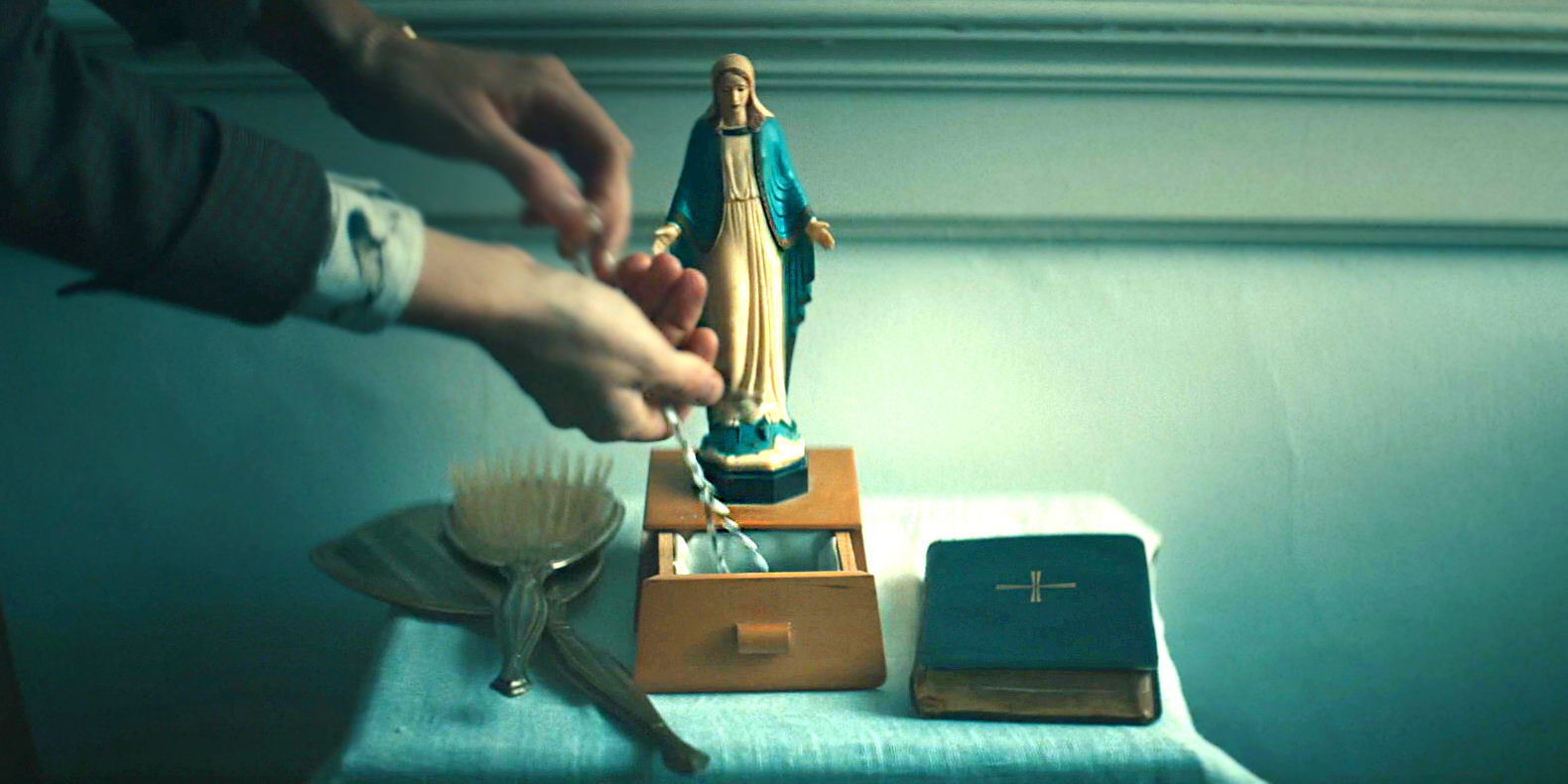
Here lies the, ahem, crux of why I return to O’Connor, Dostoyevsky, Steinbeck, and their ilk. Echoing the sentiment of my coffee hour acquaintances, Flannery’s mother Regina exclaims, “Well I don’t understand why you don’t want to write something that people would like to read!” But O’Connor refuses the cheap comfort of an electric blanket, instead requiring that we sit with the discomfort of humans living out their woundedness and wounding others. Yet, these writers also make me laugh. O’Connor has such a way with words that even as I await that gunshot, I still chuckle at her descriptions of scenery and bored families driving down old dirt roads. Wildcat captures the co-mingling of laughter and sobriety that pervades her work. And it is why we need stories that bear the tapestry of joy and grief, surprise and horror.
We need stories like these because they show us what happens when we refuse change in the name of our own comfort. We need stories that prepare us for the moment when a close friend or a therapist gives it to us straight about the grotesque parts of ourselves and the world. And by the grace of God I hope stories by writers like Flannery O’Connor have prepared us to believe there is something (or someone) else grasping at the edges of this world, that by staring at the grotesque sight of the cross dead-on we can be changed.








[…] Photo from Wildcat. Retrieved from Mockingbird. […]
[…] Photo from Wildcat. Retrieved from Mockingbird. […]
[…] Photo from Wildcat. Retrieved from Mockingbird. […]
[…] Photo from Wildcat. Retrieved from Mockingbird. […]