




Why remember something, or anything, when you have a world of pleasant oblivion at your fingertips? Christopher Nolan’s take on The Odyssey puts that question front and center, with Odysseus, prompted by his seven-year lover and patron Calypso, struggling to get the tale out before he eats another lotus petal. What is worth remembering, and why? What makes us prefer, so much of the time, petal-by-petal oblivion? And what separates art-as-distraction from art-as-remembering? Or, more accurately, un-forgetting, bringing our latent selves to birth: anamnesis.
In the opening banquet scene, we’re dropped, in ancient style, in medias res as the bard begins. Why do the suitors, abusing the law of hospitality — or “law of Zeus” — even want a song? Maybe to remember the pain and the heroism, or maybe for yet one more distraction on their long bacchanal. The bard takes us to the Trojan beach, where Odysseus won his great glory. And we get the first narrative break of the film’s many, this demanded by Penelope. She will not remember, in every detail, tonight. She’s been remembering Odysseus faithfully for twenty years, and memory sharpens desire, which sharpens sorrow, and tonight she just doesn’t want to hear his song.
Nolan’s mastery of complex narrative serves the frame-within-frame source material well, giving him the freedom to sequence the story more thematically than chronologically — though in his own way. He works in scenes of Odysseus, hunting with his beloved Argos, stringing his bow and shooting through the axe heads, lamenting with his beloved Penelope the necessity of going to war. In their short time on screen together, the husband and wife (played brilliantly by Anne Hathaway) spark with affection. If ever there was a vision of home, this is it.
But if Penelope’s pre-war Odysseus seems careful, mirthful at times, a bit boastful, the Odysseus who sails away from Troy, in Nolan’s film, isn’t. He’s quieter, less a spinner of tales. Compared to the epic poem’s Odysseus, he doesn’t use clever verbal trickery to escape the Cyclops, nor does he shout his name as he leaves, instead shooting an arrow in a futile act of vengeance that only makes things worse. His choice of route — not to follow Agamemnon — is delivered petulantly, a petty act of symbolic defiance after he’s already finished out Agamemnon’s great war. His later defiance of the islanders’ warning not to sail west comes off as restless, flippant, almost like he’s asking for trouble. And this Odysseus, rather than moving and delighting the assembled banquet hall in Phaeacia (as in the poem) instead struggles to un-forget on a paradisaical, desolate beach. Nolan gradually gives us the sense that Odysseus, though he doesn’t want to admit it, does not actually want to go home.
Here Nolan’s adroit plot work allows him to set up a mystery: how will he get home if doesn’t want to, and why doesn’t he want to go? In his halting, piecemeal delivery to Calypso, the reason unfolds.
The costs of Odysseus’s adventures are counted, first in his men’s bodies. Each episode — rendered in a brilliant mixture of grounded and fantastical, claustrophobic and sweeping — represents a moral judgment. Odysseus flouts the laws of hospitality in Polyphemus’s cave by coming without a guest-gift and eating cheese before it’s offered, sacrilegiously invoking “Zeus’s law” itself when one of his conscientious men catches him out. After Odysseus and his men blind the Cyclops, who writhes piteously about and calls his father’s name — sea god, whoops — they learn he can talk. When one of his men asks if they couldn’t have tried talking, Odysseus deadpans along the lines of, “I think we’re past that.” (As I don’t have the script, quotes are necessarily paraphrased.) In a petty act of vengeance for the men who died following his orders, Odysseus shoots the Cyclops after they’ve escaped, which enrages the Cyclops, leading to yet more bodies. The cycle of violence spins on, and the offense of their blinding Polyphemus follows them in the unrelenting sea.
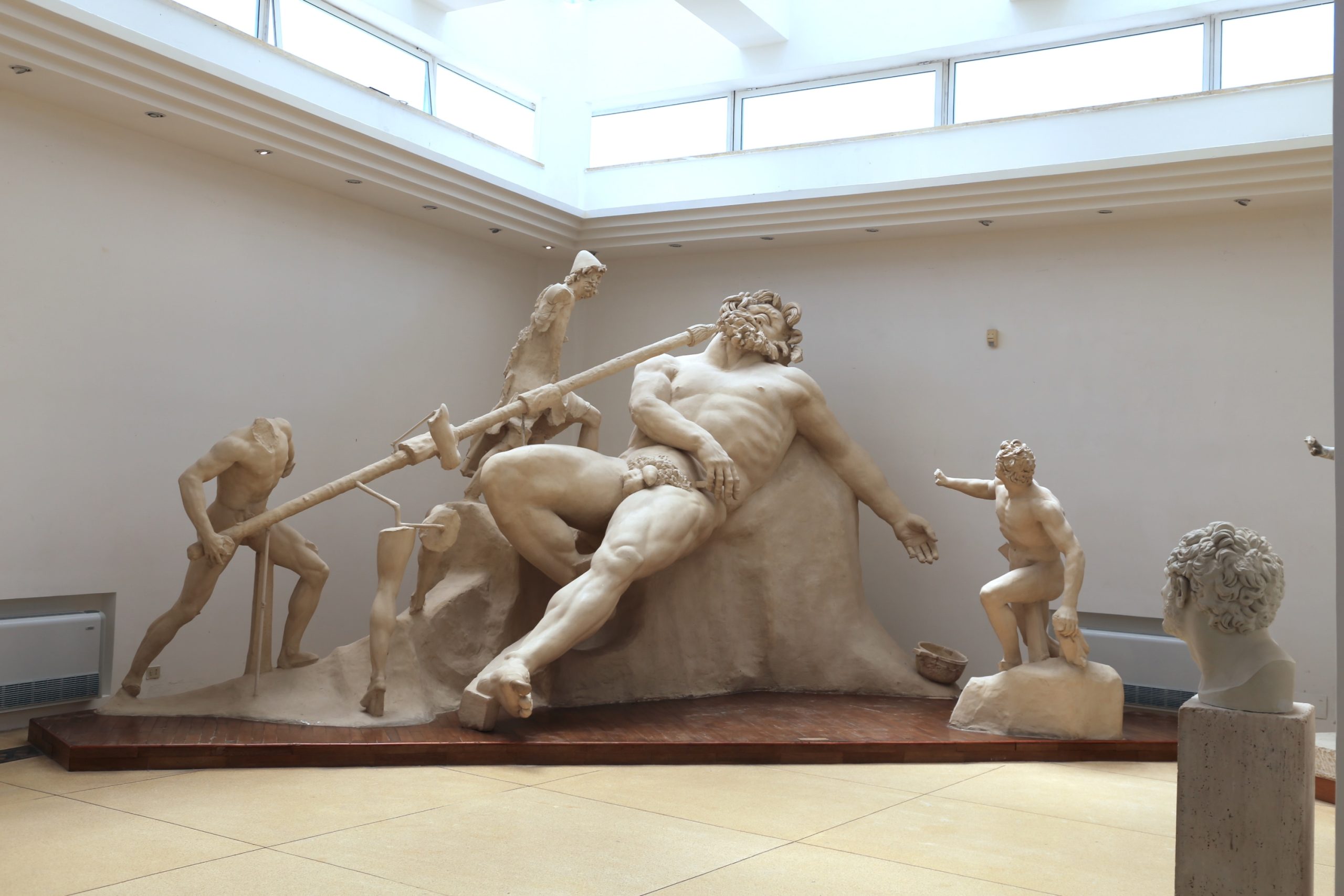
After encountering and being largely massacred by Laestrygonians, they end up with Circe, who feeds Odysseus’s men. The parallel with Penelope is uncomfortable: the men say they won’t hurt her, but she’s not exactly free, either. As Penelope said earlier, to paraphrase, “You men do what you choose. I do what I can.” Circe feeds the Argives a hideously addictive stew, and as they compulsively eat, she muscles her hands on their heads, molding them into swine. After Odysseus convinces her to heal them, she chants (again paraphrasing), “Go back to your disguises.” To her, all men are pigs, driven by animal appetite to eat and pillage and rape. In this particular context, the men are likely innocent of that particular intent, but the nature of man is fickle, changeable in the space of a spell. And after ten years of war, or three years of waiting, that brutish nature rises ever closer to the surface.
At the same time, the Greeks are put to impossible choices — immortally symbolized by Scylla and Charybdis — throughout much of Nolan’s adaptation. It’s an abomination to leave your men’s bodies unburied, but it would be worse to stay and die. Nolan’s Odysseus wants no part of Agamemnon’s war, but he can’t refuse and can’t run away drawing Agamemnon’s rage upon the Ithacans. If Homer’s Odysseus deceives readily, almost gratuitously, Nolan’s deceives reluctantly: he can’t tell the soldier left behind his plans, has to trick his crew into sailing past Scylla. By the time Tiresias warns him that if he tries for a bloodless passage past Charybdis, all his men will die, he’s learned to reckon the cost, and to accept it. The only way he can do this is by promising his unburied men that he will sail to the West to honor his fallen soldiers in a religious ritual. Amidst the impossible tradeoffs of life in a fallen world — and the world of Nolan’s Odyssey, like that of Homer, is very much fallen — there’s simply no way to come out clean. The pressure is too much, and ritual provides the only release valve. Why else do those milling about at Athena’s temple in Pylos seem so human, so pitiable? In a hard world, the vertical is the only place to turn.
The Greek sense of fate in a hard world bleeds more and more into karma, the old law of action and consequence. The film itself poses the question, Were these hardships chance or consequence? and it resolves on consequence. In the storm (caused by eating the sun god’s cows when they are starving), one of his men screams, “Pray to Poseidon! Pray for forgiveness!” It comes as a jolt, for while the film had generously embraced the mythic elements of Homer, its religious presence was toned down, more at the edges. But in the storm, it moves to center stage. Forgiveness for what? Eating a cow? Blinding a man-eating giant? For everything? The man doesn’t say, but his cry hangs there, casting a shadow over the rest of the film, the last words of Odysseus’s perished crew.
After the shipwreck, Odysseus washes up with Calypso, and we learn how she took him in. She tells him she healed his body but she couldn’t heal his mind, and he realized he didn’t want to go home. Still, his heart was always set on Ithaca, and she tells him she had always believed what was in his heart would make its way back into his mind. In the film, she acts less as enchantress — though a suggestion of that near the beginning acts as a deft red herring — and more as a nurse and Socratic midwife, coaxing Odysseus to remember. He does; his wife and son come to mind. Love causes sorrow; we sorrow when what we love is lost or threatened or separated from us — so love is always ultimately stronger, and in Odysseus it wins out. He wants to go home.
But home is increasingly under threat. The thin wicker screen dividing Penelope from the three-year feast of remorseless men feels so fragile, especially with Telemachus away. Their desire to win her in marriage, and the fact that, in lieu of any man ceding to his rivals, her own choice might play some role, is the tenuous thread on which her safety — and the lives of those loyal to Odysseus — hangs. And then Antinous catches her unraveling the shroud, pushing her towards a decision.
For a film about a man coming home to his loyal wife, Nolan’s Odysseus spends little time in flashbacks of his beloved’s smile. Instead he focuses on the Athena statuette, an icon not only of Penelope but also an entire civilized world that seems lost. His love for them might drive his remembrance and thus the narration, but the events themselves are more the grim consequences of Odysseus’s actions. It’s the fallout of his glory that drives him without rest through the lawless world. As much as we long for his and Penelope’s reunion, the stakes get higher: can satisfaction be made for his crime? Can anything be done to stem the “blood-dimmed tide” (Yeats) of civilizational decline?
On Calypso’s island, she tells Odysseus that he’s been trying to control everything around him — the Trojan War, the route home, finding food on the isle of the Cyclops, etc. — and made a mess of it. Like the soldier jumping overboard to hear the sirens, Odysseus pursued everything he wanted and hated himself for wanting, leaving a trail of broken promises and broken bodies in his wake. (Not that the other men are better; some, like Agamemnon, have done far worse.) The solution? To relinquish control, to give in to the gods rather than fighting them, and to throw himself on Athena’s promise of Zeus’s favor (Greek charis). So he relinquishes his fallible will for the second time, abandoned to the sea and to the gods, and washes up on the pebbled strand of Ithaca. Why would Zeus want to preserve him when it’s Zeus’s law he broke? Favor, or grace, is a mystery, but in the end it is all he has.
Warned by the dead Agamemnon, Odysseus comes home dressed as a beggar to “assess” the situation. The trope of the king-in-disguise works so well because he can earn by merit what is his by right, which creates a certain moral satisfaction — our hero is still the best man. But here there’s another edge to it: Odysseus has lost his men, his ships, and the spoils of Troy — lost everything but grace. And the beggar’s habit suits his first posture towards Penelope, as a supplicant and penitent.
That fragile wicker screen walling off Penelope, symbol of the delicate customs of civilization that alone keep a friendless queen safe from a mob of men, or a beggar safe from the kicks of scoffers, remains impassable by Odysseus, man of scandal. Tradition, manners, the things we say and leave unsaid — all embodied in a spindly wicker screen. Confession can’t be heard directly but is mediated by the inadequacy of words, the impossibility of making our hearts transparent to others or even ourselves. And perhaps we need some reserve of anonymity to make confession at all. So he works through his story, mediated by the screen, mediated by his disguise, his use of third-person voice, as Penelope (in priestly regalia) listens. Only with her can he actually get the words out, tell the full story.
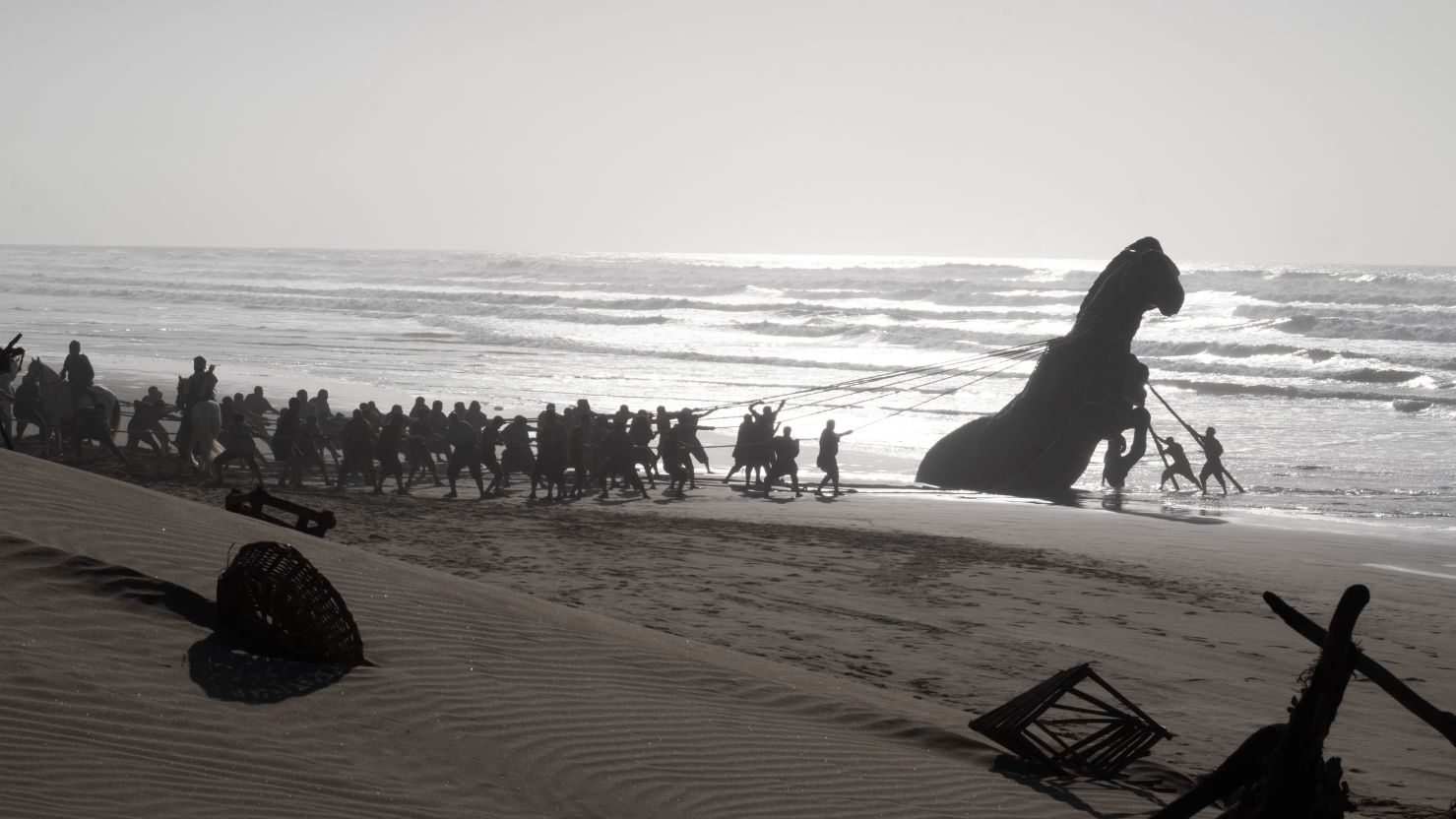
So Nolan takes us again to Troy, after Odysseus’s brilliant ruse has succeeded in opening the gates. The horse, in Nolan’s film, was a sacred gift, abused by the Greeks to enter the city by deception, to kill and to pillage. (This reading has been around at least since Virgil, but it’s a departure from Homer, where the horse is viewed more as a triumph of tactics.) We hear the Greeks committed atrocities; and the treatment of Athena (with one shot recalling Cassandra) makes the sacrilegious nature of the sack pointed. And in a trademark Nolan twist, we learn that Odysseus’s ruse and the Greeks’ sack so trampled upon the laws of hospitality that the entire ancient world is now being torn apart by right of the strong and the will to power. The ancient civilization of the Bronze Age is collapsing, all due to the sin of Odysseus. The feared Sea People — marauders who terrorize the coasts of the Mediterranean world, and whose depredations are one reason Ithaca needs a king — are in fact the Greek veterans, or those following their example. It’s an almost Adamic sin, one man’s wrong plunging the world into chaos. The threats to Ithaca and the glory of its absent king come from the same act.
We finally learn why Odysseus didn’t want to go back to his beloved Ithaca: he didn’t want to see how the savage new world he unleashed has affected it. In shirking home, he refuses to reckon with the consequences of his crime, keeping the Ithaca of his mind undefiled by his act, even as the Ithaca of reality comes under mounting threat. As in some other Nolan movies, the structure makes perfect sense but only at the end. As it turns out, confessing one’s wrongs and eating lotuses were the only two options, and to flee from one is to seek the other. He doesn’t quite get Penelope’s absolution until later, but we do see Athena alongside him, silent tears running down her cheeks. The Greek gods are many things, but in this moment we see film’s truest image of the divine, weeping alongside mortals for all the griefs we inflict and all the griefs we endure.
One great unanswered question of Homer’s poem is how the cycle of violence stops. In the poem, after the suitors are killed, their fathers come to avenge them, till Athena steps in and, deus ex machina, tells them to stop — the end. But what about their sons’ blood? Who will avenge it, and if the avengers are avenged, will it go on forever? Aeschylus, among others, tried to answer that question in the Oresteiad, and Nolan’s avenging dead owe something of their moral logic to the Furies of Greek literature myth. But where Aeschylus interposes a court of justice (plus a bit of deus ex machina) to stop the cycle, for Nolan the only answer is expiation.
Odysseus, after acknowledging the guilt he bears, becomes able to take the evils of others onto himself. In the act of remembrance, perfected in confession, he moves from lotus-eater to sin-eater. Telemachus could not kill the suitors (even if he were able to) without violating the Law of Zeus, so Odysseus becomes the lawbreaker for him. He kills them all, zealously keeping Telemachus out of it, ready to die before letting his son incur the taint of blood-feud. As the big wooden doors to the hall close, Odysseus’s killing the suitors becomes more than just a revenge tale, a way to contain the bloodguilt in himself and prevent it from becoming a generational curse.
If I had one slight criticism of the film, it might be that for Telemachus to be king (Odysseus takes back the role in the poem), he should be worthy of kingship through feats of arms, and Nolan doesn’t give you much of that — quite the opposite, in the swineherd fight (h/t DTHM). But in the terms of the film, what makes Telemachus worthy of the throne isn’t so much his martial skill as his freedom from bloodguilt. He alone can preserve Ithaca against the collapse around it because, cleansed by his father’s sacrifice, his kingship can be untainted by the mounting cycles of vengeance in their unravelling world.
Like certain goats of the ancient Jewish world, Odysseus bears his guilt into exile so that what remains can be clean — or at least, clean of the curse of vengeance — symbolized by the heavy golden circlet on Telemachus’s head. In Nolan’s version, Penelope comes away too, and they’re clearly happy together, but the sense of an ending and a departure predominates. They have a purpose, to go West to honor the unburied men.
What starts in romance must, as the forces of a world too big and too compromised by violence threaten to swamp everything, set its face toward ritual, the acts of remembering, sorrowing, and making whatever feeble gestures of respect one can. The filmmaker’s art is anemnestic, an un-forgetting of our own primal guilt, of our own nature that we share with angels and with pigs. It brings us before the unburied bones of our own history and that of our species, freeing us to rejoice with those who rejoice and coaxing us to mourn with those who mourn. As nice as a happy-ever-after ending in Ithaca would’ve been, with the moral freight Nolan’s Odysseus carries, the move from romance to ritual is the only real way to honor the gods and to the dead. Ritual reaches blindly toward some act, however imperfect, commensurate to the agony and ecstasy of our own lives and the glories and tragedies of those who’ve gone before. Storytelling does too, and Nolan’s latest grasps something worth holding onto.
A few adaptation notes for strays:
- I spent the first half of the film trying to shake off a mild annoyance that the story wasn’t being told to a Phaeacian banquet hall, but by the end Nolan’s choice made sense. Nolan’s story, limited to sub-three hours on the screen, is already large in scope and benefits from cutting Phaeacia; the emotional catharsis of Odysseus’s storytelling pays off in the Penelope scene, and the concern with “vertical” guilt beyond Poseidon’s grudge means the more intimate setting with Penelope and Athena works well.
- Nolan’s take on The Odyssey is a pretty serious one, omitting some of the fun and/or comedic elements of the poem. But the events and characters are fairly disparate (geographically and relationally; many of the people and places have little relation to one another), making a tight adaptation extremely difficult. Unity of tone seems almost necessary, and if one tone has to predominate, serious/pathos-y seems the one to hit.
- The “Law of Zeus” — that one must show hospitality to strangers — functions as a nice plumb line for the moral aspects of Nolan’s universe, but I did wince a little when one scene tries to broaden that to “do unto others as you would have them do unto you.” The “burning tower” shot in Troy immediately evoked Yeats’s “Leda and the Swan,” a reminder that the Zeus of Greek myth isn’t the “golden rule” type, and also all of this is kind of his fault.
- In an interview (above), Nolan references three films that influenced his take on The Odyssey: Tarkovsky’s Andrei Rublev, Kurosawa’s Ran, and Scorsese’s The Last Temptation of Christ. All visual masterpieces, but also films that deeply resonate with the thematic elements discussed above.








Well, this is the only thing worth reading about the film. Soooo illuminating. Top notch McDavid!
McDave – wow. I mean, wow.
This is excellent and thought-provoking. I do wish they had kept the “Nobody” ruse in the film with the cyclops. My main objection, however, was he didn’t have Odysseus speak to who I think were the two key characters in Hades: his mother (whom he didn’t know had died) and Achilles. After all, Achilles chose glory over a long life, but in Hades he tells Odysseus:
“Speak not to me, Odysseus, words of comfort concerning death. Far rather would I drudge for hire under some poor man’s roof that has scarce bread for his household, if only I might be alive upon the earth, than reign over all the nations of the dead…”
A poignant moment indeed.
Nice reference to Weston’s book that drove Elliot’s Wastelands.