




At some point during the 1990–91 school year, my fifth-grade teacher made a stunning revelation: he told our class that he believes he is Back to the Future’s uncredited source. Eighteen months before Back to the Future’s release in July of 1985, Mr. Payne published his first young adult sci-fi novel, It’s About Time (later published as Trapped in Time), which tells the story of two 1980s teens, a brother and sister, who travel to the year 1955. Upon arrival, the teens are in disbelief at the world they’ve stumbled into. A trashed newspaper gives them their “time” bearings, confirming they’ve made it to the very week their parents became high school sweethearts. Knowing the story of how their parents first fell in love, the teens make their way to witness cupid’s arrow strike, that is, until an unfortunate collision disrupts the fateful romantic encounter.
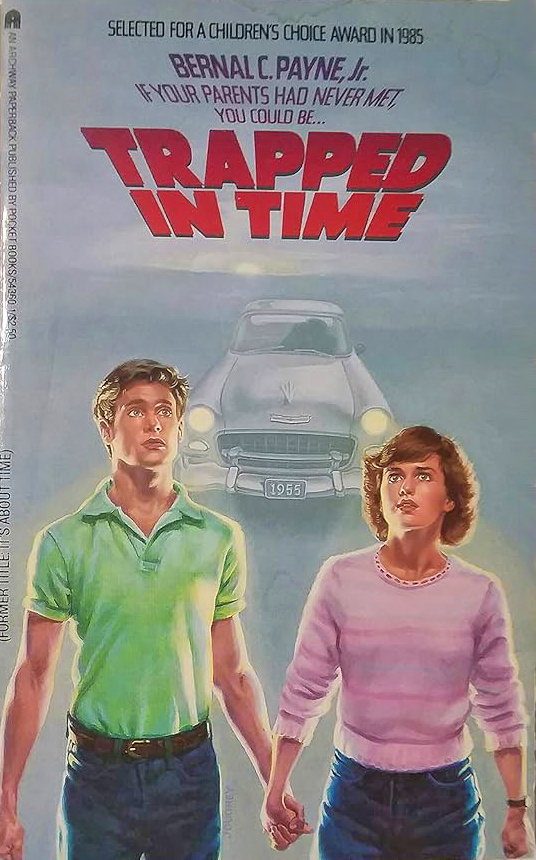 The teens quickly realize how difficult it will be to get their parents together and correct their cosmic error. Not only are George (yes, their dad’s name is George) and Liz worlds apart (with one parent popular, the other smart and bookish), but they also can’t stand each other. The teens realize their very existence has been compromised when they mysteriously begin to disappear, suggesting their mistake is somehow erasing them from history. A picture the teens carry of their future parents also goes blank, further proof they have catastrophically interfered with the past.
Seeking help, the teens confide in an older, white-haired man, but first they must convince him they are not pranksters. He asks them a series of questions about the 1980s, including who’s president, to which the teens reply, “Ronald Reagan.” The old man can’t believe it, “Whaaat! … You don’t mean the actor!” Eventually, he’s convinced (thanks in part to a digital calculator watch one of the teens wears) and he helps them. Their parents’ love blooms, the picture that had turned blank reappears (albeit differently), suggesting their parents’ romance is clinched. Realizing the risk of time travel, the teens return home with their future existence intact.
For anyone familiar with Back to the Future, it’s hard to miss the similarities. Of course, there are differences, too. Mr. Payne’s story has no Biff, no DeLorean, no Jocasta complex, no skateboard, no flux capacitor, no gigawatts, no zany scientist, and no clock tower. Still, the similarities between the two stories are hard to ignore.
Bob Gale, who wrote Back to the Future with Robert Zemeckis, came up with the idea of a teen meeting his parents during their teen years while visiting Mr. Payne’s hometown, St. Louis (which also happens to be Gale’s hometown). Gale found his father’s high school yearbook and wondered what it would be like to spend time with his parents as teens.
As Gale explains it, the “germ” of the idea for a teen meeting his parents came before the publication of Payne’s story on January 1, 1984. As early as 1980, Gale and Zemeckis were pitching their script to studios. The filming of Back to the Future finally began with Universal’s backing in November 1984 (with Eric Stoltz playing Marty McFly). Two months later, Zemeckis realized that Stoltz wasn’t fit for playing Marty and opted to re-shoot with Michael J. Fox playing the lead. Even though versions of Back to the Future existed years before the publication of Mr. Payne’s book, it’s not difficult to imagine that the script underwent revisions up until (and after) shooting began in late 1984 (with Stoltz), early 1985 (with Fox). Is it possible that aspects of It’s About Time were used by Gale, who not only stumbled upon his father’s yearbook on return visits to St. Louis but also a time-travel novel by a local author? Regardless of the answer, the question raises the thorny subject of plagiarism.
Plagiarism’s Promise
Back to the Future ends with a line capturing the American spirit: “Roads?” Doc Brown asks Marty McFly rhetorically, “Where we’re going, we don’t need roads.” For Ross Douthat, this trailblazing spirit is dead and has been replaced by an age of decadence, by which he doesn’t mean sexual deviance or a taste for rich chocolate, but cultural stagnation and exhaustion. If Douthat is correct, then culturally we sit like a blank-minded college freshman before a glowing, blank screen, desperate for something to spring to mind — a predicament often leading to plagiarism.
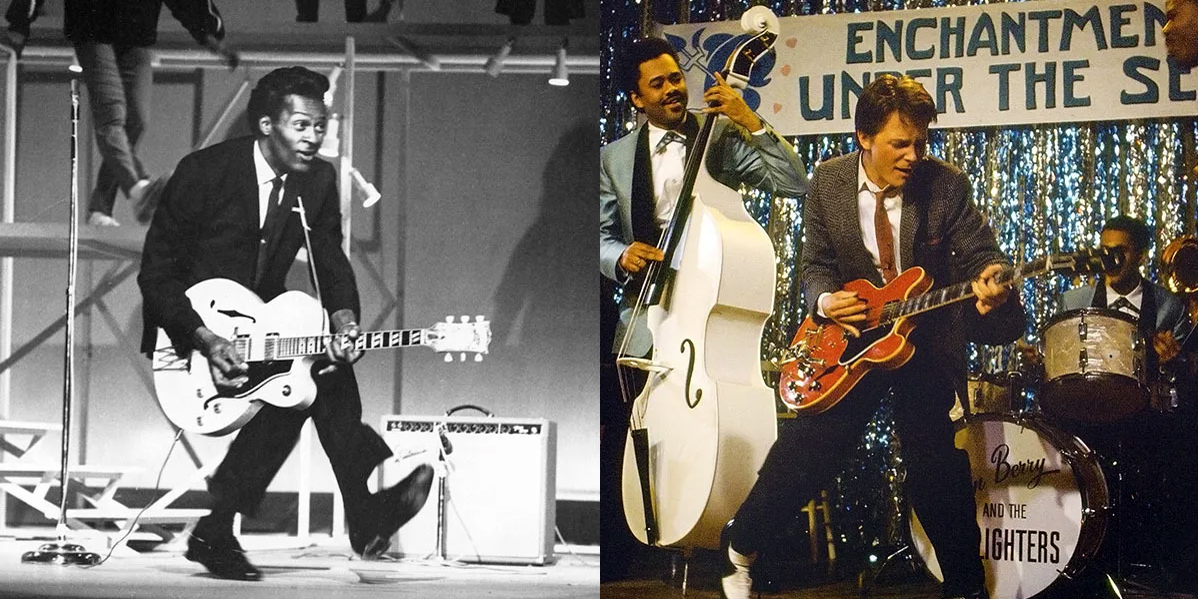
And maybe that’s okay. More plagiarism might be just what a decadent age needs. If Mr. Payne is Back to the Future’s uncredited source, the movie is better for it. The trashed newspaper that confirms Marty’s arrival in 1955; Marty’s disruption of his parents’ romantic encounter and the seemingly impossible task of getting them together, all while Marty’s older siblings are erased from the picture he carries; and Marty’s fading from existence while on stage strumming “Earth Angel.” It’s movie magic.
The trembling we feel when “plagiarism” is deployed would barely register in the minds of our pre-modern forebears who had no qualms borrowing from others without giving credit. Richard Posner cites historian Harold Ogden White on the matter: “The classical doctrine” was that “true originality” comes by way of “imitation which selects its models carefully, reinterprets them personally, and endeavors to surpass them gloriously.”[1] Consider, for example, the cento, which was an ancient poetic form that scrambled lines of other poetry, verbatim, to form new poetry.[2] Some of history’s great works are derived or are the work of others, including the writings of Shakespeare and Coleridge as well as Rembrandt’s paintings.[3]
These predecessors understood that creativity doesn’t spontaneously erupt but builds over time, and those creating need the freedom to borrow, appropriate, synthesize, and edit the best of others’ work. Perhaps more relaxed laws and mores around plagiarism would provide the necessary latitude to break free from a decadent culture’s creative block.
Yet there’s something about a plagiaristic act that strikes deep. That I can still recall Mr. Payne’s offhanded lament 35 years ago says something. The possibility that Hollywood used the ideas of a public-school teacher in middle America to create a global phenomenon while remaining copies of Payne’s novel collect dust in a few used bookstores seems wrong.
Plagiarism’s Sting
In Back to the Future’s second installment, Marty learns that Biff made millions off his idea of using a sports almanac from the future to bet on games and exclaims, “Son of a bitch stole my idea!” Marty’s response gets at the core of what plagiarism is: theft.
The Bible views creation as a bountiful gift, and our response to creation (the Bible charges at nearly every turn) ought to be thanksgiving, but since our first parent’s disobedience we favor covetousness. After Cain murders Abel and Cain’s descendants get to work developing the latent gifts of creation by building cities and developing the arts and sciences, the bombastic Lamech enters the story. Lamech, the seventh generation by way of Cain (which is to say the fullest expression of Cain’s line), takes two wives (thereby introducing polygamy) and assembles them to hear his poem of vengeance:
I have killed a man for wounding me, a young man for striking me. If Cain’s revenge is sevenfold, then Lamech’s is seventy-sevenfold.
The “man” Lamech refers to was likely a boy, and the inflicted “wound” is hardly basis for a death warrant. Lamech can’t see past his own nose. He’s lost sight of the fundamentals: that his life came by way of God’s gracious, life-preserving mark stamped upon Cain, and his enjoyment of the cultural bounty his predecessors developed is rooted in the bounty of a benevolent God. Instead of glorifying God for his mercy, bounty, and goodness, Lamech glories in his poorly aimed rage. Lamech’s problem is ours. Creation’s abundance points to an infinitely more bountiful Creator but, the Apostle Paul writes, we’ve made a “glory exchange,” directing our worship from the Creator to creation.
For Paul, this exchange that robs God of his due glory is humanity’s fundamental problem, and plagiarism is tied to it. Life serves up an endless array of gifts, and rather than acknowledging the source (God), we slight him; we fail to cite the Source. Like a good plagiarist, our creative labors seek to present the illusion of “originality,” assuming we, with godlike powers, create ourselves and our worlds ex nihilo when in fact our lives are heavily footnoted, dependent upon a myriad of graces that suspend us in the universe. While perhaps building some creative steam, the plagiaristic impulse is a cosmic misstep that gets all reality wrong, which explains why Mr. Payne’s claim still bats around in my memory some 35 years later.
Cite Your Sources
Plagiarism is certainly not the worst human offense, but it remains a chip (however small) off the block of the glory theft at the heart of the human condition. Rather than proposing policy or legal reform (as important as that may be), I’d like to suggest something more foundational: a posture to the world that would make plagiarism unthinkable.
What’s needed is the posture of the old, white-haired man in Payne’s novel, Father Dooley. Unlike Doc Brown, Back to the Future’s man of science, Dooley is a priest who operates from a truer premise: that life is large, mysterious, and beyond one’s control. As one who stewards “the mysteries of God,” Dooley has no doubt learned that there is a steady flow of gifts and blessings under the canopy of creation, a view that develops instincts of kindness. For example, Dooley spends much of his time organizing Christmas dinner for the elderly. He also encourages prayer when he realizes the difficulty the teens will have getting their parents together.
Life seen from Dooley’s vantage takes on a sense of indebtedness, which in turn produces a life-deepening response, a word of thanks. Cornelius Plantinga summarizes the many benefits that come to the grateful, including lower blood pressure, lower levels of depression, anxiety, and inflammation, better sleep, better relationships, more happiness, more life satisfaction, more patience, and more resilience under work and life pressures.[4]
For all these benefits, it’s still hard to maintain a thankful heart. Gratitude grates against much of our experience, which leads us to believe that the Dooleys of the world are delusional, blinded by naïve, cock-eyed optimism that’s out of step with the chaos swirling around in the real world. Gratitude, though not natural, is a proper response to the world as it is, and it is kicked into gear by faith. It’s revelation, not experience or reason, that substantiates the grateful life.
As it relates to plagiarism, creative labors within the bounty of creation ought to be marked by a sense of indebted collaboration with both the quick and the dead, a keen sense that we “stand on the shoulders of giants.” Creation’s abundance works against the instincts of plagiarists who presume to labor under conditions of scarcity and look to make out like bandits. An awareness of God’s gracious activity fosters readiness to cite all sources with joyful indebtedness. That’s what the tedium of footnotes or bibliographic citations represents: an indebtedness that prompts a life-deepening word of thanks.
An orientation of thanks in the world wouldn’t just impact the borrower of ideas, but the one borrowed from too. Such an orientation downgrades originality because the creative understands they are just co-creators, stewarding the abundance of creation to the glory of the Creator. This underscores the derivative nature of all creative work and warrants a looser grip on the fruit of one’s labor. Those plagiarized can be thankful for their uncredited contribution. Any residual sting, then, might prompt a turn to the cosmic sting we all inflict upon our Maker and the blood of Christ that covers it, a joy-inducing plunge into the ocean of God’s love.
It’s unlikely this posture to the world will be widely adopted, for those living life under these bountiful horizons do so because they have first passed through what Jesus calls the narrow gate, a passage mere flesh and blood can’t make. So I expect plagiarism to continue apace. Still, if our creative labors were less concerned with originality, a godlike creating ex nihilo, and more aware of the derivative nature of all creative work and creation’s canopy of abundance that enfolds it, we might be more willing to give a nod of thanks to our sources and exercise more patience for those who don’t.
Casey Shutt is pastor of King’s Cross Church in Oklahoma City. To learn more about Casey, visit his website: mindhengeartifacts.com.
[1] Quoted in Richard A. Posner, The Little Book of Plagiarism (Pantheon: New York, 2007), 54.
[2] See poetryfoundation.org/education/glossary/cento as well as Posner, 50. One could also point to the glosa, a Spanish Renaissance poetic form that develops new poetry by using lines of other poetry.
[3] See Posner, 26–27. Also see: https://www.themarginalian.org/2013/10/21/coleridge-and-plagiarism/; and Stephen Moss, A history of plagiarism (not my own work),” The Guardian (November 23, 2005): https://www.theguardian.com/books/2005/nov/23/comment.stephenmoss
[4] Plantinga’s summary is based on the findings of UC Berkeley’s 2018 report, “The Science of Gratitude.” See Cornelius Plantinga, Gratitude (Grand Rapids, MI: Brazos, 2024), 56–57.





This illustration is almost too good to believe! Casey, you may have had the coolest 5th grade teacher ever (and I should say that my own Ms. Paradis was pretty awesome). You’ve given Mr. Payne’s lament new life here, and I’m thankful that this story will quickly come to mind whenever I think of plagiarism or gratitude from here on out!