




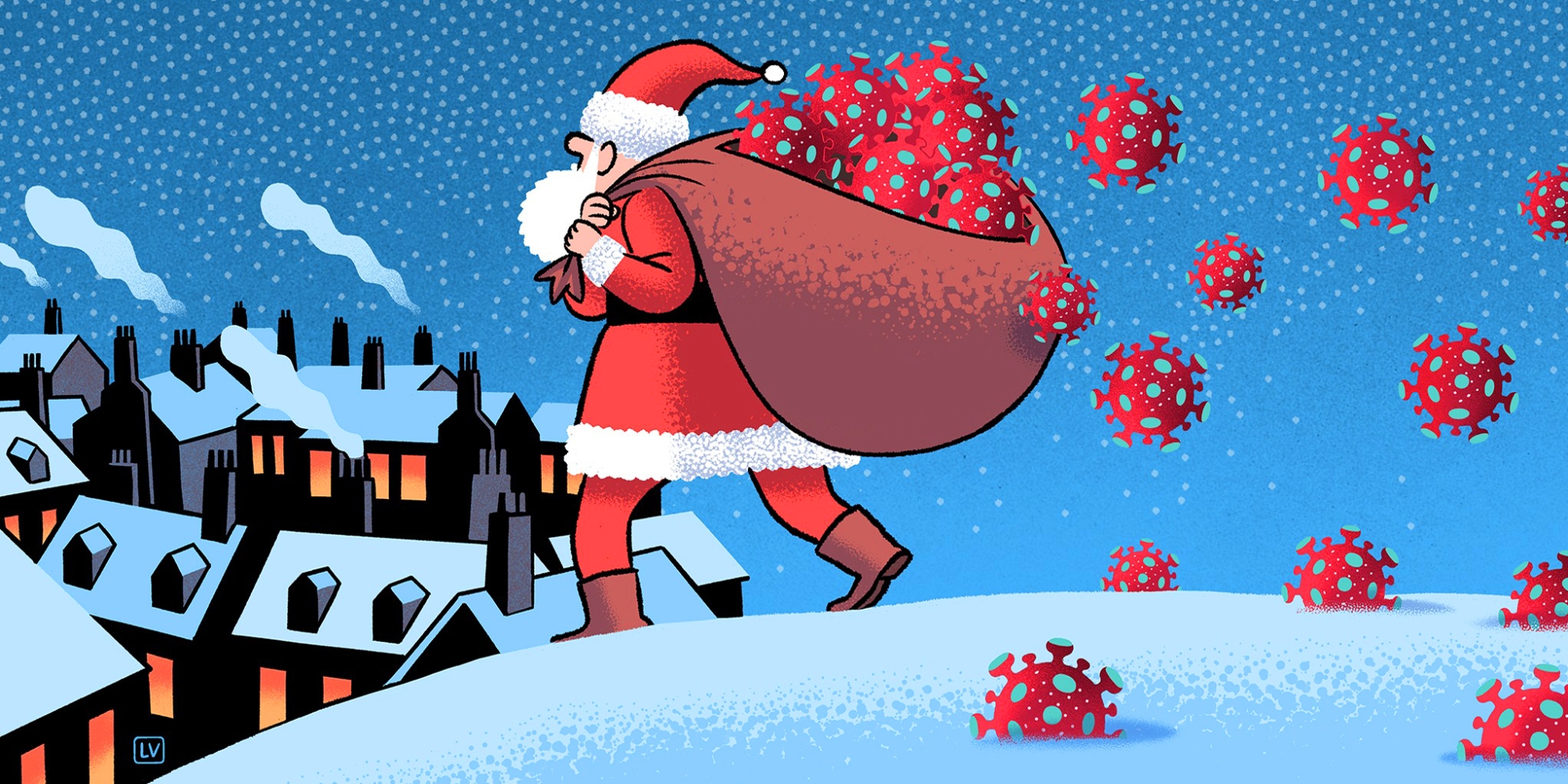
Maybe you had a wonderful Christmas. Maybe you were surrounded by loved ones, beribboned gifts and dazzling trees. Maybe you sat in the hard pews at Church and sang out “Joy to the World, the Savior reigns …” with the organ resounding behind you. Maybe you served a multi-course meal to a large table full of family or friends.
Statistics indicate it is also very likely you had a Christmas like mine, presents gleefully unwrapped, duck marinating on the top shelf of the fridge, in anticipation of the evening’s dinner party of twelve, when you were surprised by a positive rapid Covid test for your child. Maybe you had to send your parents away with the gifts for your siblings, recognizing they will now be opened on video call. Maybe you too had to call your in-laws to explain you will not be making the trip over the mountain to celebrate Christmas with them. Maybe you also lay weeping in your bed, fully dressed. Though I hope you at least remembered to slip your shoes off so the sheets didn’t get too dirty.
For almost two years, I have been appropriately vigilant about Covid — or at least that’s what I told myself. Some might have been more cautious than I. Others were less so. I simply followed the rules: I got my vaccination, got my children vaccinated, wore a mask despite my vaccination status. I properly chastised myself up when I relaxed my behaviors, even in the slightest. I followed the case numbers carefully, read up on the latest guidance for schools and safety. I did precisely what I was supposed to do.

Now, my fears of getting Covid, of my children getting sick, of exposing my parents and uncle, all of those happened overnight. For two years, I believed that only people who did not follow the rules got “infected” (as opposed to merely being sick). I am not alone in my legalistic thinking.
In an article titled “Don’t Feel Ashamed for Getting Covid,” Angela Haupt interviewed Jessica Stern, a clinical pyschologist about the stigma around something as simple as getting sick.
There’s been this large narrative about the importance of controlling your actions to prevent yourself from getting sick, and from transmitting the illness to other people. Because this narrative is so closely connected to our behaviors, I think there’s this implication, or this assumption, that if you get sick you must have done something wrong to bring it onto yourself.
She goes on to say that this belief is obviously not true but one that’s inherent to our Covid narrative.
At the core of this narrative lies something (almost) biblical. We believe we will not experience bad things as long as we follow the law perfectly. And so we face these so-called “consequences” without any grace. Even if, when we all admit it, this illness can come for anyone and our semblance of control is frail at best. Perhaps our biggest mistake was believing that righteousness meant never contracting this super contagious virus large numbers. It’s called a pandemic for a reason.
All of this is evidenced by the subtle interrogations I’ve experienced upon disclosing our test results. “Were you wearing good masks?” “Who gave it to you guys?” Where did you get it?”
This last one always reminds me of David Sedaris’s essay from Let’s Explore Diabetes with Owls. Sedaris finds a lump on his back and when it is diagnosed as a pocket of fat, a lipoma, Sedaris asks his doctor, “But where did I get it?”
His very French doctor responds to his question with another question, “Where do we get anything?”
Sedaris replies, “We buy it?”
I wish I could tell people we bought Covid from Whole Foods. At least then it’d sound like it was a good lifestyle choice. It would be easier than confessing all the times we might not have perfectly kept the pandemic rules. And much easier than replaying my week over and over in my memory to find the flaws in my behavior. All of these questions and searching implicitly attach a level of judgment to getting Covid. People ask because we are all amateur contact tracers and epidemiologists now. We all want to know what the patient did wrong so we can avoid the same mistake. I used to be a part of this group.
And thus, the guilty feeling was not merely for contracting Covid. I also realized I felt tremendous shame about how little grace I have extended to others throughout this pandemic.
I held others to impossible standards of isolation — which if I am honest, were not so hard for this raging introvert. I judged people who got infected, people who did not properly wear masks, people who chose to gather with friends or family. I judged them to validate my own behavior. I needed to believe they were terribly wrong in order to justify my own choices. I wanted to know with certainty that I had some form of control, even if all I could control was judging someone else.
And so I sense the need to apologize for my self-righteousness. I feel now how horrible it is to moralize illness and health, especially to someone who is sick or whose loved one is sick. In part because I do not believe we can shame anyone into good behavior. We know that does not work. But perhaps most of all because I need to speak grace to myself.
The oddest part of the whole Christmas debacle is that I almost feel a sense of peace. That second purple line appeared and the clouds slowly gave way to sunshine. The worst thing that I could imagine during the pandemic has happened. And while I foolishly believed we would never contract a contagious virus, we have it and now here we are. There is a serenity in realizing I ultimately control very little and that the world did not stop spinning because we got sick. Knowing I cannot be perfect has helped me let go of the illusion of omnipotence. All it took was an uncomfortable nasal swab and 15 minutes for me to realize what’s always been true: I am not actually in charge of much.
I am not arguing we should throw all public healthy guidance out the window. What I am arguing is that grace abounds, especially when we realize just how badly we’ve failed, whether it is at keeping the rules or loving our neighbors. Anne Lamott says, “Grace always bats last.”
How easily we forget that Jesus healed the lepers instead of shaming them. He gave no lectures to the sick. In this way, grace cleans up the guilt and the shame and the judgment and the failure and brings us all home. On my isolated Christmas, I could not have been more grateful.





Wow – thank you for writing this!! I’m actually coming from the other side of this divide, and I’m also realizing how little grace I extended to others. When the pandemic started, norms were in flux, and I was doing my best to navigate the situation – prioritizing what was most important for my own and loved ones’ mental health, and trying to do it with precautions. Many people in my circles were stricter about isolation and expressed judgment towards those who were less strict. In those uncertain times, I was wracked with self-doubt – wondering if I might be a murderer for going for walks and getting takeout (in those early days), or visiting family (as things reopened, but still pre-vax). And I responded with self-righteous anger towards the more cautious folks who expressed judgments. I blamed them for “making” me feel anxious and guilty in trying to balance values against risks. Like you, I needed them to be wrong to validate my own behavior – to justify to myself the calculated risks I was choosing to take (and simultaneously second guessing). Looking back, I’m sorry for blaming others for my suffering – and sometimes lashing out and saying hurtful things. I did not see that other people’s judgments came from a completely *understandable* reaction to their fear in the fact of an unprecedented threat. I did not recognize that I am responsible for managing my emotions and owning my choices. One silver lining of the pandemic was that I started going to church again – in the chaos of 2020 – after a long time away. It’s only with God’s help – grounded in the security of His love – that I’ve been able to admit my fault in this situation.