




On the Monday before Palm Sunday, at the United Nations Security Council meeting, representatives from the Ukrainian Security Service presented text messages they’d captured from the smartphones of Russian soldiers killed in action. In one thread, a soldier had written to his mother, describing how Putin’s invading army is “hitting everyone, even civilians.” The soldier continues, informing his mother that he is no longer in Crimea doing training exercises, as she’d been told. When his mother responded in the thread by asking if she can send her boy a package, he replied, “Mother, the only thing I want now is to hang myself…this is real war, mom. I’m scared, we’re hitting everyone, even civilians. We had been told that people would welcome us here but they jump under our vehicles, not letting us pass. They call us fascists. Mom, it’s so hard.”
Adam in the Garden shows us that the fundamental nature of sin is a failure to trust God’s words, “Did God say you will die if you eat of the fruit? Not only will you not die, you will become like God.” If sin is refusing to take God at his word, then I wonder if we’re ever in danger of repeating that sin by insisting, as interpretation usually does, that Jesus means something more noble and serene— something less than human— when he cries out to his mother from his cross, “Woman, behold your son.” Even if Jesus is providing for his mom at the hour of his death, why do we suppose that utterance is anything but awful for both of them?
In a New Yorker article entitled “The Woman Behind the Camera at Abu Ghraib,” Errol Morris probes the atrocities committed by American soldiers in Iraq. “Of course,” he writes, “the dominant symbol of Western civilization is the figure of a nearly naked man, tortured to death — or, more simply, the torture implement itself, the cross. But our pictures of the savage death of Jesus are the product of religious imagination and idealization. In reality, he must have been ghastly to behold.”
“Woman, behold your son.”
The essay continues, “Had there been cameras at Calvary, would twenty centuries of believers have been moved to hang photographs of the scene on their altarpieces and in their homes?”
I think not — certainly not his mother.
“He must have been ghastly to behold.”
Errol Morris writes better than Jesus can manage to compose from his cross. He saves the most important verb for the end of his sentence, “He must have been ghastly to behold.” In Hebrew and in Greek the word “Behold!” means far more than simply “See!” or “Look!” You don’t have to speak antiquated English to recognize that the word “behold” means something special. In both Testaments, the word translated “behold” conveys a sense of extraordinary disclosure, a pulling back of the curtain. In other words, something is being revealed to the beholder on Golgotha. What exactly? What does Jesus think is being revealed to his mother? An act of his Heavenly Father? A payment for sin? An appeasement of divine wrath? The solving of some eternal equation that equals atonement? 1 cross + 3 nails = 4giveness?
Perhaps we can skirt any squeamishness we might feel over the idea of a loving God meting out such a ghastly punishment on anyone— perhaps we can skirt around that unpleasant thought by reminding ourselves that the crucified one is also the incarnate one, the pre-existent Son, true God from true God, as much God as the Father and the Spirit. The crucifixion, at least of the man in the middle, is the willing, cooperative work of the three-person’d God. There, you see, we can let the doctrine of the Trinity settle our stomachs and quiet our consciences.
Except —
The Father’s eternal Son is also Mary’s quite real and very human boy.
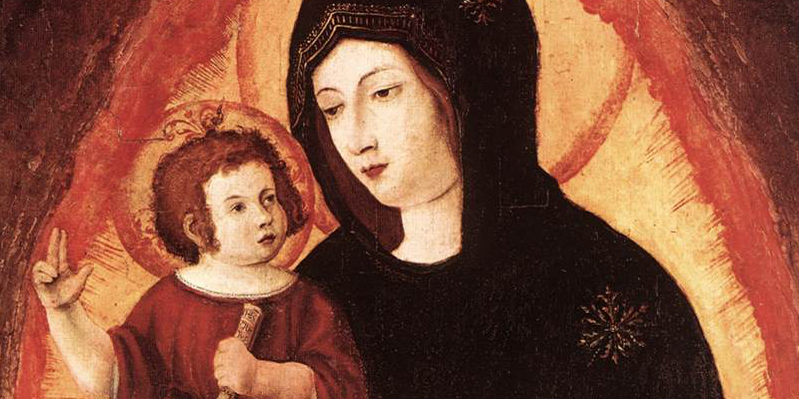
Surely Mary loves Jesus as much as that Russian mother loves her son. It’s one thing to say that the one on whom God metes out such a ghastly punishment is also God, but it’s another matter altogether to say that God would apportion such a horror upon Mary. You need not be a parent to know that to see her child suffer so would be as great a suffering. Is God’s wrath towards the wickedness of men so great that he would torture this woman?
No.
God’s decision is retroactive.
If Mary could sing Hannah’s song from memory, then she certainly knew the story from the Book of Genesis. After the flood, after Noah offers a sacrifice and the aroma is pleasing to the Lord, God sets in the clouds a rainbow. Literally, God hangs up his anger. He retires his wrath. He locks his guns in the cabinet and throws away the key. The rainbow is a sign, God declares, of God’s promise never again to destroy his creatures because of their sins. He would never again flood the earth out of his wrath nor would he flood Mary’s heart with sorrow.
*****
So, back to that word: “Woman, behold your son!”
What’s the extraordinary disclosure that warrants a word like “behold.” What’s being revealed on Calvary in the son of Mary? We are. The cross is pulling the curtain back on us. As Gerhard Forde writes in Theology is for Proclamation, what’s conveniently and conspicuously missing in most theories of the atonement is the brute fact that we killed him (121).
Woman, look what they’ve done to your son!
See what they’ve done to God.
The cross is not what God inflicts upon Mary in order to forgive; the cross is what God in Christ endures even as he forgives! The death of Jesus Christ discloses not only the work of God, in that, as Forde says, Jesus is the one in whom God does God to us. The death of Jesus also discloses the nature of God’s creatures. We are, like that Russian mother’s son, capable of unspeakable acts — Abu Ghraib, even silencing the Word made flesh.
That’s why twenty centuries of believers have hung the cross over our altars and in our homes. As if to say, Behold! Discover! See — don’t forget — the ghastly truth! The God who hung the rainbow in the sky is a God who wills only to be gracious to us, and we will his murder. As the Confession in the Book of Common Prayer once put it, “There is no health in us.”
Behold!
Peer behind the curtain on Calvary.
The only person who can heal whatever evil afflicts us we will leave dead, forsaken, and shut up in a tomb, another civilian casualty killed by an authoritarian’s cruel tool.
The boy of yet another mother.
Our only hope is that God wonʼt leave him there.





Immediately when I completed this reading, my heart was broken…surely in all of the right and good ways. Makes me want to start over and read it again afresh~Living water and Holy Spirit that blows through us similarly to wind, keep flowing, keep breezing through your people and among us for your glory.
I still think we would have a crosses But they wouldn’t be romanticized as we do now. For at the cross is both suffering, horror and evil, but also the goodness of God on full display. It forces us to see it in light of a theology of the cross instead of a theology of glory