




There were once two cousins close in age, nearly identical in appearance. Some say it was their matching beards, but there was something about their eyes, reflecting a shared weight of responsibility that haunted them. Whatever the reason, the resemblance was uncanny, to the point they looked like brothers and, at times, twins. Both were of a shared royal lineage, stretching back over a thousand years; one destined to be king, the other imprisoned and later assassinated.
Of course I’m talking about Britain’s King George V and his first cousin, Russia’s last Tsar, Nicholas II. Had you going there for a minute, didn’t I? Bet you thought I was going to say something about Kaiser Wilhelm II (their first and third cousins, respectively) didn’t you? The European royal family tree grafted back onto itself several times, so all three were related to each other on both their collective patriarchal and matriarchal lineages. Super healthy, um, yeah, nothing weird about that.
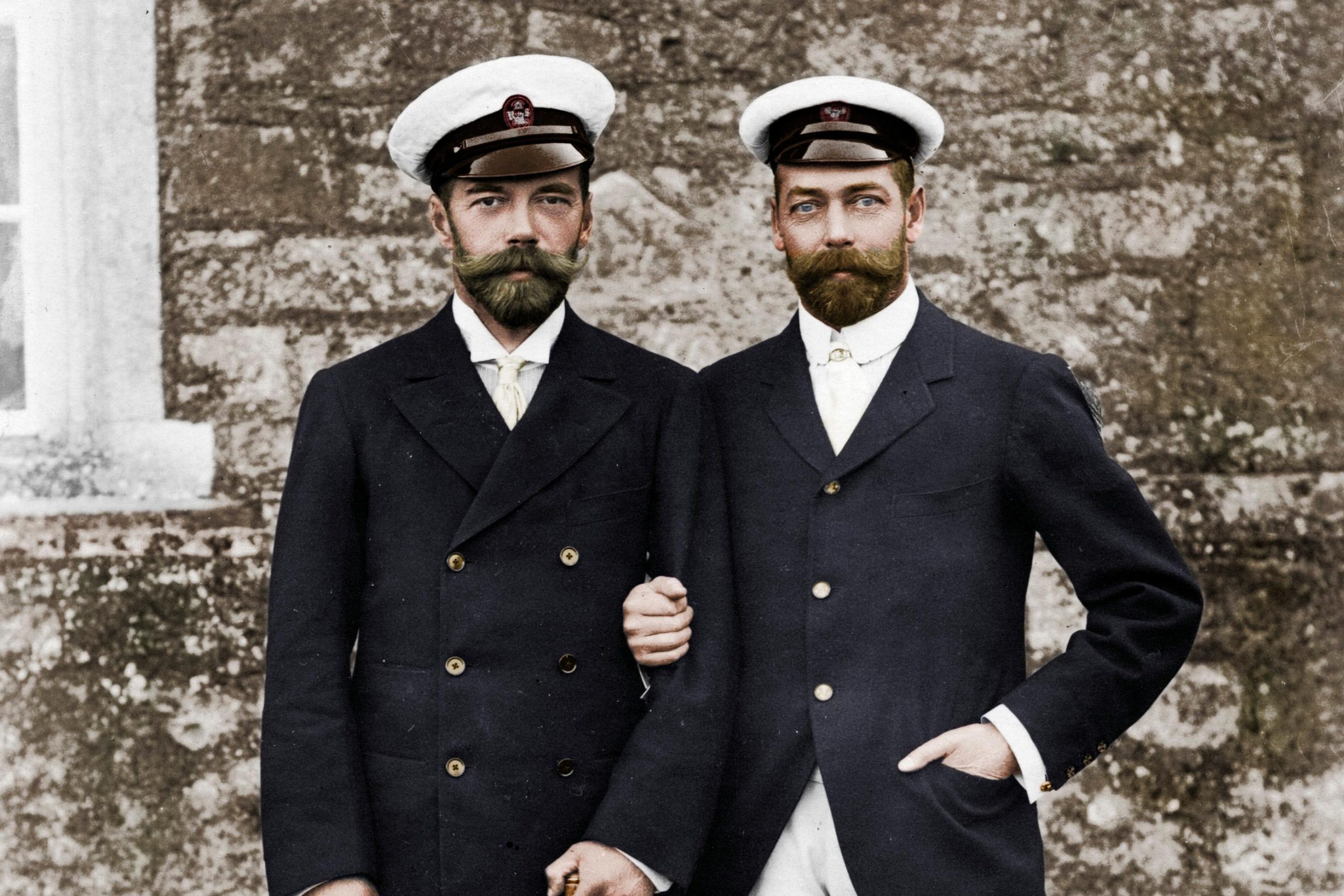
Oh, you thought it was about another set of famous cousins…
Being a cousin can be a tough gig. Cousins can serve as mirrors or as objects of comparison, usually unfairly, acting as proxies for competitive siblings or grandparents, sometimes each other. Jane Williams in her book The Art of Advent talks about that other pair of famous cousins, Jesus and John the Baptist. Using a sketch titled The Virgin and Child with Saint Anne and Saint John the Baptist by Leonardo Da Vinci as a starting point, Williams wonders, briefly, if it chafed the Baptizer to be merely an opening act for his younger cousin.
We do not know if John was ever tempted to believe that he was more than a forerunner, or whether he was confident in his humility all along. He had reason for confidence: just like Jesus, ancient prophecies were seen to be referring to John; just like Jesus, an angel came to announce the forthcoming arrival. Like Jesus, people flocked to hear John’s preaching, and he, too, attracted fascinated and terrified notice from those in power. We get no hint that John ever thought that perhaps he, and not Jesus, was the Messiah. But we do have one poignant glimpse of uncertainty. Sitting in prison and awaiting death, John sends to ask Jesus: ‘Are you the one who is to come, or are we to wait for another?’ (Matthew 11.3). John needs to know if his life’s work is done. John’s calling is to prepare for the coming of the Messiah, Jesus, but that means that he is like a gatekeeper, perpetually condemned to stand outside and point the way for others to go in. (p. 52)
As I am wont to do this time of year, I thought I would take you all on a short guided reading tour of some wise folks’ reflections of our Advent passage, Matthew 11:2–14. Picture it, John is imprisoned in Herod’s fortress, Machaerus, east of the Dead Sea in what is now modern-day Jordan. He sends his own disciples to Jesus with a question: “Help a cousin out. Are you the One?” Notice what he didn’t ask for — help with a jailbreak, the raising of an army, or even for Herod to be vaporized. Instead, “If it isn’t you, should we look for someone else?” Karl Rahner, the late Jesuit priest and theologian, surmises in his book Everyday Faith that John’s question wasn’t from a lack of faith or even cowardice but from his experience with God and how he has worked through history. I will say, cowardice or not, despite/because of having a cousin who was God incarnate, the poor guy didn’t have an easy gig as a prophet, forerunner, herald, and human lightning rod. Also, is it just me or do you hear the Silver Surfer’s voice every time you come across the word “herald“?
He (John) believes despite everything. He is the messenger preparing the way for God, in his own life and heart first of all, preparing the way for God who takes such an inhumanly long time to come and does not even hurry when his prophet is perishing, the God who always seems to arrive when it is too late. The Baptist knows that God always makes his point, that he wins by losing, that he is living and gives by being put to death himself, that he is the future which seems to have no future. (p.29)
Jesus did answer John’s question through an interesting riff on the words of another prophet, Isaiah, or as the late Robert W. Jenson puts it in Story and Promise:
He (Jesus) once made a melange of references to Isaiah: ‘The blind see, the lame walk, lepers are cleansed, the deaf hear, the dead are raised, and the poor hear good news.’ The purpose of creation is to be achieved, and all negation overcome. The dead are not mentioned in the Isaiah texts, they are Jesus’ addition. History’s wedding celebration is beginning. […] The beginning of the new age is necessarily the death of the old. (p. 36)
Irenaeus picks up on this age that is past, this ending-of-the-law-and-prophets-in-Christ theme when speaking of John in Against Heresies, “Since, then, the law originated with Moses, it terminated with John as a necessary consequence. Christ had come to fulfill it: wherefore the law and the prophets were with them until John.” Here, Irenaeus is echoing Christ’s words in verse 13, “For all the prophets and the law prophesied until John.”
Paul Zahl underlines in his great little book The First Christian why we celebrate John’s role of pointing to Christ in Advent, why this fulfillment in time, in and by Christ, is so earth-shatteringly important. Or, to put it another way: What’s next, what was John heralding (this “kingdom of heaven” mentioned in verse 12), and what does it mean to live in it?
The environment is the kingdom of heaven. It is identified with Jesus. […] The first division is all time up to and including John the Baptist, who was God’s summation as well as his prelude. The second division is the time since, the time of the kingdom of heaven. (p.69)
If I live in the time of fulfillment – that is, if I think that all was fulfilled in Christ’s arrival, his first advent, to us the old language – then I will look for and expect victory and blessing on every front. Yet, disappointment will invariably come. I shall lose my hope of victory and of the triumph of the good.
But if I live in the time between, in the second of the three compartments of human narrative, then I am living in two worlds simultaneously. […] I can live with the plural loose ends of my experience of living, yet not be satisfied with them, desperate over them, cyclical about them, hopeless because of them, a nihilist in the acceptance of them. […] Finality would arrive, but not yet (Matthew 13:24-40). Human beings live in the middle ages. (p. 73–74)
We live in the “already and not yet” you often hear talked about. We are thankful for the not yet part because we can experience the hope of Jesus’ death and resurrection, the supreme expression of God’s life-giving love — also known as the end of nihilism, the destruction of despair, the death of death. Or, the middle ages of hope, waiting for his return. We live in the ultimate liminal space, but thankfully one without a question mark as to what’s next. Zahl expands on this later in the same chapter.
The ground for Jesus’ compassion was his theology of the end-time. The threat of the Law, the threat of God’s impending, oncoming, and non-exception-granting righteousness, was John the Baptist’s great theme. It was unbearable unless conceived in immediate collision with the erupting end. But the threat of the cathartic end relaxed in the way of Christ, as he was the beginning of the end but not the end, just as John the Baptist was, and also triggered, the end of the beginning. (p. 75)
That last line of Zahl’s is a sort of recapitulation of Revelation 1:8, “I am the Alpha and the Omega, the Beginning and the End,” says the Lord, “who is and who was and who is to come, the Almighty.” This is what Christ’s accomplishment brings to us. It’s what allowed John to be confident that his end wasn’t simply for his cranium to be a gruesome ornament on a platter but something we share with him; no end, because Christ is the End, the fulfillment of the law, life everlasting with the eternal God, the light that casts out the darkness of Advent. As Jesus said, and as only he could have said, “The dead are raised up.”
The beloved and sorely missed Frederick Buechner, in his Beyond Words devotional, brings us back, along with John, to that seminal moment on the banks of the Jordan; which, I’m sure, he replayed every second of in his mind, the rush of memories coalescing in that jail cell like a flash of lightning.
Nobody knows how John reacted when his disciples came back with Jesus’ message, but maybe he remembered how he had felt that day when he’d first seen him heading toward him through the tall grass along the riverbank and how his heart had skipped a beat when he heard himself say, “Behold the Lamb of God who taketh away the sins of the world” (John 1:29), and maybe after he remembered all that and put it together with what they’d told him about the deadbeats and the aluminum walkers, he decided he must have been right the first time. (p. 193)
I like to think that was when the penny dropped for John, carefully listening to his cousin’s words coming from the lips of his followers, his confusion and fear now replaced with peace and joyful expectation as he realized “Blessed is the one who is not offended by me” wasn’t a curse or a jab by Jesus at his question but the start of an everlasting blessing. “Behold the Lamb of God who taketh away the sins of the world.” Sounds like Advent to me!








Hey, Josh, thank you; a beautiful piece. Part of the “not yet” for me, older now, is all the books I won’t get read. So thanks for giving me snapshots from Joy Williams and Paul Z. Grace and peace, T
p.s. and thanks for helping me connect John standing at the edge of the new age with Moses seeing but not entering the Promised Land, to be succeeded by another Yeshua!
Beautiful Josh, thank you for this piece. Also thanks for posting it on Substack.
I agree with Tony’s description – This is as beautifully written as could only be done by a believer. It reads like you have compassion for John and hope for his cousin 🙂