




When the Bible scholar N. T. Wright was a college chaplain, he’d make a point of personally meeting with every incoming freshman. Some of the students would remark about how they don’t believe in God, so this would be the last time he’d see them. Wright would respond with a question, “What sort of God do you not believe in?” Responses would vary, but generally had something to do with God’s moralism, cruelty, apathy, or impotence. To every student, Wright would reply with the same line, “Well, I don’t believe in that God, either.”
I, too, don’t believe in a moralistic God. If anything, I think that the religion of Christianity is morally under-developed. If one were to catalogue all the explicit commands one finds in the New Testament, the list would be surprisingly short, and it would overlook a large number of daily activities.
Imagine, if you will, a first-century Gentile convert to Christianity. On the day after his baptism, his middle-class routine remains almost exactly as it was before. He wakes up at the same time and gets dressed in the same clothes he’s always had. He gets a shave from his servant and eats his usual breakfast (bread). He kisses his unbelieving spouse (to whom he’s been explicitly told to remain married to) before heading off to work at the shop his grandfather opened. Throughout the morning, he (silently) prays, because he was told to do so “without ceasing” (1 Thes 5:17). After closing his shop before the afternoon heat, he either fulfills household obligations, attends the theater or chariot races, or lounges at the forum before patronizing the local bathhouse. He ends his day with a large dinner surrounded by friends and family.
The checklist of activities this hypothetical middle-class Christian wouldn’t do is a relatively short one. He wouldn’t offer sacrifices to Caesar or the local patron god (though he would likely attend the usual festivals). He also wouldn’t imbibe excessive alcohol or go to the brothel.
While the social costs of becoming a Christian were high, it’s entirely likely — as it was for others (cf. Phil 4:22) — that this Gentile convert could be a Christian anonymously, without any of his neighbors noticing any significant change. His daily activities, wardrobe, diet, and occupation would largely remain as they were before. A similar anonymity from a more Jewish-Christian context can be seen in James, the brother of Jesus. The second-century writer Hegesippus notes how this leader of the Jerusalem church was only discovered to be a Christian when the scribes and Pharisees asked him to dissuade others from becoming Christians.
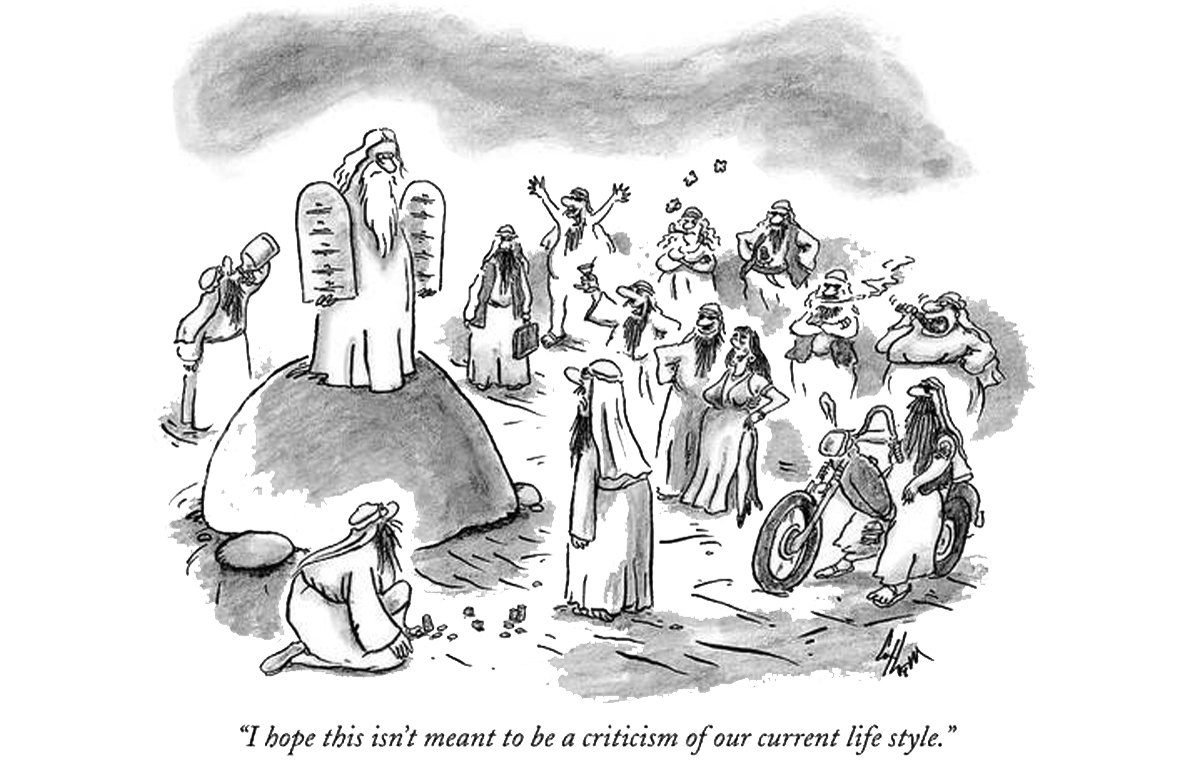
It’s easy to overlook, but the overwhelming majority of commands in the New Testament are long on description and short on prescription. Take, for example Romans 12, where Paul pivots in his lengthy letter to what preachers like to call “application.” Paul begins with what sounds like a call to live radically different from the world, “Do not be conformed to this age,” before then stipulating what this nonconformity looks like: “but be transformed through the renewing of your mind” to “discern the will of God” (v.2). The differences between this age and the believer are ones of attitudes and beliefs. Continuing further, one searches in vain for what this mental transformation looks like in practical terms.
In what follows, there are exhortations to be a certain kind of person, instructions to have a certain kind of disposition, and broad categories of actions to fulfill.[1] One is to serve the church in the role they have and be generous with what one has been given. With genuine love, Christians should hate evil and cling to the good. They are to be devoted to one another in love, outdoing each other in showing honor. When persecuted or reviled, one responds with blessing by attending to their persecutor’s needs. Christians are to live peaceably with everyone, be subject to those in authority, and pay their taxes.
These are radical, world-changing ethical ideals that ran counter to Roman culture and, I’d argue, are especially needed today. But at every turn Paul resists the impulse to be even remotely pragmatic. As if to underscore this point, Paul concludes by turning to the Ten Commandments, where he explicitly redirects his readers’ aims away from a checklist morality and toward the Law’s summation, namely love. Do the latter and you needn’t worry about the former. Paul is long on ideals, but short on application.
Paul gives to the church a way of thinking about ethics that prioritizes motivations, values, beliefs, and identity over precise normative customs. He traces the outline of what self-giving love looks like (namely Jesus) but leaves the details to the conscience of the believer. Reducing ethics to a taxonomy of do and do nots, it seems, would needlessly limit the dynamism of the Spirit’s movement.[2]
For many, Christianity’s underdeveloped morality is a source of embarrassment and discomfort, though they would never describe it in those terms. Reading between the lines of ethical exhortations, theologians and preachers routinely domesticate Christianity’s idealism through everyday application.
Today, the new convert to Christianity would find themselves confronted by a strange new world of expectations that touches almost every aspect of life. The list of things this new Christian wouldn’t do is a lengthy one. The caricature of teetotaling Bible thumpers of yesterday is mostly an outdated one, and yet the legalist spirit of ethical checklists is alive and well in new forms. Beyond the usual political headlines, one finds a bevy of Christian how-to manuals. “Would Jesus be on TikTok?” (unequivocally “no”). “Which books should Christians read?” (Oddly, the answer seems to be “Greek philosophy”). “Would Jesus go to the gym” (every day, it seems). To say nothing of the many voices encouraging people to set better boundaries, wake up early in the morning, and be an attentive parent/spouse/fill in the blank while still finding time to cultivate friendships, live a pseudo-monastic spirituality, and serve the local church.
Far from a liability, I find the underdeveloped morality of Christianity to be both intentional and one of its greatest strengths.
There is no single, one-size-fits-all cultural expression of Christianity. In the same way one could be a Christian while living as a Jew or Gentile, one can be a Christian while living as an American, Egyptian, or Guatemalan. This contextual malleability provides at least one reason why Christianity has been able to spread around the globe and across the millennia.
Beyond this more sociological insight, however, I think there are very good reasons why early Christianity refrained from providing exhaustive moral checklists. Jesus, frankly, doesn’t care what time you wake up in the morning. Or what you wear, what you eat, or whether you’re getting enough exercise. He has no interest in creating a moral checklist for you to fulfill all (self) righteousness. Action always follows from being and never the reverse. When one makes Christianity’s lofty ideals into pragmatic, bit-sized chunks, one fools themself into believing that moral progress in the Christian life can be achieved without divine aid. Checklists are inherently attainable, largely dependent upon willpower for their completion. It requires far more than mere decision or the magically transformative accrual of quotidian habits to actually be loving, kind, and joyful.
When faced with the high bar of Christian moral ideals, their attainment isn’t found in greater effort. Instead, the inverse is true. The less something feels like work, the more it arises from a fundamental change of character that only comes from the outside. Grace, in other words, feels like freedom. Those who have been moved by grace have no need to be told how to love, but do so without reserve or calculation. Christianity’s underdeveloped morality is a feature, not a bug. There is freedom to do what is necessary and what is not. In place of rigidity, there is flexibility. In place of willpower, there is a boundless grace that always exceeds our checklists.
[1] These same categories could be said for much of Jesus’ teachings as well.
[2] “[Paul’s] ethics is not centered in knowing what is the good, but in knowing who is our Lord.” Nancy J. Duff, “The Significance of Pauline Apocalyptic for Theological Ethics” in Apocalyptic and the New Testament: Essays in Honor of J. Louis Martyn. Ed. by Joel Marcus and Marion L. Soards (Sheffield: Sheffield Academic), p. 293.








Thank you Todd! Another essential post for the importance of Mbird ministry.
Well said! Amen! Great work
[…] all makes me think about our own Todd Brewer’s excellent reflection this week on the “underdeveloped morality” of the New Testament, and how Paul was […]