1a. Let’s talk about the “Conscientiousness Crisis.”
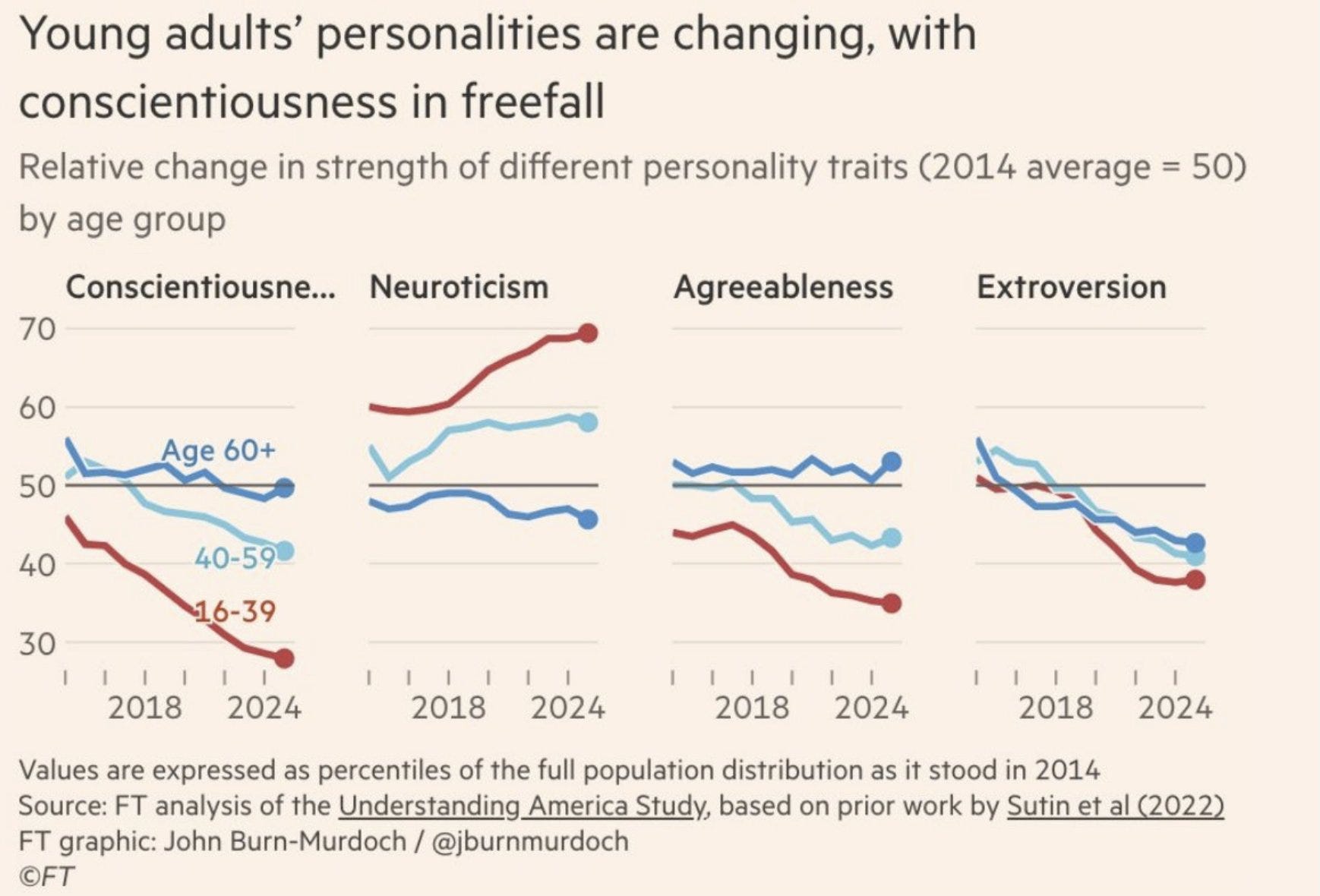
Last week, John Burn-Murdoch shared a report that American personalities were in flux. Conscientiousness (the personality trait that describes industriousness, goal orientation, and motivation) has been dropping since the pandemic years of 2020. At the same time, neuroticism (the personality trait that describes how much stress and pain a person can handle in relationship to sadness, depression, self-condemnation, anxiety, and fear) is increasing. That’s bad news according to the data-science psychology types, because the most successful people in life tend to be those who have high conscientiousness and low neuroticism. Our personalities, he worries, are starting to work against our better selves, an especially startling trend since the data shows the most change happening in adults 40 and under. His short article, with all the appropriate links and sources cited, can be read here. A sampling:
Studies consistently find that traits such as conscientiousness (the quality of being dependable and disciplined), emotional stability or agreeableness have a stronger link with professional success, relationship durability and longevity than the links between those outcomes and someone’s intelligence or socio-economic background.
Of all personality types, conscientious people tend to fare best on a number of key measures. They live the longest, have the most career success and are less likely to go through divorce. They even manage to hold down a job during recessions. Intuitively, this makes sense. Life isn’t just about knowing what you should do, or having the resources to do it, it’s about following through. Being motivated and persistent is a huge help.
Some studies suggest the advantage of conscientiousness is growing over time, and it’s easy to imagine why. When contemporary daily life is full of temptations — from always-on mobile internet and the lures of social media and online gambling, to hyper-palatable foods — the ability to ignore it all and put long-term wellbeing ahead of short-term kicks becomes a superpower. […]
All this makes it disconcerting that levels of conscientiousness in the population appear to be in decline. Extending a pioneering 2022 US study which identified early signs of a drop during the pandemic, I found a sustained erosion of conscientiousness, with the fall especially pronounced among young adults.
1b. Yes, smartphones and streaming and distraction, but also … talking with Burn-Murdoch on his Plain English podcast, Derek Thompson suggests there are other cultural trends that may be at work as well, including the rise of atomized exercise culture. As he wrote on his Substack last week, Americans have become obsessed with exercise, but group classes like Soul Cycle and Barre are being replaced by solitary activities like home workouts, YouTube yoga, and running or garage gyms.
This is partly about young people health-maxing in an age of declining social connection. Several weeks ago, I had a fascinating conversation with Emily Sundberg about how young people today consider an early-morning workout more high status than a late-night party. Indeed, I think being a young person today involves less social fitness and more physical fitness. Compared to previous generations, Gen Z has fewer parties, and more jogs; less hanging out, and more yoga; less hooking up, and less alcohol. They’re health-maxing in a way historically unique, at the same time that their withdrawal from physical social connection is similarly without precedent. As I’ve said many times, I think exercise is pretty much the greatest behavioral intervention ever, and I’m never going to suggest that the rise of fitness culture is a bad thing. But when I look at a graph like this, I cannot help but think that young people today need to think about the costs of both chronic disease and chronic solitude.
The exception, of course, is pickleball, but that’s an outlier. Thompson rightly explores this chicken/egg question: are we working out alone because we’re more neurotic and less social and less conscientious, or are we more neurotic and less social and less conscientious because we’re working out alone? It’s an extension of what Thompson wrote about last January (covered masterfully on our site by Grace and Cali), where social changes like takeout dining, streaming services, and remote work have made Americans more isolated than any civilization in history. But are we ordering takeout because we’re more neurotic, or is our antisocial takeout habit making us more neurotic?
1c. Olga Khazan writes on her Substack that the problem may have a different “first cause”: a crisis of meaning and purpose, a “first thing” of sorts that undercuts the chicken and egg problem that Thompson explores. Why do people work hard? How do people become conscientious? Since Khazan’s latest book is about changing our personality, she has fresh data on the question:
In my reporting on conscientiousness, I talked to lots of people who never felt conscientious until they had a dream, a desire, or a big idea. One wanted to start a business. One wanted to go to grad school. One wanted to lose a bunch of weight. These folks had never run a company, written a paper, or worked out before, respectively, but this vision of what they could accomplish ignited something within them and made them very, very persistent toward that goal. They figured out how to make the Google calendar. They learned MLA format. They got down to the gym — and so forth. They became conscientious, because they had something to be conscientious for.
In order to be conscientious, in other words, you have to have something you want. You are not going to independently write a long research paper if there is literally no hope of you ever becoming a tenured academic, which was that one particular guy’s dream. You aren’t going to drag ass to the gym if there’s no way you would ever lose one pound.
It all makes me think about our own Todd Brewer’s excellent reflection this week on the “underdeveloped morality” of the New Testament, and how Paul was careful to structure his ethics in the broadest terms possible to make room for the work of the Holy Spirit. It is good to be conscientious, but we are left with the question as to how people become conscientious. Todd and Olga Khazan are both right that it comes from an inner heart transformation, an affection, a desire, a Freudian “libido,” that is as varied as our fingerprints and fueled by a certain spirit (or The Spirit).
We may not, then, solve the “conscientious crisis” by finger-wagging, shame, or becoming grouchy about “the kids these days.” It’s no good making Gen Z out to be the neurotic generation, just like it wasn’t helpful to label millennials as the “Avocado Toast” generation. Conscientiousness is a consequence, which means the problem is spiritual. If young adults have imbibed the messaging that they’ll never, say, own a home or get married and have kids, or if they’ve concluded that AI will render their future career opportunities obsolete, or if they’re resigned to the fact that global warming is going to cook the planet, I can understand why they’d be a little more neurotic and less dutiful.
4. On to a spicier topic. I agree with Ellen Cushing, who is confused about the rise of painfully spicy food in America. Scoville units, the Hot Ones YouTube series, ridiculous pepper breeds with names like Dragon’s Breath and Carolina Reaper … spicy foods are in vogue in a way they weren’t a decade prior. It’s not my bag, but I want to understand more. After the obligatory stats and anecdotes, Cushing writes that there’s something more to the trend than taste alone.
In the 1970s, when he was studying spice in Oaxaca, [psychologist Paul] Rozin found that even children had learned to tolerate spice. When he offered the local pigs and dogs a choice, they picked bland food every time.
The dogs might be onto something. Then again, they don’t know about viral food challenges, or about the idea that your food choices reflect your identity, or how powerful it can feel to confront agony and swallow it whole. Mao Zedong is said to have suggested that anyone who couldn’t tolerate chiles couldn’t be a revolutionary; all over the world, and for centuries, spiciness has been something to conquer, and chiles have symbolized strength, bravery, national pride, and virility. America, it seems, is finally catching up. Self-taught superhot cultivators have spent the past decade trying to outdo themselves, crossbreeding progressively more infernal peppers with progressively more ridiculous names, ones like Death Spiral and Dragon’s Breath. (The Reaper isn’t even the world’s hottest anymore: That would be Pepper X, which has an average Scoville rating of above 2.6 million.) Rich and famous people with much, much better things to do are willingly humiliating themselves on Hot Ones, a web show that invites celebrities to eat hot wings while answering interview questions and that sold last year for $82.5 million.
Internet-facilitated food challenges have become both more common and more extreme. The extreme has, as it tends to do, seeped into everyday life. Blandness has become not just a culinary flaw but a moral failing, evidence of spinelessness and unsophistication. Being able to withstand spicy food, by contrast, is probably the most meaningless matter of personal preference people feel comfortable bragging about. (Think about it: Beyoncé would never sing about keeping ketchup in her bag.) The whole thing does feel very human: The impulse to defeat nature and find ever more extraordinary ways to test the limits of having a body, even if (especially if) it hurts a little. So we swill milk and cry in front of an audience of millions, or battle against our own biology at breakfast — just for the thrill, just because we can.
I’m reminded of the 2014 boredom study in which the majority of participants would rather have zapped themselves with a non-lethal shock than sit in an empty room alone with their thoughts. Or the Boys Who Wear Shorts All Winter, which is another sort of mild self-proving that one can withstand life’s sufferings. Cushing’s reflection that the rise of spicy food has to do more with identity curation and self-justification than taste seems accurate. When you have to sign a waiver to eat the food because of its potential physiological disruption to your health, we have left the world of the culinary arts into a realm where taste is secondary.
5. The back to school season brings back to school laughs, like McSweeney’s “Our Kids Will No Longer Be in the Same Class, So I Guess We’re Dead to Each Other Now”
It was beautiful witnessing our children’s blossoming friendship when they were in Miss Penny’s first-grade class — and by extension, our friendship too. That said, seeing as next year your kid will be in Mrs. Lang’s Second Grade Class, and mine in Mr. Dodd’s, I’m afraid it’s time to say goodbye, because we will never see each other ever again.
It’s not you, it’s me. But mostly, it’s my kid’s fault. They will forget who your child is when they’re not in each other’s faces every day. And I will now have to befriend some other kid’s parents. You and I will be like characters from Severance. As soon as second grade starts, we will not be capable of holding both first-grade and second-grade friends in our divided and weary minds.
Our kids, when together, did lots of pretending, but you and I are too old for illusions. Friendship is not, in fact, forever. It lasts approximately nine to ten months when you’re an adult with elementary school-aged children. And our bell has rung, and our time is up.
Other laughs this week: “Christian Rock Band Waiting Until Marriage to Write Songs About Sex” is a great headline (but the article falls a little flat, sayeth the writer, who was in a high school Christian rock garage band himself). “Novelty Nachos Helmet Works Way Into Regular Dishes Rotation” is a nostalgic nod to my childhood (and yours too if you were in a loving, working-class family).
6. Richard Beck has been on a tear, making the case for a reality-grounded “ontological” Christianity over the past few weeks. For the Christian faith to become grounded in a person’s life, argues Beck, it must soak down below the moral element of someone’s life, and even below the existential matters of life, into the reality of life itself. At time of writing, he’s on part 11 of his reflection, and you’d do well by yourself to start at part 1. But part 10 stood out for this reflection on the moralism of the ex-Christian activist:
There are many ex-Christian people who continue to embrace the role and mantle of social justice “prophet.” That these ex-Christians continue to embrace the Judeo-Christian ethic regarding concern for the oppressed shouldn’t be a surprise. Most ex-Christians reject Christianity on very Christian grounds. That is, in fact, one of their chief complaints, how Christians are not very Christian.
Using the framework of this series, these ex-Christians continue to embrace the moral and political layer of Christianity. They don’t, generally, become Nietzschean or acolytes of Ayn Rand. As I said, their rejection of Christianity tends to be very moralized and politicized. What is making these people ex-Christian isn’t moral or political but their jettisoning of the ontological layer, a rejection of Christian metaphysics as being Real or True. The moral and political commitments related to social justice and creation care are retained, but dogmatic metaphysical convictions are rejected.
This, however, is an untenable situation. As I’ve put it, these are prophets who no longer believe in the Lord. Moral realism, the heart and soul of prophetic criticism, is incompatible with post-modernism. You can’t be dogmatic about your moral convictions while at the same time being undogmatic about the ontological truth behind those convictions. Prophets are not post-modernists. You can’t be a prophet and a nihilist at the same time. Simply put, if you want to speak truth to power you need to believe in truth. This isn’t rocket science.
All this is why I described the moral convictions of these ex-Christian prophets as “sentimental.” Since their moral convictions no longer reflect anything Real or True, given how Christian metaphysics has been deconstructed and rejected, prophetic outcry has been reduced to expressions of personal sentiment. Severed from the True, moral speech no longer traffics in obligating and universal duties but becomes an expression of your preferences. Where prophets once roared “Thus saith the Lord!” in the face of oppression and injustice, the best the ex-Christian prophet can offer is, “I’d rather you not do that.”
7. The last word this week comes from Stephen Freeman, whose reflection on prayer is as countercultural as it comes. Prayer, writes Freeman, is rooted in humility, while prayers for self-improvement or personal progress get us nowhere. It’s the self-emptying of prayer that reflects mostly the heart of Christ:
St. Paul says, “Have this mind among yourselves,” and then describes the self-emptying of Christ on the Cross (Philippians 2:5-11). This “self-emptying” mind is the hallmark of sanctity and is at the heart of what we describe as “humility.” It is the humble heart that pleases God, we are told, whereas, God “resists the proud” (James 4:6). And it is at this particular juncture that modernity and its drive for progress are unmasked.
“I want to be a better man,” sounds like the words of a saint’s heart. But the opposite is true. St. Paul was such a “better man” when he was a Pharisee that he later described himself as “blameless.” That blameless Pharisee, strangely, had made himself the enemy of God.
It is the same St. Paul who writes with such eloquence and care about our weakness and sin. I have written previously that we are only saved “in our weakness.” Christ has not come to save the righteous – only sinners. By the same token, we are not saved through our excellence, nor our mastery of life. Those who imagine their life as a striving for progress and excellence risk making themselves the enemies of God. Fortunately, most of us are unable to be excellent, though our failure often only leads to despair rather than God. […]
St. James’ observation could easily be limited to those examples that seem obvious: greedy prayer gets nowhere. But his principle runs much more deeply. We will not be saved by getting what we want. The only creatures in the universe who get what they want are demons – indeed, they have largely become nothing more than a “wanting”: their rationality has almost completely disappeared.
True prayer is a movement into ever greater self-emptying. It is the normative means of our daily union with Christ. Like Christ, it broods over the lost and those who are in bondage. True prayer willingly enters with Him into Hades (both literally and figuratively) to intercede for those who are held captive. St. Paul even willed that he himself be damned if it would mean the salvation of Israel. That is the heart of Christ.
No doubt, our modern world will continue to “make progress,” at least in its own mind. But those who adopt that mind for their Christian worldview will find themselves frustrated at every turn.
Strays:
- Matt Milliner makes the case that Julian of Norwich is for everyone, regardless of political tradition. An excellent read if you’re flirting with capital “O” Orthodoxy, concerned about the longevity of Protestantism, or interested in someone beating Luther to the idea of imputation.
- Whenever a pastor has been at it for 30 years and they offer wisdom and advice, I make it a habit to perk up and take notice. Doubly so when that pastor is Russell Moore.
- A short primer on one of my favorite Reformation figures, Martin Bucer, from Amy Mantravadi.