




1. The day has finally arrived. After several threats to ban the beloved short-form video app TikTok, the U.S. government may finally get their wish should the Supreme Court vote in their favor. If the ban goes through, will Gen Z finally get their attention span back? Will the terrifying spread of misinformation slow down? The answer to both is a resounding “no.” After all, TikTok copycats like Instagram Reels and YouTube Shorts will still exist. Not to mention Mark Zuckerberg’s decision to stop Meta’s fact-checking system — instead relying on its users to correct misinformation.
Charlie Warzel and Mike Caulfield in the Atlantic examine the broken world of the Internet with its algorithmic filter bubbles that function as, what they call, “a justification machine”:
Lately, our independent work has coalesced around a particular shared idea: that misinformation is powerful, not because it changes minds, but because it allows people to maintain their beliefs in light of growing evidence to the contrary. The internet may function not so much as a brainwashing engine but as a justification machine. A rationale is always just a scroll or a click away, and the incentives of the modern attention economy—people are rewarded with engagement and greater influence the more their audience responds to what they’re saying — means that there will always be a rush to provide one. This dynamic plays into a natural tendency that humans have to be evidence foragers, to seek information that supports one’s beliefs or undermines the arguments against them. Finding such information (or large groups of people who eagerly propagate it) has not always been so easy. Evidence foraging might historically have meant digging into a subject, testing arguments, or relying on genuine expertise. That was the foundation on which most of our politics, culture, and arguing was built.
The current internet — a mature ecosystem with widespread access and ease of self-publishing—undoes that. […]
Confronted with information that could shake their worldviews, people can now search for confirming evidence and mainline conspiracist feeds or decontextualized videos. They can ask AI and their favorite influencers to tell them why they are right. They can build tailored feeds and watch as algorithms deliver what they’re looking for. And they will be overwhelmed with data.
The hum of the justification machine is comforting. It makes the world seem less unpredictable, more knowable. Underneath the noise, you can make out the words “You’ve been right all along.”
When writing persuasive essays in grade school, it wasn’t enough to reinforce your claim with three points of evidence. A good persuasive essay involved acknowledgement of and research for the counterarguments. Of course, scrolling on social media is not the same as crafting a persuasive essay. The internet is always evolving at a rapid pace — what was once trendy became cringey, what was once the hot topic of dinner conversation became last week’s news.
But what would happen if we consumed media with more care? What if we took the time to read all the facts and consider both sides of the coin? Perhaps we’d discover that our differences aren’t as polarized as we’ve been led to believe.
2. The epidemic of loneliness is not a new concept — Surgeon General Vivek Murthy published an advisory about it in 2023, the UK appointed a minister for loneliness in 2018, and Japan did the same in 2021. We’ve also covered it plenty on the site. But Derek Thompson, for the Atlantic, takes it a step further:
Self-imposed solitude might just be the most important social fact of the 21st century in America. Perhaps unsurprisingly, many observers have reduced this phenomenon to the topic of loneliness […]
But solitude and loneliness are not one and the same. “It is actually a very healthy emotional response to feel some loneliness,” the NYU sociologist Eric Klinenberg told me. “That cue is the thing that pushes you off the couch and into face-to-face interaction.” The real problem here, the nature of America’s social crisis, is that most Americans don’t seem to be reacting to the biological cue to spend more time with other people. Their solitude levels are surging while many measures of loneliness are actually flat or dropping. A 2021 study of the widely used UCLA Loneliness Scale concluded that “the frequently used term ‘loneliness epidemic’ seems exaggerated.” Although young people are lonelier than they once were, there is little evidence that loneliness is rising more broadly today. A 2023 Gallup survey found that the share of Americans who said they experienced loneliness “a lot of the day yesterday” declined by roughly one-third from 2021 to 2023, even as alone time, by Atalay’s calculation, rose slightly.
What is responsible for this shift? Thompson answers:
Day to day, hour to hour, we are choosing this way of life—its comforts, its ready entertainments. But convenience can be a curse. Our habits are creating what Atalay has called a “century of solitude.” This is the anti-social century.
Over the past few months, I’ve spoken with psychologists, political scientists, sociologists, and technologists about America’s anti-social streak. Although the particulars of these conversations differed, a theme emerged: The individual preference for solitude, scaled up across society and exercised repeatedly over time, is rewiring America’s civic and psychic identity. And the consequences are far-reaching — for our happiness, our communities, our politics, and even our understanding of reality.
The more convenient it becomes to communicate with people online the more susceptible we can become to isolation. This false sense of connection created through texting, DMs, chat rooms, and dating apps is replacing real in-person connection. The stakes are much lower when looking at words on a screen rather than the expressions on someone’s face.
One might prefer solitude to avoid having to deal with a myriad of feelings (rejection, embarrassment, frustration, disruption, etc.), but any comforts they may have gained in their time alone do not account for the loss of emotional connection.
3. This next one may spark some different feelings amongst readers, but I found it fascinating. In her Substack, Anne Helen Petersen interviews Dana Miranda, author of You Don’t Need a Budget. You’ve heard of diet culture and wellness culture, but have you ever heard of budget culture? If you’ve ever had to pay off student loans, save up for a security deposit, or (not for Gen Z, ha) pay off a mortgage, perhaps you know the term “budget” all too well. Maybe you’re really good at saving money by couponing and putting your leftover change in a jar for emergencies, or maybe your dire need for retail therapy curtails your well-intentioned money plans — either way, all of us have to deal with money at some point or another.
Miranda makes the case against budget culture, and her reasoning makes a lot of anthropological sense:
Budget culture steps into this environment, defines a “right” set of goals, creates a set of rules, and tells you you can reach those goals if you follow those rules. Just like the promises of fad diets, the latest relationship advice, or the one bad company you can avoid to stop from destroying the planet, there’s an enormous appeal to finding the one right way to do anything. It can briefly quiet the noise of all the uncertainty our messy culture causes.
What I hear from people who insist on budgeting is that it makes them feel in control. A budget gives you a simple set of rules that promises to address the huge problems of capitalism, inequality and financial insecurity in your life, and you finally feel like you know the next step to take…
But budgeting and budget culture are actually ways of being controlled through self-monitoring, the judgment from people around you and the apps you use to measure your behavior.
Bryan Jarrell, for Mbird a few years back, brought up a good point: “Budgeting culture, likewise, puts the blame for poverty squarely on the behaviors of the poor, with little consideration for uncontrollable life circumstances. Like diet culture, budget culture trades in judgment, making even the most mundane of expenses a cause for guilt or anxiety.” As with most things, debt (albeit avoidable or unavoidable) tends to be moralized — it doesn’t look nor feel good to be in need of help, to recognize our dependence. Miranda explores the consequences of this moralization:
With everything — but money in particular — our culture trains us to believe we never have what we need, and there’s not enough to go around. Our culture’s focus on individuality and individual responsibility makes it hard to be generous and easy to ignore someone else’s need. Advice for “responsible” money management is focused on hoarding what you can, worrying about finding the next dollar and taking precautions to avoid losing everything you have.
There’s no room for generosity in that mindset, because it convinces you that you inevitably get less when someone else gets more.
4. A slow week for humor, but at least it’s a reprieve from money talk. In light of Instagram’s new privacy settings for teens, here’s the New Yorker‘s “App Privacy Updates For Teens,”
Teen Instagram: Parents can rest assured that the new security features won’t interfere with your child’s secret Snapchat account.
Teen Astrology Zone: Vulnerable, lovelorn teens will no longer have access to sensitive content, such as astrological charts confirming that their crush is a Scorpio.
Teen LinkedIn: Children under the age of seventeen can apply for jobs, expand their professional network, and get a head start at grinding their teeth at night.
For when reality fails to meet your expectations, here’s Points in Case, “I Waited in Line for 11 Years and That Cronut Just Wasn’t Worth It,”
My time came at last. The tiny bell on the door heralded my arrival. I trudged to the counter and dumped a pile of rumpled bills and change onto the counter. Before I knew it, the bag was in my hand and I fled with my prize. I secreted myself to a trash-strewn alley and opened the bag, inhaling the intensely sweet aroma of my warm Cronut. This was it: The moment I had waited over a decade for. I had given up everything for this. I took a bite, chewing slowly with my remaining teeth […]
And it was okay. It was basically a puffy doughnut. This icing was sort of sliding off, likely because it was applied when the Cronut was still too warm. It was smaller than it had looked in the pictures I’d seen, and flatter, too—maybe the delicate matrix of interior dough had collapsed some? I admit it’s possible I may have built it up in my mind just a bit.
And lastly in humor, here’s a New Yorker comic that transitions perfectly into the next article:
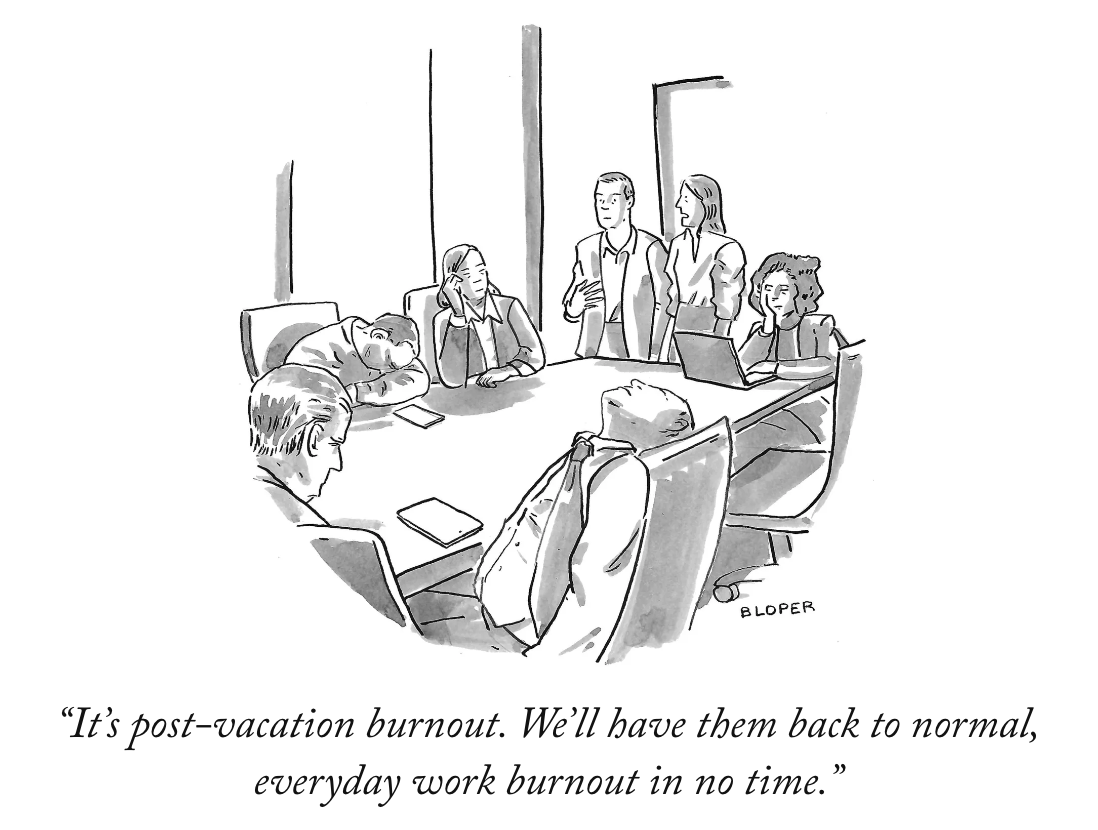
5. On the subject of burnout, it’s hard to pick just one quote from Ezra Klein’s most recent interview with Oliver Burkeman. Let’s start with what Burkeman has to say about modern conveniences and control:
We do live in a time when there is an expectation that life should be manageable in that way. There is also the promise in technology that we’re sort of almost there — that with one last heave of self-discipline — combined with the right set of apps and the right outsourced services that handle our food delivery or our D.I.Y. around the house — we could finally cross that gap.
Go back to the medieval period, when people would have lived in this situation of completely endemic uncertainty. I don’t think it’s necessarily true that they didn’t find the opportunity to be happy. I think the crucial distinction is that they wouldn’t have postponed that until they felt in control. They wouldn’t have said, “Before we can have a festival, before we can sit back and look at the stars, we have to know what we’re doing here and feel in charge and in control of things” — just exactly because that possibility of being in control of things, for most people anyway, was so remote.
So I think the closer it feels like we’re getting to being in charge of life, the more tormenting and dispiriting it gets that we still aren’t.
Burkeman eventually defines what he calls the “productivity debt”:
[Klein] Tell me about the idea of productivity debt.
[Burkeman] I stumbled across this concept and found that it resonated a lot with my audience. I define this as the feeling that so many of us have when we wake up in the morning feeling like we have to output a certain amount of work in order to justify our existence on the planet.
As with paying off a financial debt, the very best thing that could happen if the day goes really well is that you end up at zero again — before the next day, when it all starts again and you wake up in a new productivity debt.
And just to head off an obvious objection, anyone who works for money is in a kind of productivity debt to whoever pays them. But I’m really trying to pinpoint this existential sense that if you don’t do a certain amount, you don’t quite deserve to be here.
And there are lots of causes we could look at here. The Protestant work ethic — the idea that there’s something inherently virtuous in hard work — is relevant here.
But that’s a really powerful thought — that we go through the day in deficit. And our best hope is to get to the end of the day exhausted and be like: OK, I just about earned the right to be here for one more day.
If the productivity debt wasn’t enough to make us feel behind, look no further than the popular idiom “Seize the Day”:
I think there’s a certain kind of clichéd version of memento mori in the culture that says that life is very short, so you’ve therefore got to cram every minute of every day with being as impressive or unusual or generally high-octane as you possibly can.
And I don’t think that’s the point. I think the point is that when you really begin to let it permeate you that we are of the nature to be finite, you get to exhale. You get to let your shoulders drop. Not in order to veg out but precisely to move forward to do the most meaningful things with your day. It’s a refocusing. […]
All sorts of meaningful and ultimately very joyous experiences of life are kind of uncomfortable to let ourselves fall into, because they involve accepting our limited nature, our vulnerability to distressing emotions. We have to just be present and ready for whatever might happen.
6. To close, Herman Mendoza shares his testimony in Christianity Today. Mendoza, who got involved in drug trafficking at an early age, found God in a prison chapel:
As the months passed, I grew increasingly depressed. My wife had left me, my friends had abandoned me, and I was desperate for a way out. But Emilio refused to let me wallow in self-pity. One night, he said, “Come to the service with me. God can help you through this.”
I shrugged. I needed help from something or someone. Why not God? I had once trusted God, however imperfectly, to get me out of jail. Even though I had strayed far from him since then, maybe this time he could do something about the ache inside me that wouldn’t go away.
And so I found myself in the prison chapel once again.
The preacher explained that whatever had landed us in prison was a result of sin and that God wanted to give us peace and salvation. He quoted Romans 5:8: “God demonstrates his own love for us in this: While we were still sinners, Christ died for us.” He said, “Christ wants to meet you right now.”
It was as if his words were meant just for me. I couldn’t help but reflect on all the things I had done or experienced in my life and where they had led me—prison, literally and figuratively. Even if I escaped from prison, I could never escape the prison of my past. Just as that thought formed in my mind, the preacher said, “God has a way out for you.”
My heart pounded hard in my chest. Did God tell him to say that?
The preacher continued, “God wants you to know that he can fill that void. Christ can make you a new person.” The fog cleared in my mind. When the preacher invited us to come and pray, I walked to the front of the chapel and fell to my knees, sobbing.
The weight of my sins and their far-reaching consequences hit me. I thought about all the people I had wronged, the lives wrecked by addiction, my broken family. I said, “God, forgive me.” As the words tumbled out, a warmth enveloped me. It felt as if God had physically reached inside me, taking out all the guilt and shame, all the dark deeds, and filled that space with light. He had answered my prayers and saved me when I least deserved it.
Strays:








[…] extension of what Thompson wrote about last January (covered masterfully on our site by Grace and Cali), where social changes like takeout dining, streaming services, and remote work have made Americans […]