1. I’m going to start with a trip down memory lane that includes the hottest daytime hosts of the ’90s: Geraldo Rivera, Phil Donahue, Maury Povich, red-rimmed Sally Jessy Raphael (she read like a church lady and was my fav), and Ricki Lake. For The Hedgehog Review, John Rosenthal offers a full-throated defense of their shows. His fav: Jenny Jones.
Unlike Geraldo Rivera and Sally Jessy Raphael, TV veterans who treated their guests with a creepy journalistic curiosity, Jenny, like a hostess at a party for social misfits, found amusement in her guests’ problems and eccentricities. She didn’t seem to be above them. Critics mistook this familiarity as a flaw, as if Jenny’s show wasn’t serious enough. But in defense of the lighter touch, I should note that Jenny never condescended to her guests, or treated them as damaged goods, or, even worse, intriguing specimens. Geraldo, with his law degree from Brooklyn Law School, most assuredly didn’t want to be seen as a barker selling glimpses of “Men in Lace Panties” — but that’s exactly what he was.
If Jenny’s rapport with her guests was easy and familiar, if she rarely wore a concerned look, the reason wasn’t mysterious: Jenny was a creation of show business. She had no experience in broadcasting or journalism. No college degree. Not even a high school degree. She wasn’t even [actually named] Jenny Jones.
You may be tempted to dismiss these shows as trash — guilty pleasure programs that no one dared to admit watching. You wouldn’t be alone. This was the era of Jerry Falwell’s moral majority, and in October 1995, Democratic Senator Joe Lieberman and Republican William Bennett held a bipartisan press conference condemning the frivolity and rampant sexuality of daytime tabloid talk shows where “indecent exposure is celebrated as a virtue.”
Bennett and Lieberman styled themselves defenders of the civilized world, but they were, at heart, East Coast snobs of the Yale-Harvard variety. Tabloid TV wasn’t tailored to the sensibilities of the educated elite but to the Midwest’s large working class, who preferred the drama of confrontation (upset people yelling) to Letterman’s cool detachment or the ironic nihilism of Seinfeld. […]
By the early 2000s, tabloid talk shows began to lose ground to reality TV. These new shows offered tense, mostly unscripted drama with the voyeuristic spectacle of an unraveling — now with prize money.
But something else was happening. After 9/11, as terrorists began to haunt the national imagination, America grew less inclined to openly ridicule. A new wellness movement arrived, ushering in reams of self-help books and a new TV paradigm led by Oprah and Dr. Phil: the tabloid talk show as therapeutic theater. Guests were no longer ridiculed; they were to be understood by pop psychologists like Dr. Phil. Instead of caricatures — men in diapers, obstreperous moms in hot pants — guests were framed as survivors of human misfortune: domestic violence, child abuse, addiction, cancer, OCD, even medical malpractice. Dr. Phil and Oprah didn’t look frivolous like Jenny or smarmy like Geraldo, but their lavish sincerity was engineered to sell products.
Where am I going with this? The Jenny Jones Show is a quintessential artifact of low culture, of which Mockingbird tends to have a high(ish) view, because of our #LowAnthropology. I didn’t watch Jenny Jones just out of voyeurism, though there was some of that, but because deep down I saw a little bit of myself in her motley crew of characters. Far from respectable in the classic sense, they were confused, lonely, grieving, foolish, and ridiculous. Very often, that which we condemn out of our own snobbery is that which we are tempted to ourselves become.
The need to ridicule may change its shape over time, but it never disappears. Call it the tabloid spirit. To Plautus, the Roman satirist, the Other consisted of scolding women, effeminate foreigners, and supercilious old men. To Jenny’s producers, it was rebellious teens, embarrassing boyfriends, and cross-dressers. Nothing new. Both ridicule the Other as a means of upholding the status quo, which, to our consternation, is always in the process of becoming a new status quo. Even though Dr. Phil and Oprah diluted trash TV under the guise of “healing,” the shaming instinct (the scarlet letter) never vanished. It just held its breath. […]
It’s easy to dismiss tabloid TV as lowbrow entertainment, and yet its jeering note found an echo in the tone of progressive ideology. Wokeness, impervious to nuance, claimed the high ground, but its very name insulted those it intended to wake. As it turned out, the unwoke, who, electorally, were non-college voters, didn’t welcome the news that their everyday speech was offensive and their lives were defined by “cis” privilege. They felt insulted. Looked down upon. That is a fundamental mistake righteous reformers make, a paradox born of moral urgency, for which a terrible price is usually paid.
Enter our present social and political moment of backlash. You can hate these sorts of talk shows and still be suspicious of your contempt for the people who feature on them. It’s tempting to ridicule Mike the Mophead, but who’s laughing when you can’t get out of bed for days after some tragedy strikes? We’re all the brunt of someone else’s joke at some point in our lives. So maybe there was a little bit of Jesus in the unflappability of Jenny Jones? After all, the savior of the world doesn’t sensationalize our sinfulness, he redeems it.
2. Attention is a flimsy thing. This next piece from LitHub is an adaption of David Pakman’s forthcoming book, Pay Attention: How the Algorithms and Media Wars Are Suppressing Truth and Rewiring Your Brain. It could’ve been written ten years ago, but it was written two days ago and it’s still relevant. Pakman starts his lament by recalling a trip to the Louvre where he, like many, was shocked by the tiny size of the Mona Lisa. Not only that, he was bummed out that onlookers were more preoccupied with being photographed in front of da Vinci’s masterpiece than they were in seeing it.
In that crowded gallery, I saw an entire room of people trading the thing itself for the image of the thing, convinced that the capture was more valuable than the contact. The experience had already been translated into something shareable before it was fully experienced.
The moment you become visible, the reflection starts talking back.
One could argue that the camera is simply recording the moment, but the truth is that the camera is redefining the purpose of the moment.
This pattern repeats everywhere. At concerts, the front rows glow with raised screens. Fans watch the performance through their cameras, checking their framing while the musician performs, sometimes as close as only a few feet away. At scenic overlooks, people turn their backs to the landscape to stage a selfie photograph. At restaurants, plates grow cold while lighting is adjusted and angles are tested. At children’s school performances, parents watch their child through a phone screen even though the child is directly in front of them partaking in an event that will only happen once.
The common thread is that these behaviors are more about verification than they are about documentation. The experience feels incomplete until it exists in a form that others can observe.
Presence alone is no longer enough. The moment must be seen in order to count.
As children we all perform our lives as if we have an audience, but these days that tendency has extended well into adulthood. Thousands of personalities on YouTube film themselves doing the most ordinary tasks. In a moment of distraction earlier this week, I watched one of the self-styled creators take out her recycling. In a world of online documentation and performativity, we don’t take the family vacation; we produce evidence that the vacation was a dream. And we don’t simply hold an opinion; we begin imagining if the opinion will be corroborated or contended in little psychological courtrooms of our devising — on X.
Human beings have always adjusted their behavior when they feel observed. […]
Digital life has turned this psychological tendency into a permanent condition. The audience has become a continuous presence. It exists not only in front of you but inside your imagination. You begin to carry the audience in your mind.
Sociologist Charles Horton Cooley described something he called the “looking glass self”; the idea that we form our identity by imagining how others see us. We picture their judgment, interpret their reaction, and adjust ourselves accordingly. Social platforms have industrialized this process by providing constant signals about how others respond to us. Identity becomes a feedback loop. […]
You begin to perform the version of yourself that performs best.
So why does Pakman see this as problematic?
Over time they become a character in the imagination of their audience. They perform that character because the performance receives validation. A complex self becomes a simplified projection because simplicity travels more easily across networks designed for speed.
The result resembles a translation from three dimensions into two. A living, evolving individual becomes a flattened version of themselves that fits neatly within a screen. This is the beginning of capture. The audience ceases to be a destination for your voice and becomes the structure that shapes it. Expression gives way to expectation. Exploration gives way to repetition. Eventually you are speaking as the audience, representing what the audience “would want,” rather than speaking to the audience.
Whole industries are propelled in the universe of “looking glass selves.” If your “self” is compressed in order that your audience might know (and love) you, what self is left for God to know (and love)? And how does the feedback loop of sanctification interrupt the feedback loop of “rates, reviews, and subscribes?” What happens when the imagined gaze of the audience occludes our awareness of God’s omniscience? How is actual need — not performed need — met with grace?
I don’t have any answers, but I take consolation in the message we’ll preach until we’re blue in the face: God sees us, God loves us, and our worth is not based on our performance. You can turn the ring light off for a bit.
3. Over at Slate, Rebecca Onion absolutely whoopie-pie-pans Andrew Huberman’s new 540-page book, Protocols: An Operating Manual for the Human Body. Like Onion, you may occasionally listen to Huberman’s podcast — and even decide to pick up this book — because you’re interested in feeling better, living longer, and keeping your hair.
Don’t bother, she says. Spare yourself the guilt and shame.
Divided into the seven not-entirely-intuitive categories of sleep; exercise; stress control; nutrition; light; focus, motivation, and learning; and personal growth — [the book] can provoke a frenzied feeling of insufficiency, an unhealthy fixation on getting everything right. Lying awake in bed a few nights ago, after hacking my way through a couple hundred Huberpages, I did the opposite of what the only helpful insomnia advice I’ve ever read tells you to do: I panicked and blamed myself.
Huberman’s proposition, familiar to his many, many fans, is that “science,” well applied, can help you optimize your meatsuit for the highest possible performance […] What Huberman’s worldview proposes is that motivated people can take small actions to relieve themselves of these endemic problems of middle age. What it implies is that if you don’t, you kind of deserve what you get.
I often wonder what my social media feeds and podcast streams would look like if “self as project” was a fad that had long passed. But it’s just so lucrative! And of course it is because, as far as Onion can tell, it makes us more productive employees. What does Huberman think people need to be at their best for? WORK.
Huberman treats people and their bodies as something that can be optimized through knowledge and discipline. If we can just know enough about our bodies, brains, habits, hormones, and nervous system, then we can become the people we want to be. This kind of advice puts people on a treadmill they can never step off of. Even if you’re relieved of your back pain, you can’t be relieved of the awareness that your back pain, baldness, and sleepless nights are somehow entirely your fault and within your power to overcome. Sometimes I wonder if the Church of Scientology feels like these folks are encroaching on their mission, or if they’re pleased that their creed of unlimited human potential, spiritual awareness, and self-betterment is more mainstream than ever.
4. In a breezy piece at the Atlantic, theoretical physicist and podcast-less writer Carlo Rovelli contends that science itself — specifically physics — proves that knowledge can never be complete and wholly transformative. That is a myth. If Huberman is an ever-optimistic (and buff) mind of the post-Enlightenment period, Rovelli reminds us that our physical reality is full of questions without answers and problems without solutions.
Humanity has always been aware that our understanding is partial and biased. But the fact that an objective and knowable reality is incompatible with the grammar of physics is astonishing. […]
This means that all of our knowledge is intrinsically uncertain. All statements have unavoidable margins of uncertainty. Indeed, we can be wrong about anything, even the basic facts of our own lives […] Humanity has been collectively wrong over and over again. We thought the sun moved around the earth, then learned that it is the earth that orbits the sun. Great scientists are even more likely to be wrong than others, because they have the courage to try — Einstein’s published work includes many mistakes. […]
Recognizing the perspectival aspect of knowledge, values, and beliefs, and of reality itself, could help us become a bit less arrogant, a bit humbler and wiser. Conflicts between individuals or countries don’t stem only from greed and thirst for power. They are also fueled by the belief that we are objectively right and the enemy is objectively wrong, which ignores the plurality of perspectives. We have our values that guide us, but understanding the perspective of others is the first step toward wisdom — and toward peace.
You can see the sharp contrast between someone like Huberman and someone like Rovelli. Expecting knowledge to be salvific is a tall order.
5. Okay, just a little bit more about self-optimization, the attention economy, and contemporary loneliness, please? Stopping soon.
When I was a single twentysomething and then single thirtysomething gal living in NYC, I remember my girlfriends and I sipping dry martinis and hypothesizing that we’d have better chances of meeting someone if we moved to Denver, West Virginia, or Silicon Valley (not even tech bros were beyond the pale). But we didn’t want to move. We loved our lives, and so just as any NYer would, we worked harder at being datable. Maybe we needed to work out more, read better books, focus less on looking interesting and more on looking beautiful (real advice I got from a married friend). Whatever our current fate, it was ours to fix. And we tried. Boy did we try and try and try.
Rikki Schlott, a 26-year-old from New York and author of an upcoming book on modern dating, Nothing Serious, has interviewed dozens of young adults in her city. She described New York to me as “a magnet for the most ambitious, striving young people from across the country and the world.” But because they apply the same attitude to their dating lives, “in our age of dating apps and situationships, that cutthroat attitude is on steroids.”
Schlott believes that “perhaps nowhere in the world are there so many eligible singles so paralyzed by their own striving. It’s almost as though they’ve forgotten love is a mutual experience rather than a competition.” Of course, not everyone wants to get married young, and some might move to big cities because they want to prioritize work. But there are others who might have wanted to settle down, but aren’t looking for love because so few around them are.
After a few brutal years living through the pandemic, when I was nearing spinster territory (as my dad said), I stopped trying for a little bit, moved to a new city, and met my husband. Apparently this happens. And the Institute for Family Studies (who desperately want us to be married and having kids, a little too much, to be honest) have confirmed that this is not that unusual. Here they’ve launched, as pointed out by Freya India in The Free Press,
a new interactive Marriage Map of where adults between the ages of 22 to 39 are getting married in the United States. It shows that young adults do face different odds depending on where they live. For example, among those who want to get married at a younger age, defined as 22 to 29, the highest marriage rates are in Utah, Kansas, Nebraska, Tennessee, and Kentucky. The lowest are in big coastal cities like New York City and Los Angeles, where marriage rates rise only later, among adults in their 30s.
If geography matters as much as these statistics indicate, why, India wonders, are young people encouraged to work so hard on becoming the best possible mates?
I wonder, then, why singles are so often told to focus on themselves, on fixing what’s wrong with them. We know that location matters — putting yourself in proximity to the kind of person you are looking for is standard dating advice. […]
But many young adults, especially young men, are beating themselves up for what may be a brutal dating market: places where women are out-earning men and have higher expectations, where options are so endless it feels irrational not to keep them open, where nobody even talks about marriage in their 20s, let alone plans for it. […]
All of this makes me wonder why we never tell young adults to plan more for marriage. Both men and women are encouraged to obsessively optimize themselves for work and education and to be productive — to organize their lives around where the best career opportunities are. When moving somewhere new, we consider the job market, the salaries, the networking opportunities — but marriage rates never come to mind.
Moving somewhere with better career prospects is ambitious and a smart decision, but moving somewhere with better marriage prospects seems like madness, a desperate gamble.
So if you’re struggling with your singleness, know that it is not a lovability litmus test. Your romantic circumstances are not a gauge of your worth — you may just live in a place that leaves you feeling that way. There is nothing wrong with you. I mean, everything is wrong with you, but everything is wrong with everyone. You may move. You may stay where you are, but God’s love knows no bounds.
6. Looking for a little grin at the end of a long week? Points in Case has a few good ones for you: “Probable Reasons They Haven’t Texted You Back,” followed by “I Am Your Password Security and I Am Not Insecure,” and “The Many Totally Obvious Translations of ‘Let’s Get Coffee.’”
If those have left you feeling insecure (me too), here’s a list of affirmations you can do in the office bathroom:
+ It is okay and valid that I am wearing very recognizable shoes that are visible from the stall gap, and therefore my coworkers can identify that the sounds are coming from me.
+ It is okay and valid that it takes me a lot of toilet paper.
+ My pee stream is not more powerful than the pee streams of others.
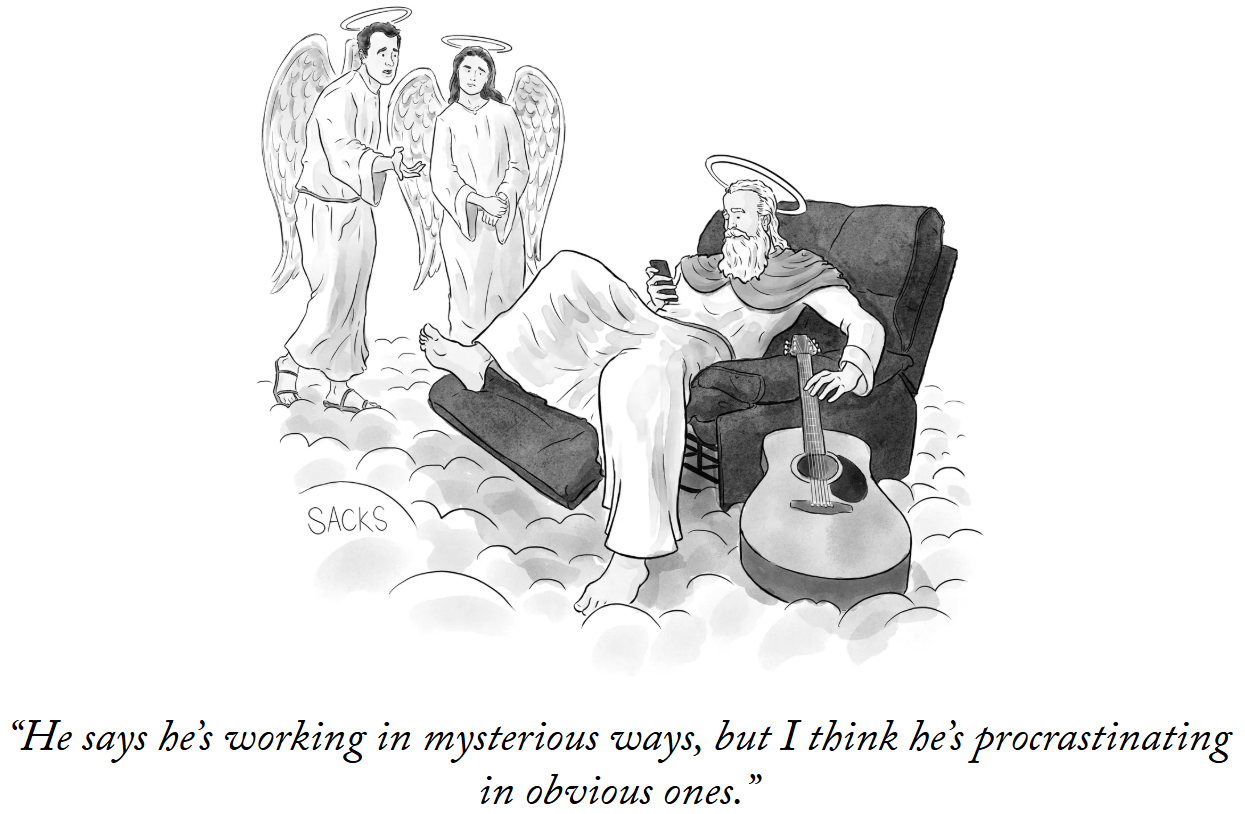
7. Let’s close up shop by checking in on part ten of Richard Beck’s multipart series on “nature and grace.” Parts one to nine have been their own adventure, but here Beck turns to a different question: Why did Jesus have to die on a cross? And while the route he takes to arrive there (criticizing atonement theories) won’t be everyone’s cup of tea, the answer he offers is characteristically thought-provoking (with a big assist from Jordan Hillebert’s book Henri de Lubac and the Drama of Human Existence):
Why is this hideous display necessary for what should have been a big warm hug?
The answer is the same one de Lubac articulated over against intrinsicist views of humanity. Humans are loved, but the reality of sin intrudes. Consequently, the cross is both mercy and indictment, compassion and crisis. We have been loved from the foundation of the world, but our journey toward God can only pass through the cross. The theophany of the cross is grievous because sin is grievous, and we are called to metanoia as we behold the tortured body of Jesus.
In short, as I recently described in this space, the cross is a bivalent symbol, a Stop and a Go. The Go is the communication of unconditional love, mercy, grace, and pardon. But if this Go were all that was communicated on the cross, it would collapse into what Dietrich Bonhoeffer called “cheap grace,” the gospel reduced to a message of affirmational niceness. But the cross also communicates a Stop, a message of prophetic indictment, where our sin is exposed and confronted and where we face the evangelical demand of conversion. Conversely, if the cross is reduced to the Stop, its message becomes a harsh, judgmental “sinners in the hands of an angry God” sermon.
Following de Lubac, the cross stands between intrinsicism and extrinsicism. All Go and no Stop becomes the cheap grace of intrinsicism, the gospel as a message of affirmation incapable of confronting sin. All Stop and no Go becomes the guilt-inducing damnation of extrinsicism, the gospel as a message of wrathful condemnation. In short, the vision of the atonement I try to articulate in The Book of Love attempts, as de Lubac did, to navigate between two false visions of the atonement — one progressive and the other conservative — to articulate something more complex, more paradoxical, and, I would argue, more truthful.
Or, to paraphrase in an entirely different theological register, the cross is both law and gospel, judgment and grace, God’s “No” and God’s “Yes.”
Strays:
- Alissa Wilkinson, reviewing the movie Your Mother Your Mother Your Mother for the New York Times, asks: Can we be forgiven for the worst things we have done? Does grace extend to our darkest hour?”
- Lily Meyer’s essay “An Ingredient That’s All Too Rare in Adult Life” makes a case for reveling in adult silliness. Not irony, or absurdity, or sarcasm — ideas adults understand and embrace like a second skin — but “unadulterated loopiness” of the bizarre and childlike variety.
- More than 500 influential stars, showrunners, and other notable names in the world of TV voted on the best series released since Jan. 1, 2000. See what they chose.
- “Fear-driven churches create three kinds of Christians“: believers that become scared of God, scared of outsiders, and scared of their own communities — but those aren’t the only options.