




Not too long ago, I was listening to the NPR program 1A, and I happened to hear two surprising expressions of faith. In the episode, host Jenn White asked listener-submitted questions to two seasoned NASA astronauts: Eileen Collins, the first woman to be a space shuttle pilot and commander, and Terry Virts, a former commander of the International Space Station. One of the questions she posed was this: “How have your experiences [in space] influenced your spiritual beliefs, if at all?”
Both astronauts said that their time in outer space had only strengthened their faith, but each for different reasons. Here’s an excerpt from Collins’ response:
I remember these beautiful passes of Earth … You look down at these cities and you say, God, there’s New York City. There’s eight million people living in that one little dot. And you can see that the Earth’s atmosphere is very, very thin … Then when you look in the other direction, you just see black. And you know, at this point, we have not found any other planets that can support life. It’s a little bit scary to realize, we’re on the surface of a ball … revolving around the sun, and that layer of air is all that’s keeping us alive. You can’t help but to reflect … There’s got to be a power greater than us that has made this tiny little oasis that we’re living on.
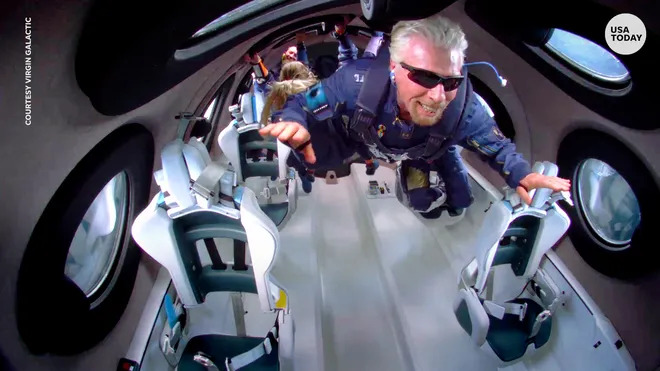
As inspiring as it is, this response seems to me to be the most natural one, the one most of us would have if we were looking down from hundreds of miles up in space at this extraordinary blue marble we inhabit: One cannot help but feel the specialness and preciousness of our world — our “tiny little oasis” amid the vast black deserts of space. It’s a vantage point that would presumably instill in most of us both enormous gratitude (hence faith) and a sense of responsibility to care for this world. We can only hope Jeff Bezos and Richard Branson feel that way.
But the other astronaut, Terry Virts, had a slightly different and perhaps more arresting response to being in space. Here’s some of what he said:
Every once in a while, you look out and you see this incredible universe that we have. There was this one moment on a spacewalk where I stopped for a second. I looked out and it just was overwhelming. It was like I was hearing from God … This is something that humans aren’t meant to see. And then I had to get back to work because I had to put some grease on a bolt. It was like this incredible, I call it a juxtaposition of sublime and mundane. So, I just came away with this awe and wonder of the universe, of my own body … I kind of don’t have enough faith to be an atheist. There’s just such an amazing universe out there. Somebody pretty smart had to be involved.
Now, both of these were beautiful responses of faith, but while Collins’ response was directed back at earth, Virts’ response seemed to be directed “out there” at the grandeur and import of all of creation. And it was his response that I found most moving.
Why did it move me? Well, I think the idea of outer space has always scared me a bit. Not because I ever wanted to be an astronaut myself — no doubt a risky profession — but simply because of the unfathomable vastness of space. According to NASA, the universe is about 13.7 billion years old and 94 billion light years across (whatever that means!). So far, astronomers have identified over 5,000 other planets, a drop in a very large bucket. They estimate that “our galaxy alone has around 100 billion stars, and there could be trillions of galaxies in the universe.”
Trillions of galaxies? It’s enough to make a person feel pretty insignificant. In fact, I’ve had conversations with nonbelievers who cited this ungraspable immensity as evidence against the existence of a personal God. Their implication is that we earthlings are essentially on our own — tiny insects marooned in this bleak, mostly dark, mostly empty universe — and that God (in the unlikely event there is one) can’t possibly care what we’re up to on this sodden planet in the middle of nowhere. Can’t possibly care enough to attend to our puny little lives/prayers, let alone descend in the form of a man to live our life and die our death.
And yes, if you believe that the only thing that has any value in the cosmos is earth, and more specifically human life, then the vastness of the universe or the unimaginable breadth of time might indeed make you feel a little unsure of whether God could care about us. Was this whole universe really set up just for us? It’s certainly enough to shake the old medieval cosmological suppositions about earth (read: humans) being at the center of all creation.
But that’s not the only way to look at it. What Virts’ response does — and why I found it strangely moving — is that it reframes the rest of the universe. Maybe it’s not all just wasted space. Maybe God and God’s grace are not only found here on earth, among us supposedly enlightened humans, but out there, too, far beyond what we could ever hope to observe or understand. Maybe there are other worlds and species that God loves as much as our own.
What Virts describes is an experience of religious awe, a kind of burning bush encounter, but floating in outer space. As Dacher Keltner defines it, “Awe is the feeling of being in the presence of something vast that transcends your current understanding of the world.” And that, to me, seems like the most interesting and encouraging faith response to all that lies beyond our planetary borders and beyond the span of our own species.
Of course, Collins’ “tiny little oasis” take is not wrong, just misleading. It suggests that the broader universe is essentially void of value. At the risk of overextrapolating, I would wager that, though faithful, such a response is grounded in a fundamentally disenchanted view of the universe, one that — as humans have always done — prioritizes earth and humans above other possible planets or species, but for reasons more modern in origin. Yes, our earth is unfathomably precious. But in emphasizing its/our unique blessedness and import amid the vast universe, we run the risk of giving gratitude only to a kind of benevolent “watchmaker” God, one who, as Nanci Griffith sang, is “watching us from a distance.”
According to the famous “watchmaker analogy,” our world is like an intricate timepiece that someone discovers while walking along a beach: “Contemplating the complex design of the watch, you ask the obvious question: Who made this? Obviously, some intelligent mind crafted this object. Where there is a watch, there must be a watchmaker.” In his book Hunting Magic Eels, Richard Beck unpacks the roots and consequences of modern disenchantment and traces some of those roots back to Newton and the advent of modern science, which gave rise to this persuasive but deeply flawed “watchmaker” concept of God. As Beck writes,
Newtonian mechanics [changed] how we imagined the cosmos. Before Newton, objects moved in consistent, regular patterns because they were obeying the benevolent will of God. In the final lines of The Divine Comedy, Dante stands looking into the heavens to behold “the Love that moves the sun and the other stars.” Before Newton’s apple, Love moved the stars. But after Newton’s apple, this changed. In light of Newtonian mechanics, we came to view the cosmos as a machine, less alive and more like an intricately designed watch.
Yes, this “watchmaker” God endowed earth and human beings with special gifts, but he is no longer really involved in creation. At best, he occasionally fiddles. Even among people of faith, this disenchanted view of the universe is extremely prominent. The problem with it, beyond the fact that it isn’t true, is that it leaves us with a Deist God, and thus utterly stranded on this blessed but nevertheless doomed earth. As Beck continues,
Watches imply watchmakers, but once wound, the watch doesn’t need the watchmaker anymore. The watch runs on its own… Watches don’t obey the Love that moves the stars. Watches tick because they obey the laws of physics.
The world was once alive and enchanted, quivering with the love of God. The mere existence of the world was a miracle… We’ve lost track of that miracle. We don’t behold the world as crackling with God’s power and love.
What Beck suggests is that we need to regain our enchantment, our sense that it is Love that moves the stars. Only that kind of faith answers not only the great cosmic questions — Why is there something rather than nothing? Why is there order rather than chaos? Why does nature follow “laws” in the first place?—but also the more basic questions of life—Who am I? Why am I here? What is the purpose of life? Am I loved? Can I be forgiven?
According to Christianity, God is not just a distant creator/judge, but the ever-present sustainer and redeemer of all that exists, the love that powers the whole bizarre cosmic enterprise, every second of every day. And just as Copernicus argued that the sun and not the earth was at the center of our solar system — with all the planets orbiting it and getting their light and energy from it — so too is God’s grace at the heart of all creation, with everything, us included, revolving around God and getting life and energy and substance from him.
“The world is charged with the grandeur of God,” wrote Gerard Manley Hopkins. So is every other world. The universe is alive, God’s spirit pulsing through every atom. Of course, this does not mean that the universe is God, or that “everything happens for a reason.” Simply that God is immanent and sovereign. As the monks like to say, “bidden or unbidden, God is present,” even in the darkest corners of the deep. It’s his universe. We’re just living in it.
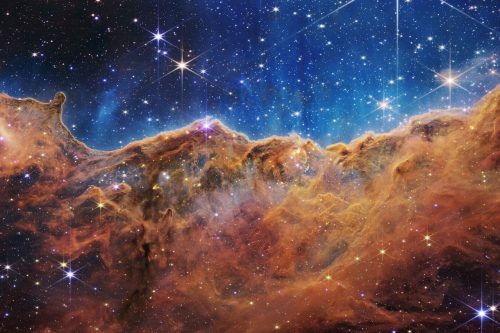
One of the great shifts in my own faith has been this Copernican revolution — the gradually-dawning sense that there’s infinitely more going on in this universe than I/we can perceive, and that it revolves around God, not me. If we can begin to see all creation in that manner, charged with his grandeur, then its size and strangeness isn’t really disturbing. It’s thrilling. For it suggests God is greater and up to far more than we could ever imagine. Deep space might look void of value from our puny vantage point, but that hardly means it is.
Perhaps, as a reminder of how awesome God is and utterly dependent on him we are, there is even great comfort in the immensity of the universe and our tiny place in it. That indeed is one of the great themes of C. S. Lewis’ Space Trilogy, a fitting place to conclude. Elwin Ransom, an aging British philologist and the unlikely protagonist of the first two entries of the series — Out of the Silent Planet (1938) and Perelandra (1943) — undergoes just such a “Copernican revolution” in his own faith after he journeys to Mars and Venus.
Vaulted into outer space against his will, Ransom admits that, although he was a Christian, he “always thought space was dark and cold.” Yet, as he hurtles through the solar system, his eyes are filled with progressive wonders. He beholds “planets of unbelievable majesty, and constellations undreamed of: there were celestial sapphires, rubies, emeralds and pin-pricks of burning gold … and between all and behind all, far more emphatic and palpable than it showed on Earth, the undimensioned, enigmatic blackness.”
Best of all were the “hours spent in the sunward hemisphere.” As Lewis writes,
Often [Ransom] rose after only a few hours’ sleep to return, drawn by an irresistible attraction, to the regions of light… There, totally immersed in a bath of pure ethereal color and of unrelenting though unwounding brightness… he felt his body and mind daily rubbed and scoured and filled with new vitality. …
But Ransom, as time wore on, became aware of another and more spiritual cause for his progressive lightening and exultation of heart. A nightmare, long engendered in the modern mind by the mythology that follows in the wake of science, was falling off him. He had read of ‘Space’: at the back of his thinking for years had lurked the dismal fancy of the black, cold vacuity, the utter deadness, which was supposed to separate the worlds. He had not known how much it affected him till now—now that the very name ‘Space’ seemed a blasphemous libel for this empyrean ocean of radiance in which they swam. He could not call it ‘dead’; he felt life pouring into him from it every moment. How indeed should it be otherwise, since out of this ocean the worlds and all their life had come? He had thought it barren: he saw now that it was the womb of worlds, whose blazing and innumerable offspring looked down nightly even upon the earth with so many eyes—and here, with how many more! No: Space was the wrong name. Older thinkers had been wiser when they named it simply the heavens.
Of course, Lewis was not attempting in these works of early science fiction to paint a scientifically accurate portrait of worlds beyond our own, but instead to paint an imaginative portrait that might help expand our own imaginations of what’s out there and its “value,” and in so doing, perhaps re-enchant what we have come to view with disenchantment.
For all the astonishing technological advances it has afforded us (thank God), scientific materialism as a way of understanding reality is indeed a kind of nightmare from which we must awaken, for it has drained the universe, and often our very lives, of color and meaning. And that, really, is what makes us feel insignificant, rather than our mere smallness relative to the rest of creation. Faith in a loving God, on the other hand, brings back the color, the significance of all things, no matter how small. As a mighty angel tells Ransom at the end of Perelandra, “Be comforted, small one, in your smallness. [God] lays no merit on you. Receive and be glad. Have no fear, lest your shoulders be bearing this world.”








Beautiful…this essay should be sent to the Templeton Foundation for their podcast.
Loved this, esp. the Silent Planet shoutout, and I want to point out the courage involved in anybody engaged in the sciences publicly acknowledging God in any sense, however oblique, especially as the astronaut did here acknowledging the frailty of our habitat as evidence of a Creator. And on NPR!